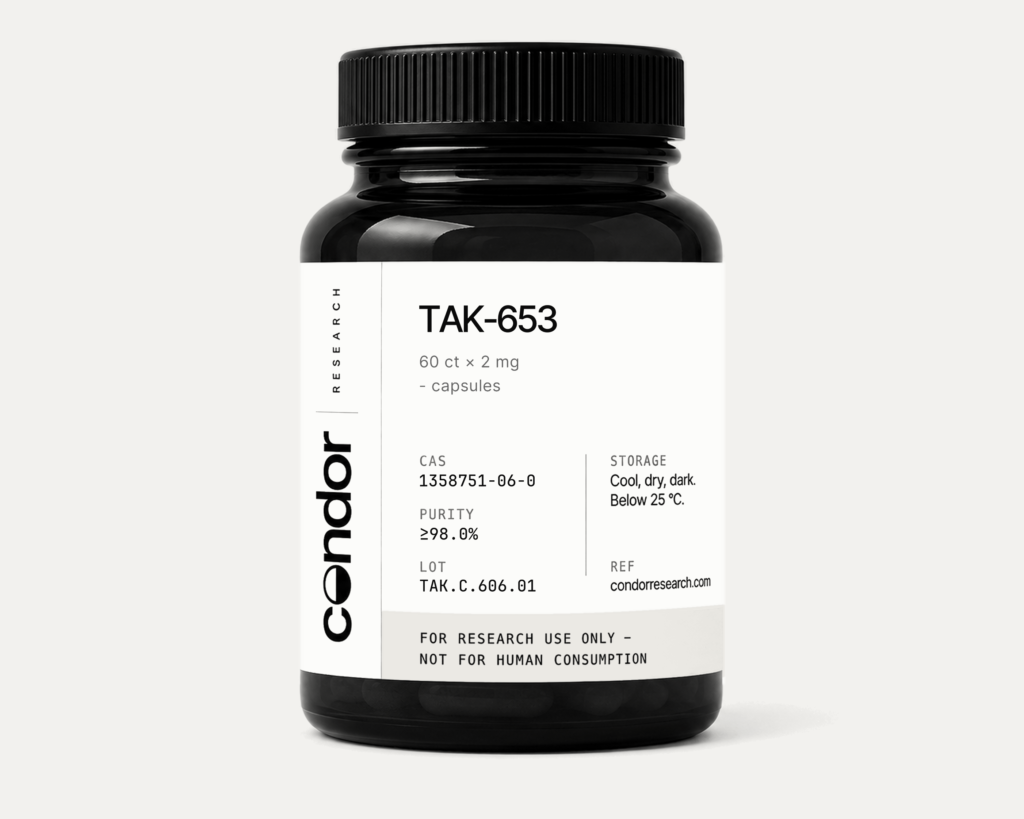
per bottle
Encapsulated · ≥98% (HPLC) ·
Size
One restock alert. You also join the research list; unsubscribe anytime.
Ships from Slovakia · no EU customs ·
TAK-653 (INN: osavampator; 9-(4-cyclohexyloxyphenyl)-7-methyl-3,4-dihydropyrazino[2,1-c][1,2,4]thiadiazine 2,2-dioxide) is a synthetic small molecule that acts as a positive allosteric modulator of AMPA-type glutamate receptors, designed to potentiate receptor responses to glutamate with minimal direct agonism. CAS 1358751-06-0; molecular formula C19H23N3O3S; molecular weight 373.47 g/mol. Supplied encapsulated at HPLC ≥98% purity. For laboratory research use only; not for human or veterinary use.
Most glutamate-receptor pharmacology is built on a blunt idea: switch a receptor on, or switch it off. TAK-653 is built on a subtler one. It does not open the AMPA receptor itself; it is studied for how it amplifies the response of receptors that glutamate has already activated. That distinction — potentiation without agonism — is the reason it has become a reference tool in research on synaptic plasticity and on the glutamatergic mechanisms behind rapid-acting antidepressant models.
A modulator that waits for glutamate. In recombinant and primary-neuron systems, TAK-653 bound the ligand-binding domain of AMPA receptors in a glutamate-dependent manner and strictly potentiated glutamate-induced calcium influx, with little agonistic effect of its own; in brain slices it enhanced AMPA-receptor-mediated synaptic potentials more potently than either an agonist or a prominent-agonism potentiator (Suzuki et al., 2021). The authors argue that this strict dependence on physiologically released glutamate is what separates robust synaptic and cognitive effects from the narrow response window and seizure liability associated with strongly agonistic potentiators.
From receptor to signalling cascade. In rat primary cortical neurons, TAK-653 increased the phosphorylated forms of mTOR, p70S6 kinase, Akt and ERK, together with BDNF protein, and a sub-chronic regimen produced an antidepressant-like effect in a rat behavioural model, reported with a favourable preclinical safety profile in rats (Hara et al., 2021). Reviews place this AMPA → mTOR → BDNF axis at the centre of current thinking about how rapid-acting antidepressants such as ketamine work, and TAK-653 as one of the potentiators developed to engage it directly (Suzuki et al., 2023; Freudenberg et al., 2025).
What the research explores. Across cell-culture, animal and early volunteer studies, TAK-653 has been investigated along several converging lines:
The activity described here is drawn from cell-culture, animal and early volunteer-pharmacology studies; it characterises biological behaviour in experimental models and does not establish efficacy or safety in humans. Full citations are listed under the Scientific References tab. TAK-653 is an investigational compound; the volunteer studies were small pharmacodynamic experiments, not evidence of therapeutic benefit. Related reference materials and reading: the TAK-653 evidence dossier, HBT1, another AMPA receptor potentiator, Dihexa Capsules.
Physicochemical profile. CAS No. 1358751-06-0 · Molecular formula C19H23N3O3S · Molecular weight 373.47 g/mol · Appearance: White to off-white powder · Solubility: Soluble in DMSO.
Specification & quality. Each bottle contains 60 HPMC (plant-derived) capsules, each containing 2mg of TAK-653 at ≥98% (HPLC). Encapsulated — no reconstitution required. Every batch is independently third-party tested, and a Certificate of Analysis (COA) is available. Store at room temperature, protect from light and moisture; shelf life 24 months from the manufacture date. EU warehoused.
This product is intended for laboratory research use only (RUO). It is not a drug, food, cosmetic, or dietary supplement, and is not for human or veterinary use, ingestion, or diagnostic application. Handling is restricted to qualified research professionals operating in an appropriately equipped laboratory.
Research overview: TAK-653 (Osavampator): The Evidence Dossier. A Forum Nootropic in a Phase 3 Depression Programme
Supplied for in-vitro laboratory research use only (RUO). Not a drug, food or supplement; not for human or veterinary use.
Certificate of Analysis — lot-specific COA ships with every order and is available on request.
Each lot is tested by an independent third-party laboratory for identity (mass spectrometry) and purity (HPLC). The Certificate of Analysis for your specific batch ships with the order and is available on request — no house data, no exceptions.
References are illustrative of the research literature surrounding this compound. All claims relate to in-vitro and animal models only.
TAK-653 (INN: osavampator) is an AMPA receptor positive allosteric modulator with minimal agonistic activity, studied in cell, rodent and primate models and in early volunteer pharmacology for synaptic potentiation and mTOR/BDNF signalling (Hara et al., 2021; Suzuki et al., 2021). Condor Research supplies it strictly as a Research Use Only reference compound, not as a medicine or supplement for human or veterinary use.
Ketamine is an NMDA-receptor antagonist whose rapid antidepressant-like effects in models are reported to depend on downstream AMPA-receptor activation, whereas TAK-653 acts on the AMPA receptor directly as a positive allosteric modulator (Hara et al., 2021; Suzuki et al., 2023). That makes TAK-653 a tool for isolating the AMPA step without NMDA blockade. Both are discussed here only as research tools; this product is for research use only.
Potentiators with prominent agonism are associated in the literature with seizure risk and bell-shaped response curves, whereas TAK-653 strictly potentiates glutamate-driven activation and showed a wide margin against convulsion in rats (Suzuki et al., 2021). This is a preclinical characterisation, not a safety claim for humans. Supplied for research use only.
TAK-653 has one of the broader published preclinical-to-volunteer datasets in its class, spanning rodent behaviour, a primate stress model and healthy-volunteer pharmacodynamics (Hara et al., 2021; Li et al., 2025; Dijkstra et al., 2022). Patent and review literature surveys the wider class (Colson et al., 2026). Condor Research supplies TAK-653 for research use only.
Yes. Condor Research supplies TAK-653 strictly as a Research Use Only reference compound to professionals and institutions, not as a medicine, supplement or product for human or veterinary use. Buyers are responsible for confirming import legality in their own country. TAK-653 is an investigational compound; its availability and any intellectual-property position are matters buyers should confirm for their jurisdiction. Questions: info@condorresearch.com.
The capsule is a pre-weighed solid format that makes a fixed 2mg quantity of TAK-653 powder easy to store and handle in the laboratory, using HPMC (vegan) shells. It is not intended for consumption and does not imply ingestion. The capsule format is provided strictly for research use only; not for human or veterinary use.
No. Each capsule already contains pre-weighed solid TAK-653 powder, so no reconstitution is required for laboratory handling. For in vitro work, researchers may dissolve the contents in an appropriate solvent such as DMSO. This product is for research use only and not for human or veterinary use.
Each bottle contains 60 HPMC (vegan) capsules, with each capsule providing 2mg of TAK-653 at ≥98% (HPLC) purity. Every batch is independently third-party tested. The capsules are a pre-measured solid format for laboratory research use only, not for human or veterinary use.
TAK-653 has the molecular formula C19H23N3O3S, a molecular weight of 373.47 g/mol, and CAS number 1358751-06-0. It presents as white to off-white powder; soluble in DMSO. It is supplied strictly as a research-use-only reference compound.
Yes. Every TAK-653 batch is tested by an independent third-party laboratory by HPLC for identity and purity (≥98%), and ships with a lot-specific Certificate of Analysis. To request the COA for a particular lot, contact info@condorresearch.com. For laboratory research use only. Not for human or veterinary use.
Condor Research supplies TAK-653 Capsules directly, dispatched from our EU facility in Slovakia to the EU, EEA, UK and Switzerland. Deliveries to EU destinations clear no third-country customs, and shipping is calculated at checkout. Supplied strictly as a research-use-only reference material — not for human or veterinary use.
Yes. Osavampator is the international nonproprietary name associated with the development code TAK-653 (CAS 1358751-06-0). Published studies use the code TAK-653; the INN appears in more recent reviews. Supplied strictly for research use only.
No verified reviews yet.
Leave a review
Cookies
We use strictly necessary cookies to run the store. With your consent we also use analytics (order attribution) and marketing (Omnisend) cookies. Read our Cookie Policy.