Lyophilised · ≥98% (HPLC) ·
Supplied lyophilised. Reconstitution typically uses bacteriostatic water.
9-Methyl-β-carboline (9-Me-BC) is a synthetic methylated β-carboline alkaloid and potent dopaminergic research compound; CAS 2521-07-5; molecular formula C₁₂H₁₀N₂; molecular weight 182.22 g/mol. Studied in vitro and in rodent models for dopaminergic neuroprotection, neurogenesis, and mitochondrial function. Purity ≥99% by HPLC. Supplied as encapsulated powder. For laboratory research use only; not for human or veterinary use.
A simple methyl group, added to a naturally occurring alkaloid, transforms an ordinary β-carboline into one of the most intriguing molecules in dopaminergic research. 9-Me-BC (9-methyl-β-carboline) is a small, blood-brain-barrier-permeable β-carboline that has drawn sustained attention for an unusual combination of properties observed in laboratory models — it appears to stimulate, protect and even encourage the regeneration of dopaminergic neurons in the same experimental system.
An alkaloid scaffold with a dopaminergic signature. β-Carbolines are a family of indole alkaloids found throughout nature, but the position of a single methyl group changes their pharmacology dramatically. The 9-methyl isomer stands apart: across cell-culture and rodent models it has been characterised as exerting stimulatory, neuroprotective and anti-inflammatory effects on dopaminergic systems, a profile that has been described as exceptional within its chemical class (Polanski et al., 2010; Polanski et al., 2011).
Mechanistic work points toward several intersecting routes — inhibition of monoamine oxidase activity, induction of neurotrophic factor expression by astrocytes, and support for mitochondrial and dendritic endpoints — rather than a single target (Keller et al., 2020).
What the research explores. Across cell-culture and animal systems, 9-Me-BC has been investigated along several converging lines:
The activity described here is drawn from in-vitro and animal studies; it characterises biological behaviour in experimental models and does not establish efficacy or safety in humans. Full citations are listed under the Scientific References tab.
Physicochemical profile. CAS No. 2521-07-5 · Molecular formula C12H10N2 · Molecular weight 182.22 g/mol · Appearance: Off-white crystalline powder · Solubility: Soluble in DMSO and ethanol; sparingly in water.
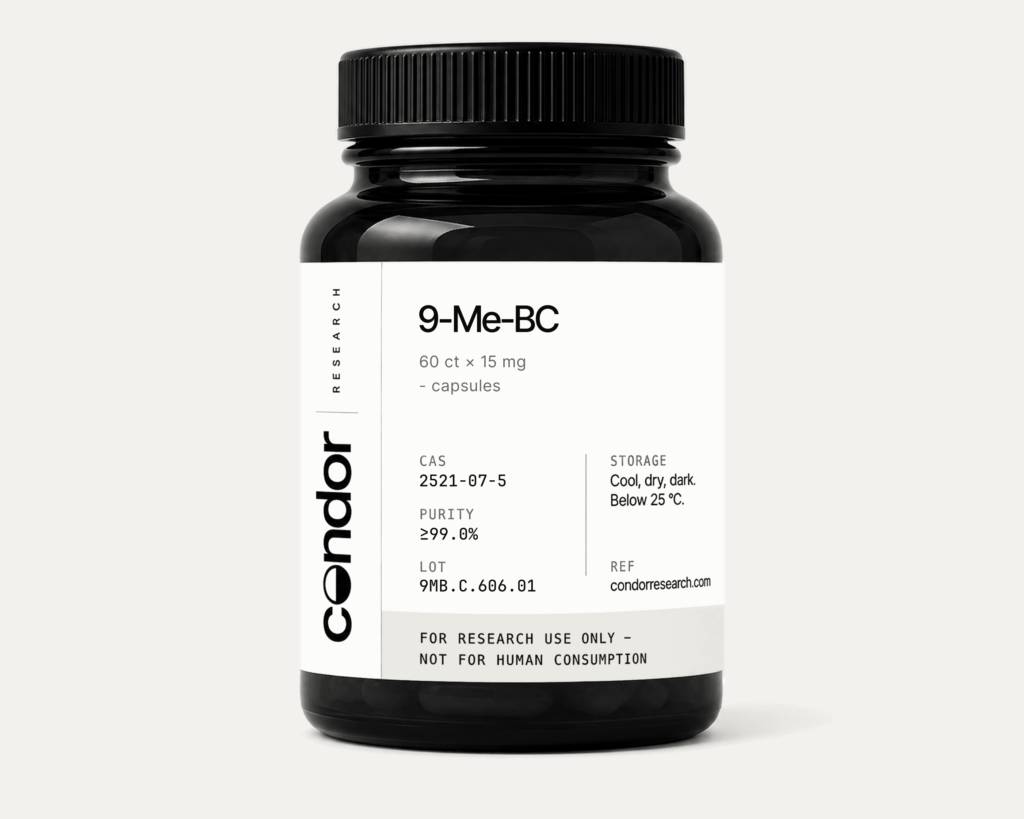
Specification & quality. Each bottle contains 60 HPMC (vegan) capsules, each providing 15mg of 9-Me-BC at ≥98% (HPLC). Encapsulated — no reconstitution required. Every batch is independently third-party tested, and a Certificate of Analysis (COA) is available. Store at room temperature, protect from light and moisture; shelf life 24 months from the manufacture date. EU warehoused.
This product is intended for laboratory research use only (RUO). It is not a drug, food, cosmetic, or dietary supplement, and is not for human or veterinary use, ingestion, or diagnostic application. Handling is restricted to qualified research professionals operating in an appropriately equipped laboratory.
Supplied for in-vitro laboratory research use only (RUO). Not a drug, food or supplement; not for human or veterinary use.
Certificate of Analysis — lot-specific COA ships with every order and is available on request.
Each lot is tested by an independent third-party laboratory for identity (mass spectrometry) and purity (HPLC). The Certificate of Analysis for your specific batch ships with the order and is available on request — no house data, no exceptions.
References are illustrative of the research literature surrounding this compound. All claims relate to in-vitro and animal models only.
9-Me-BC (9-methyl-β-carboline) is a small β-carboline alkaloid studied in cell and rodent models as a research nootropic, with work focused on dopaminergic signalling, neurotrophic-factor expression and neuroprotection (Polanski et al., 2010). Condor Research supplies it strictly as a Research Use Only reference compound for in vitro and animal studies, not as a medicine or supplement for human or veterinary use.
Most dopaminergic research tools act narrowly, for example as receptor agonists or reuptake inhibitors, whereas 9-Me-BC has been characterised in models as combining stimulation, protection and regeneration of dopaminergic neurons alongside anti-inflammatory effects (Polanski et al., 2010). This multimodal profile means it is used to probe different research questions than single-target dopaminergic agents. Both classes are supplied only as research-use-only reference compounds.
Classical MAO inhibitors are defined chiefly by enzyme blockade, while 9-Me-BC has been reported to inhibit monoamine oxidase activity and, in parallel, to stimulate neurotrophic-factor expression by astrocytes (Keller et al., 2020). Researchers therefore use it to study mechanisms that extend beyond MAO inhibition alone. Each is offered strictly for laboratory research, never for human or veterinary use.
β-Carbolines are a broad natural family, but the position of the methyl group sharply alters their pharmacology; the 9-methyl isomer has been singled out for an unusual dopaminergic profile in Parkinson's-disease models (Wernicke et al., 2010). This isomer-specific behaviour is precisely why it is studied separately from other β-carboline derivatives. All such compounds are research-use-only reference materials.
In rodents, 9-Me-BC-associated cognitive endpoints have been linked to elevated hippocampal dopamine levels together with dendritic and synaptic proliferation (Gruss et al., 2012). These are observations in experimental animal systems and do not establish any effect in humans. The compound is supplied for laboratory research use only.
Yes. Condor Research supplies 9-Me-BC strictly as a Research Use Only reference compound to professionals and institutions, not as a medicine, supplement or product for human or veterinary use. Buyers are responsible for confirming import legality in their own country. Questions: info@condorresearch.com.
The capsule is a pre-weighed solid format that simplifies laboratory handling and storage of a fixed 15mg quantity of powder, using HPMC (vegan) shells. It is not a dose for consumption and does not imply ingestion. The capsule format is provided strictly for research use only; not for human or veterinary use.
No. Each capsule is already encapsulated with pre-weighed solid 9-Me-BC powder, so no reconstitution is required for laboratory handling. Researchers may dissolve the contents in an appropriate solvent such as DMSO or ethanol for in vitro work. This product is for research use only and not for human or veterinary use.
Each bottle contains 60 HPMC (vegan) capsules, with each capsule providing 15mg of 9-Me-BC at ≥98% (HPLC) purity. Every batch is independently third-party tested. The capsules are a pre-measured solid format for laboratory research use only, not a dose for human or veterinary use.
9-Me-BC has the molecular formula C12H10N2, a molecular weight of 182.22 g/mol, and CAS number 2521-07-5. It presents as an off-white crystalline powder, soluble in DMSO and ethanol and sparingly in water. It is supplied strictly as a research-use-only reference compound.
Yes. Every 9-Me-BC batch is tested by an independent third-party laboratory by HPLC for identity and purity (≥98%), and ships with a lot-specific Certificate of Analysis. To request the COA for a particular lot, contact info@condorresearch.com. For laboratory research use only. Not for human or veterinary use.
Condor Research supplies 9-Me-BC Capsules directly, dispatched from our EU facility in Slovakia to the EU, EEA, UK and Switzerland. Deliveries to EU destinations clear no third-country customs, and shipping is calculated at checkout. Supplied strictly as a research-use-only reference material — not for human or veterinary use.
No verified reviews yet.
Leave a reviewCookies
We use strictly necessary cookies to run the store. With your consent we also use analytics (order attribution) and marketing (Omnisend) cookies. Read our Cookie Policy.