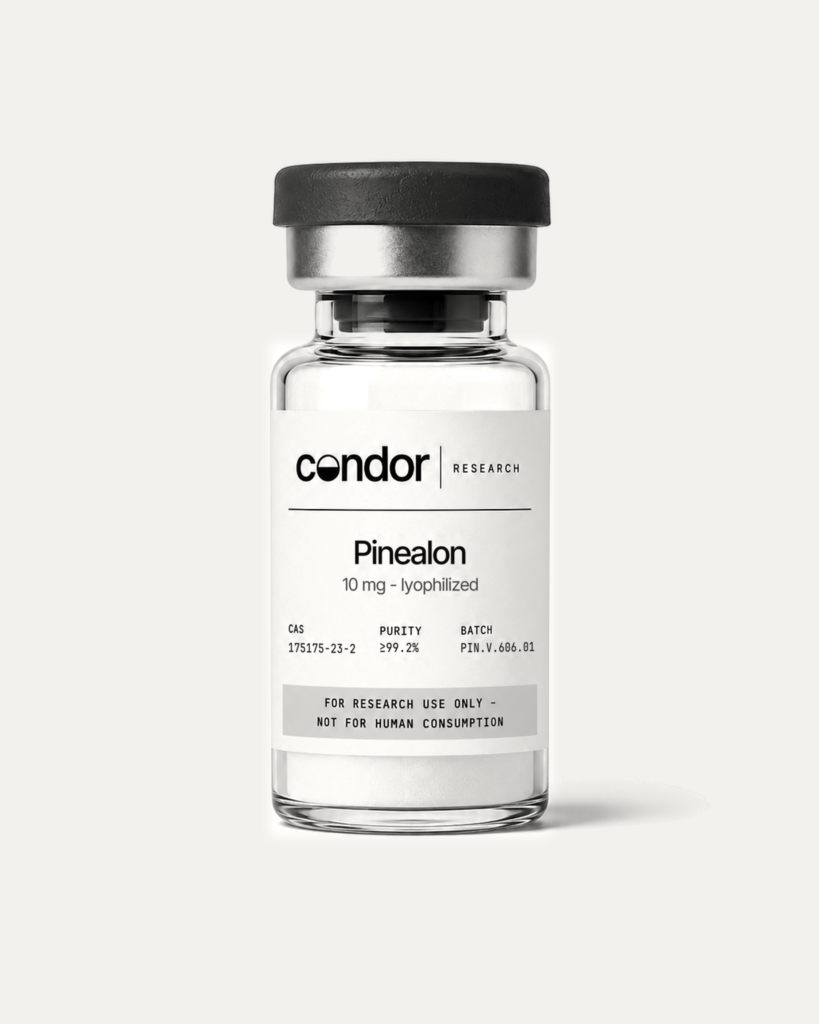
Lyophilised · ≥99% (HPLC) ·
Supplied lyophilised. Reconstitution typically uses bacteriostatic water.
Pinealon is a synthetic tripeptide (Glu-Asp-Arg; EDR) derived from the pineal gland, studied for neuroprotective and neurogenic activity in preclinical models of neurodegeneration, oxidative stress, and cognitive decline. Molecular formula C15H26N6O8; molecular weight 418.40 g/mol; supplied as a 10 mg lyophilized vial at HPLC ≥99% purity. For laboratory research use only; not for human or veterinary use.
Some of the shortest peptides in biology may carry instructions that reach all the way to the genome. Pinealon is a synthetic tripeptide, Glu-Asp-Arg (the "EDR" peptide), developed within the field of short peptide bioregulators. Composed of just three amino acids, it is studied as a model for how minimal peptide sequences may influence neuronal viability, oxidative balance, and gene expression in cell and animal systems.
A three-letter word in the peptide-bioregulator alphabet. Research on short peptides proposes that sequences such as EDR are small enough to enter cells and even interact with DNA, potentially modulating the expression of specific genes — an epigenetic-style hypothesis that distinguishes this peptide class from receptor-only signaling molecules (Khavinson et al., 2020). Pinealon is frequently examined alongside other tripeptide bioregulators as a tool for probing these proposed mechanisms.
What the research explores. The literature centers on neuronal and protective endpoints:
These findings come from in vitro and animal research describing biological activity; they do not establish safety or efficacy in humans. Full citations are listed under the Scientific References tab.
Physicochemical profile. CAS 175175-23-2 · Molecular formula C₁₅H₂₆N₆O₈ · Molecular weight 418.40 g/mol · Sequence Glu-Asp-Arg · Appearance: white lyophilized powder · Soluble in water.
Specification & quality. Each individually sealed vial contains 10 mg of Pinealon as a white lyophilized powder at ≥99% purity by HPLC. Every batch is third-party tested, with a Certificate of Analysis (COA) available. Store at −20 °C, protected from light and moisture.
This product is intended for laboratory research use only (RUO). It is not a drug, food, cosmetic, or dietary supplement, and is not for human or veterinary use, ingestion, or diagnostic application. Handling is restricted to qualified research professionals operating in an appropriately equipped laboratory.
Supplied for in-vitro laboratory research use only (RUO). Not a drug, food or supplement; not for human or veterinary use.
Certificate of Analysis — lot-specific COA ships with every order and is available on request.
Each lot is tested by an independent third-party laboratory for identity (mass spectrometry) and purity (HPLC). The Certificate of Analysis for your specific batch ships with the order and is available on request — no house data, no exceptions.
References are illustrative of the research literature surrounding this compound. All claims relate to in-vitro and animal models only.
Pinealon is a synthetic short peptide bioregulator with the sequence Glu-Asp-Arg (the EDR tripeptide), studied in neuroprotection and cellular-aging research. It belongs to the family of short "peptide bioregulators" investigated for effects reaching the genome in research models. Condor Research supplies it as a 10 mg lyophilized vial at ≥99% HPLC purity, for in-vitro laboratory use only.
Both are short synthetic peptide bioregulators, but they differ in sequence and research framing. Pinealon is the tripeptide Glu-Asp-Arg (EDR), emphasized in neuroprotection research, while Epitalon is the tetrapeptide Ala-Glu-Asp-Gly (AEDG), modelled on the pineal peptide complex and studied in cellular-aging research. Condor Research offers each as a separate ≥99% HPLC, research-use-only reference compound.
Pinealon (Glu-Asp-Arg) is a tripeptide bioregulator studied mainly for neuroprotective mechanisms, whereas Epitalon (Ala-Glu-Asp-Gly) is a tetrapeptide associated with the pineal complex and longevity research. They share the short-peptide-bioregulator class but differ by one residue in length and by research emphasis. Both are supplied as separate ≥99% HPLC, research-use-only reference materials, each with a batch COA.
Pinealon is a Glu-Asp-Arg tripeptide bioregulator studied in neuroprotection and aging research, while P21 (P021) is a synthetic BDNF-mimetic neurotrophic tetrapeptide used in neurodegeneration research. Both carry neuroprotective framing but derive from different concepts — peptide bioregulation versus neurotrophic-factor mimicry. Condor Research supplies each as a distinct ≥99% HPLC, research-use-only reference compound.
Pinealon (Glu-Asp-Arg) is a short peptide bioregulator studied in neuroprotection and cellular-aging contexts, whereas DSIP (Delta Sleep-Inducing Peptide) is a naturally occurring nonapeptide investigated in sleep and neuromodulation research. They address different research questions through unrelated mechanisms. Both are offered as separate ≥99% HPLC, research-use-only reference materials for in-vitro laboratory study.
Pinealon (EDR tripeptide) is selected when a research model is oriented toward neuroprotective mechanisms, while Epitalon (AEDG tetrapeptide) is more associated with cellular-aging and telomere-related research. The choice depends on which short-peptide-bioregulator framing fits your in-vitro study. Both remain research-use-only reference materials with no human or veterinary application.
Yes. The tripeptide sequence Glu-Asp-Arg (CAS 175175-23-2) is verified for each lot by an independent third-party laboratory using HPLC for purity and mass spectrometry for identity. Results are documented on the batch-specific Certificate of Analysis, which can be requested before ordering at info@condorresearch.com.
Yes. Pinealon is supplied strictly for laboratory research use only (in vitro). It is not a medicine, food, supplement, cosmetic, or medical device, and is not for human or veterinary use, administration, or consumption. Condor Research provides no dosing, protocols, or human-use guidance. Purchase is limited to qualified professionals and institutions aged 18 or over.
Yes. Each Pinealon lot is tested by an independent third-party laboratory by HPLC for identity and purity, with mass spectrometry confirmation, and ships against a batch-specific Certificate of Analysis verifying ≥99% purity. To request the COA for the current lot before ordering, contact info@condorresearch.com.
For analytical laboratory preparation only, Pinealon is water-soluble and can be reconstituted with a sterile aqueous diluent; the chosen volume sets the working concentration. Store the sealed lyophilized vial at -20°C, protected from light, with a 24-month shelf life from manufacture. This is laboratory handling information, not guidance for any human or animal use.
Condor Research supplies Pinealon directly, dispatched from our EU facility in Slovakia to the EU, EEA, UK and Switzerland. Deliveries to EU destinations clear no third-country customs, and shipping is calculated at checkout. Supplied strictly as a research-use-only reference material — not for human or veterinary use.
No verified reviews yet.
Leave a reviewCookies
We use strictly necessary cookies to run the store. With your consent we also use analytics (order attribution) and marketing (Omnisend) cookies. Read our Cookie Policy.