
What Is 9-Me-BC (9-Methyl-β-Carboline)? The Alkaloid That Seems to Nurture Dopamine Neurons
A small beta-carboline alkaloid that, in animal models, appears to stimulate, protect and even regenerate dopaminergic neurons — from a chemical family that also contains neurotoxins. Here is what the preclinical record actually shows.
9-Me-BC (9-methyl-β-carboline) is a small, brain-penetrant beta-carboline alkaloid studied in animal and cell models for stimulating, protecting and regenerating dopamine neurons, drawing interest as a Parkinson’s research tool. Evidence is preclinical only, with a real family-safety caveat. It is not an approved nootropic anywhere and is supplied research-use-only.
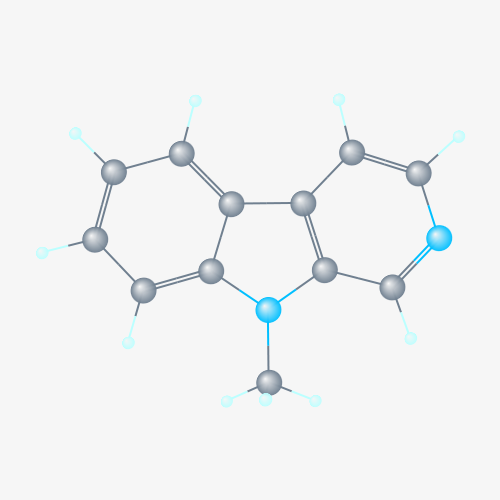
Chemistry has a sense of irony. The beta-carbolines are a sprawling family of small alkaloids that turn up in trace amounts in coffee, cooked meat, tobacco smoke and even human brain tissue — and some of their members are frankly dangerous, structurally kin to the neurotoxins that wipe out the very dopamine neurons whose loss defines Parkinson’s disease29. So it is genuinely surprising that one cousin in this family, carrying a single extra methyl group in just the right place, seems to do the opposite. In animal models, 9-methyl-β-carboline — 9-Me-BC for short — appears not to poison dopamine neurons but to feed them29.
What exactly is 9-Me-BC?
9-Me-BC is a beta-carboline, a tricyclic aromatic alkaloid built on the same indole-and-pyridine scaffold shared by serotonin-adjacent molecules and a long list of naturally occurring compounds. What sets this one apart is positional. The molecule is small and lipophilic enough to cross the blood-brain barrier, and the methyl group parked at the 9-position is not cosmetic — in this family, where a substituent sits often decides whether a beta-carboline is inert, protective or toxic52. The preclinical literature on the class treats 9-Me-BC as a standout case worth investigating precisely because that methylation appears to flip the expected script.
That single-atom difference is why researchers keep returning to it. It is the kind of natural experiment medicinal chemists love: hold the scaffold fixed, move one group, and watch a neurotoxin’s relatives behave like neurotrophic agents instead.
How does 9-Me-BC affect dopamine neurons?
The proposed mechanism is layered rather than single. First, 9-Me-BC is reported to inhibit monoamine oxidase, the enzyme that breaks down dopamine and other monoamines34 — which alone would tend to raise local dopamine availability. Second, and more interesting, it appears to act on the cells around the neurons: in culture it is described as stimulating astrocytes to express neurotrophic factors34, the growth signals that keep dopaminergic neurons alive and wired. Third, the preclinical record attributes anti-inflammatory activity to it, dampening the glial inflammation that accompanies dopaminergic degeneration9.
Stack those together and you get a compound that, in principle, supports dopamine neurons from several directions at once: more available transmitter, more trophic support, less inflammatory damage. In Parkinson’s research models, 9-Me-BC has been reported to exert restorative effects on the dopaminergic system rather than merely slowing decline8, and to protect against the classic MPTP neurotoxin pathway — the chemical insult researchers use to mimic dopaminergic loss78.
In preclinical models, 9-Me-BC is described as doing something rare for a single small molecule: appearing to stimulate, protect and regenerate dopaminergic neurons92 — the “dopaminergic triad” that anchors its interest as a Parkinson’s research tool.
Does 9-Me-BC do anything beyond dopamine?
The cognitive findings are where the story widens. In rodent work, 9-Me-BC has been associated with cognitive enhancement that tracks with elevated hippocampal dopamine and, strikingly, with dendritic and synaptic proliferation6 — the neurons did not just fire differently, they appeared to grow more connections. In cell culture, the compound has been reported to up-regulate differentiated dopaminergic neurons, nudging precursor cells toward the dopaminergic fate10. Review syntheses of this work fold the threads into a single thesis: 9-Me-BC as a candidate neuroprotectant worth serious preclinical scrutiny12.
This is the same neighbourhood as other non-peptide research nootropics being explored for neurotrophic and neuroprotective signatures — readers comparing candidates may want our non-peptide nootropics hub and the curcumin-derived molecule J-147, which likewise reaches for neurotrophic mechanisms from a small-molecule scaffold.
| Attribute | 9-Me-BC | Why it matters |
|---|---|---|
| Chemical class | Beta-carboline alkaloid; methylated at the 9-position | Brain-penetrant; one methyl group appears decisive for its profile |
| Reported action | Stimulate, protect, regenerate dopamine neurons | A rare triad driving Parkinson’s research interest |
| Proposed mechanism | MAO inhibition; astrocyte neurotrophic-factor induction; anti-inflammatory | Multi-target support of the dopaminergic system |
| Safety caveat | Family also contains neurotoxic members; no human data | Safety is non-trivial and unestablished |
9-Me-BC at a glance — the stimulate/protect/regenerate triad sits beside an unresolved family-safety question.
How strong is the evidence for 9-Me-BC, really?
Here is the honest accounting. Everything above — the dopaminergic triad, the MAO inhibition, the trophic and anti-inflammatory effects, the cognitive and synaptic findings — comes from preclinical work: rodent models, cell culture, and review syntheses of that literature. There are no human clinical data on 9-Me-BC. None. A clean signal in a Petri dish or a mouse hippocampus is a reason to keep studying a molecule, not a verdict on what it does in people. Treat every claim here as preliminary and animal- or cell-based until human research says otherwise — and so far there is none.
And the family it belongs to demands real caution. The beta-carbolines are not a uniformly benign group; some members are recognised neurotoxins, and structural relatives have been implicated in dopaminergic damage. That 9-Me-BC seems to invert that behaviour is the whole intrigue — but it also means its safety cannot be assumed by analogy or waved through. The same chemistry that makes the family interesting makes its safety non-trivial to establish, and it has not been established. 9-Me-BC is an investigational research compound, not an approved medicine or nootropic in the EU, the US, or anywhere else.
What does research-use-only mean for 9-Me-BC?
Because 9-Me-BC has no approved human use and no human safety record, the only responsible frame is the laboratory bench. Condor Research supplies it strictly as a research-use-only reference material — not for human or veterinary use, not a supplement, not a therapy. In that context the questions that matter are not about effects but about identity and purity: is the material in the vial actually 9-Me-BC, free of the structurally similar beta-carbolines that could confound a result or carry the family’s toxic baggage?
That is what a Certificate of Analysis exists to answer. For a compound from a family where one atom separates a neuroprotectant from a neurotoxin, analytical confirmation of identity and purity is not a nicety — it is the foundation of any clean experiment. Every unit Condor ships is accompanied by a COA so the reference material at the bench is exactly what the label claims, and nothing else.
- 9-Me-BC is a beta-carboline alkaloid whose single methyl group at the 9-position appears decisive for its unusual dopamine-friendly profile.
- In rodent and cell-culture models it is reported to stimulate, protect and help regenerate dopaminergic neurons — a rare triad that has made it a Parkinson’s-disease research tool.
- Proposed mechanisms include monoamine-oxidase inhibition, induction of neurotrophic factors by astrocytes, and anti-inflammatory effects.
- The safety case is non-trivial: the beta-carboline family also contains neurotoxic members, and there are no human data whatsoever.
- Not approved as a medicine or nootropic anywhere; Condor supplies it strictly research-use-only with a Certificate of Analysis.
What is 9-Me-BC used for?
In research, 9-Me-BC (9-methyl-β-carboline) is studied in animal and cell models as a tool for understanding dopaminergic neuron health and Parkinson’s disease, where it has shown stimulatory, protective and regenerative effects on dopamine neurons preclinically. It is not approved for any human use and is supplied research-use-only.
Is 9-Me-BC safe?
Its safety is unestablished. 9-Me-BC belongs to the beta-carboline family, which also contains recognised neurotoxic members, so safety cannot be assumed by analogy. There are no human clinical or safety data, and it is not an approved medicine. It is handled strictly as a research-use-only reference material.
How does 9-Me-BC work?
Proposed mechanisms from preclinical studies include inhibition of monoamine oxidase, stimulation of astrocytes to express neurotrophic factors that support dopamine neurons, and anti-inflammatory activity. Together these are thought to support the dopaminergic system from several directions, though this is shown only in animal and cell models.
Is 9-Me-BC approved or legal as a nootropic?
No. 9-Me-BC is an investigational research compound not approved as a medicine or nootropic in the EU, the US, or anywhere else. It is supplied as a research-use-only reference material with a Certificate of Analysis, not as a supplement or therapeutic product.
Why does the 9-methyl position matter for 9-Me-BC?
In the beta-carboline family, the position of a substituent can determine whether a molecule is inert, protective or toxic. The single methyl group at the 9-position is treated in the preclinical literature as decisive: it appears to give 9-Me-BC its unusual dopamine-friendly, neurotrophic profile rather than the toxic behaviour seen in some relatives.