
What Is J-147? The Curcumin Descendant That Hit an Unexpected Brain Target
J-147 is an experimental neuroprotective compound engineered at the Salk Institute from curcumin, the turmeric molecule the body destroys too fast to be a drug. Chemists rebuilt it for stability and ageing brains, and it turned out to act on an unexpected target inside the mitochondrion.
J-147 is a curcumin-derived experimental compound, designed at the Salk Institute and studied in rodent and cell models for neuroprotection, memory and ageing, where it has been reported to act on mitochondrial ATP synthase. Its human efficacy is unestablished. It is research-use-only and is not an approved nootropic or medicine anywhere.
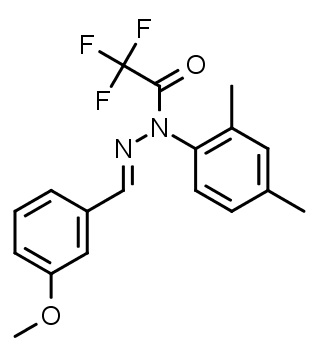
Turmeric has been swallowed for three thousand years and studied as a medicine for at least fifty, and the verdict from pharmacology is brutally simple: curcumin, the yellow molecule everyone is excited about, barely makes it into the bloodstream before the body chews it apart. It is poorly absorbed, rapidly metabolised and gone almost before it arrives1. For a compound meant to protect the slowest-failing organ we have — the ageing brain — that is close to disqualifying. So a team of medicinal chemists at the Salk Institute did what chemists do. They kept the parts of curcumin that seemed to matter, threw away the parts that made it fragile, and built a stable descendant. They called it J-147112. And when they later went looking for how it actually worked, the answer was not the one anyone had written on the whiteboard.
What is J-147 and where did it come from?
J-147 is a synthetic, curcumin-derived experimental compound developed through a Salk programme aimed squarely at the biology of brain ageing rather than at any single disease gene. That framing matters. Most Alzheimer’s chemistry of the last three decades chased amyloid plaques; the Salk approach instead screened for molecules that protected neurons against the cluster of insults that accompany getting old — oxidative stress, energy failure, inflammation112. The same medicinal-chemistry philosophy that produced flavonoid-derived geroprotective candidates produced J-147 as its small-molecule sibling. It is, in the most literal sense, an engineered version of a kitchen spice: curcumin’s reactive, short-lived skeleton rebuilt into something a laboratory can actually dose and track in a dish.
The fraction of orally ingested curcumin that reaches the bloodstream intact is widely described as negligible — the molecule is poorly absorbed and rapidly degraded, and that bioavailability failure is precisely the problem J-147 was engineered to solve1.
How does J-147 work, and why is its target a surprise?
For years J-147 was described loosely as “neuroprotective” without a clean molecular address. Then target-identification work landed on something genuinely unexpected: mitochondrial ATP synthase, the rotary turbine that manufactures the cell’s energy currency115. A curcumin descendant aimed at the ageing brain turning out to bind the cell’s power plant is the kind of plot twist that makes pharmacologists sit up — partly because the same ATP-synthase machinery has been implicated in longevity pathways across very different organisms215.
From that binding event, a recognisable signalling cascade has been reported in the models. Engaging ATP synthase appears to flip metabolic master switches, modulating AMPK and downstream lipid and metabolic signalling in ways consistent with a low-energy, stress-resistant cellular state369. Separately, in cell-death assays J-147 has been reported to interfere with the oxytosis/ferroptosis pathway — an iron-dependent, oxidative route to neuronal death that has become a major theme in neurodegeneration research4. And in rodent mood paradigms it has been described as shifting monoaminergic tone, including 5-HT1A serotonergic signalling1014. If that mitochondrial framing sounds familiar, it echoes the logic behind another small molecule studied for brain energetics — see our primer on Methylene Blue, which also lives or dies by what it does inside the mitochondrion.
| Feature | J-147 | What is actually studied |
|---|---|---|
| Origin | Curcumin derivative, Salk Institute | Re-engineered for stability the parent molecule lacks |
| Reported target | Mitochondrial ATP synthase | Identified via target-ID work; an unexpected binding partner |
| Downstream signalling | AMPK, lipid/metabolic; oxytosis/ferroptosis; 5-HT1A | Energy-stress and cell-death pathways in cell/rodent models |
| Endpoints explored | Memory, neuroprotection, mood, ageing | Alzheimer’s, TBI/stroke, neuroinflammation, post-surgical cognition |
| Human status | No established efficacy | Advanced toward early clinical work; not an approved medicine |
J-147 at a glance — an engineered curcumin descendant whose best-characterised target sits inside the mitochondrion, with effects documented almost entirely in animal and cell systems.
What has J-147 actually been studied for?
The preclinical breadth is, frankly, the most striking thing about the molecule. In Alzheimer’s and geroprotection models it has been a recurring character, with reports of improved memory endpoints in aged animals11213. Beyond chronic neurodegeneration, it has been probed in acute brain injury: traumatic brain injury and haemorrhagic stroke models, where the AMPK and metabolic effects are invoked as a protective mechanism68. It appears in neuroinflammation and sepsis-associated depression work37, and in studies of post-surgical cognition and anxiety5. That is an unusually wide net for a single experimental compound — which is both the case for taking it seriously and the reason to read the next section carefully.
How strong is the evidence for J-147 in humans?
This is where intellectual honesty has to do the heavy lifting. The preclinical literature on J-147 is broad, mechanistically coherent and genuinely interesting — and it is also, overwhelmingly, animal and cell-based. Mice are not small people. The history of neuroprotection is a graveyard of compounds that rescued rodent memory and then did nothing measurable in human trials, and the translational gap is especially punishing for brain ageing, where decades of slow pathology resist anything a months-long study can capture.
J-147 advanced toward early clinical development, which is more than most research molecules manage1. But “advanced toward” is not “demonstrated in.” There is, at present, no established human efficacy for J-147 in cognition, mood, neuroprotection or ageing. The mitochondrial ATP-synthase mechanism is elegant on paper, yet a molecule that perturbs the cell’s central energy machine also demands careful safety characterisation that animal models only begin to provide115. Anyone reading the preclinical excitement as a verdict has skipped the part of the experiment that has not been run. For the wider landscape of how these molecules are evaluated, our non-peptide nootropics hub sets out the same caution compound by compound.
Is J-147 approved or sold as a nootropic?
No. J-147 is an investigational research compound. It is not approved as a medicine in the EU, the US or anywhere else, and it is not an approved nootropic or cognitive enhancer. It has no recognised human dose, no therapeutic indication and no regulatory clearance for consumption of any kind. Condor Research supplies J-147 strictly as a research-use-only reference material — for in vitro and laboratory work, not for human or veterinary use.
Within that frame, the only honest claim a supplier can make is about the material itself rather than its effects. Mechanistic studies depend entirely on knowing that the compound in the vial is the compound on the label — correct identity, characterised purity, no undisclosed contaminants — because a target as central as ATP synthase will respond to whatever you actually add to the dish, not to what you intended to. That is why every batch ships with a Certificate of Analysis documenting identity and purity. For a research compound whose entire interest lives in preclinical mechanism, the COA is not paperwork; it is the experiment’s first control.
- J-147 was engineered at the Salk Institute as a chemically stable descendant of curcumin, the turmeric molecule that fails as a drug because the body clears and degrades it almost instantly.
- Target-identification work has pointed to mitochondrial ATP synthase as an unexpected binding partner, with reported downstream effects on AMPK and lipid/metabolic signalling.
- The preclinical record is broad — Alzheimer's and geroprotection, traumatic brain injury and haemorrhagic stroke, neuroinflammation, sepsis-associated depression and post-surgical cognition — but almost all of it is in animal or cell models.
- It has been reported to engage the oxytosis/ferroptosis cell-death pathway and to shift monoaminergic/5-HT1A signalling in rodent mood paradigms.
- J-147 has no established human efficacy, is not an approved nootropic or medicine anywhere, and Condor supplies it strictly as a research-use-only reference material with a Certificate of Analysis.
What is J-147?
J-147 is a synthetic experimental compound derived from curcumin and developed at the Salk Institute as part of a programme targeting brain ageing. It is studied in rodent and cell models for neuroprotection, memory and metabolic effects, and has been reported to act on mitochondrial ATP synthase. It is research-use-only and not an approved medicine or nootropic anywhere.
How does J-147 work?
Target-identification studies have pointed to mitochondrial ATP synthase as a primary binding partner, an unexpected result for a curcumin descendant. Downstream, J-147 has been reported to modulate AMPK and lipid/metabolic signalling, to engage the oxytosis/ferroptosis cell-death pathway, and to shift monoaminergic 5-HT1A signalling in rodent mood models. These mechanisms are documented in animal and cell systems, not in established human studies.
Is J-147 the same as curcumin?
No. J-147 was engineered from curcumin but is a distinct, chemically stable compound. Curcumin has near-zero bioavailability because the body absorbs and degrades it almost immediately, which is precisely the limitation J-147 was designed to overcome. They share an ancestry, not an identity, and J-147 acts on a different molecular target.
Is J-147 proven to work in humans?
No. The evidence for J-147 is overwhelmingly preclinical, meaning animal and cell-based. While it advanced toward early clinical development, there is no established human efficacy for cognition, mood, neuroprotection or ageing. Rodent results frequently fail to translate to people, especially in brain-ageing research.
Is J-147 a legal, approved nootropic?
J-147 is an investigational research compound that is not approved as a medicine or nootropic in the EU, US or elsewhere. It has no recognised human dose or therapeutic indication. Condor Research supplies it strictly as a research-use-only reference material with a Certificate of Analysis, for laboratory work only and not for human or veterinary use.