Lyophilised · ≥98% (HPLC) ·
Supplied lyophilised. Reconstitution typically uses bacteriostatic water.
J-147 is a synthetic curcumin-derived small molecule (CAS 1146963-51-0; molecular formula C₁₈H₁₇F₃N₂O₂; MW 350.3 g/mol) developed as a potent neuroprotective and potential anti-aging research compound, studied for its inhibition of mitochondrial ATP synthase (ATP5A1, alpha subunit of Complex V) and modulation of BDNF/NGF pathways in neurodegeneration models. Supplied as oral capsules, HPLC ≥99% purity. For laboratory research use only; not for human or veterinary use.
Born from an effort to improve on curcumin and refined through an Alzheimer's drug-discovery program, J-147 is an experimental neuroprotective compound that took an unexpected turn when researchers traced its activity to the mitochondria. Screened originally for effects on age-associated neurotoxicity, it is now studied as a molecule that acts on cellular energy machinery rather than on a single disease protein.
A curcumin-derived molecule with a mitochondrial target. J-147 was developed as a more potent, orally framed successor to curcumin within a phenotypic screening effort, and subsequent work identified mitochondrial ATP synthase (the α-subunit, ATP5A) as a molecular target underlying its geroprotective behaviour in experimental systems (Kepchia et al., 2021). This places it among a small set of Alzheimer's drug candidates whose effects are framed through bioenergetics and the oxytosis/ferroptosis cell-death pathway (Sanchez et al., 2025).
Reviews of the compound describe a broad experimental footprint spanning neuroprotection, neuroinflammation and memory endpoints across multiple nervous-system disease models (Qiu et al., 2023).
What the research explores. Across cell-culture and animal systems, J-147 has been investigated along several converging lines:
The activity described here is drawn from in-vitro and animal studies; it characterises biological behaviour in experimental models and does not establish efficacy or safety in humans. Full citations are listed under the Scientific References tab.
Physicochemical profile. CAS No. 1146963-51-0 · Molecular formula C18H17F3N2O2 · Molecular weight 350.33 g/mol · Appearance: Off-white to pale powder · Solubility: Soluble in DMSO.
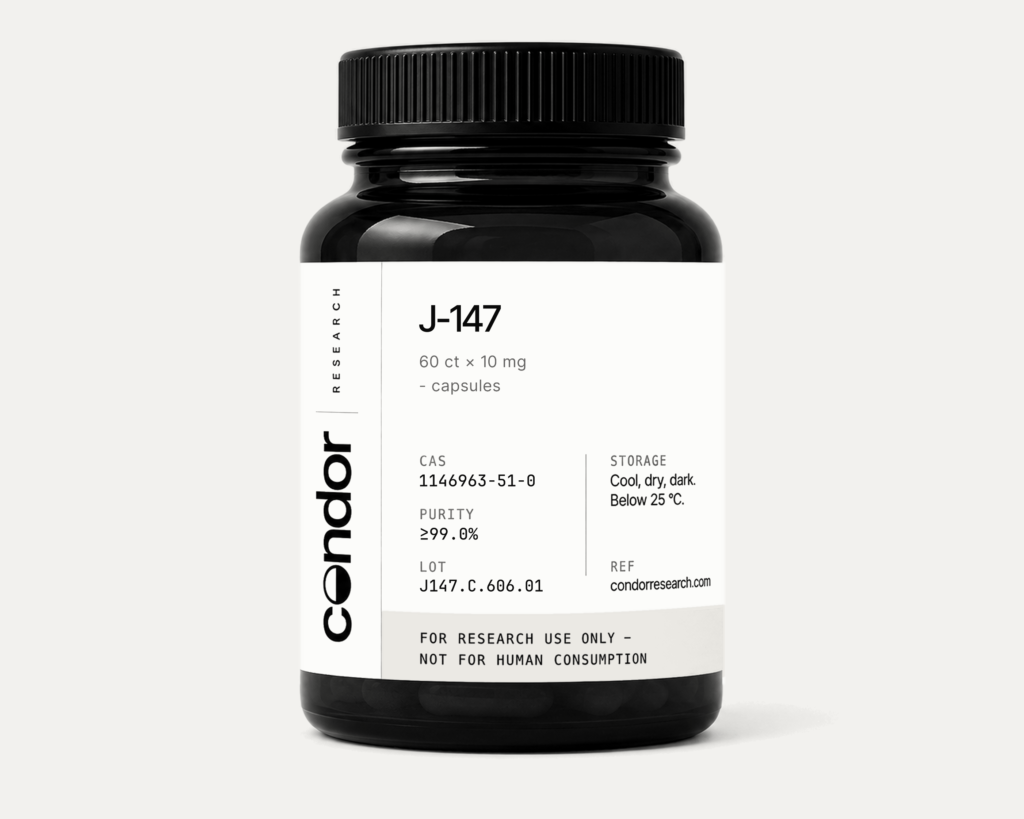
Specification & quality. Each bottle contains 60 HPMC (vegan) capsules, each providing 10mg of J-147 at ≥98% (HPLC). Encapsulated — no reconstitution required. Every batch is independently third-party tested, and a Certificate of Analysis (COA) is available. Store at room temperature, protect from light and moisture; shelf life 24 months from the manufacture date. EU warehoused.
This product is intended for laboratory research use only (RUO). It is not a drug, food, cosmetic, or dietary supplement, and is not for human or veterinary use, ingestion, or diagnostic application. Handling is restricted to qualified research professionals operating in an appropriately equipped laboratory.
Supplied for in-vitro laboratory research use only (RUO). Not a drug, food or supplement; not for human or veterinary use.
Certificate of Analysis — lot-specific COA ships with every order and is available on request.
Each lot is tested by an independent third-party laboratory for identity (mass spectrometry) and purity (HPLC). The Certificate of Analysis for your specific batch ships with the order and is available on request — no house data, no exceptions.
References are illustrative of the research literature surrounding this compound. All claims relate to in-vitro and animal models only.
J-147 is a curcumin-derived experimental compound from an Alzheimer's drug-discovery program, studied in cell and animal models for neuroprotection, mitochondrial bioenergetics and memory endpoints, with mitochondrial ATP synthase identified as a target (Kepchia et al., 2021). Condor Research supplies it strictly as a Research Use Only reference compound for in vitro and animal studies, not as a medicine or supplement for human or veterinary use.
Both are studied as mitochondrially active small molecules, but by different mechanisms: J-147 is reported to engage mitochondrial ATP synthase as a target (Kepchia et al., 2021), whereas methylene blue is studied as an electron-cycling redox compound supporting cytochrome-c-oxidase activity. They are therefore used to probe distinct aspects of bioenergetics in research. Both are supplied only as research-use-only reference compounds.
J-147 was derived from curcumin and refined through phenotypic screening to obtain a distinct, more defined molecule for neurodegeneration research, with its own identified mitochondrial mechanism (Kepchia et al., 2021). Researchers use it when a stable, single-entity reference compound is preferred over a natural polyphenol mixture. Each is offered strictly for laboratory research, never for human or veterinary use.
Many Alzheimer's candidates target amyloid or tau, whereas J-147 is characterised among geroprotective candidates acting through bioenergetics and the oxytosis/ferroptosis cell-death pathway (Sanchez et al., 2025). This positions it for research questions about cellular energy and oxidative cell death rather than protein aggregation. All such compounds are research-use-only reference materials.
In model systems, J-147 has been examined for modulation of microglial polarisation via CAMKK2/AMPK signalling, framed as an anti-neuroinflammatory mechanism (He et al., 2025). These are findings in experimental systems and do not establish any effect in humans. The compound is supplied for laboratory research use only.
Yes. Condor Research supplies J-147 strictly as a Research Use Only reference compound to professionals and institutions, not as a medicine, supplement or product for human or veterinary use. Buyers are responsible for confirming import legality in their own country. Questions: info@condorresearch.com.
The capsule is a pre-weighed solid format that makes a fixed 10mg quantity of J-147 powder easy to store and handle in the laboratory, using HPMC (vegan) shells. It is not a dose for consumption and does not imply ingestion. The capsule format is provided strictly for research use only; not for human or veterinary use.
No. Each capsule already contains pre-weighed solid J-147 powder, so no reconstitution is required for laboratory handling. For in vitro work, researchers may dissolve the contents in an appropriate solvent such as DMSO. This product is for research use only and not for human or veterinary use.
Each bottle contains 60 HPMC (vegan) capsules, with each capsule providing 10mg of J-147 at ≥98% (HPLC) purity. Every batch is independently third-party tested. The capsules are a pre-measured solid format for laboratory research use only, not a dose for human or veterinary use.
J-147 has the molecular formula C18H17F3N2O2, a molecular weight of 350.33 g/mol, and CAS number 1146963-51-0. It presents as an off-white to pale powder, soluble in DMSO. It is supplied strictly as a research-use-only reference compound.
Yes. Every J-147 batch is tested by an independent third-party laboratory by HPLC for identity and purity (≥98%), and ships with a lot-specific Certificate of Analysis. To request the COA for a particular lot, contact info@condorresearch.com. For laboratory research use only. Not for human or veterinary use.
Condor Research supplies J-147 Capsules directly, dispatched from our EU facility in Slovakia to the EU, EEA, UK and Switzerland. Deliveries to EU destinations clear no third-country customs, and shipping is calculated at checkout. Supplied strictly as a research-use-only reference material — not for human or veterinary use.
No verified reviews yet.
Leave a reviewCookies
We use strictly necessary cookies to run the store. With your consent we also use analytics (order attribution) and marketing (Omnisend) cookies. Read our Cookie Policy.