Lyophilised · ≥99% (USP grade) ·
Supplied lyophilised. Reconstitution typically uses bacteriostatic water.
Methylene Blue (methylthioninium chloride) is a USP-grade phenothiazine dye studied at low concentrations as a mitochondrial electron-cycler in bioenergetics and neuroprotection research. CAS 61-73-4; molecular formula C16H18ClN3S; identity and purity confirmed to ≥99% (USP grade); 60 capsules at 10 mg each. For laboratory research use only.
A dye older than most modern pharmacology, Methylene Blue (methylthioninium chloride) has spent more than a century moving between the histology bench and the research laboratory. At low concentrations it is studied not for its colour but for an electrochemical trick: the molecule can shuttle electrons within the mitochondrial respiratory chain, a property that has placed this classic phenothiazine dye at the centre of contemporary bioenergetics research.
A phenothiazine dye studied as a mitochondrial electron-cycler. Supplied here as USP-grade methylthioninium chloride, methylene blue is investigated at low concentrations as a redox agent that can support cytochrome-c-oxidase activity and modulate mitochondrial function in experimental systems (Isaev et al., 2024). Its concentration dependence is a defining feature of the research literature: the same molecule that behaves as a benign electron-cycler at low levels is characterised among penetrating cations with concentration-dependent effects (Sokolov et al., 2023).
Reviews place methylene blue within ongoing experimental work on bioenergetics, oxidative stress and neuroprotection across model systems (Hashmi et al., 2023).
What the research explores. Across cell-culture and animal systems, methylene blue has been investigated along several converging lines:
The activity described here is drawn from in-vitro and animal studies; it characterises biological behaviour in experimental models and does not establish efficacy or safety in humans. Full citations are listed under the Scientific References tab.
Physicochemical profile. CAS No. 61-73-4 · Molecular formula C16H18ClN3S · Molecular weight 319.85 g/mol · Appearance: Dark green to blue crystalline powder · Solubility: Soluble in water.
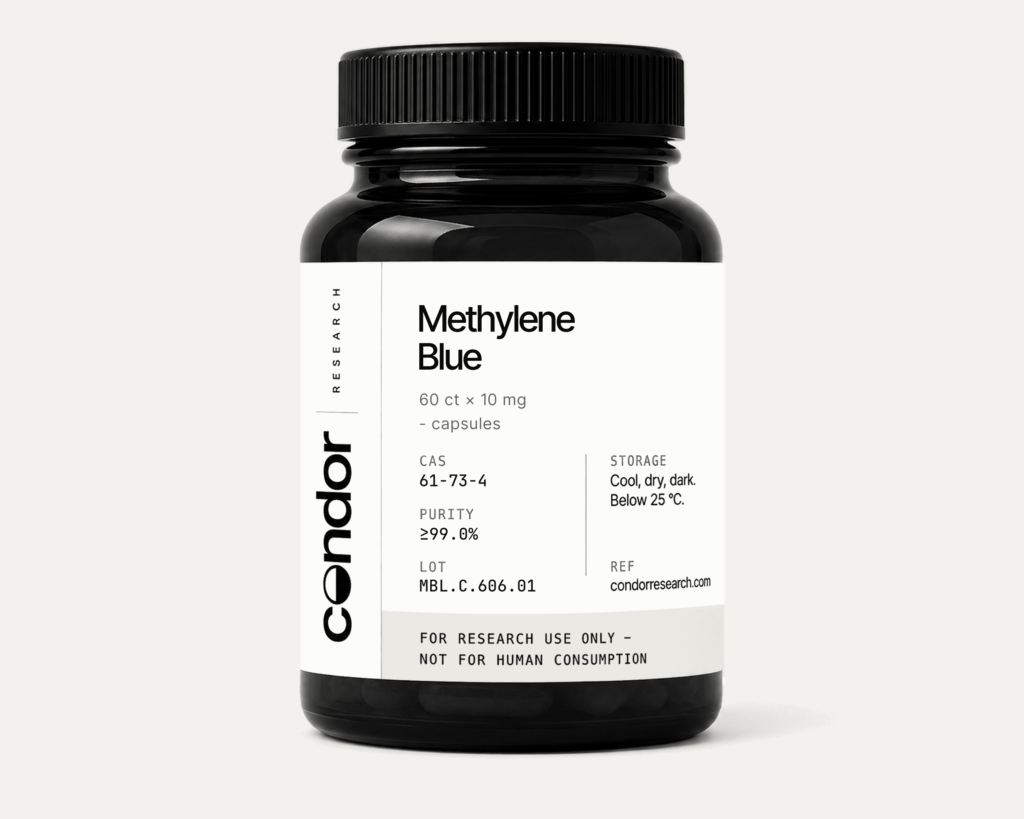
Specification & quality. Each bottle contains 60 HPMC (vegan) capsules, each providing 10mg of Methylene Blue (USP grade) at ≥99% (USP grade). Encapsulated — no reconstitution required. Every batch is independently third-party tested, and a Certificate of Analysis (COA) is available. Store at room temperature, protect from light; shelf life 24 months from the manufacture date. EU warehoused.
This product is intended for laboratory research use only (RUO). It is not a drug, food, cosmetic, or dietary supplement, and is not for human or veterinary use, ingestion, or diagnostic application. Handling is restricted to qualified research professionals operating in an appropriately equipped laboratory.
Supplied for in-vitro laboratory research use only (RUO). Not a drug, food or supplement; not for human or veterinary use.
Certificate of Analysis — lot-specific COA ships with every order and is available on request.
Each lot is tested by an independent third-party laboratory for identity (mass spectrometry) and purity (HPLC). The Certificate of Analysis for your specific batch ships with the order and is available on request — no house data, no exceptions.
References are illustrative of the research literature surrounding this compound. All claims relate to in-vitro and animal models only.
Methylene Blue (methylthioninium chloride, USP grade) is a phenothiazine dye studied in cell and animal models at low concentrations as a mitochondrial electron-cycler that can support cytochrome-c-oxidase activity (Isaev et al., 2024). Condor Research supplies it strictly as a Research Use Only reference compound for in vitro and animal studies, not as a medicine or supplement for human or veterinary use.
Both are studied as mitochondrially active molecules, but by different routes: methylene blue is investigated as a redox electron-cycler supporting the respiratory chain (Isaev et al., 2024), while J-147 is studied as a curcumin-derived compound that engages mitochondrial ATP synthase. They are used to probe distinct aspects of bioenergetics in research. Both are supplied only as research-use-only reference compounds.
MitoQ is a mitochondria-targeted antioxidant, whereas methylene blue is studied as a redox cycler; both have been examined together in mitochondrial-targeted approaches to skeletal ageing (Poudel et al., 2024). The two represent different mechanistic strategies for the same broad research area. Each is offered strictly for laboratory research, never for human or veterinary use.
As a penetrating cation, methylene blue shows strongly concentration-dependent behaviour that distinguishes its low-concentration redox-cycling profile from effects seen at higher levels (Sokolov et al., 2023). This concentration dependence is central to how it is used and interpreted in research. All such compounds are research-use-only reference materials, not products for human or veterinary use.
Reviews describe an experimental footprint across bioenergetics, oxidative stress and neuroprotection in model systems (Hashmi et al., 2023), including neuroprotective endpoints in injury models such as traumatic optic neuropathy in rats (Ciranna et al., 2025). These are observations in experimental systems and do not establish any effect in humans. The compound is supplied for laboratory research use only.
Yes. Condor Research supplies Methylene Blue strictly as a Research Use Only reference compound to professionals and institutions, not as a medicine, supplement or product for human or veterinary use. Buyers are responsible for confirming import legality in their own country. Questions: info@condorresearch.com.
The capsule is a pre-weighed solid format that makes a fixed 10mg quantity of methylene blue powder easy to store and handle in the laboratory, and the HPMC (vegan) shell helps contain a strongly staining material. It is not a dose for consumption and does not imply ingestion. The capsule format is provided strictly for research use only; not for human or veterinary use.
No. Each capsule already contains pre-weighed solid methylene blue powder, so no reconstitution is required for laboratory handling. Because it is water-soluble, researchers may dissolve the contents in an appropriate aqueous medium for in vitro work. This product is for research use only and not for human or veterinary use.
Each bottle contains 60 HPMC (vegan) capsules, with each capsule providing 10mg of USP-grade Methylene Blue at ≥99% purity. Every batch is independently third-party tested. The capsules are a pre-measured solid format for laboratory research use only, not a dose for human or veterinary use.
Methylene Blue has the molecular formula C16H18ClN3S, a molecular weight of 319.85 g/mol, and CAS number 61-73-4. It is USP grade and presents as a dark green to blue crystalline powder, soluble in water. It is supplied strictly as a research-use-only reference compound.
Yes. Every Methylene Blue batch is tested by an independent third-party laboratory for identity and purity (≥99%, USP grade), and ships with a lot-specific Certificate of Analysis. To request the COA for a particular lot, contact info@condorresearch.com. For laboratory research use only. Not for human or veterinary use.
Condor Research supplies Methylene Blue Capsules directly, dispatched from our EU facility in Slovakia to the EU, EEA, UK and Switzerland. Deliveries to EU destinations clear no third-country customs, and shipping is calculated at checkout. Supplied strictly as a research-use-only reference material — not for human or veterinary use.
No verified reviews yet.
Leave a reviewCookies
We use strictly necessary cookies to run the store. With your consent we also use analytics (order attribution) and marketing (Omnisend) cookies. Read our Cookie Policy.