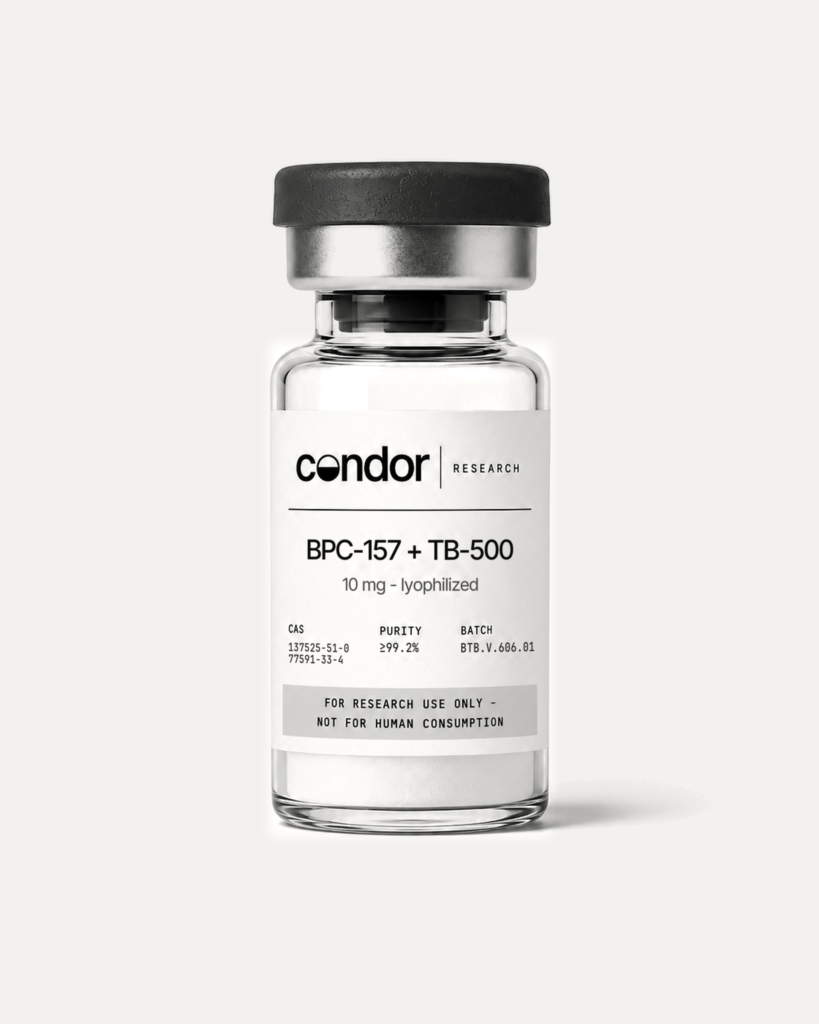
Lyophilised · ≥99% (HPLC) ·
Supplied lyophilised. Reconstitution typically uses bacteriostatic water.
BPC-157 + TB-500 is a dual-peptide research blend combining BPC-157 (Body Protection Compound-157), a synthetic 15-amino-acid pentadecapeptide (sequence GEPPPGKPADDAGLV; CAS 137525-51-0; MW 1419.5 g/mol) derived from human gastric juice, with TB-500, a synthetic analogue of the actin-sequestering peptide Thymosin Beta-4 (CAS 77591-33-4; MW 4963 g/mol). Both components are supplied lyophilised at ≥99% purity by HPLC. For laboratory research use only; not for human or veterinary use.
This blend pairs two of the most extensively investigated peptides in regenerative and cytoprotective research, BPC-157 and TB-500, in a single co-formulated vial. The combination is studied because the two molecules act through largely distinct mechanisms — one rooted in gastric cytoprotection, the other in actin-binding cell motility — making them a frequent pairing in tissue-repair model systems.
Two repair peptides with separate origins. BPC-157 is a synthetic pentadecapeptide derived from a protective protein in gastric juice, characterised as a pleiotropic, stable agent in a large experimental literature (Sikiric et al., 2024). TB-500 is the synthetic, bioavailable fragment corresponding to the active region of thymosin β4, a naturally occurring actin-sequestering peptide expressed across many human tissues during development (Faa et al., 2024).
What the research explores. Each component has its own body of experimental work, and together they are studied across complementary repair themes:
All of the activity described here comes from in-vitro and animal studies; these findings characterise biological behaviour in experimental models and do not demonstrate efficacy or safety in humans. Full citations are listed under the Scientific References tab.
Specification & quality. Each individually sealed vial contains 10 mg of BPC-157 and 10 mg of TB-500 as a white lyophilized powder at ≥99% purity by HPLC, soluble in water. Every batch is third-party tested, and a Certificate of Analysis (COA) is available. Store at −20 °C, protected from light and moisture; shelf life 24 months from the manufacture date.
This product is intended for laboratory research use only (RUO). It is not a drug, food, cosmetic, or dietary supplement, and is not for human or veterinary use, ingestion, or diagnostic application. Handling is restricted to qualified research professionals operating in an appropriately equipped laboratory.
Supplied for in-vitro laboratory research use only (RUO). Not a drug, food or supplement; not for human or veterinary use.
Certificate of Analysis — lot-specific COA ships with every order and is available on request.
Each lot is tested by an independent third-party laboratory for identity (mass spectrometry) and purity (HPLC). The Certificate of Analysis for your specific batch ships with the order and is available on request — no house data, no exceptions.
References are illustrative of the research literature surrounding this compound. All claims relate to in-vitro and animal models only.
It is a single co-formulated, lyophilized vial pairing two extensively studied regenerative-research peptides: BPC-157 (10 mg), a gastric-derived 15-mer, and TB-500 (10 mg), a thymosin beta-4 fragment. It is supplied strictly as a Research Use Only reference material for in vitro and animal tissue-repair and cytoprotection studies.
The blend pairs them because BPC-157 and TB-500 act through different molecular pathways in tissue-repair models, so they are studied as complementary rather than overlapping reagents. Co-formulating both in one vial lets researchers investigate them together under identical conditions. For research use only, in vitro and animal models.
The blend co-formulates 10 mg BPC-157 and 10 mg TB-500 in one vial, reconstituted together, so the two are always studied at a fixed combined ratio. Buying them separately lets you vary each peptide independently. The amounts match the standalone 10 mg vials. Both formats are research use only.
The BPC-157 + TB-500 blend contains two repair peptides (10 mg each). GLOW adds GHK-Cu (50 mg), a copper-binding tripeptide studied in skin-regeneration and tissue-repair research, making it a three-peptide formulation. Choose the two-peptide blend for a simpler system, or GLOW to include the copper peptide. Research use only.
In peptide content, yes: the blend contains 10 mg BPC-157 and 10 mg TB-500, matching the standalone vial amounts. The difference is that they are co-formulated in a single vial and reconstituted together at a fixed ratio, rather than prepared independently. Research use only, in vitro and animal models.
Purity is verified per component. For blends, the >=99% HPLC specification applies to each peptide individually, confirmed by independent third-party testing before co-formulation, with a batch Certificate of Analysis. To request the COA covering both components for a specific lot, contact info@condorresearch.com.
Both peptides are water-soluble, so one diluent reconstitutes the blend in the lab. For example, adding 2 mL of bacteriostatic water to the 20 mg vial (10 mg + 10 mg) gives 5 mg/mL BPC-157 and 5 mg/mL TB-500; adjust volume for other target concentrations. For research preparation only, not human use.
Yes. Condor supplies the BPC-157 + TB-500 blend strictly as a Research Use Only (in vitro) reference material to professionals and institutions, not as a medicine or product for human or veterinary use. Buyers are responsible for confirming import legality in their country. Questions: info@condorresearch.com.
Store the sealed blend vial at -20C, protected from light; shelf life is 24 months from manufacture. Lyophilized peptide is stable for short room-temperature transit, so cold-pack shipping is generally not required. All preparation and handling is for in vitro and animal research only, never human or veterinary use.
Condor Research supplies BPC-157 + TB-500 directly, dispatched from our EU facility in Slovakia to the EU, EEA, UK and Switzerland. Deliveries to EU destinations clear no third-country customs, and shipping is calculated at checkout. Supplied strictly as a research-use-only reference material — not for human or veterinary use.
No verified reviews yet.
Leave a reviewCookies
We use strictly necessary cookies to run the store. With your consent we also use analytics (order attribution) and marketing (Omnisend) cookies. Read our Cookie Policy.