Lyophilised · ≥99% (HPLC) ·
Supplied lyophilised. Reconstitution typically uses bacteriostatic water.
When a cell needs to move, rebuild a wound edge, or sprout a new vessel, it first has to remodel its own internal scaffolding — and that scaffolding is actin. TB-500 is the synthetic counterpart of the active region of Thymosin β-4, a 43-amino-acid actin-sequestering peptide that sits at the heart of how cells reshape themselves during migration and repair. It has become a reference tool for laboratories probing the molecular choreography of tissue regeneration.
An actin-binding peptide drawn from a developmental regulator. Thymosin β-4 is one of the most abundant actin-binding proteins in many cell types, and its expression has been mapped across human organ development, marking it as a deeply conserved player in tissue formation (Faa et al., 2024). TB-500 reproduces the G-actin-binding motif responsible for much of that activity, which is why it is studied as a probe for cell motility, angiogenesis and regenerative signalling.
Beyond simple actin handling, the parent molecule has been framed as a candidate for anti-ageing and regenerative paradigms, with research mapping new mechanistic directions for the peptide family (Bock-Marquette et al., 2023).
What the research explores. Across cell-culture and animal systems, TB-500 has been investigated along several converging lines:
The activity described here is drawn from in-vitro and animal studies; it characterises biological behaviour in experimental models and does not establish efficacy or safety in humans. Full citations are listed under the Scientific References tab.
Physicochemical profile. CAS No. 77591-33-4 · Molecular formula C212H350N56O78S · Molecular weight 4963.44 g/mol · Sequence Ac-Ser-Asp-Lys-Pro-Asp-Met-Ala-Glu-Ile-Glu-Lys-Phe-Asp-Lys-Ser-Lys-Leu-Lys-Lys-Thr-Glu-Thr-Gln-Glu-Lys-Asn-Pro-Leu-Pro-Ser-Lys-Glu-Thr-Ile-Glu-Gln-Glu-Lys-Gln-Ala-Gly-Glu-Ser (43 aa) · Appearance: White lyophilized powder · Solubility: Soluble in water.
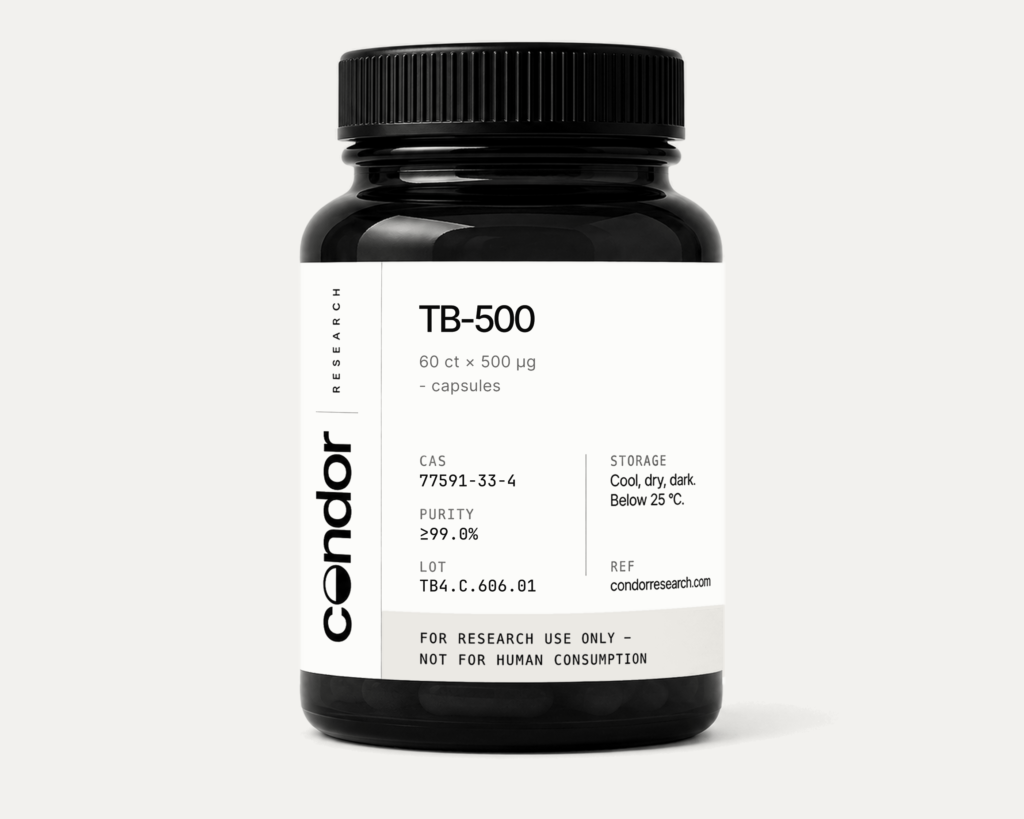
Specification & quality. Each bottle contains 60 HPMC (vegan) capsules, each providing 500mcg of TB-500 at ≥99% (HPLC). Encapsulated — no reconstitution required. Every batch is independently third-party tested, and a Certificate of Analysis (COA) is available. Store at -20°C, protect from light and moisture; shelf life 24 months from the manufacture date. EU warehoused.
This product is intended for laboratory research use only (RUO). It is not a drug, food, cosmetic, or dietary supplement, and is not for human or veterinary use, ingestion, or diagnostic application. Handling is restricted to qualified research professionals operating in an appropriately equipped laboratory.
Supplied for in-vitro laboratory research use only (RUO). Not a drug, food or supplement; not for human or veterinary use.
Certificate of Analysis — lot-specific COA ships with every order and is available on request.
Each lot is tested by an independent third-party laboratory for identity (mass spectrometry) and purity (HPLC). The Certificate of Analysis for your specific batch ships with the order and is available on request — no house data, no exceptions.
References are illustrative of the research literature surrounding this compound. All claims relate to in-vitro and animal models only.
TB-500 is the synthetic version of the active region of Thymosin β-4, a 43-amino-acid actin-sequestering peptide studied for its role in cell migration, angiogenesis and tissue-repair signalling. Its biology has been examined across cardiac, corneal and regenerative models (Maar et al., 2025). Condor Research supplies it strictly as a Research Use Only reference compound for in vitro and animal studies, not for human or veterinary use.
TB-500 is a 43-residue thymosin β-4 fragment studied primarily as an actin-binding peptide governing cell motility and angiogenesis, whereas BPC-157 is a 15-residue gastric pentadecapeptide studied around cytoprotection and the nitric-oxide system. They sit in different mechanistic classes and address different research questions about tissue dynamics. Both are supplied strictly as research-use-only reference compounds, not for human or veterinary use.
No. Thymosin β-4 is the full 43-residue protein and one of the most abundant actin-binding molecules in many cells, with expression mapped across human organ development (Faa et al., 2024). TB-500 reproduces the active actin-binding region of that protein, making it a focused tool for studying the same pathways. Both are handled only as research-use-only reference materials, never for human or veterinary use.
TB-500 is studied around actin regulation, cell migration and angiogenesis, while KPV is a melanocortin-derived tripeptide studied chiefly for anti-inflammatory signalling in intestinal and dermal models. They illuminate different stages of the tissue-response question — structural remodelling versus inflammatory tone. Each is offered solely as a Research Use Only reference compound, not for human or veterinary use.
Yes. Condor Research supplies TB-500 strictly as a Research Use Only reference compound to professionals and institutions, not as a medicine, supplement or product for human or veterinary use. Buyers are responsible for confirming import legality in their own country. Questions: info@condorresearch.com.
The capsule is simply a pre-weighed solid format: 500mcg of TB-500 sealed in an HPMC (vegan) shell so each unit holds a precise, handling-ready quantity. This removes weighing steps at the bench and requires no reconstitution. The format is a laboratory convenience only and does not imply or permit human or veterinary consumption — for research use only.
No. The peptide is already encapsulated as a pre-measured solid, so no reconstitution is required for handling. Researchers prepare working solutions according to their own validated experimental protocols. The capsule is a laboratory format only and is not intended for human or veterinary use.
Each bottle contains 60 HPMC (vegan) capsules, with 500mcg of TB-500 per capsule at ≥99% (HPLC) purity. Every batch is independently third-party tested and a Certificate of Analysis is available on request. This specification describes a research reference material, not a product for human or veterinary use.
TB-500 has CAS No. 77591-33-4, molecular formula C212H350N56O78S and a molecular weight of 4963.44 g/mol. It is a 43-amino-acid acetylated peptide supplied as a white lyophilized powder, soluble in water. These values are provided for laboratory characterisation and research use only.
Yes. Every TB-500 batch is tested by an independent third-party laboratory by HPLC for identity and purity (≥99%), and each lot ships with a lot-specific Certificate of Analysis. To request the COA for your batch, contact info@condorresearch.com. This documentation supports research use only, not human or veterinary application.
Store at -20°C, protected from light and moisture, to preserve peptide integrity over the stated 24-month shelf life from the manufacture date. Stock is EU warehoused for reliable regional supply. For laboratory research use only. Not for human or veterinary use.
Condor Research supplies TB-500 Capsules directly, dispatched from our EU facility in Slovakia to the EU, EEA, UK and Switzerland. Deliveries to EU destinations clear no third-country customs, and shipping is calculated at checkout. Supplied strictly as a research-use-only reference material — not for human or veterinary use.
No verified reviews yet.
Leave a reviewCookies
We use strictly necessary cookies to run the store. With your consent we also use analytics (order attribution) and marketing (Omnisend) cookies. Read our Cookie Policy.