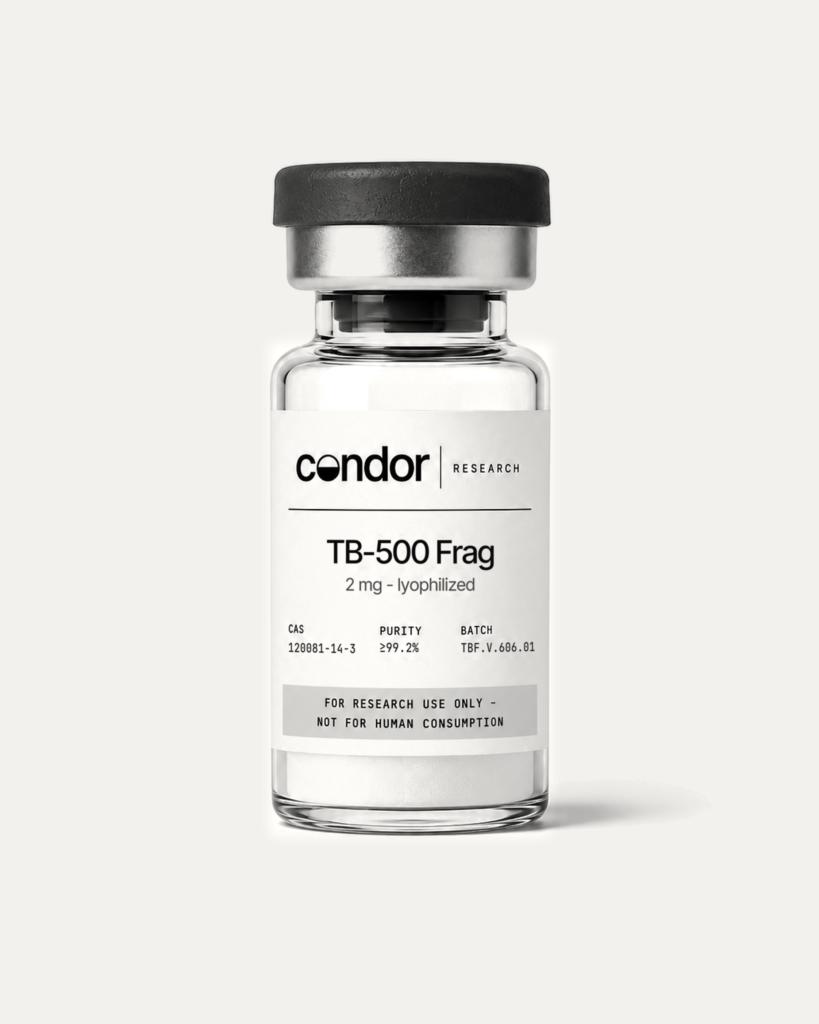
Lyophilised · ≥99% (HPLC) ·
Supplied lyophilised. Reconstitution typically uses bacteriostatic water.
Hidden inside a large repair protein is a tiny fragment that the body cleaves out and uses on its own. TB-500 (Frag) is the synthetic acetylated tetrapeptide Ac-Ser-Asp-Lys-Pro (Ac-SDKP, also called goralatide), a naturally occurring fragment released from thymosin β4. Rather than the full thymosin β4 molecule, this listing is the short Ac-SDKP sequence itself — one of the most studied antifibrotic and anti-inflammatory peptide fragments in the literature.
A fragment with a life of its own. Ac-SDKP is generated endogenously from thymosin β4 through the action of prolyl oligopeptidase and is regulated within the renin-angiotensin system, where angiotensin-converting enzyme (ACE) is a primary route of its degradation (Kassem et al., 2019). Because ACE inhibition raises Ac-SDKP levels, the peptide sits at an intersection of cardiovascular and tissue-remodeling biology, making it a focused tool for fibrosis research distinct from full-length thymosin β4.
What the research explores. The literature concentrates on anti-fibrotic and anti-inflammatory endpoints:
These findings derive from in vitro and animal research describing biological activity; they do not establish safety or efficacy in humans. Full citations are listed under the Scientific References tab.
Physicochemical profile. CAS 120081-14-3 · Molecular formula C₂₀H₃₃N₅O₉ · Molecular weight 487.5 g/mol · Sequence Ac-Ser-Asp-Lys-Pro · Appearance: white lyophilized powder · Soluble in water.
Specification & quality. Each individually sealed vial contains 2 mg of TB-500 (Frag) — Ac-SDKP — as a white lyophilized powder at ≥99% purity by HPLC. Every batch is third-party tested, with a Certificate of Analysis (COA) available. Store at −20 °C, protected from light and moisture.
This product is intended for laboratory research use only (RUO). It is not a drug, food, cosmetic, or dietary supplement, and is not for human or veterinary use, ingestion, or diagnostic application. Handling is restricted to qualified research professionals operating in an appropriately equipped laboratory.
Supplied for in-vitro laboratory research use only (RUO). Not a drug, food or supplement; not for human or veterinary use.
Certificate of Analysis — lot-specific COA ships with every order and is available on request.
Each lot is tested by an independent third-party laboratory for identity (mass spectrometry) and purity (HPLC). The Certificate of Analysis for your specific batch ships with the order and is available on request — no house data, no exceptions.
References are illustrative of the research literature surrounding this compound. All claims relate to in-vitro and animal models only.
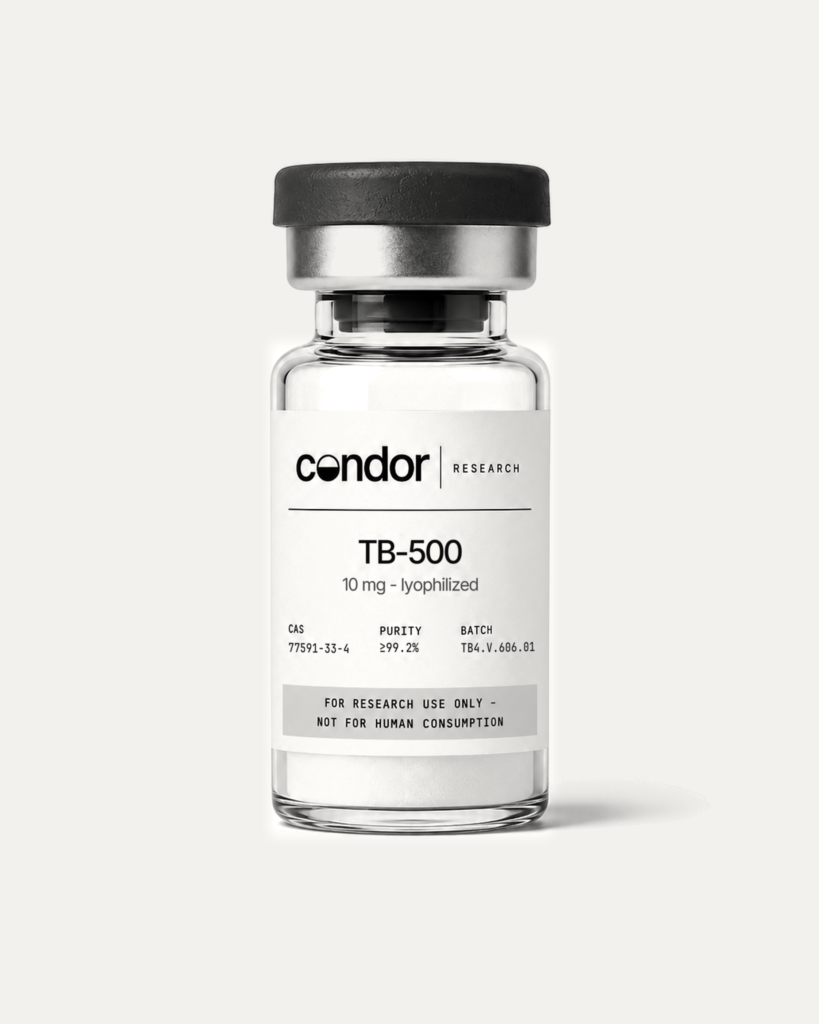
TB-500 (Frag) is the synthetic tetrapeptide Ac-Ser-Asp-Lys-Pro (Ac-SDKP, also known as goralatide), a small fragment that the body cleaves from a larger thymosin β4 precursor and that acts on its own in research models. Condor Research supplies it as a 2 mg lyophilized vial at ≥99% HPLC purity, strictly for in-vitro laboratory research use only.
They are different molecules. TB-500 (Frag) is the four-residue Ac-SDKP (goralatide) tetrapeptide, whereas the standard TB-500 product is the much larger 43-residue actin-binding fragment derived from thymosin β4. The Frag isolates one short, naturally cleaved sequence rather than the full peptide. Condor Research offers each as a separate ≥99% HPLC, research-use-only reference compound, each with its own COA.
TB-500 (Frag) is the small Ac-SDKP tetrapeptide and is offered as a 2 mg vial, while the larger 43-residue TB-500 is supplied at 10 mg; the masses are analytical reference quantities for two distinct molecules, not doses. To compare value per mg or for current pricing, contact info@condorresearch.com. Both are ≥99% HPLC research-use-only materials.
TB-500 (Frag) isolates the single Ac-Ser-Asp-Lys-Pro (goralatide) sequence, a defined cleavage product, whereas full-length TB-500 is the 43-residue actin-binding fragment with broader structural features. Researchers choose the Frag to study that one short motif specifically. Both are supplied as separate ≥99% HPLC, research-use-only reference compounds; selection depends on your in-vitro research question.
TB-500 (Frag) is the Ac-SDKP tetrapeptide derived from thymosin β4 biology, while BPC-157 is a 15-residue gastric pentadecapeptide studied for cytoprotective mechanisms. They are both short peptides in regenerative research but have unrelated sequences and pathways. Condor Research offers each as a distinct ≥99% HPLC, research-use-only reference compound; the choice depends on your experimental target.
TB-500 (Frag) is selected when the focus is specifically the Ac-SDKP (goralatide) tetrapeptide as an isolated, naturally cleaved sequence, rather than the broader 43-residue thymosin β4 fragment. Researchers studying that short motif on its own choose the Frag. Both remain research-use-only reference materials with no human or veterinary application.
Yes. The acetylated tetrapeptide Ac-Ser-Asp-Lys-Pro (CAS 120081-14-3) is verified for each lot by an independent third-party laboratory using HPLC for purity and mass spectrometry for identity, confirming both the sequence and N-terminal acetylation. Results are documented on the batch-specific Certificate of Analysis, available on request at info@condorresearch.com.
Yes. TB-500 (Frag) is supplied strictly for laboratory research use only (in vitro). It is not a medicine, food, supplement, cosmetic, or medical device, and is not for human or veterinary use, administration, or consumption. Condor Research provides no dosing, protocols, or human-use guidance. Purchase is limited to qualified professionals and institutions aged 18 or over.
Yes. Each TB-500 (Frag) lot is tested by an independent third-party laboratory by HPLC for identity and purity, with mass spectrometry confirmation, and ships against a batch-specific Certificate of Analysis verifying ≥99% purity. To request the COA for the current lot before ordering, contact info@condorresearch.com.
For analytical laboratory preparation only, TB-500 (Frag) is water-soluble and can be reconstituted with a sterile aqueous diluent; with a 2 mg vial the chosen volume sets the working concentration. Store the sealed lyophilized vial at -20°C, protected from light, with a 24-month shelf life. This is laboratory handling information, not guidance for any human or animal use.
Condor Research supplies TB-500 (Frag) directly, dispatched from our EU facility in Slovakia to the EU, EEA, UK and Switzerland. Deliveries to EU destinations clear no third-country customs, and shipping is calculated at checkout. Supplied strictly as a research-use-only reference material — not for human or veterinary use.
No verified reviews yet.
Leave a reviewCookies
We use strictly necessary cookies to run the store. With your consent we also use analytics (order attribution) and marketing (Omnisend) cookies. Read our Cookie Policy.