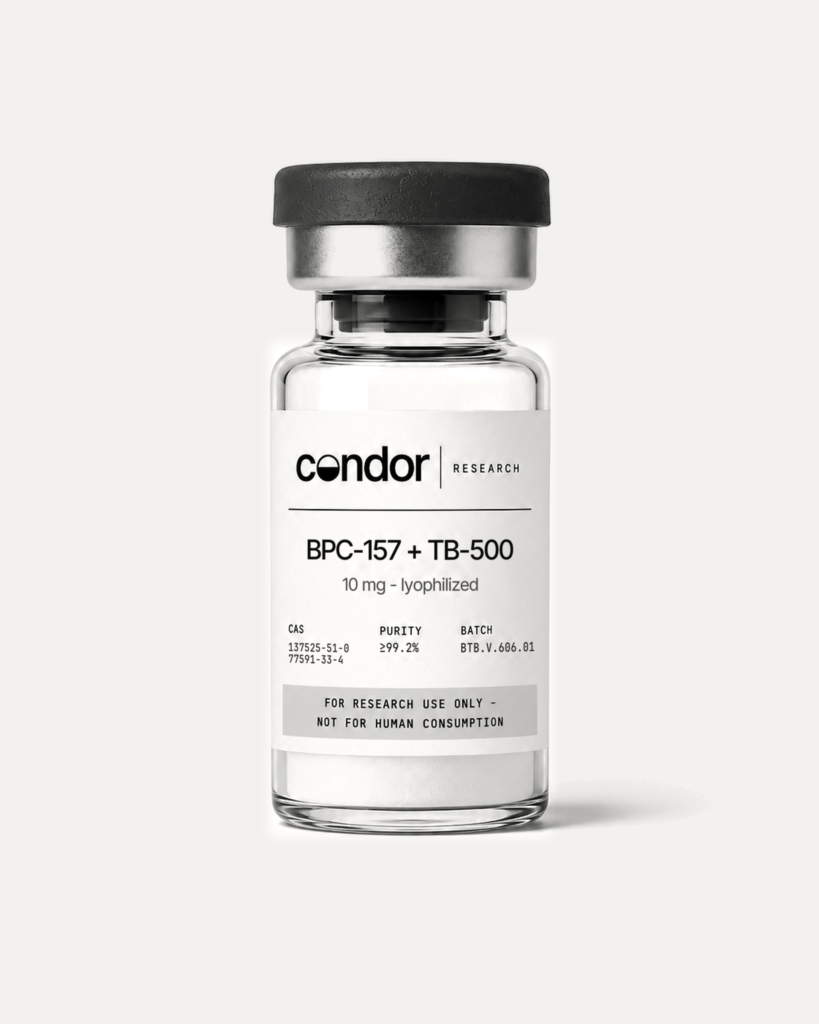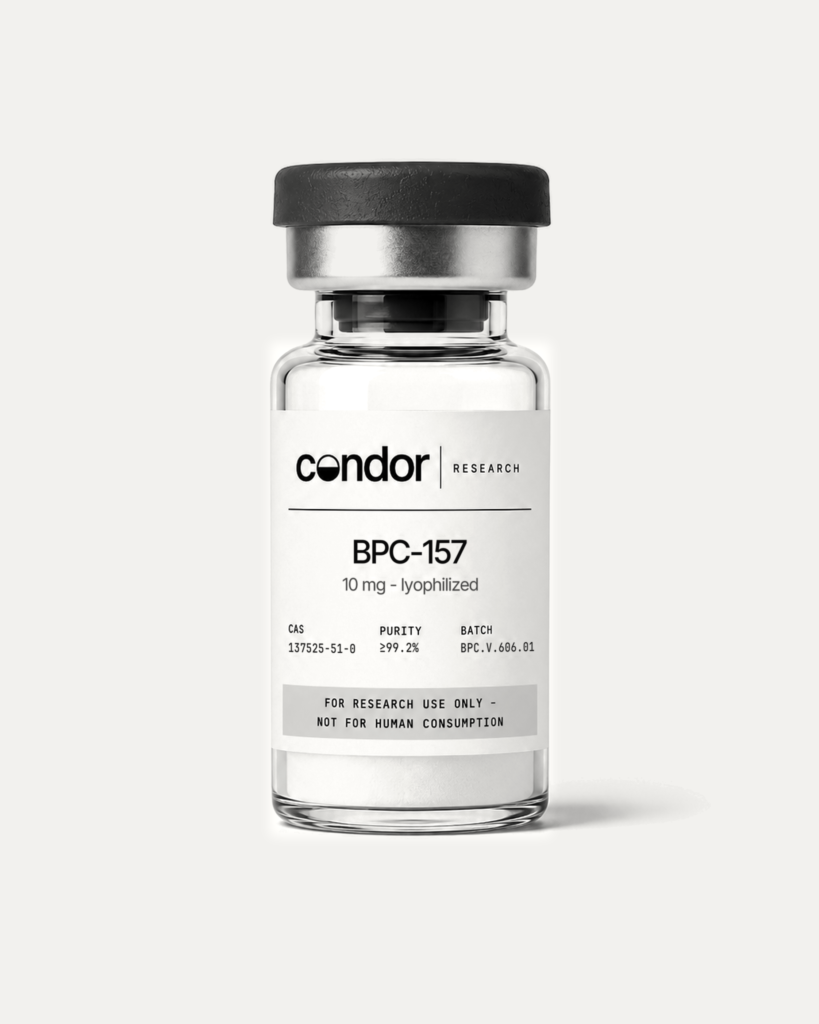
Lyophilised · ≥99% (HPLC) ·
Supplied lyophilised. Reconstitution typically uses bacteriostatic water.
BPC-157 (Body Protection Compound-157) is a synthetic 15-amino-acid pentadecapeptide derived from a protective protein in human gastric juice, and one of the most studied compounds in regenerative and cytoprotective research. Sequence GEPPPGKPADDAGLV; CAS 137525-51-0; molecular weight 1419.53 g/mol; supplied lyophilised at ≥99% purity by HPLC. For laboratory research use only; not for human or veterinary use.
First identified in a protein that protects the lining of the stomach, BPC-157 (Body Protection Compound-157, also designated PL 14736) is a synthetic pentadecapeptide — a 15-amino-acid chain (Gly-Glu-Pro-Pro-Pro-Gly-Lys-Pro-Ala-Asp-Asp-Ala-Gly-Leu-Val) prized for its stability. Unusually robust in aqueous solution and resistant to gastric acid, it has become one of the most extensively investigated molecules in regenerative and cytoprotective research.
A peptide born from the body's own defences. BPC-157 is derived from a naturally occurring protective sequence found in human gastric juice — the tissue that withstands one of the harshest environments in the body. Researchers isolated and stabilised this fragment to study how the organism shields and repairs itself, and since the late 1990s the Zagreb group led by Sikirić and colleagues has built much of the foundational literature around it (Sikirić et al., 2024).
What the research explores. Rather than acting on a single target, BPC-157 is studied as a pleiotropic agent — one that appears to influence several repair pathways at once, with the nitric-oxide (NO) system and angiogenic, growth-factor signalling recurring throughout the literature. Investigations cluster into four broad domains:
All of the above derives from in-vitro and animal studies and is provided strictly for scientific context; it does not constitute evidence of safety or efficacy in humans. Every research statement maps to a verifiable, peer-reviewed source — with PMID and DOI — under the Scientific References tab.
Physicochemical profile. CAS 137525-51-0 · Molecular formula C₆₂H₉₈N₁₆O₂₂ · Molecular weight 1419.53 g/mol · Sequence GEPPPGKPADDAGLV · Soluble in water (≈1 mg/mL) and standard aqueous buffers.
Specification & quality. Each individually sealed vial contains 10 mg of BPC-157 supplied as a sterile, lyophilised white powder at ≥99% purity by reversed-phase HPLC. Every batch is independently third-party tested, with identity and purity confirmed by HPLC and mass spectrometry; a Certificate of Analysis is available for verified research accounts. Store lyophilised at −20 °C, protected from light and moisture.
This product is intended for laboratory research use only (RUO). It is not a drug, food, cosmetic, or dietary supplement, and is not for human or veterinary use, ingestion, or diagnostic application. Handling is restricted to qualified research professionals operating in an appropriately equipped laboratory.
Supplied for in-vitro laboratory research use only (RUO). Not a drug, food or supplement; not for human or veterinary use.
Certificate of Analysis — lot-specific COA ships with every order and is available on request.
Each lot is tested by an independent third-party laboratory for identity (mass spectrometry) and purity (HPLC). The Certificate of Analysis for your specific batch ships with the order and is available on request — no house data, no exceptions.
References are illustrative of the research literature surrounding this compound. All claims relate to in-vitro and animal models only.
BPC-157 (Body Protection Compound-157, also designated PL 14736) is a synthetic 15-amino-acid peptide whose sequence was derived from a protein found in gastric juice. It is supplied strictly as a research-use-only reference compound for in vitro and animal cytoprotection and tissue-repair studies, not for human or veterinary use.
BPC-157 is a 15-amino-acid synthetic peptide derived from a gastric protein, studied for cytoprotection and angiogenesis in vitro. TB-500 is a much larger 43-residue peptide corresponding to thymosin beta-4, studied for actin binding and cell migration. They act through different mechanisms, which is why both are used as distinct regenerative-research reagents.
They are studied as complementary, not redundant, reagents. BPC-157 (a 15-mer gastric-derived peptide) and TB-500 (a 43-residue thymosin beta-4 peptide) act through different molecular pathways in tissue-repair models, which is the rationale for the co-formulated BPC-157 + TB-500 blend. For research use only, in vitro and animal models.
Standalone BPC-157 is a single 10 mg peptide for isolating its effects in research. GLOW co-formulates it with GHK-Cu (50 mg) and TB-500 (10 mg); KLOW adds KPV (10 mg) as a fourth component. Choose the standalone to study one variable, or a blend to investigate the peptides together. Research use only.
Yes. Condor Research supplies BPC-157 strictly as a Research Use Only (in vitro) reference compound to professionals and institutions, not as a medicine, supplement or product for human or veterinary use. Buyers are responsible for confirming import legality in their own country. Questions: info@condorresearch.com.
Yes. Every BPC-157 batch is tested by an independent third-party laboratory by HPLC for identity and purity (>=99%), with mass spectrometry confirmation, and ships with a batch-specific Certificate of Analysis. To request the COA for a specific lot before ordering, contact info@condorresearch.com.
This BPC-157 has the molecular formula C62H98N16O22 and a molecular weight of 1419.53 (CAS 137525-51-0). Its pentadecapeptide sequence is Gly-Glu-Pro-Pro-Pro-Gly-Lys-Pro-Ala-Asp-Asp-Ala-Gly-Leu-Val. Identity and mass are confirmed by HPLC and mass spectrometry on each batch, and the values are documented in the lot-specific Certificate of Analysis supplied with the product.
Store the sealed BPC-157 vial at -20C, protected from light; shelf life is 24 months from manufacture. For laboratory preparation it is reconstituted in water (listed solubility 1 mg/mL). All handling is for in vitro and animal research only; no preparation here is intended for human or veterinary use.
The 1 mg/mL figure is the verified solubility reference used for laboratory preparation, not necessarily an absolute ceiling. For a 10 mg vial, adding 10 mL of diluent yields a 1 mg/mL solution. For concentrations above this, contact info@condorresearch.com. This data is for in vitro research preparation only.
Yes. Orders ship from the EU warehouse in plain, neutral outer packaging with tracking, and each vial carries the required Research Use Only laboratory labeling. Customs declarations are made truthfully as RUO research material with correct classification and value; contents are never mislabeled or undervalued. Questions: info@condorresearch.com.
Lyophilized BPC-157 is stable for short room-temperature transit, so cold packs are generally not required for shipping; brief delivery times within Europe do not compromise the powder. On arrival, store the sealed vial at -20C, protected from light, for long-term stability. Questions: info@condorresearch.com.
If a vial arrives damaged or non-conforming, notify info@condorresearch.com ideally within 48 hours with photos, and a replacement, reshipment or store credit can be arranged. Each batch is independently HPLC-tested at >=99% with a Certificate of Analysis backing the stated purity. Sealed laboratory goods are otherwise final sale (B2B).
Condor Research supplies BPC-157 directly, dispatched from our EU facility in Slovakia to the EU, EEA, UK and Switzerland. Deliveries to EU destinations clear no third-country customs, and shipping is calculated at checkout. Supplied strictly as a research-use-only reference material — not for human or veterinary use.
No verified reviews yet.
Leave a reviewCookies
We use strictly necessary cookies to run the store. With your consent we also use analytics (order attribution) and marketing (Omnisend) cookies. Read our Cookie Policy.