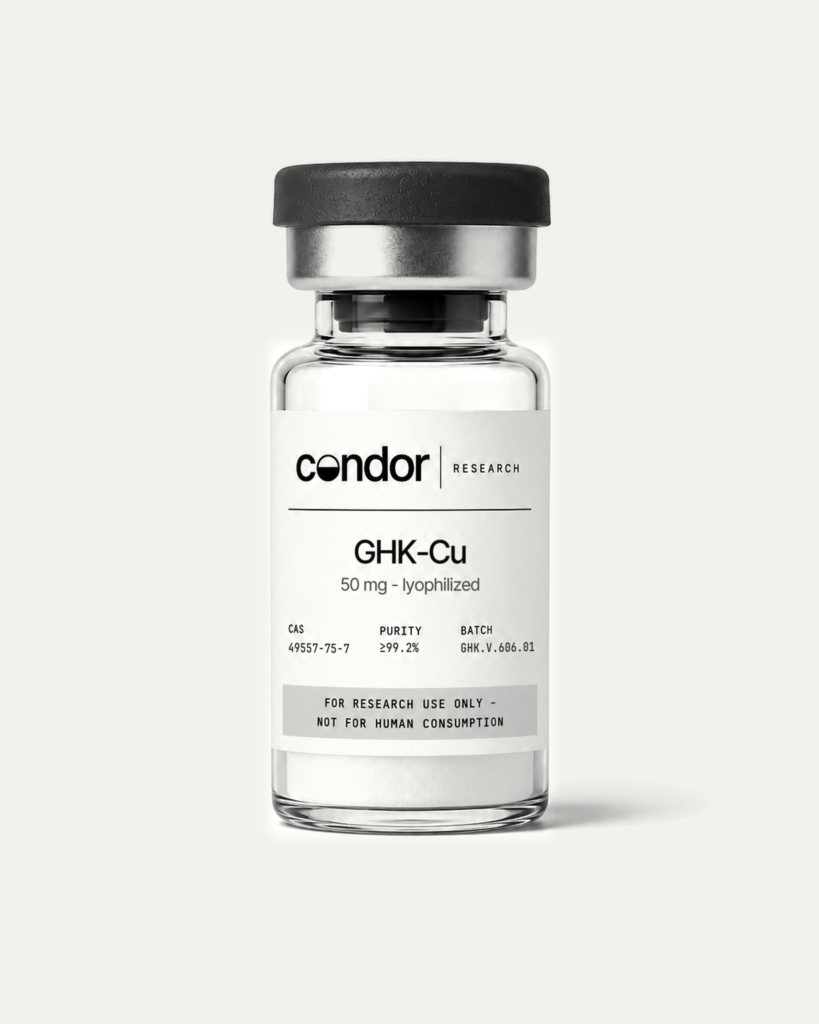
Lyophilised · ≥99% (HPLC) ·
Supplied lyophilised. Reconstitution typically uses bacteriostatic water.
GHK-Cu (copper tripeptide-1) is a naturally occurring copper-binding tripeptide, glycyl-L-histidyl-L-lysine bound to copper(II), and one of the most studied copper peptides in regenerative and dermatological research. CAS 49557-75-7; molecular formula C14H22CuN6O4; molecular weight approximately 403.9 g/mol; sequence Gly-His-Lys (Cu2+); supplied lyophilised at ≥99% by HPLC. For laboratory research use only.
Isolated from human plasma nearly half a century ago, GHK-Cu is a naturally occurring copper-binding tripeptide (glycyl-L-histidyl-L-lysine complexed with copper(II)) that has become one of the most studied small peptides in skin-regeneration and copper-homeostasis research. Its characteristic blue-green colour is the visual signature of the copper ion held within the histidine-lysine coordination site.
A signalling molecule discovered in human blood. The parent tripeptide was first identified in 1977, when researchers traced a growth-modulating activity in human serum to a single small molecule, glycyl-histidyl-lysine (Schlesinger et al., 1977). Early work showed it could influence the behaviour of cultured cells (Barra et al., 1987), and decades of subsequent investigation reframed GHK-Cu as a copper-delivery peptide that interacts with a broad set of cellular pathways (Pickart et al., 2015).
What the research explores. Rather than acting on one isolated target, GHK-Cu has been examined across several overlapping themes in experimental models:
The findings summarised here derive from in-vitro, cell-culture, and animal studies; they describe biological activity observed under laboratory conditions and do not establish efficacy or safety in humans. Full citations are listed under the Scientific References tab.
Physicochemical profile. CAS No. 49557-75-7 · Molecular formula C14H24CuN6O4 · Molecular weight 403.92 g/mol · Sequence Gly-His-Lys (copper-complexed) · Appearance: blue-green lyophilized powder · Solubility: soluble in water at 1 mg/mL.
Specification & quality. Each individually sealed vial contains 50 mg of GHK-Cu as a blue-green lyophilized powder at ≥99% purity by HPLC. Every batch is third-party tested, and a Certificate of Analysis (COA) is available. Store at −20 °C, protected from light and moisture; shelf life 24 months from the manufacture date.
This product is intended for laboratory research use only (RUO). It is not a drug, food, cosmetic, or dietary supplement, and is not for human or veterinary use, ingestion, or diagnostic application. Handling is restricted to qualified research professionals operating in an appropriately equipped laboratory.
Supplied for in-vitro laboratory research use only (RUO). Not a drug, food or supplement; not for human or veterinary use.
Certificate of Analysis — lot-specific COA ships with every order and is available on request.
Each lot is tested by an independent third-party laboratory for identity (mass spectrometry) and purity (HPLC). The Certificate of Analysis for your specific batch ships with the order and is available on request — no house data, no exceptions.
References are illustrative of the research literature surrounding this compound. All claims relate to in-vitro and animal models only.
GHK-Cu is a naturally occurring copper-binding tripeptide, glycyl-L-histidyl-L-lysine complexed with copper(II), originally isolated from human plasma. It is one of the most studied small peptides in skin-regeneration and tissue-repair research. Condor supplies it strictly as a Research Use Only reference compound for in vitro and animal studies.
Both are copper-binding tripeptides, but they differ by one amino acid: GHK-Cu is glycyl-histidyl-lysine and AHK-Cu is alanyl-histidyl-lysine, each complexed with copper(II). GHK-Cu is the more extensively studied in skin and tissue-repair research. They are offered as distinct reagents for comparative copper-peptide studies, research use only.
Yes, the copper matters. GHK-Cu is the tripeptide bound to copper(II), the form in which much of its skin-regeneration and tissue-repair biology has been characterized. The copper-free peptide (GHK) lacks the bound metal central to that activity. This product is the copper(II) complex, supplied for research use only.
Yes. The GHK-Cu component in the GLOW and KLOW blends is the same 50 mg copper(II) tripeptide as the standalone vial, co-formulated with other peptides rather than supplied alone. Choose the standalone to study GHK-Cu in isolation, or a blend to investigate it alongside BPC-157 and TB-500. Research use only.
Yes. Condor Research supplies GHK-Cu strictly as a Research Use Only (in vitro) reference compound to professionals and institutions, not as a cosmetic, supplement or product for human use. Buyers are responsible for confirming import legality in their own country. Questions: info@condorresearch.com.
Yes. Each GHK-Cu batch is tested by an independent third-party laboratory by HPLC for identity and purity (>=99%) and ships with a lot-specific Certificate of Analysis. To request the COA, including how copper content for the batch is documented, contact info@condorresearch.com before ordering.
Yes. A blue color is expected and characteristic of the copper(II)-tripeptide complex; it indicates the bound copper, not contamination. GHK-Cu is reconstituted in water for laboratory preparation (listed solubility 1 mg/mL). This is a research-use-only reagent; reconstitution is for in vitro and animal work, never human or veterinary use.
For laboratory preparation, adding 50 mL of water to the 50 mg vial gives a 1 mg/mL solution (the listed solubility reference); scale the volume for other concentrations. Store the sealed vial at -20C, protected from light; shelf life is 24 months. For research preparation only, not human or veterinary use.
This GHK-Cu has the molecular formula C14H24CuN6O4 and a molecular weight of 403.92, with sequence Gly-His-Lys complexed with copper(II) (CAS 49557-75-7). Identity and purity (>=99%) are confirmed by HPLC on each batch and documented in the lot-specific Certificate of Analysis.
No. The copper is chemically bound within the GHK-Cu tripeptide complex and the product ships as a sealed lyophilized research reagent, declared truthfully as Research Use Only material with correct customs classification and value. Buyers remain responsible for import rules in their own country. Questions: info@condorresearch.com.
If a vial arrives damaged or non-conforming, notify info@condorresearch.com ideally within 48 hours with photos, and a replacement, reshipment or store credit can be arranged. Note that a blue solution after reconstitution is normal for this copper complex. Each batch is independently HPLC-tested at >=99% with a Certificate of Analysis.
Condor Research supplies GHK-Cu directly, dispatched from our EU facility in Slovakia to the EU, EEA, UK and Switzerland. Deliveries to EU destinations clear no third-country customs, and shipping is calculated at checkout. Supplied strictly as a research-use-only reference material — not for human or veterinary use.
No verified reviews yet.
Leave a reviewCookies
We use strictly necessary cookies to run the store. With your consent we also use analytics (order attribution) and marketing (Omnisend) cookies. Read our Cookie Policy.