Lyophilised · ≥98% (HPLC) ·
Supplied lyophilised. Reconstitution typically uses bacteriostatic water.
GHK-Cu (copper tripeptide-1) is a naturally occurring tripeptide-copper complex with sequence Gly-His-Lys coordinated to a Cu²⁺ ion; CAS 89030-95-5; molecular weight 402.92 g/mol; molecular formula C₁₄H₂₃CuN₆O₄⁺. The free tripeptide GHK (CAS 49557-75-7, MW 340.38 g/mol) is the copper-free precursor and is a distinct compound. GHK-Cu is found endogenously in human plasma, saliva, and urine and has been studied in wound healing, collagen synthesis, antioxidant response, and tissue remodelling models. For laboratory research use only; not for human or veterinary use.
It begins as a faint blue powder — the colour itself a fingerprint of the copper ion locked at its core. GHK-Cu is the tripeptide glycyl-L-histidyl-L-lysine bound to copper(II), a naturally occurring matrikine first isolated from human plasma and now one of the most intensively studied copper-peptide complexes in regenerative and skin-biology research. The metal is not an impurity but the active heart of the molecule: the histidine-lysine motif cradles Cu(II) in a defined coordination geometry that governs almost everything the complex does.
A copper carrier with a coordination chemistry of its own. The way GHK grips copper has been resolved by X-ray and solution structural work, which compared the redox behaviour of Cu(II)-GHK against related N-terminal motifs and showed how the binding mode tunes the complex's reactivity (Hureau et al., 2011). Thermodynamic titration studies have since quantified just how tightly the tripeptide competes for the metal, framing GHK-Cu as a controlled copper-delivery scaffold rather than a passive chelate (Trapaidze et al., 2012).
Within the broader peptide literature, GHK-Cu is repeatedly catalogued among the matrix-signalling and regenerative peptides of interest to musculoskeletal, dermatological and gerontology research programmes (Rahman et al., 2026; Mavrych et al., 2026).
What the research explores. Across cell-culture and animal systems, GHK-Cu has been investigated along several converging lines:
The activity described here is drawn from in-vitro and animal studies; it characterises biological behaviour in experimental models and does not establish efficacy or safety in humans. Full citations are listed under the Scientific References tab.
Physicochemical profile. CAS No. 89030-95-5 · Molecular formula C14H24N6O4·Cu (copper complex) · Molecular weight 401.93 g/mol · Sequence Gly-His-Lys · copper(II) complex · Appearance: Blue lyophilized powder (copper complex) · Solubility: Soluble in water.
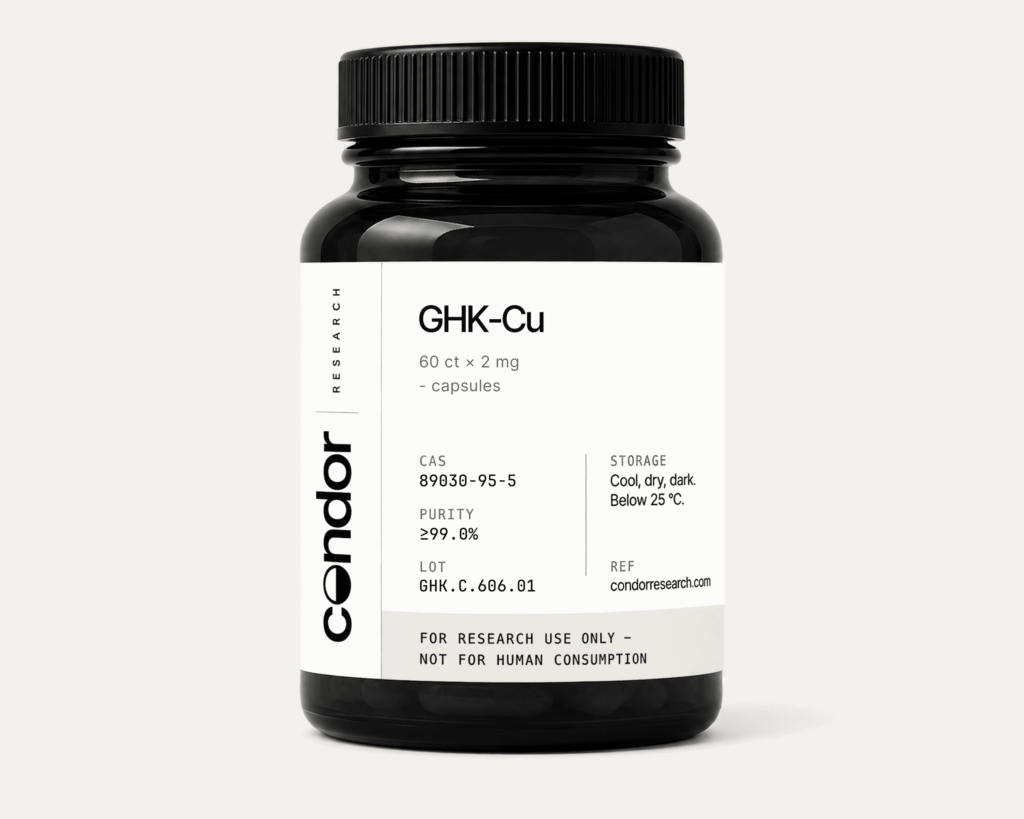
Specification & quality. Each bottle contains 60 HPMC (vegan) capsules, each providing 2mg of GHK-Cu at ≥98% (HPLC). Encapsulated — no reconstitution required. Every batch is independently third-party tested, and a Certificate of Analysis (COA) is available. Store at -20°C, protect from light and moisture; shelf life 24 months from the manufacture date. EU warehoused.
This product is intended for laboratory research use only (RUO). It is not a drug, food, cosmetic, or dietary supplement, and is not for human or veterinary use, ingestion, or diagnostic application. Handling is restricted to qualified research professionals operating in an appropriately equipped laboratory.
Supplied for in-vitro laboratory research use only (RUO). Not a drug, food or supplement; not for human or veterinary use.
Certificate of Analysis — lot-specific COA ships with every order and is available on request.
Each lot is tested by an independent third-party laboratory for identity (mass spectrometry) and purity (HPLC). The Certificate of Analysis for your specific batch ships with the order and is available on request — no house data, no exceptions.
References are illustrative of the research literature surrounding this compound. All claims relate to in-vitro and animal models only.
GHK-Cu is the tripeptide glycyl-L-histidyl-L-lysine (Gly-His-Lys) bound to copper(II), forming a defined blue copper-peptide complex. It is studied in cell and animal models for wound-repair, antioxidant and tissue-remodelling endpoints. Condor Research supplies it strictly as a Research Use Only reference compound for in vitro and animal studies, not for human or veterinary use.
The blue colour comes from the copper(II) ion coordinated by the histidine and lysine residues of the tripeptide — the metal is integral to the complex, not a contaminant. Structural studies have resolved exactly how GHK grips copper and how that geometry shapes its redox chemistry (Hureau et al., 2011). The product is therefore presented as a copper complex, and is supplied for laboratory research use only.
Both are copper(II) tripeptide complexes that appear as blue lyophilised powders. GHK-Cu (Gly-His-Lys) is most studied around wound-healing, antioxidant and dermal-remodelling endpoints, while AHK-Cu (Ala-His-Lys) swaps the N-terminal glycine for alanine and is more often examined in hair-follicle and angiogenesis models. They address different research questions despite sharing the His-Lys copper-binding motif. Both are supplied as research-use-only reference compounds.
GHK-Cu is a copper-bound tripeptide studied as a matrikine in skin-repair, antioxidant and remodelling models, where the copper ion is central to its activity. BPC-157 is a 15-residue gastric-derived peptide investigated mainly in soft-tissue and gastrointestinal injury paradigms and carries no metal. They belong to different structural classes and serve distinct experimental questions. Both are supplied strictly for research use only.
GHK-Cu is a copper-peptide complex studied in wound-repair and dermal models, whereas NMN is a small-molecule NAD+ precursor studied in metabolic and mitochondrial pathways. Interestingly, parts of the GHK literature touch ageing biology, with lifespan and mitochondrial-pathway effects reported in C. elegans (Wen et al., 2026) — a different mechanistic angle than NMN's NAD+ route. They are complementary research tools, each supplied for research use only.
Yes. Condor Research supplies GHK-Cu strictly as a Research Use Only reference compound to professionals and institutions, not as a medicine, supplement or product for human or veterinary use. Buyers are responsible for confirming import legality in their own country. Questions: info@condorresearch.com.
The capsule is a pre-weighed solid format that simplifies laboratory handling and inventory of a fixed quantity of the copper-peptide complex, with light- and moisture-sensitive material contained in an HPMC (vegan) shell. It is a measured solid format, not a dose, and does not imply consumption of any kind. For laboratory research use only. Not for human or veterinary use.
No. Unlike lyophilised vials, these are encapsulated — no reconstitution required. Each HPMC (vegan) capsule contains a fixed 2mg quantity of GHK-Cu in solid form for laboratory handling. This format is for research use only and is not intended for ingestion or human use.
Each bottle contains 60 HPMC (vegan) capsules, each providing 2mg of GHK-Cu at ≥98% (HPLC) purity. The capsules are independently third-party tested. The stated quantity refers to a pre-weighed laboratory reference format, not a human dose, and the material is for research use only.
Our GHK-Cu has CAS No. 89030-95-5, molecular formula C14H24N6O4·Cu (copper complex) and a molecular weight of 401.93 g/mol, with the sequence Gly-His-Lys · copper(II) complex. It is supplied as a blue lyophilised powder (copper complex), soluble in water. For laboratory research use only.
Yes. Every GHK-Cu batch is tested by an independent third-party laboratory by HPLC for identity and purity (≥98%), and each lot ships with a lot-specific Certificate of Analysis. To request the COA for your batch, contact info@condorresearch.com. For laboratory research use only. Not for human or veterinary use.
Condor Research supplies GHK-Cu Capsules directly, dispatched from our EU facility in Slovakia to the EU, EEA, UK and Switzerland. Deliveries to EU destinations clear no third-country customs, and shipping is calculated at checkout. Supplied strictly as a research-use-only reference material — not for human or veterinary use.
No verified reviews yet.
Leave a reviewCookies
We use strictly necessary cookies to run the store. With your consent we also use analytics (order attribution) and marketing (Omnisend) cookies. Read our Cookie Policy.