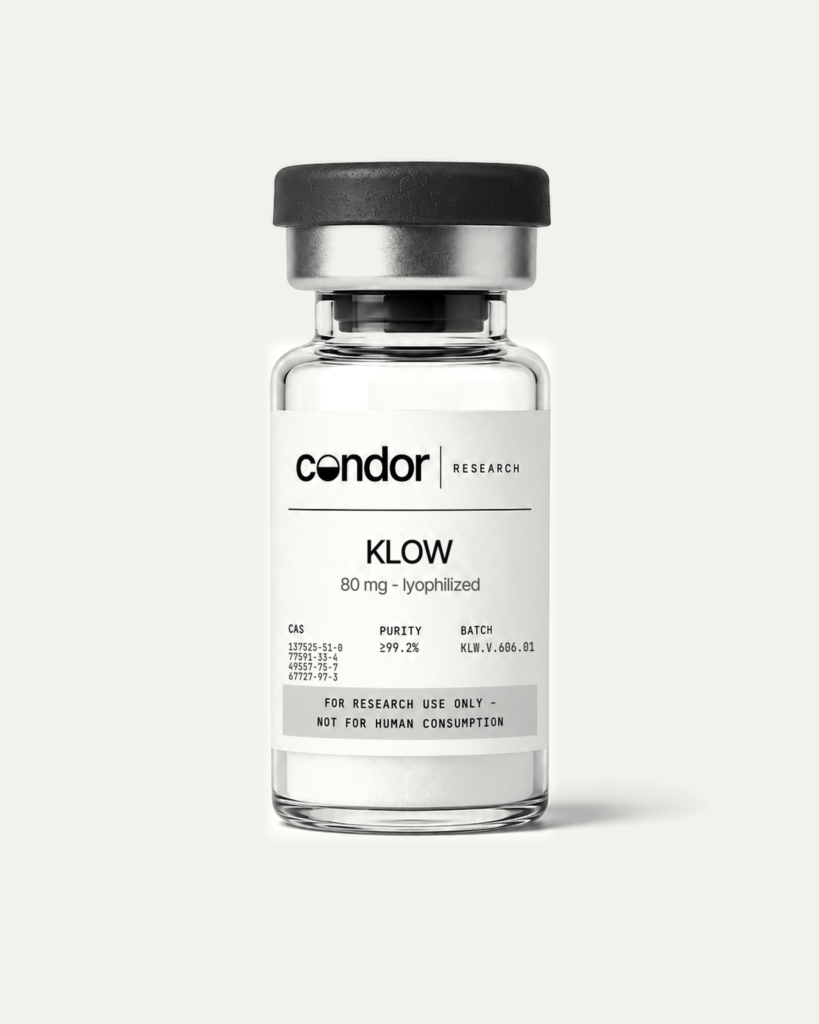
Lyophilised · ≥99% (HPLC) ·
Supplied lyophilised. Reconstitution typically uses bacteriostatic water.
KLOW is a four-peptide research blend supplying GHK-Cu 50 mg, BPC-157 10 mg, TB-500 10 mg and KPV 10 mg in a single vial, combining copper-tripeptide, cytoprotective, actin-binding and anti-inflammatory research peptides. Each component is supplied lyophilised at ≥99% purity by HPLC. For laboratory research use only.
An expanded four-peptide research formulation, KLOW brings together GHK-Cu (50 mg), BPC-157 (10 mg), TB-500 (10 mg) and KPV (10 mg) in a single lyophilized vial. It builds on the familiar three-peptide regenerative panel by adding KPV, a short anti-inflammatory tripeptide, giving researchers a combined reagent for studying tissue-repair and inflammatory signalling under one set of handling conditions. KLOW is a defined multi-component mixture rather than a single molecular entity.
Four peptides spanning repair and inflammation research. GHK-Cu is a copper-binding tripeptide originally identified in human plasma; BPC-157 is a synthetic pentadecapeptide based on a gastroprotective protein; TB-500 is the synthetic active fragment of the natural protein Thymosin β4; and KPV (Lys-Pro-Val) is the C-terminal tripeptide of α-melanocyte-stimulating hormone, widely studied for anti-inflammatory signalling. Together they assemble a broad investigational panel.
What the research explores. Each component has its own experimental record, confined to cellular and animal models:
These findings are derived solely from in‑vitro and animal research and do not support human conclusions. Full citations are listed under the Scientific References tab.
Composition. GHK-Cu 50 mg + BPC-157 10 mg + TB-500 10 mg + KPV 10 mg per vial · Appearance white lyophilized powder · Soluble in water. As a multi-component blend, single-molecule CAS, molecular formula and molecular weight values do not apply; refer to the individual component entries for those data.
Specification & quality. Each individually sealed vial contains the combined 80 mg peptide blend at ≥99% purity by HPLC per component. Every batch is third-party tested, with a Certificate of Analysis (COA) available. Store at −20 °C, protected from light and moisture.
This product is intended for laboratory research use only (RUO). It is not a drug, food, cosmetic, or dietary supplement, and is not for human or veterinary use, ingestion, or diagnostic application. Handling is restricted to qualified research professionals operating in an appropriately equipped laboratory.
Supplied for in-vitro laboratory research use only (RUO). Not a drug, food or supplement; not for human or veterinary use.
Certificate of Analysis — lot-specific COA ships with every order and is available on request.
Each lot is tested by an independent third-party laboratory for identity (mass spectrometry) and purity (HPLC). The Certificate of Analysis for your specific batch ships with the order and is available on request — no house data, no exceptions.
References are illustrative of the research literature surrounding this compound. All claims relate to in-vitro and animal models only.
KLOW is an expanded four-peptide research blend in a single lyophilized vial, combining GHK-Cu (50 mg), BPC-157 (10 mg), TB-500 (10 mg), and KPV (10 mg), for 80 mg total. "KLOW" is Condor Research's name for this co-formulation, not a single molecule. It is supplied strictly as a research-use-only reference material for in-vitro laboratory study.
KLOW is GLOW plus a fourth peptide. Both share GHK-Cu (50 mg), BPC-157 (10 mg), and TB-500 (10 mg); KLOW adds KPV (10 mg), making it 80 mg total versus GLOW's 70 mg. Choose KLOW when KPV is part of your research model and GLOW when the three-peptide base suffices. Both are research-use-only co-formulated blends.
KLOW extends the GLOW base (GHK-Cu, BPC-157, TB-500) with KPV, the short tripeptide Lys-Pro-Val derived from the α-MSH C-terminus and studied in tissue and immune-related research. Adding it gives researchers a four-component reference in one vial. The combination is offered for laboratory study only, with no implied human, therapeutic, or wellness application.
The BPC-157 + TB-500 blend contains two repair peptides (10 mg + 10 mg). KLOW is far broader: it adds GHK-Cu (50 mg) and KPV (10 mg) to the same BPC-157 and TB-500, forming a four-component, 80 mg co-formulation. The two differ substantially in composition. Both are supplied as research-use-only reference blends for in-vitro study.
Yes. Each KLOW lot is tested by an independent third-party laboratory, with purity assessed per component (≥99% by HPLC for each peptide) and identity confirmed by mass spectrometry, then shipped against a batch-specific Certificate of Analysis (COA) covering GHK-Cu, BPC-157, TB-500, and KPV. To review the COA before ordering, contact info@condorresearch.com.
Purity is assessed per component, so each of KLOW's four peptides — GHK-Cu, BPC-157, TB-500, and KPV — is held to the ≥99% HPLC standard individually, because one blanket figure cannot describe a four-component blend. Independent third-party testing documents identity and purity on the lot's Certificate of Analysis. KLOW is a research-use-only reference material.
For analytical laboratory preparation only, all four components are water-soluble and reconstitute together with a sterile aqueous diluent; the volume chosen sets each peptide's concentration. To get a component's mg/mL, divide its mass (GHK-Cu 50, BPC-157 10, TB-500 10, KPV 10 mg) by the diluent volume. This is laboratory handling information, not human-use guidance.
Yes — for laboratory preparation only, KLOW reconstitutes the same way as GLOW with a sterile aqueous diluent, since KPV is also water-soluble and dissolves alongside the other three peptides. The added component does not change the basic technique. Store the sealed vial at -20°C, protected from light. This describes in-vitro handling, not any human or animal use.
Yes, a blue tint is expected and normal. GHK-Cu is a copper(II) tripeptide complex whose characteristic blue color carries into a reconstituted KLOW solution. This reflects the copper complex, not contamination or degradation of the blend. KLOW is supplied as a research-use-only reference material; this note describes laboratory appearance only, not any non-research use.
KLOW differs from GLOW only by the added KPV (10 mg), bringing it to 80 mg total across four peptides. Whether that addition is worthwhile depends on whether KPV is part of your research model. Because final prices are set at checkout, request a current GLOW-versus-KLOW price comparison from info@condorresearch.com. Both are research-use-only materials.
KLOW supplies all four peptides (50/10/10/10 mg, 80 mg total) co-formulated in one vial, which differs from purchasing four standalone vials in both convenience and pricing. Since prices are finalized at checkout, request a current per-mg and bundle comparison from info@condorresearch.com. All formats are research-use-only reference materials.
Condor Research supplies KLOW (GHK-Cu + BPC-157 + TB-500 + KPV) directly, dispatched from our EU facility in Slovakia to the EU, EEA, UK and Switzerland. Deliveries to EU destinations clear no third-country customs, and shipping is calculated at checkout. Supplied strictly as a research-use-only reference material — not for human or veterinary use.
No verified reviews yet.
Leave a reviewCookies
We use strictly necessary cookies to run the store. With your consent we also use analytics (order attribution) and marketing (Omnisend) cookies. Read our Cookie Policy.