
What Is TB-500? The Lab-Made Version of a Natural Repair Peptide
TB-500 is a synthetic version of thymosin β4, a 43-residue protein that helps build and rebuild tissue across the body. Here is what the preclinical research actually shows — and where the human evidence runs thin.
TB-500 is a synthetic peptide corresponding to thymosin β4, a naturally occurring 43-residue actin-binding protein expressed across many human tissues. It is studied in vitro and in animal models of wound healing and tissue repair, and is supplied strictly for research use only — not as a medicine.
Inside almost every cell in your body sits a small, busy protein you have probably never heard of. It is called thymosin β4, and at just 43 amino acids it is widely expressed across human tissue — a molecular handyman that grabs hold of actin, the protein scaffolding that lets cells crawl, divide and rebuild themselves after injury5. During development it lights up across organ after organ, from the heart to the kidney to the brain2. TB-500 is the laboratory’s attempt to reproduce that natural peptide cleanly enough that it can actually be studied.
Where does TB-500 come from?
To understand TB-500 you have to start with its parent. Thymosin β4 (often written Tβ4) is a naturally occurring, water-soluble peptide expressed throughout the body. Its headline job is to bind monomeric actin, acting as a reservoir that the cell draws on whenever it needs to remodel its internal skeleton — the process underlying cell migration, the very first physical step of closing a wound5. A 2024 review in Cells mapped how Tβ4 and its sibling β10 appear across human organs during development, a distribution that hints at just how deeply the peptide is woven into how tissue is built in the first place2.
Thymosin β4 is just 43 amino acids long — a compact peptide, yet one expressed across organ after organ during human development.
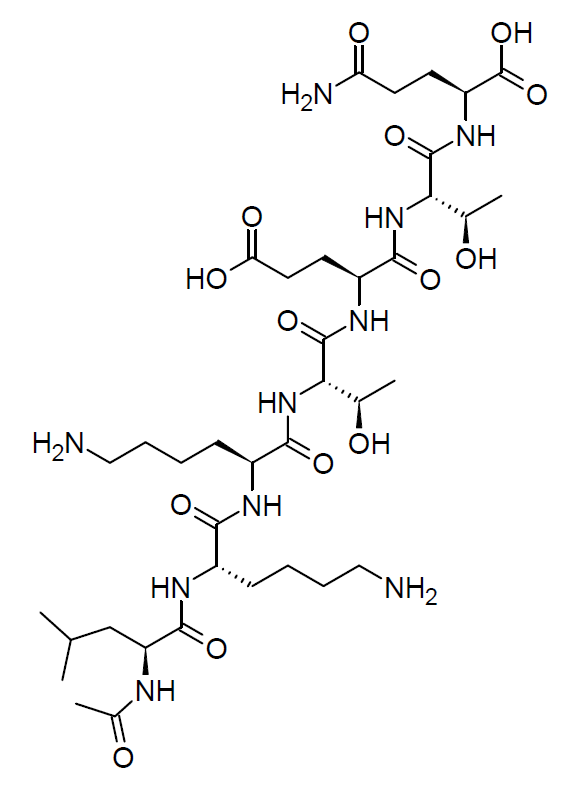
TB-500 is the synthetic, research-grade version of this molecule: the same 43-residue, acetylated sequence as the natural peptide, reproduced so it can be handled, characterised and tested in a laboratory. The point of making it is simple — a clean, defined molecule is something you can study reproducibly, in a way that messy biology rarely allows. (As a supplier note, this material is catalogued under CAS 77591-33-4 with the molecular formula C212H350N56O78S and verified to ≥99% purity by HPLC; these are house specifications for the product, not figures drawn from the research literature below.)
What does the research actually study?
What makes Tβ4 unusual is the sheer breadth of biology it touches — less a single mechanism than a recurring theme of cells on the move. The most intuitive thread is wound healing. Researchers have studied Tβ4 in corneal repair, where an engineered tandem thymosin peptide promoted healing of the eye’s surface in experimental models13, and in defending the cornea against Pseudomonas infection by shaping neutrophil behaviour6. For skin, a 2026 study loaded Tβ4 into dissolvable microneedles as a delivery platform for wound repair7.
A second thread runs through the cardiovascular system. A 2025 paper in Cardiovascular Research reported that recombinant Tβ4 improved ischemic cardiac dysfunction in mice10, and separate work showed it could stabilise the fragile microvascular endothelium of the brain under low-oxygen stress, acting through the S1PR1 signalling pathway11. The peptide even surfaces in paediatric cardiology: a 2025 study examined Tβ4 in relation to coronary artery lesions in children with Kawasaki disease15.
From there the map only widens. Tβ4 has emerged as a candidate of interest in kidney disease, with a 2026 review framing it as exactly that1 and earlier work focusing on the glomerulus — the kidney’s filtration unit — in health and disease3. In the brain, Tβ4-derived peptides reduced neuroinflammation and neurite atrophy in 5xFAD Alzheimer-model mice9, while a 2025 study used human brain organoids to probe Tβ4 as an Alzheimer’s target14. The peptide also turns up in cancer biology, where one study examined how a Tβ4-linked pathway influences p53/AKT signalling in medulloblastoma4. Chemists, meanwhile, have been working out how the peptide coordinates zinc — a structural detail that may shape its function8. The biology is not uniformly flattering, either: one 2025 model found Tβ4 could impair the intestinal barrier in an irritable bowel context12, a useful reminder that a repair signal is not automatically benign.
BPC-157 vs TB-500: what is the difference?
In research forums and protocols, TB-500 is almost never discussed alone. It is paired with BPC-157 as a kind of ‘repair duo’. The pairing is real in practice but can blur an important fact: these two molecules come from completely different places and are studied around different organising ideas. The table below lays out the contrast at a glance.
| TB-500 | BPC-157 | |
|---|---|---|
| Origin / parent | Synthetic version of thymosin β4, a natural 43-residue actin-binding peptide | Synthetic peptide derived from a sequence linked to a gastric protective protein |
| Core mechanism studied | Actin binding and cell migration — the physical movement of cells | Angiogenesis and tissue protection pathways |
| Main research themes | Corneal/skin wound healing, cardiac and vascular repair, renal, neuro | Tendon, ligament, gut and soft-tissue repair models |
| Evidence base | Overwhelmingly in vitro / animal; one human STEMI cohort reported | Largely animal models; limited human data |
The two most-discussed ‘repair’ peptides share a goal but not a lineage — different parents, different mechanisms, the same preclinical caveats.
How strong is the human evidence, honestly?
Here is where intellectual honesty matters more than enthusiasm. The body of work on Tβ4 is genuinely large, but it is also overwhelmingly preclinical — cell culture, organoids, and animal models. The corneal studies are in experimental systems613. The Alzheimer’s work is in mice and human-derived organoids, not patients914. The kidney literature is reviews and mechanistic models13. Even the striking microvascular and intestinal findings sit firmly in the laboratory1112.
The closest thing to a human signal in this reference set is the 2025 Cardiovascular Research study, which reported on a cohort of STEMI (heart attack) patients alongside its mouse experiments10. That is notable — and it is also a single study within a field that remains dominated by animal and in vitro work. One cohort does not make a treatment. The Kawasaki disease work, similarly, is observational research into how Tβ4 levels relate to coronary lesions in children, not evidence that anyone should administer the peptide15. The candid summary is this: the mechanistic story is rich, the human story is thin. As a separate regulatory matter — and not a finding from the scientific literature above — it is also worth knowing that Tβ4 and its derivatives appear on the World Anti-Doping Agency (WADA) Prohibited List, and are therefore banned in competitive sport.
Why does verified purity matter for research use only?
Everything above is the reason TB-500 exists as a research material and nothing more. It is not a medicine, not approved for human or veterinary use, and not something this writing endorses for consumption in any form. Its value is as a defined, characterisable molecule that lets scientists ask precise questions about cell migration and tissue repair — the kind of questions the Tβ4 literature keeps raising5.
That framing also explains why purity is not a marketing flourish but the whole point. A peptide of 43 residues can carry truncated sequences, deletions or contaminants that quietly corrupt an experiment. Verification by HPLC and mass spectrometry, confirmed by a per-batch certificate of analysis, is what separates a usable research reagent from an unknown. If you want to understand what a peptide actually does, you first have to be certain of what is in the vial. For research use only.
- TB-500 corresponds to thymosin β4 (Tβ4), a natural 43-residue actin-binding peptide the body expresses across many organs during development.
- Research themes span an unusually broad map: corneal and skin wound healing, cardiac and vascular repair, kidney glomerular biology, and neuroinflammation.
- It is frequently paired with BPC-157 in ‘repair peptide’ discussions, but the two have completely different origins — one a developmental actin-binding protein, the other a gastric-derived sequence.
- The evidence is overwhelmingly in vitro and in animal models; one 2025 study reports a human STEMI cohort, but the field remains preclinical-dominated.
- As a regulatory note, Tβ4 and its derivatives appear on the WADA Prohibited List; TB-500 is supplied for research use only, never for human or veterinary use.
What is TB-500?
TB-500 is a synthetic, research-grade version of thymosin β4, a naturally occurring 43-residue actin-binding protein expressed across many human tissues. It is studied in vitro and in animal models of cell migration and tissue repair, and is supplied strictly for research use only — not as a medicine.
Is TB-500 the same as thymosin beta-4?
In sequence, yes — TB-500 corresponds to the 43-residue, acetylated thymosin β4 that the body expresses across many organs. The difference is provenance: TB-500 is the synthetic, laboratory-made form, reproduced cleanly so it can be characterised and studied as a defined research reagent.
What is the difference between BPC-157 and TB-500?
They share a ‘repair’ reputation but have different origins. TB-500 corresponds to the natural peptide thymosin β4 and is studied around actin binding and cell migration; BPC-157 is a separate synthetic sequence studied around angiogenesis and tissue protection. Both are dominated by preclinical, animal-model evidence.
Is there human evidence for TB-500?
The evidence base is overwhelmingly in vitro and animal. One 2025 Cardiovascular Research study reported on a STEMI patient cohort alongside mouse work, but the field remains preclinical-dominated. There is no basis here for therapeutic claims, and TB-500 is not approved for human or veterinary use.
Is TB-500 banned in sport?
Yes. As a regulatory matter, thymosin β4 and its derivatives, including TB-500, appear on the WADA Prohibited List and are banned in competitive sport. This is stated as a fact, not as advice; the material is sold for research use only.