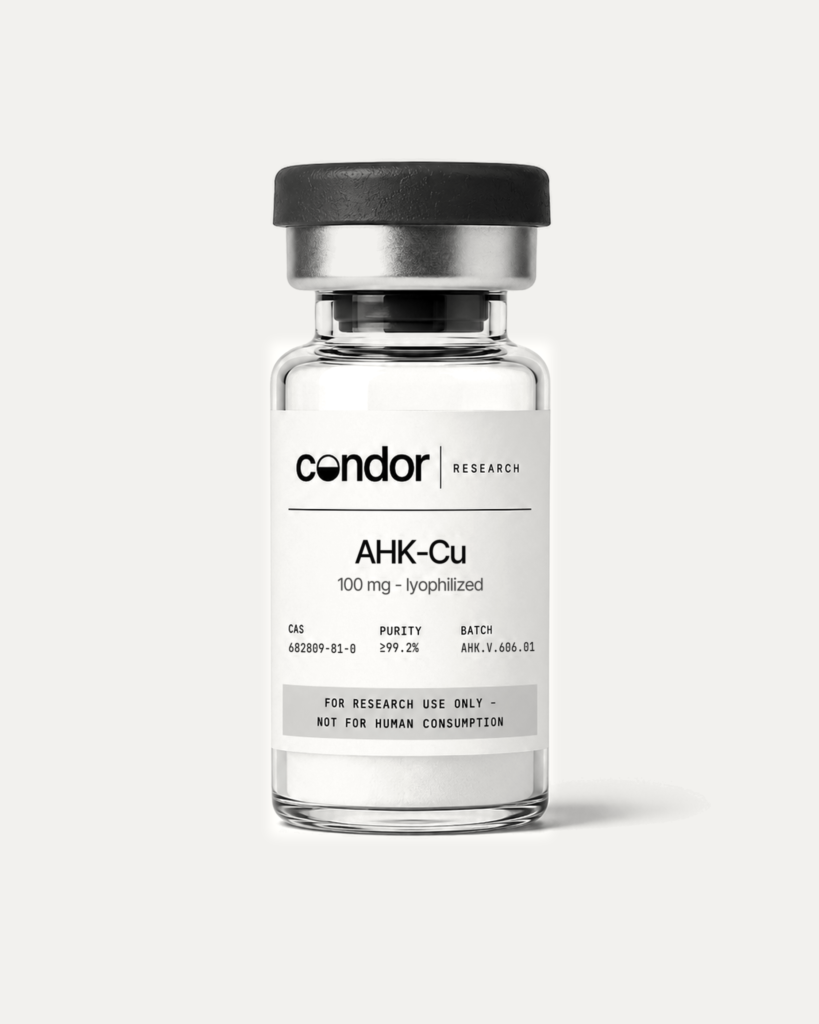
Lyophilised · ≥99% (HPLC) ·
Supplied lyophilised. Reconstitution typically uses bacteriostatic water.
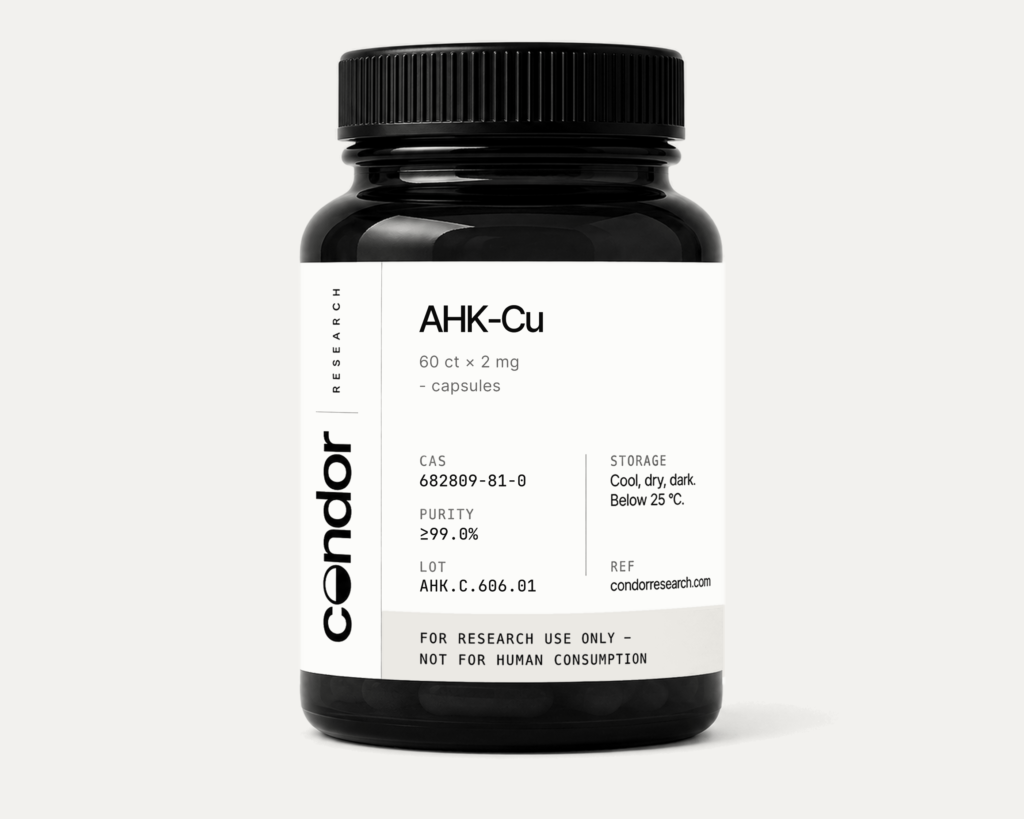
AHK-Cu (Ala-His-Lys copper complex) is a tripeptide-copper(II) chelate studied in vitro for its role in angiogenesis, wound-healing signalling, and extracellular-matrix remodelling. Sequence Ala-His-Lys; free tripeptide CAS 126828-32-8; molecular weight 354.41 g/mol (free tripeptide, C₁₅H₂₆N₆O₄); supplied lyophilised at HPLC ≥99% purity. For laboratory research use only; not for human or veterinary use.
Copper is essential to life but dangerous when loose, so the body carries it on small peptide carriers — and chemists have learned to copy them. AHK-Cu is a synthetic copper-binding tripeptide, alanyl-histidyl-lysine complexed with a copper(II) ion, presented as a characteristic blue lyophilized powder. As a member of the histidine-containing copper-peptide family, it serves as a model system for studying copper coordination chemistry and copper-dependent cellular signaling.
A peptide built around a metal. The histidine imidazole, the N-terminal amine, and the peptide backbone create a coordination geometry well suited to chelating Cu(II), echoing the canonical Xxx-His copper-binding motifs found in serum and matrix peptides. Structural and thermodynamic studies of closely related GHK and DAHK copper complexes have mapped how such tripeptides bind copper and modulate its redox behavior (Hureau et al., 2011; Trapaidze et al., 2012), providing the chemical backdrop against which AHK-Cu is investigated.
What the research explores. Work on AHK and related copper peptides spans several directions:
These findings come from in vitro and biochemical research describing coordination chemistry and cellular activity; they do not establish human safety or efficacy. Full citations are listed under the Scientific References tab.
Physicochemical profile. CAS 682809-81-0 · Molecular formula C₁₅H₂₄ClCuN₆O₄ · Molecular weight 451.39 g/mol · Sequence Ala-His-Lys (Cu²⁺) · Appearance: blue lyophilized powder · Soluble in water.
Specification & quality. Each individually sealed vial contains 100 mg of AHK-Cu as a blue lyophilized powder at ≥99% purity by HPLC. Every batch is third-party tested, with a Certificate of Analysis (COA) available. Store at −20 °C, protected from light and moisture.
This product is intended for laboratory research use only (RUO). It is not a drug, food, cosmetic, or dietary supplement, and is not for human or veterinary use, ingestion, or diagnostic application. Handling is restricted to qualified research professionals operating in an appropriately equipped laboratory.
Supplied for in-vitro laboratory research use only (RUO). Not a drug, food or supplement; not for human or veterinary use.
Certificate of Analysis — lot-specific COA ships with every order and is available on request.
Each lot is tested by an independent third-party laboratory for identity (mass spectrometry) and purity (HPLC). The Certificate of Analysis for your specific batch ships with the order and is available on request — no house data, no exceptions.
References are illustrative of the research literature surrounding this compound. All claims relate to in-vitro and animal models only.
AHK-Cu is a synthetic copper-binding tripeptide — alanyl-histidyl-lysine complexed with copper(II) — studied in skin, hair, and tissue-regeneration research. The bound copper gives the lyophilized powder its characteristic blue color. Condor Research supplies it as a 100 mg vial at ≥99% HPLC purity, strictly for in-vitro laboratory research use only.
Both are copper(II)-binding tripeptides, but they differ in their first residue: AHK-Cu is alanyl-histidyl-lysine, while GHK-Cu is glycyl-histidyl-lysine. GHK-Cu is the more extensively studied of the two, particularly in skin-regeneration research, whereas AHK-Cu is often investigated in hair and pigmentation contexts. Condor Research offers each as a separate ≥99% HPLC, research-use-only reference compound.
GHK-Cu is the more extensively characterized copper tripeptide, with a long research history in skin and tissue regeneration. AHK-Cu, differing by a single N-terminal residue (alanine instead of glycine), has a narrower but distinct literature, frequently in hair and pigmentation research. Both are supplied as separate ≥99% HPLC, research-use-only reference materials, each with a batch COA.
AHK-Cu is offered as a 100 mg vial and GHK-Cu as a 50 mg vial, reflecting their separate catalog formats; the stated masses are analytical reference quantities, not doses. To compare value on a per-mg basis, or for current pricing on either copper peptide, contact info@condorresearch.com. Both are ≥99% HPLC research-use-only reference materials.
AHK-Cu (alanyl-histidyl-lysine-copper) is often investigated in hair-focused regeneration research, while GHK-Cu (glycyl-histidyl-lysine-copper) is more associated with skin-regeneration literature. The single-residue difference shifts their research emphasis despite both being copper(II) tripeptides. Researchers select by target pathway. Condor Research supplies both as distinct ≥99% HPLC, research-use-only reference compounds.
They are not interchangeable. Although both are copper(II)-binding tripeptides, the N-terminal difference (alanine in AHK-Cu, glycine in GHK-Cu) gives each a distinct research profile and literature base. They should be treated as separate reference compounds rather than substitutes. Both are offered as ≥99% HPLC, research-use-only materials for in-vitro laboratory study only.
Each AHK-Cu lot (CAS 682809-81-0) is tested by an independent third-party laboratory by HPLC for identity and purity, with mass spectrometry confirmation, and ships against a batch-specific Certificate of Analysis verifying ≥99% purity. For specifics on how copper loading is documented for the current lot, request the COA at info@condorresearch.com.
Yes. AHK-Cu is supplied strictly for laboratory research use only (in vitro). It is not a medicine, food, supplement, cosmetic, or medical device, and is not for human or veterinary use, administration, or consumption. Condor Research provides no dosing, protocols, or human-use guidance. Purchase is limited to qualified professionals and institutions aged 18 or over.
Yes. The blue color comes from the copper(II) ion bound within the AHK tripeptide and is an expected feature of the complex, not a sign of contamination. For analytical laboratory preparation only, AHK-Cu is water-soluble and the diluent volume you choose sets the working concentration. This is laboratory handling information, not human-use guidance.
Store the sealed lyophilized AHK-Cu vial at -20°C, protected from light, with a 24-month shelf life from manufacture. As a copper(II) complex it is light-sensitive like other copper peptides; standard sterile aqueous diluent is suitable for analytical preparation. This is laboratory handling information only and does not apply to any human or animal use.
Condor Research supplies AHK-Cu directly, dispatched from our EU facility in Slovakia to the EU, EEA, UK and Switzerland. Deliveries to EU destinations clear no third-country customs, and shipping is calculated at checkout. Supplied strictly as a research-use-only reference material — not for human or veterinary use.
No verified reviews yet.
Leave a reviewCookies
We use strictly necessary cookies to run the store. With your consent we also use analytics (order attribution) and marketing (Omnisend) cookies. Read our Cookie Policy.