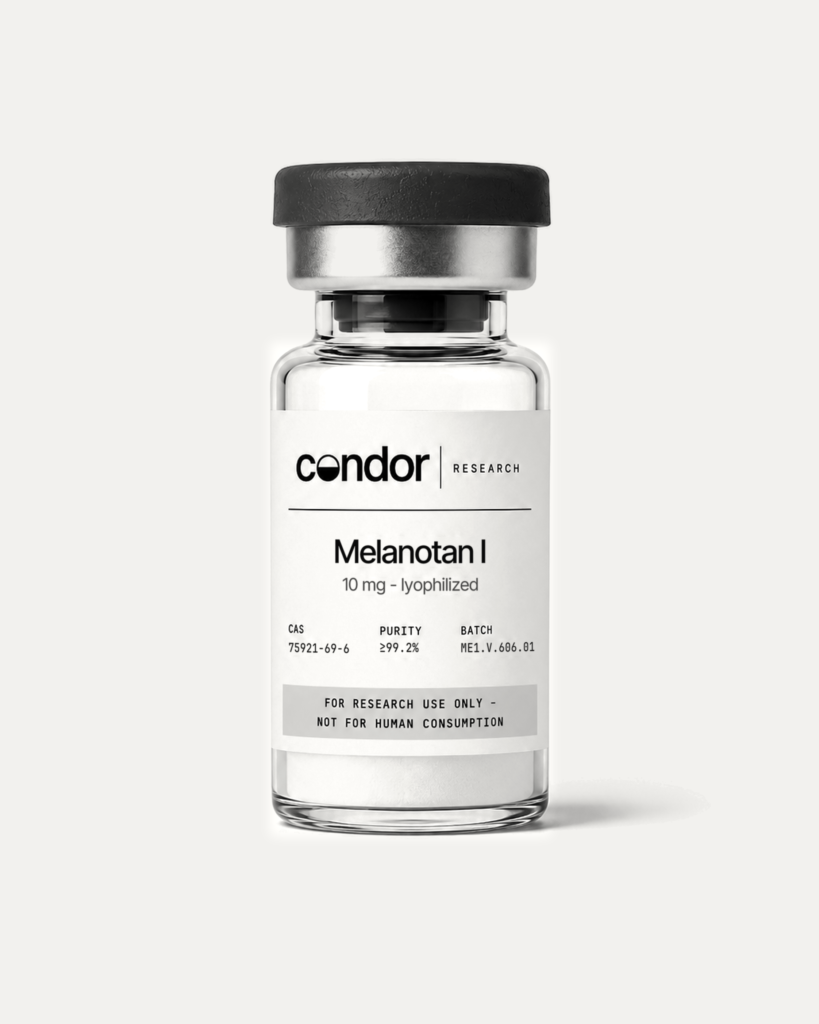
Lyophilised · ≥99% (HPLC) ·
Supplied lyophilised. Reconstitution typically uses bacteriostatic water.
Melanotan I (Afamelanotide) is a synthetic tridecapeptide analogue of α-melanocyte-stimulating hormone (α-MSH), with the sequence Ac-Ser-Tyr-Ser-Nle-Glu-His-D-Phe-Arg-Trp-Gly-Lys-Pro-Val-NH₂; CAS 75921-69-6; molecular weight 1646.87 g/mol; supplied lyophilised at ≥99% purity by HPLC. A potent, long-acting MC1R agonist studied in photoprotection, melanogenesis and pigmentation models. For laboratory research use only; not for human or veterinary use.
The pigment system that protects skin from light is governed by a single hormone — and a synthetic analog of it has become one of the best-characterized melanocortin peptides in research. Melanotan I, known generically as afamelanotide, is a synthetic 13-amino-acid analog of α-melanocyte-stimulating hormone (α-MSH), formally [Nle⁴,D-Phe⁷]-α-MSH. Substituting two residues in the native sequence yields a more stable, longer-acting agonist of the melanocortin-1 receptor (MC1R), making it a valuable tool for studying pigmentation and photoprotection biology.
A more durable version of a natural signal. Native α-MSH is rapidly degraded, limiting its experimental utility. The norleucine-4 and D-phenylalanine-7 substitutions in afamelanotide confer resistance to enzymatic breakdown and enhanced receptor affinity, prolonging MC1R activation and the downstream synthesis of eumelanin (Minder et al., 2017). This pharmacology has positioned afamelanotide as a reference compound in melanocortin research and as the subject of sustained clinical investigation.
What the research explores. The literature concentrates on pigmentation and photoprotective endpoints:
These findings derive from clinical, observational, and laboratory research describing biological activity; they are presented for scientific context and do not constitute human use guidance from this listing. Full citations are listed under the Scientific References tab.
Physicochemical profile. CAS 75921-69-6 · Molecular formula C₇₈H₁₁₁N₂₁O₁₉ · Molecular weight 1646.8 g/mol · Sequence Ac-Ser-Tyr-Ser-Nle-Glu-His-D-Phe-Arg-Trp-Gly-Lys-Pro-Val-NH₂ · Appearance: white lyophilized powder · Soluble in water.
Specification & quality. Each individually sealed vial contains 10 mg of Melanotan I (afamelanotide) as a white lyophilized powder at ≥99% purity by HPLC. Every batch is third-party tested, with a Certificate of Analysis (COA) available. Store at −20 °C, protected from light and moisture.
This product is intended for laboratory research use only (RUO). It is not a drug, food, cosmetic, or dietary supplement, and is not for human or veterinary use, ingestion, or diagnostic application. Handling is restricted to qualified research professionals operating in an appropriately equipped laboratory.
Supplied for in-vitro laboratory research use only (RUO). Not a drug, food or supplement; not for human or veterinary use.
Certificate of Analysis — lot-specific COA ships with every order and is available on request.
Each lot is tested by an independent third-party laboratory for identity (mass spectrometry) and purity (HPLC). The Certificate of Analysis for your specific batch ships with the order and is available on request — no house data, no exceptions.
References are illustrative of the research literature surrounding this compound. All claims relate to in-vitro and animal models only.
Melanotan I, also called Afamelanotide, is a synthetic linear 13-amino-acid analogue of α-melanocyte-stimulating hormone — [Nle4,D-Phe7]-α-MSH (Ac-Ser-Tyr-Ser-Nle-Glu-His-D-Phe-Arg-Trp-Gly-Lys-Pro-Val-NH2). It is one of the best-characterized melanocortin peptides in pigmentation research. Condor Research supplies it as a 10 mg lyophilized vial at ≥99% HPLC purity, for in-vitro laboratory use only.
They are distinct molecules. Melanotan I (Afamelanotide) is a linear 13-residue α-MSH analogue, while Melanotan II is a smaller cyclic heptapeptide. Melanotan I more closely resembles native α-MSH and is studied as a more receptor-faithful pigmentation tool, whereas Melanotan II is a non-selective melanocortin agonist. Condor Research offers each as a separate ≥99% HPLC, research-use-only reference compound.
Melanotan I is a linear 13-amino-acid peptide built on the α-MSH backbone, whereas Melanotan II is a constrained cyclic heptapeptide. The cyclization in Melanotan II broadens its melanocortin-receptor activity, while Melanotan I's linear structure stays closer to the natural hormone. Researchers choose between them by receptor profile. Both are research-use-only reference materials, never for human use.
Melanotan I is a linear α-MSH analogue studied in skin and pigmentation research, while PT-141 (Bremelanotide) is a cyclic heptapeptide melanocortin analogue investigated in different research contexts. Both belong to the melanocortin family but differ in structure and receptor emphasis. Condor Research supplies each as a separate ≥99% HPLC, research-use-only reference compound with its own batch COA.
Melanotan I (Afamelanotide) is selected when a research model calls for a linear α-MSH analogue that stays close to the native hormone's structure, rather than the broader, non-selective activity of cyclic Melanotan II. The choice depends entirely on the receptor profile required by your in-vitro study. Both remain research-use-only reference materials with no human application.
Melanotan I is a full 13-residue α-MSH analogue spanning the hormone's active core, while KPV is just the three C-terminal residues (Lys-Pro-Val) of α-MSH, studied mainly for anti-inflammatory research rather than pigmentation. One models the broad melanocortin signal; the other an isolated fragment. Both are offered as separate ≥99% HPLC, research-use-only reference compounds.
Yes. Melanotan I is supplied strictly for laboratory research use only (in vitro). It is not a medicine, food, supplement, cosmetic, or medical device, and is not for human or veterinary use, administration, or consumption. Condor Research provides no dosing, protocols, or human-use guidance. Purchase is limited to qualified professionals and institutions aged 18 or over.
Yes. Each lot is verified as Melanotan I (Afamelanotide), CAS 75921-69-6, by an independent third-party laboratory using HPLC for purity and mass spectrometry for identity, distinguishing it clearly from the cyclic Melanotan II. It ships against a batch-specific Certificate of Analysis confirming ≥99% purity, available on request at info@condorresearch.com.
Condor Research ships from the EU with sanctions and export screening before dispatch, and does not ship to restricted territories. Whether a specific compound can be imported into your country is your responsibility to verify, and some destinations may have product-specific restrictions. For confirmation on your destination, contact info@condorresearch.com before ordering.
For analytical laboratory preparation only, Melanotan I is water-soluble and can be reconstituted with a sterile aqueous diluent; the chosen volume sets the working concentration. As a melanocortin peptide, store the sealed lyophilized vial at -20°C, protected from light, with a 24-month shelf life. This is laboratory handling information, not guidance for any human or animal use.
Condor Research supplies Melanotan I (Afamelanotide) directly, dispatched from our EU facility in Slovakia to the EU, EEA, UK and Switzerland. Deliveries to EU destinations clear no third-country customs, and shipping is calculated at checkout. Supplied strictly as a research-use-only reference material — not for human or veterinary use.
No verified reviews yet.
Leave a reviewCookies
We use strictly necessary cookies to run the store. With your consent we also use analytics (order attribution) and marketing (Omnisend) cookies. Read our Cookie Policy.