Lyophilised · ≥99% (HPLC) ·
Supplied lyophilised. Reconstitution typically uses bacteriostatic water.
KPV is a synthetic C-terminal tripeptide fragment of alpha-melanocyte-stimulating hormone (α-MSH), with the sequence Lys-Pro-Val; CAS 67727-97-3; molecular formula C16H30N4O4; molecular weight 342.43 g/mol. It is studied for its anti-inflammatory and cytoprotective properties, including interaction with melanocortin receptors and modulation of NF-κB signalling in cellular research models. For laboratory research use only; not for human or veterinary use.
Sometimes the most interesting fragment of a hormone is its final three letters. KPV is the C-terminal tripeptide — lysine-proline-valine — of α-melanocyte-stimulating hormone (α-MSH), the smallest piece of that molecule still carrying much of its anti-inflammatory character. Stripped of the pigmentation-driving portion of α-MSH, KPV has become a focal reference compound for laboratories dissecting how melanocortin signalling dampens inflammation.
An anti-inflammatory tripeptide beyond the pharmacophore. KPV belongs to a family of α-MSH-related tripeptides whose anti-inflammatory and protective effects have been characterised across in-vitro and in-vivo systems, often acting independently of classical melanocortin-receptor pigmentation pathways (Brzoska et al., 2008; Brzoska et al., 2010). This separation of activity from pigmentation is exactly what makes the tripeptide attractive as a clean research tool.
Within the melanocortin literature, the system has been mapped specifically onto inflammatory-bowel-disease mechanisms, positioning KPV-type peptides as probes for mucosal inflammation research (Gravina et al., 2023).
What the research explores. Across cell-culture and animal systems, KPV has been investigated along several converging lines:
The activity described here is drawn from in-vitro and animal studies; it characterises biological behaviour in experimental models and does not establish efficacy or safety in humans. Full citations are listed under the Scientific References tab.
Physicochemical profile. CAS No. 67727-97-3 · Molecular formula C16H30N4O4 · Molecular weight 342.43 g/mol · Sequence Lys-Pro-Val (3 aa) · Appearance: White lyophilized powder · Solubility: Soluble in water.
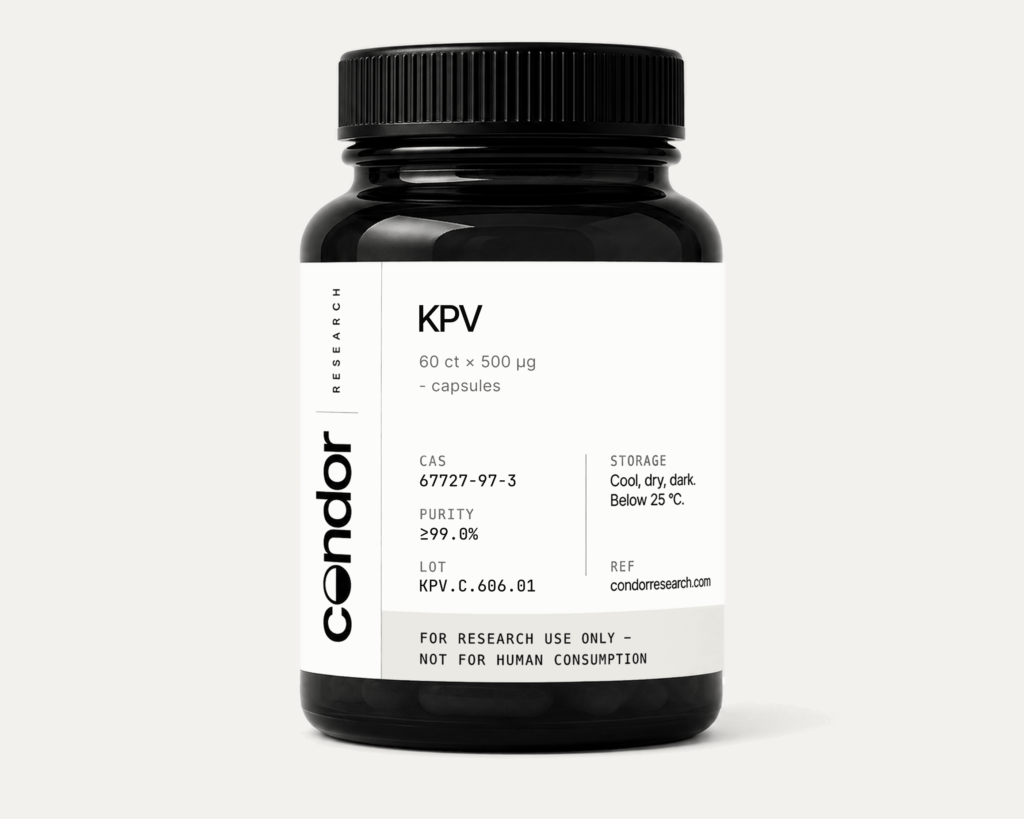
Specification & quality. Each bottle contains 60 HPMC (vegan) capsules, each providing 500mcg of KPV at ≥99% (HPLC). Encapsulated — no reconstitution required. Every batch is independently third-party tested, and a Certificate of Analysis (COA) is available. Store at -20°C, protect from light and moisture; shelf life 24 months from the manufacture date. EU warehoused.
This product is intended for laboratory research use only (RUO). It is not a drug, food, cosmetic, or dietary supplement, and is not for human or veterinary use, ingestion, or diagnostic application. Handling is restricted to qualified research professionals operating in an appropriately equipped laboratory.
Supplied for in-vitro laboratory research use only (RUO). Not a drug, food or supplement; not for human or veterinary use.
Certificate of Analysis — lot-specific COA ships with every order and is available on request.
Each lot is tested by an independent third-party laboratory for identity (mass spectrometry) and purity (HPLC). The Certificate of Analysis for your specific batch ships with the order and is available on request — no house data, no exceptions.
References are illustrative of the research literature surrounding this compound. All claims relate to in-vitro and animal models only.
KPV is the C-terminal tripeptide (lysine-proline-valine) of α-melanocyte-stimulating hormone, studied for anti-inflammatory signalling in intestinal and dermal models that appears largely independent of pigmentation pathways (Brzoska et al., 2008). Its small size and retained activity make it a clean research probe for melanocortin biology. Condor Research supplies it strictly as a Research Use Only reference compound for in vitro and animal studies, not for human or veterinary use.
KPV is a 3-residue melanocortin-derived tripeptide studied chiefly for anti-inflammatory signalling in intestinal and dermal models, whereas BPC-157 is a 15-residue gastric pentadecapeptide studied for cytoprotection and the nitric-oxide system. They probe different mechanisms within the broader question of mucosal and tissue response. Both are supplied strictly as research-use-only reference compounds, not for human or veterinary use.
α-MSH is the full melanocortin peptide that drives both pigmentation and immune signalling, while KPV is just its C-terminal tripeptide, which retains much of the anti-inflammatory character without the pigmentation pharmacophore (Brzoska et al., 2010). That separation makes KPV a cleaner tool for isolating anti-inflammatory mechanisms in research. Both are handled only as Research Use Only reference materials, not for human or veterinary use.
KPV is a melanocortin-derived tripeptide studied for anti-inflammatory signalling, while TB-500 is a 43-residue thymosin β-4 fragment studied for actin regulation and cell migration. They address different stages of the tissue-response question — inflammatory tone versus structural remodelling. Each is supplied solely as a Research Use Only reference compound, not for human or veterinary use.
Yes. Condor Research supplies KPV strictly as a Research Use Only reference compound to professionals and institutions, not as a medicine, supplement or product for human or veterinary use. Buyers are responsible for confirming import legality in their own country. Questions: info@condorresearch.com.
The capsule is a pre-weighed solid format: 500mcg of KPV sealed in an HPMC (vegan) shell so each unit holds a precise, handling-ready quantity. This removes bench weighing of a low-mass tripeptide and requires no reconstitution. The format is a laboratory convenience only and does not imply or permit human or veterinary consumption — for research use only.
No. The tripeptide is already encapsulated as a pre-measured solid, so no reconstitution is required for handling. Researchers prepare any working solutions according to their own validated experimental protocols. The capsule is a laboratory format only and is not intended for human or veterinary use.
Each bottle contains 60 HPMC (vegan) capsules, with 500mcg of KPV per capsule at ≥99% (HPLC) purity. Every batch is independently third-party tested and a Certificate of Analysis is available on request. This specification describes a research reference material, not a product for human or veterinary use.
KPV has CAS No. 67727-97-3, molecular formula C16H30N4O4 and a molecular weight of 342.43 g/mol. It is a 3-amino-acid peptide (Lys-Pro-Val) supplied as a white lyophilized powder, soluble in water. These values are provided for laboratory characterisation and research use only.
Yes. Every KPV batch is tested by an independent third-party laboratory by HPLC for identity and purity (≥99%), and each lot ships with a lot-specific Certificate of Analysis. To request the COA for your batch, contact info@condorresearch.com. This documentation supports research use only, not human or veterinary application.
Condor Research supplies KPV Capsules directly, dispatched from our EU facility in Slovakia to the EU, EEA, UK and Switzerland. Deliveries to EU destinations clear no third-country customs, and shipping is calculated at checkout. Supplied strictly as a research-use-only reference material — not for human or veterinary use.
No verified reviews yet.
Leave a reviewCookies
We use strictly necessary cookies to run the store. With your consent we also use analytics (order attribution) and marketing (Omnisend) cookies. Read our Cookie Policy.