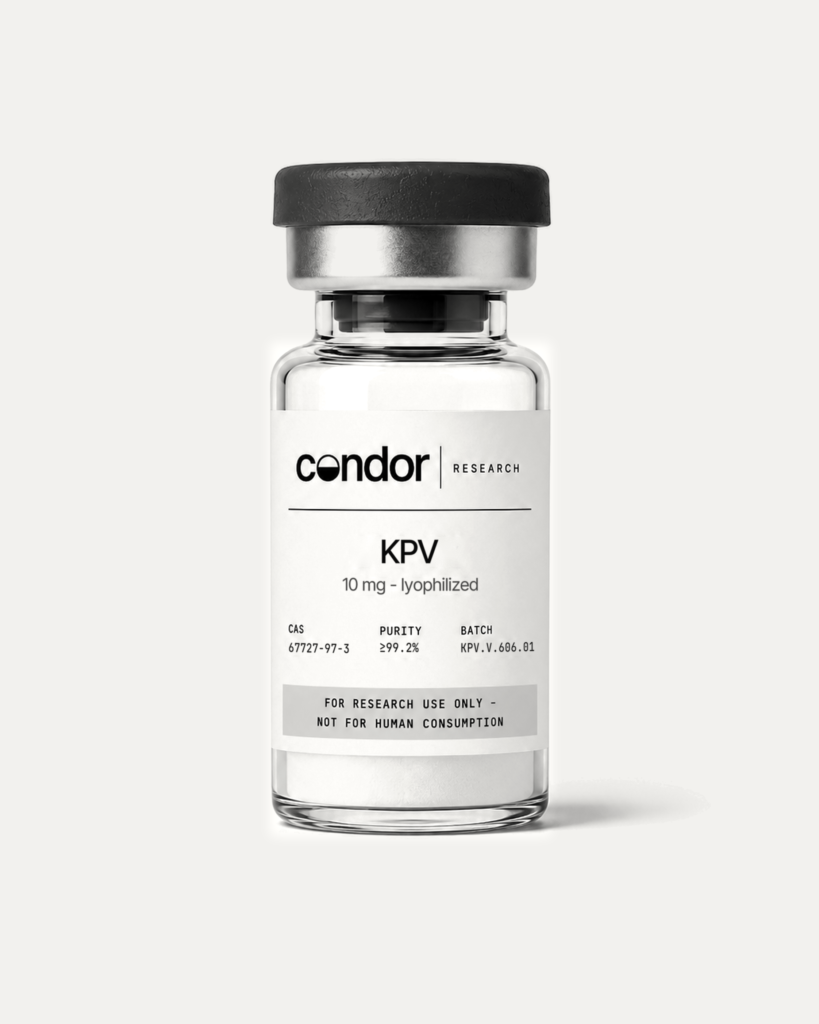
Lyophilised · ≥99% (HPLC) ·
Supplied lyophilised. Reconstitution typically uses bacteriostatic water.
KPV (Lys-Pro-Val) is the C-terminal tripeptide of alpha-melanocyte-stimulating hormone (alpha-MSH) and a focus of anti-inflammatory peptide research, studied in inflammation, gut-mucosal and wound models. CAS 67727-97-3; molecular formula C16H29N5O4; sequence Lys-Pro-Val; supplied lyophilised at ≥99% purity by HPLC in a 10 mg vial. For laboratory research use only.
Just three amino acids long, KPV is a synthetic tripeptide — lysine-proline-valine — that corresponds to the C-terminal sequence of α-melanocyte-stimulating hormone (α-MSH). Despite its minimal size, it has drawn sustained research interest because it appears to retain much of the parent hormone's anti-inflammatory signalling while shedding its pigmentary activity, making it a compact and informative probe of inflammation biology.
The active tail of a larger hormone. Investigators dissecting α-MSH found that its anti-inflammatory potency is concentrated in the terminal Lys-Pro-Val motif. Isolating this fragment revealed that the tripeptide alone can dampen inflammatory signalling, prompting a body of work into how such a small molecule exerts effects independent of the classic melanocortin pigment pathway (Getting et al., 2003).
What the research explores. KPV has been studied across inflammation and delivery-science models:
These findings come from in vitro and animal research; no human-use conclusions are implied. Full citations are listed under the Scientific References tab.
Physicochemical profile. CAS 67727-97-3 · Molecular formula C₁₆H₃₀N₄O₄ · Molecular weight 342.43 · Sequence Lys-Pro-Val · Appearance: white lyophilized powder · Solubility: soluble in water.
Specification & quality. Each individually sealed vial contains 10 mg of KPV as a white lyophilized powder of ≥99% purity by HPLC. Every batch is third-party tested, with a Certificate of Analysis (COA) available. Store at −20 °C, protected from light and moisture. Shelf life: 24 months from the manufacture date.
This product is intended for laboratory research use only (RUO). It is not a drug, food, cosmetic, or dietary supplement, and is not for human or veterinary use, ingestion, or diagnostic application. Handling is restricted to qualified research professionals operating in an appropriately equipped laboratory.
Supplied for in-vitro laboratory research use only (RUO). Not a drug, food or supplement; not for human or veterinary use.
Certificate of Analysis — lot-specific COA ships with every order and is available on request.
Each lot is tested by an independent third-party laboratory for identity (mass spectrometry) and purity (HPLC). The Certificate of Analysis for your specific batch ships with the order and is available on request — no house data, no exceptions.
References are illustrative of the research literature surrounding this compound. All claims relate to in-vitro and animal models only.
KPV is a synthetic tripeptide — lysine-proline-valine — that corresponds to the C-terminal sequence (residues 11-13) of α-melanocyte-stimulating hormone (α-MSH). Just three amino acids long, it is studied chiefly for anti-inflammatory activity. Condor Research supplies it as a 10 mg vial, third-party tested to ≥99% purity by HPLC, strictly for in-vitro research use.
KPV is just the three C-terminal residues (Lys-Pro-Val) of α-MSH, whereas full α-MSH analogues reproduce the larger peptide and engage melanocortin receptors broadly. KPV is studied mainly for anti-inflammatory activity attributed to this short fragment, without the pigmentary melanocortin-receptor profile of the full-length analogues. Both are Research Use Only reference materials.
Size and research focus differ sharply. KPV is a three-residue α-MSH C-terminal fragment studied for anti-inflammatory activity. Melanotan II is a larger cyclic melanocortin heptapeptide studied at melanocortin receptors for pigmentary research. They share an α-MSH origin but address different research areas. Both are supplied strictly as in-vitro research materials.
Both feature in gut and tissue research but are unrelated in structure. KPV is a three-residue α-MSH fragment studied for anti-inflammatory activity. BPC-157 is a 15-residue synthetic pentadecapeptide studied in cytoprotection and tissue repair. Condor Research also co-formulates both in the four-peptide KLOW blend. Each is offered strictly as a Research Use Only reference compound.
Both are tripeptides but differ in composition and focus. KPV (Lys-Pro-Val) is an α-MSH C-terminal fragment studied for anti-inflammatory activity. GHK-Cu (Gly-His-Lys) is a copper-binding tripeptide complexed with copper(II), studied in skin and tissue regeneration. One is metal-free and immune-focused, the other a copper complex. Both are in-vitro research materials.
KLOW is the expanded four-peptide formulation that adds KPV (10 mg) on top of the three peptides in GLOW (GHK-Cu, BPC-157 and TB-500). KPV contributes its distinct anti-inflammatory research angle as an α-MSH fragment, which is why it defines the KLOW blend. GLOW omits it and stays a three-peptide formula. Both blends are Research Use Only.
Each lot is tested by an independent third-party laboratory, with identity and purity confirmed by HPLC and mass spec, and ships with a batch-specific Certificate of Analysis certifying ≥99% purity. The listed Lys-Pro-Val sequence and molecular weight (342.43) correspond to KPV. To request the current lot COA, email info@condorresearch.com.
KPV is a water-soluble lyophilized powder, dissolved in a compatible aqueous diluent for in-vitro preparation, with volume chosen to reach the target analytical concentration from the 10 mg vial. Store the sealed vial at -20°C, protected from light (24-month shelf life). This is analytical preparation only; no human or veterinary dosing guidance is provided.
No — KPV is supplied strictly as a Research Use Only (in vitro) reference material: not a medicine, supplement or medical device, and not for human or veterinary administration or consumption. Sales are restricted to professionals and institutions aged 18+. Buyers are responsible for confirming the legality of import in their own jurisdiction.
Condor Research supplies KPV directly, dispatched from our EU facility in Slovakia to the EU, EEA, UK and Switzerland. Deliveries to EU destinations clear no third-country customs, and shipping is calculated at checkout. Supplied strictly as a research-use-only reference material — not for human or veterinary use.
No verified reviews yet.
Leave a reviewCookies
We use strictly necessary cookies to run the store. With your consent we also use analytics (order attribution) and marketing (Omnisend) cookies. Read our Cookie Policy.