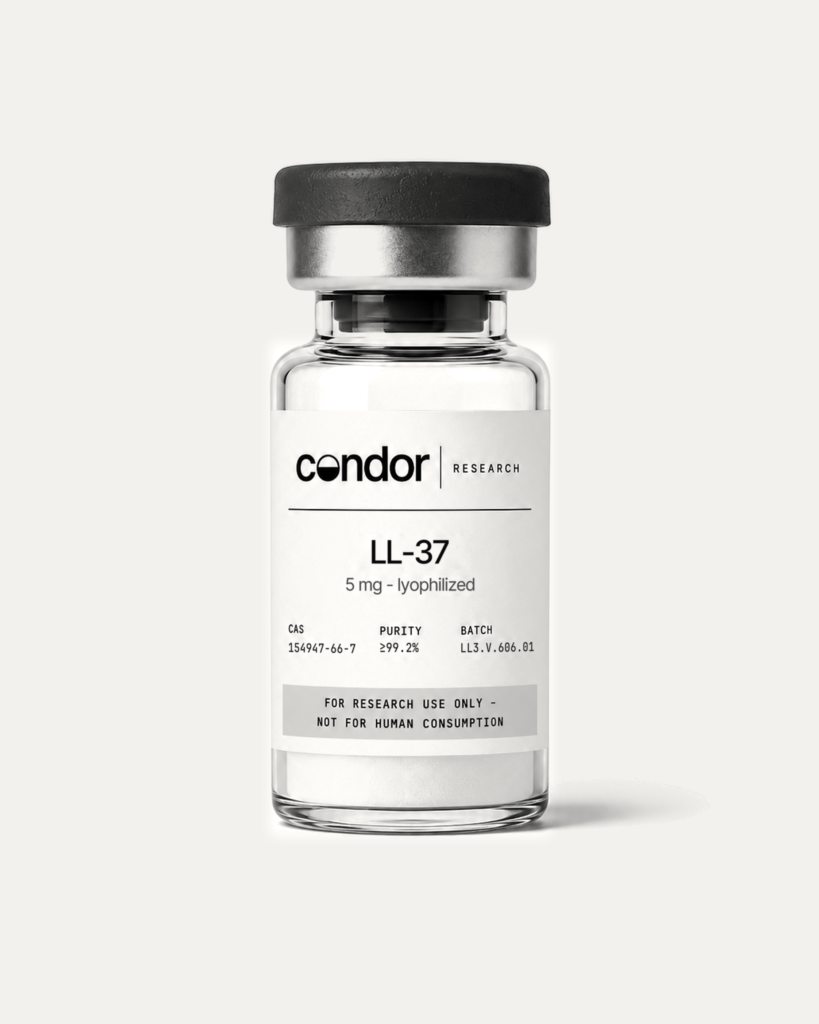
Lyophilised · ≥99% (HPLC) ·
Supplied lyophilised. Reconstitution typically uses bacteriostatic water.
LL-37 is a 37-amino-acid cationic host-defence peptide, the sole known human cathelicidin, cleaved from the C-terminus of the hCAP-18 precursor protein and studied for its broad-spectrum antimicrobial, immunomodulatory, and wound-healing activities in vitro and in animal models. CAS 154947-66-7; molecular weight approximately 4493 g/mol; supplied lyophilised at ≥99% purity by HPLC. For laboratory research use only; not for human or veterinary use.
Released by immune and epithelial cells at the very first sign of microbial invasion, LL-37 is the only human cathelicidin-derived antimicrobial peptide and a cornerstone molecule in innate-immunity research. This 37-residue, cationic, amphipathic peptide (sequence LLGDFFRKSKEKIGKEFKRIVQRIKDFLRNLVPRTES) is cleaved from the precursor protein hCAP18 and has become one of the most studied effectors of the body's first line of host defence.
A peptide forged at the front line of host defence. LL-37 takes its name from the two leucine residues that begin its 37-amino-acid chain. Stored as an inactive precursor in neutrophil granules and produced by epithelial surfaces, it is liberated by proteolytic processing when tissues encounter pathogens. Its positively charged, helix-forming structure lets it associate with the negatively charged membranes of microbes — a biophysical property that places it at the intersection of antimicrobial action, immune signalling, and tissue biology, and explains why it remains a reference scaffold for peptide design.
What the research explores. Work across biochemical, cellular, and animal models has examined several facets of cathelicidin biology:
These findings stem from in vitro, animal, and clinical studies in controlled research settings; they characterise the peptide's biology and do not represent evidence of benefit for any non-investigational application. Full citations are listed under the Scientific References tab.
Physicochemical profile. CAS 154947-66-7 · Molecular formula C₂₀₅H₃₄₀N₆₀O₅₃ · Molecular weight 4493 · Sequence: LLGDFFRKSKEKIGKEFKRIVQRIKDFLRNLVPRTES · Appearance: white lyophilized powder · Solubility: soluble in water.
Specification & quality. Each individually sealed vial contains 5 mg of LL-37 as a white lyophilized powder, verified at ≥99% purity by HPLC. Every batch is third-party tested, and a Certificate of Analysis (COA) is available. Store at −20 °C, protected from light and moisture.
This product is intended for laboratory research use only (RUO). It is not a drug, food, cosmetic, or dietary supplement, and is not for human or veterinary use, ingestion, or diagnostic application. Handling is restricted to qualified research professionals operating in an appropriately equipped laboratory.
Supplied for in-vitro laboratory research use only (RUO). Not a drug, food or supplement; not for human or veterinary use.
Certificate of Analysis — lot-specific COA ships with every order and is available on request.
Each lot is tested by an independent third-party laboratory for identity (mass spectrometry) and purity (HPLC). The Certificate of Analysis for your specific batch ships with the order and is available on request — no house data, no exceptions.
References are illustrative of the research literature surrounding this compound. All claims relate to in-vitro and animal models only.
LL-37 is the only human cathelicidin-derived antimicrobial peptide, a 37-residue cationic peptide used as a cornerstone reagent in innate-immunity research. It is supplied as a synthetic peptide for laboratory research use only (in vitro). It is not a medicine, food, supplement or medical device, and is not for human or veterinary use, administration or consumption.
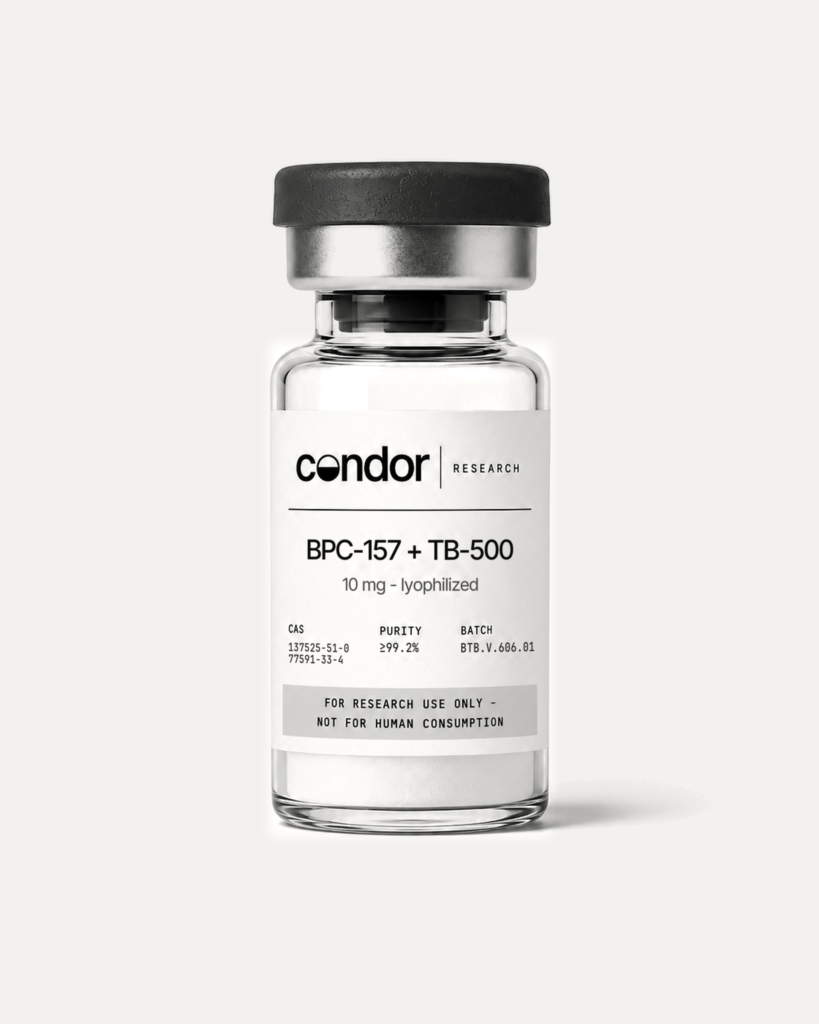
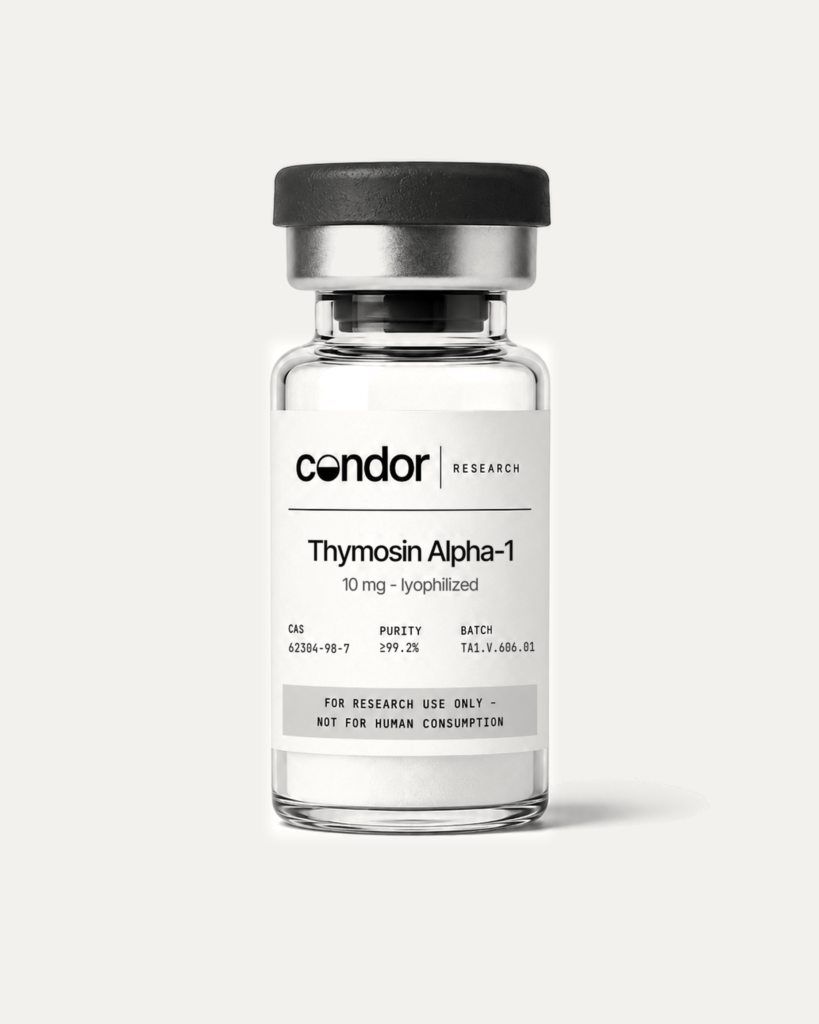
LL-37 is a cathelicidin-derived antimicrobial peptide central to innate-immunity studies, while Thymosin Alpha-1 is a 28-amino-acid thymic peptide studied as an immune modulator. One is a direct antimicrobial cationic peptide; the other is a thymus-derived immunoregulatory peptide. They are distinct molecules with different sequences. Both are supplied strictly for laboratory research use only (in vitro).
LL-37 is a 37-residue cathelicidin antimicrobial peptide investigated for innate-immune and host-defence activity, whereas KPV is a three-amino-acid α-MSH-derived tripeptide studied largely in anti-inflammatory and tissue contexts. They differ greatly in size and research focus. Both are offered only as in-vitro research reagents and are not for human or veterinary use, administration or consumption.
LL-37 is the single human cathelicidin-derived antimicrobial peptide, which makes it the reference molecule when studying human innate antimicrobial defence specifically. Other immune peptides (e.g. Thymosin Alpha-1, KPV) have different mechanisms and origins. Selection depends on the research question. LL-37 is supplied strictly for laboratory research use only (in vitro), with no human or veterinary application.
LL-37 is a cathelicidin antimicrobial peptide studied in innate immunity and host defence, while BPC-157 is a pentadecapeptide investigated in tissue-repair and cytoprotection research. They target entirely different research areas and share no sequence relationship. Both are supplied as synthetic peptides for laboratory research use only (in vitro), not for human or veterinary use.
Each batch is tested by an independent third-party laboratory with identity confirmed by mass spectrometry and purity verified at ≥99% by HPLC, documented in a per-lot Certificate of Analysis. For endotoxin status or any additional assay-specific parameters on a given batch, contact info@condorresearch.com so the available documentation can be confirmed. Supplied for laboratory research use only.
Purity is verified at ≥99% by HPLC and identity by mass spectrometry per batch, with results on the Certificate of Analysis. For highly charged peptides, net peptide content and counterion (e.g. TFA) details can affect functional assays; for the specific values on a given lot, contact info@condorresearch.com. The product is supplied strictly for laboratory research use only (in vitro).
Yes. Every lot is tested by an independent third-party laboratory, with identity confirmed by mass spectrometry and purity at ≥99% by HPLC, and a Certificate of Analysis is issued per batch. Manufacturer documentation is not published, to preserve supply-chain integrity. Request the lot-specific COA via info@condorresearch.com. LL-37 is supplied for laboratory research use only.
LL-37 is listed as soluble in water, so it is reconstituted with an aqueous diluent for analytical laboratory preparation; the vial contains 5 mg of lyophilised peptide. Store the unopened vial at -20°C, protected from light (24-month shelf life). Any reconstitution data is for in-vitro laboratory use only, never for human or animal use, and no dosing guidance is given.
Yes. LL-37 is sold strictly for laboratory research use only (in vitro) and is not a medicine, food, supplement, cosmetic or medical device, and not for human or veterinary use, administration or consumption. Handling is laboratory preparation only; any reconstitution data applies to analytical work, not to use in people or animals. Questions: info@condorresearch.com.
Condor Research supplies LL-37 directly, dispatched from our EU facility in Slovakia to the EU, EEA, UK and Switzerland. Deliveries to EU destinations clear no third-country customs, and shipping is calculated at checkout. Supplied strictly as a research-use-only reference material — not for human or veterinary use.
No verified reviews yet.
Leave a reviewCookies
We use strictly necessary cookies to run the store. With your consent we also use analytics (order attribution) and marketing (Omnisend) cookies. Read our Cookie Policy.