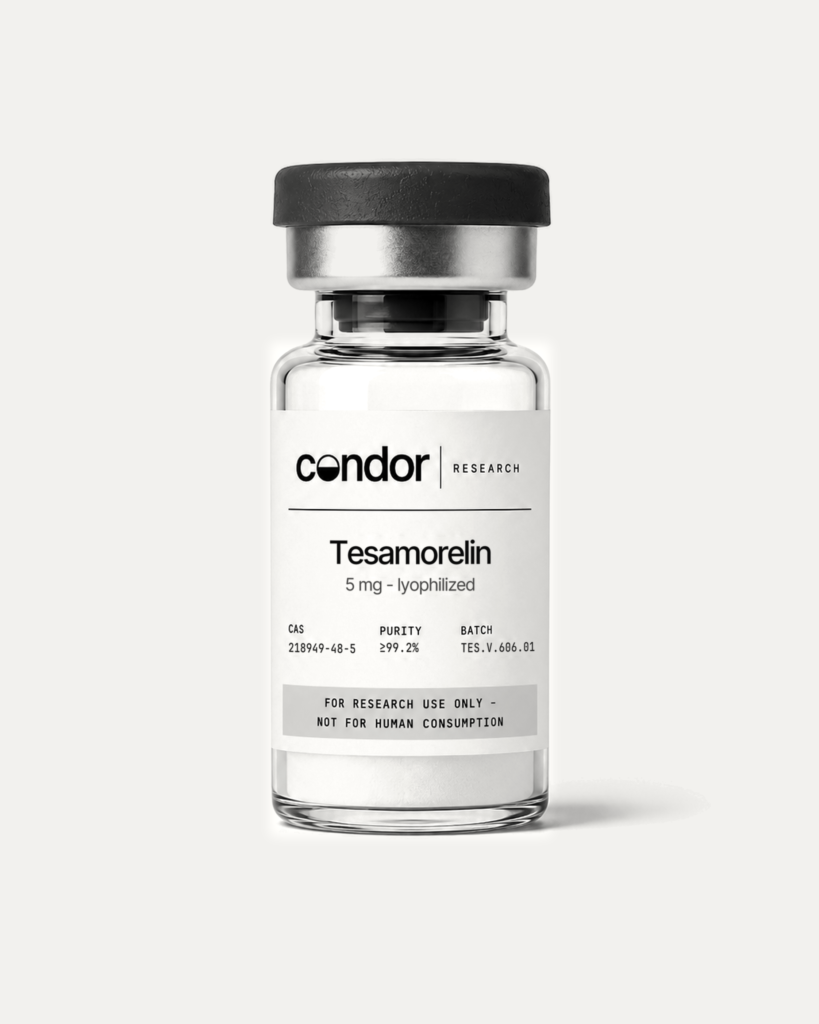
Lyophilised · ≥99% (HPLC) ·
Supplied lyophilised. Reconstitution typically uses bacteriostatic water.
Tesamorelin is a synthetic 44-amino-acid analogue of human growth hormone-releasing hormone (GHRH), stabilised by trans-3-hexenoic acid conjugation at the N-terminus to resist dipeptidyl peptidase IV degradation, and studied for its selective stimulation of pituitary growth hormone secretion. CAS 218949-48-5; molecular weight 5135.9 g/mol; belongs to the GHRH peptide class. Supplied lyophilised at ≥99% purity by HPLC. For laboratory research use only; not for human or veterinary use.
Stabilised at its N-terminus by a distinctive trans-3-hexenoyl cap, Tesamorelin is a synthetic analogue of human growth-hormone-releasing hormone (GHRH), a 44-residue peptide engineered for enhanced metabolic stability over the native hormone. It is among the most thoroughly characterised GHRH analogues in clinical endocrinology research, notably as a tool for studying visceral adiposity and the GH/IGF-1 axis.
A hormone fragment built to endure. Native GHRH is cleaved rapidly in circulation. By fusing a hexenoic-acid moiety to the full-length GRF(1-44) sequence, the molecule gains resistance to enzymatic degradation while retaining its ability to engage the GHRH receptor and drive pulsatile growth-hormone secretion. This stability is what allowed it to become the most extensively investigated analogue of its class in human metabolic studies (Wang et al., 2009; Tomlinson et al., 2006).
What the research explores. The peptide has anchored a large body of investigation into the endocrine control of fat distribution:
These data arise from clinical and laboratory research; this listing makes no representation of therapeutic benefit outside those investigational contexts. Full citations are listed under the Scientific References tab.
Physicochemical profile. CAS 218949-48-5 · Molecular formula C₂₂₁H₃₆₆N₇₂O₆₇S · Molecular weight 5136 · Appearance: white lyophilized powder · Solubility: soluble in water.
Specification & quality. Each individually sealed vial contains 5 mg of Tesamorelin as a white lyophilized powder of ≥99% purity by HPLC. Every batch is third-party tested, with a Certificate of Analysis (COA) available. Store at −20 °C, protected from light and moisture. Shelf life: 24 months from the manufacture date.
This product is intended for laboratory research use only (RUO). It is not a drug, food, cosmetic, or dietary supplement, and is not for human or veterinary use, ingestion, or diagnostic application. Handling is restricted to qualified research professionals operating in an appropriately equipped laboratory.
Supplied for in-vitro laboratory research use only (RUO). Not a drug, food or supplement; not for human or veterinary use.
Certificate of Analysis — lot-specific COA ships with every order and is available on request.
Each lot is tested by an independent third-party laboratory for identity (mass spectrometry) and purity (HPLC). The Certificate of Analysis for your specific batch ships with the order and is available on request — no house data, no exceptions.
References are illustrative of the research literature surrounding this compound. All claims relate to in-vitro and animal models only.
Tesamorelin is a synthetic analogue of human growth-hormone-releasing hormone (GHRH), a 44-residue peptide stabilized at its N-terminus by a distinctive trans-3-hexenoyl cap that improves its metabolic stability over the native hormone. Condor Research supplies it as a 5 mg lyophilized vial, third-party tested to ≥99% purity by HPLC, strictly for in-vitro research use.
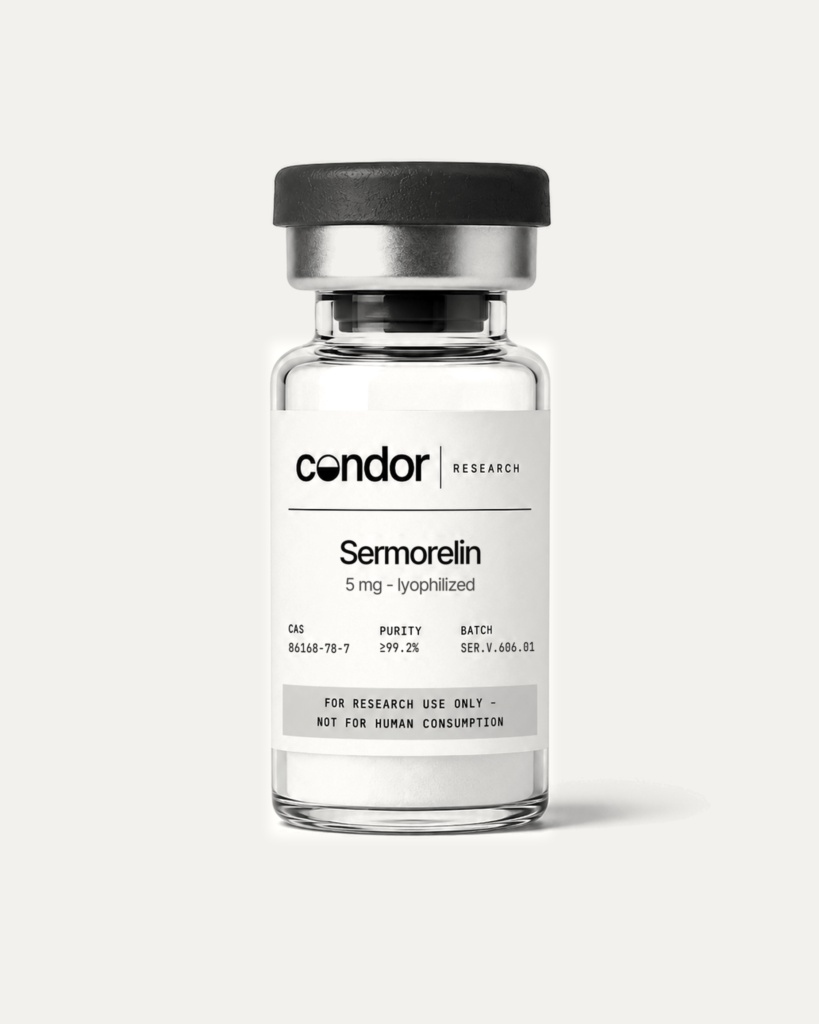
Length and stabilization differ. Sermorelin is the minimal 29-residue GRF(1-29) fragment with no added protection, whereas Tesamorelin is a longer 44-residue GHRH analogue carrying a trans-3-hexenoyl cap that resists enzymatic breakdown. Both are GHRH-analogue research peptides, but Tesamorelin is engineered for greater metabolic stability. Each is sold as Research Use Only material.
The trans-3-hexenoyl cap on Tesamorelin's N-terminus shields it from rapid enzymatic degradation, extending its stability relative to the unmodified GRF(1-29) sequence of Sermorelin. This makes Tesamorelin a longer, more stable GHRH analogue, while Sermorelin represents the native minimal active core. Both are studied as in-vitro reference peptides.
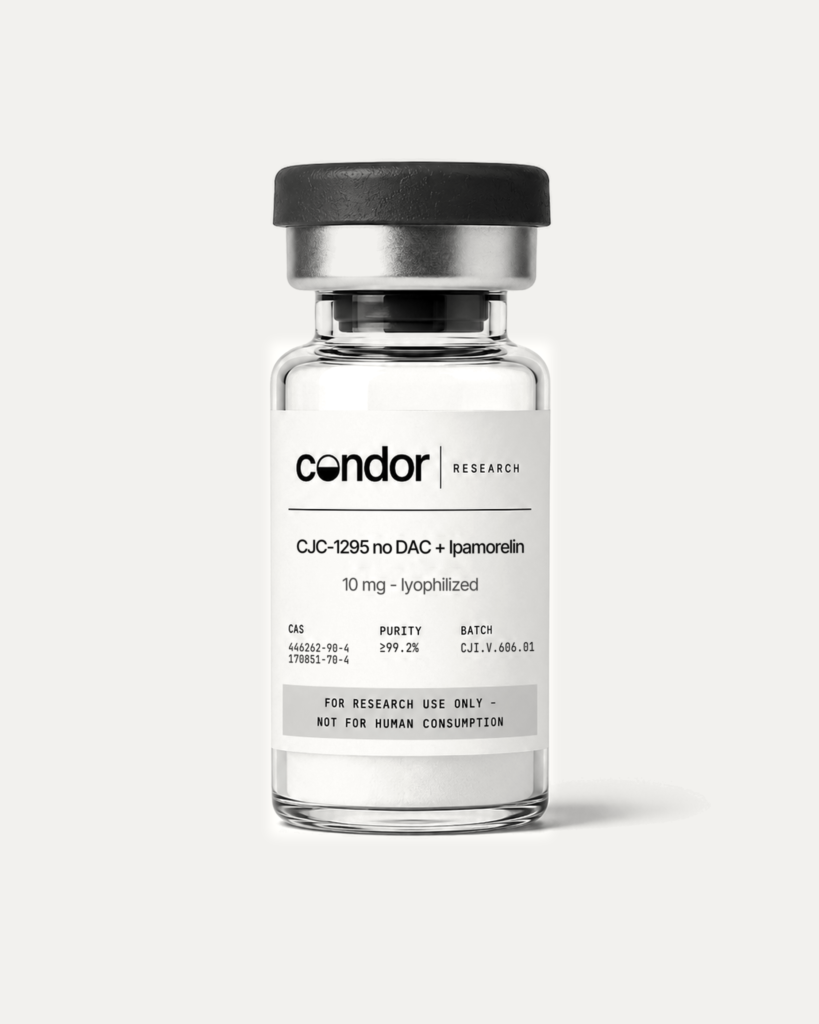
Both are stabilized GHRH analogues using different approaches. Tesamorelin is a 44-residue peptide stabilized by a trans-3-hexenoyl cap; CJC-1295 (no DAC), or Modified GRF (1-29), is a 29-residue fragment stabilized by amino-acid substitutions. They are distinct research molecules at the GHRH-receptor pathway. Both are supplied strictly for in-vitro laboratory use.
They act at opposite points of growth-hormone biology. Tesamorelin is a GHRH analogue, a secretagogue-type molecule modeled on the hormone that signals upstream of GH. AOD-9604 is instead a fragment of the GH molecule itself (residues 177-191), studied as a lipolytic-domain peptide. Both are offered as Research Use Only reference compounds.
All three are GHRH-receptor analogues differing in length and stabilization: Sermorelin is the native 29-residue GRF(1-29); CJC-1295 no DAC is the substitution-stabilized Modified GRF (1-29); Tesamorelin is the 44-residue, hexenoyl-capped analogue. Selection depends on your in-vitro model. Condor Research supplies them as research materials only and gives no use protocols — research design is the investigator's.
Each lot is tested by an independent third-party laboratory, with identity and purity confirmed by HPLC and mass spec, and ships with a batch-specific Certificate of Analysis certifying ≥99% purity. The listed sequence and molecular weight (5136) correspond to hexenoyl-capped Tesamorelin. To request the current lot COA, email info@condorresearch.com.
Tesamorelin is a water-soluble lyophilized powder, dissolved in a compatible aqueous diluent for in-vitro preparation, with volume chosen to reach the target analytical concentration from the 5 mg vial. Store the sealed vial at -20°C, protected from light (24-month shelf life). This is analytical preparation only; no human or veterinary dosing guidance is provided.
No — Tesamorelin is supplied strictly as a Research Use Only (in vitro) reference material: not a medicine, supplement or medical device, and not for human or veterinary administration or consumption. Sales are restricted to professionals and institutions aged 18+. Buyers are responsible for confirming the legality of import in their own country.
Condor Research supplies Tesamorelin directly, dispatched from our EU facility in Slovakia to the EU, EEA, UK and Switzerland. Deliveries to EU destinations clear no third-country customs, and shipping is calculated at checkout. Supplied strictly as a research-use-only reference material — not for human or veterinary use.
No verified reviews yet.
Leave a reviewCookies
We use strictly necessary cookies to run the store. With your consent we also use analytics (order attribution) and marketing (Omnisend) cookies. Read our Cookie Policy.