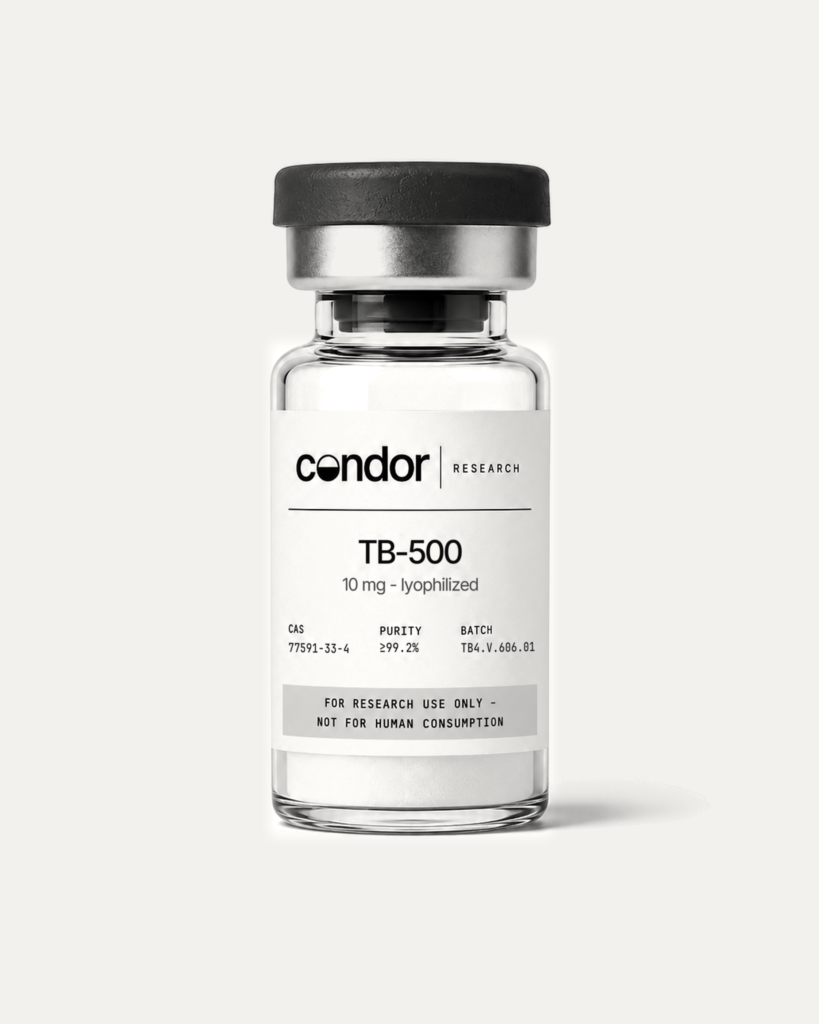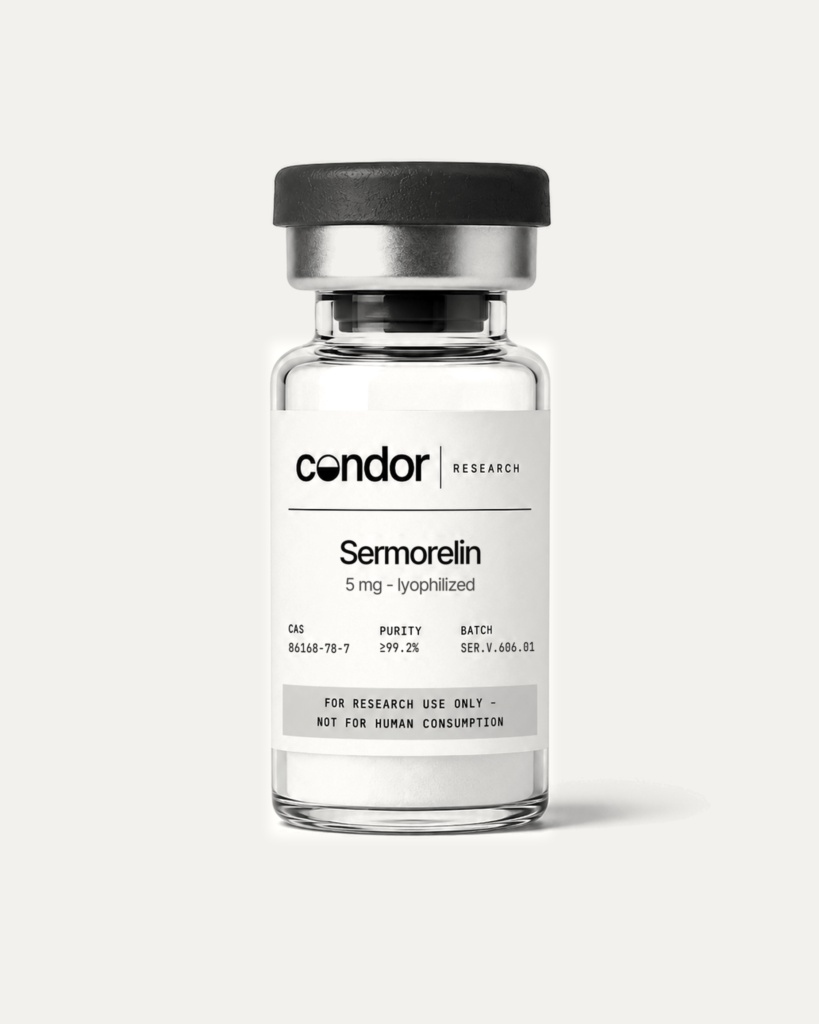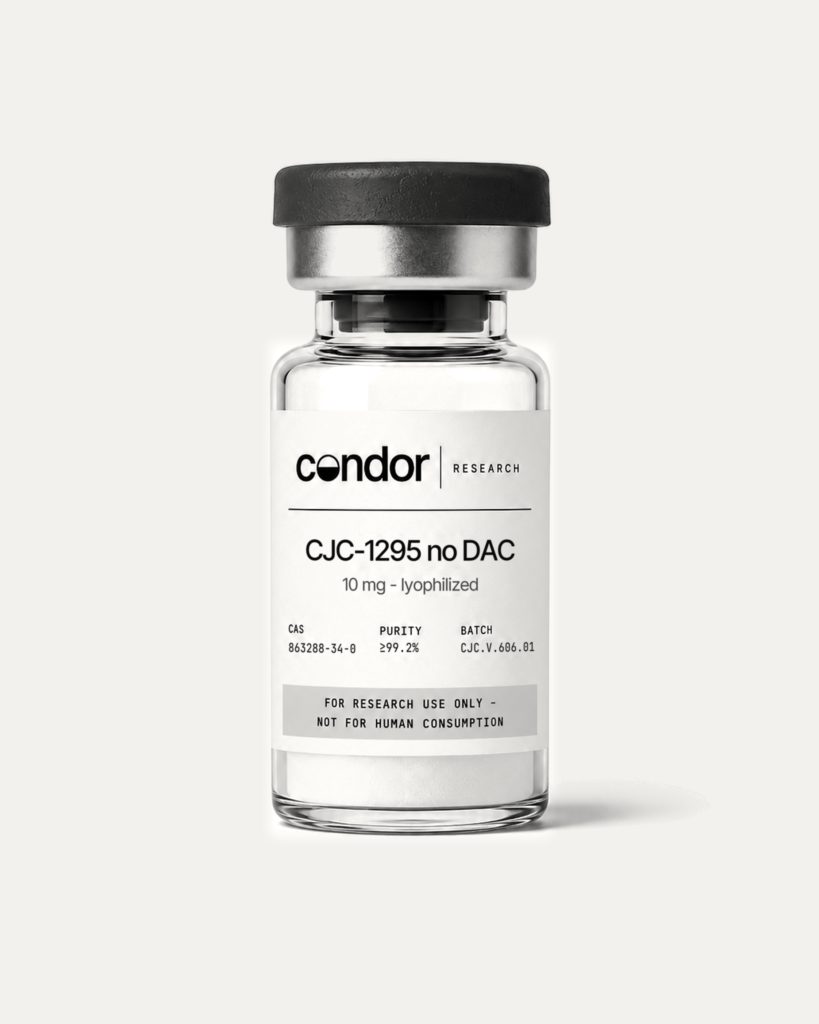
Lyophilised · ≥99% (HPLC) ·
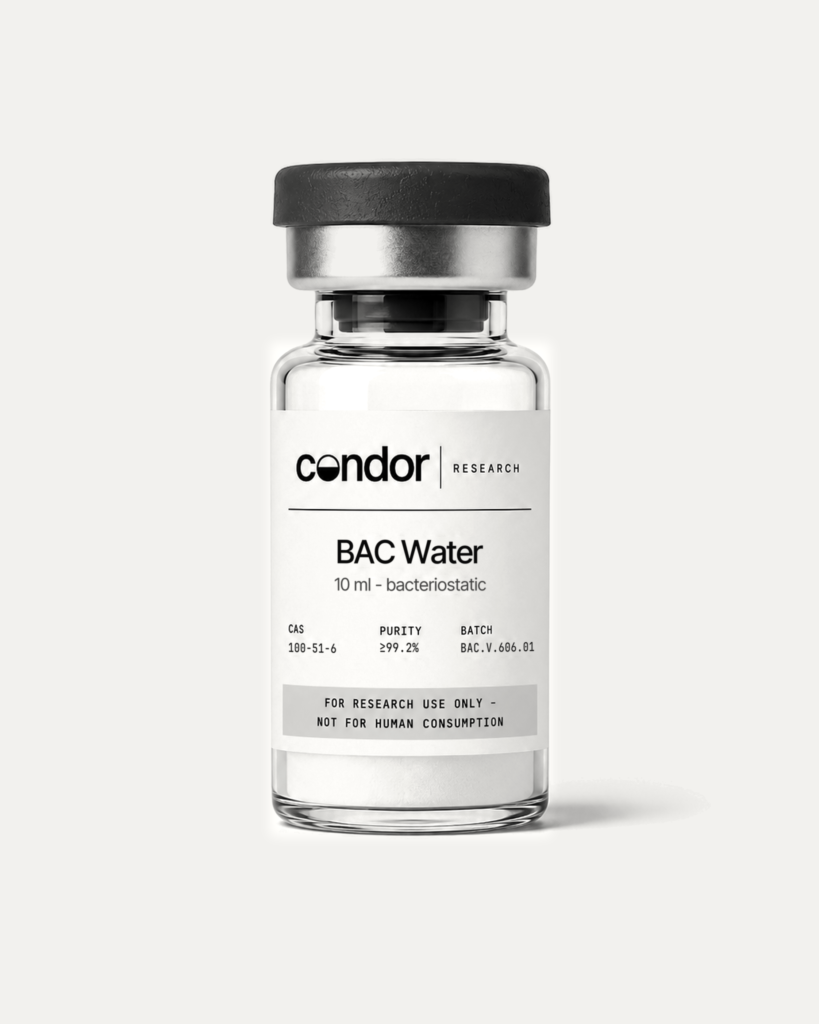
Supplied lyophilised. Reconstitution typically uses bacteriostatic water.
CJC-1295 (no DAC) is a synthetic 29-amino-acid analogue of growth hormone-releasing hormone (GHRH), engineered without the Drug Affinity Complex (DAC) to preserve the native pulsatile GH-secretion kinetics studied in neuroendocrine research. CAS 863288-34-0; molecular weight 3367.9 g/mol; supplied lyophilised at ≥99% purity by HPLC. For laboratory research use only; not for human or veterinary use.
Engineered to outlast the body's own rapid clearance of growth-hormone-releasing factor, CJC-1295 (no DAC) — also known as Modified GRF (1-29) — is a synthetic 29-amino-acid analogue of the bioactive N-terminal fragment of human growth-hormone-releasing hormone (GHRH). Critically, it is the variant without the Drug Affinity Complex (DAC), making it the lighter, shorter-acting tetrasubstituted peptide that has become a workhorse in endocrine signalling research.
A fragment refined, not reinvented. Native GRF(1-29) carries the full agonist activity of GHRH but is degraded within minutes, primarily by dipeptidyl peptidase IV (DPP-IV) cleaving its exposed N-terminus (Bai et al., 1995). To counter this, researchers introduced four targeted substitutions — most notably D-Ala at position 2 — yielding a backbone markedly more resistant to enzymatic breakdown while preserving receptor recognition. Unlike its DAC-bearing sibling, this form does not bind albumin, so its activity is comparatively transient.
What the research explores. The molecule has served as a probe for the GHRH receptor and the downstream GH/IGF-1 axis across several lines of inquiry:
These findings derive exclusively from in vitro, animal, and early investigational studies; no conclusions regarding human use are supported. Full citations are listed under the Scientific References tab.
Physicochemical profile. CAS 863288-34-0 · Molecular formula C₁₅₂H₂₅₂N₄₄O₄₂ · Molecular weight 3367.9 · Sequence Tyr-D-Ala-Asp-Ala-Ile-Phe-Thr-Gln-Ser-Tyr-Arg-Lys-Val-Leu-Ala-Gln-Leu-Ser-Ala-Arg-Lys-Leu-Leu-Gln-Asp-Ile-Leu-Ser-Arg-NH₂ · Appearance: white lyophilized powder · Solubility: soluble in water.
Specification & quality. Each individually sealed vial contains 10 mg of CJC-1295 (no DAC) as a white lyophilized powder of ≥99% purity by HPLC. Every batch is third-party tested, with a Certificate of Analysis (COA) available. Store at −20 °C, protected from light and moisture. Shelf life: 24 months from the manufacture date.
This product is intended for laboratory research use only (RUO). It is not a drug, food, cosmetic, or dietary supplement, and is not for human or veterinary use, ingestion, or diagnostic application. Handling is restricted to qualified research professionals operating in an appropriately equipped laboratory.
Supplied for in-vitro laboratory research use only (RUO). Not a drug, food or supplement; not for human or veterinary use.
Certificate of Analysis — lot-specific COA ships with every order and is available on request.
Each lot is tested by an independent third-party laboratory for identity (mass spectrometry) and purity (HPLC). The Certificate of Analysis for your specific batch ships with the order and is available on request — no house data, no exceptions.
References are illustrative of the research literature surrounding this compound. All claims relate to in-vitro and animal models only.
CJC-1295 (no DAC), also known as Modified GRF (1-29), is a synthetic 29-amino-acid analogue of the bioactive N-terminal fragment of growth-hormone-releasing hormone (GHRH). The "no DAC" version carries no Drug Affinity Complex, so it does not bind albumin and is shorter-acting. Condor Research supplies it as a 10 mg vial, ≥99% HPLC, for in-vitro research only.
The DAC (Drug Affinity Complex) moiety is the difference. CJC-1295 DAC adds a lysine-linked group that binds serum albumin, greatly extending its circulating half-life. CJC-1295 no DAC (Modified GRF 1-29) omits this group, making it a lighter molecule with no albumin binding and a much shorter duration of action. Both are GHRH-analogue research peptides.
Because the DAC group binds covalently to serum albumin, shielding the peptide from rapid enzymatic clearance, which extends its half-life substantially in research models. CJC-1295 no DAC has no such albumin anchor, so it is cleared quickly and acts over a much shorter window. This contrast is studied as a model of half-life extension in vitro.
Both are 29-residue GHRH N-terminal analogues, but CJC-1295 no DAC is the "modified" GRF(1-29): it carries amino-acid substitutions (including D-Ala at position 2) that resist enzymatic breakdown, giving greater stability than Sermorelin, which is the bare native GRF(1-29) sequence. Both are supplied as Research Use Only peptides.
Both are stabilized GHRH analogues but use different strategies. CJC-1295 no DAC (Modified GRF 1-29) is stabilized by amino-acid substitutions on a 29-residue fragment; Tesamorelin is a longer 44-residue analogue stabilized by an N-terminal trans-3-hexenoyl cap. They are distinct research molecules; both are offered strictly for in-vitro laboratory use.
They act on different receptors. CJC-1295 no DAC (Modified GRF 1-29) is a GHRH-receptor analogue, while Ipamorelin is a selective ghrelin-receptor (GHS-R) agonist. Because they target complementary pathways, they are frequently studied together — and Condor Research offers them co-formulated in the CJC-1295 no DAC + Ipamorelin blend. Both are Research Use Only.
Each lot is tested by an independent third-party laboratory, with identity and purity confirmed by HPLC and mass spec, and ships with a batch-specific Certificate of Analysis certifying ≥99% purity. The listed sequence and molecular weight (3367.9) correspond to the no-DAC Modified GRF (1-29) molecule. Request the current lot COA at info@condorresearch.com.
It is a water-soluble lyophilized powder, dissolved in a compatible aqueous diluent for in-vitro preparation, with volume chosen to reach the target analytical concentration from the 10 mg vial. Store the sealed vial at -20°C, protected from light (24-month shelf life). This is analytical preparation only; no human or veterinary dosing guidance is provided.
No — it is supplied strictly as a Research Use Only (in vitro) reference material: not a medicine, supplement or medical device, and not for human or veterinary administration. Sales are limited to professionals and institutions aged 18+, with a professional-capacity declaration at checkout. Buyers are responsible for confirming the legality of import in their own jurisdiction.
Condor Research supplies CJC-1295 (no DAC) directly, dispatched from our EU facility in Slovakia to the EU, EEA, UK and Switzerland. Deliveries to EU destinations clear no third-country customs, and shipping is calculated at checkout. Supplied strictly as a research-use-only reference material — not for human or veterinary use.
No verified reviews yet.
Leave a reviewCookies
We use strictly necessary cookies to run the store. With your consent we also use analytics (order attribution) and marketing (Omnisend) cookies. Read our Cookie Policy.