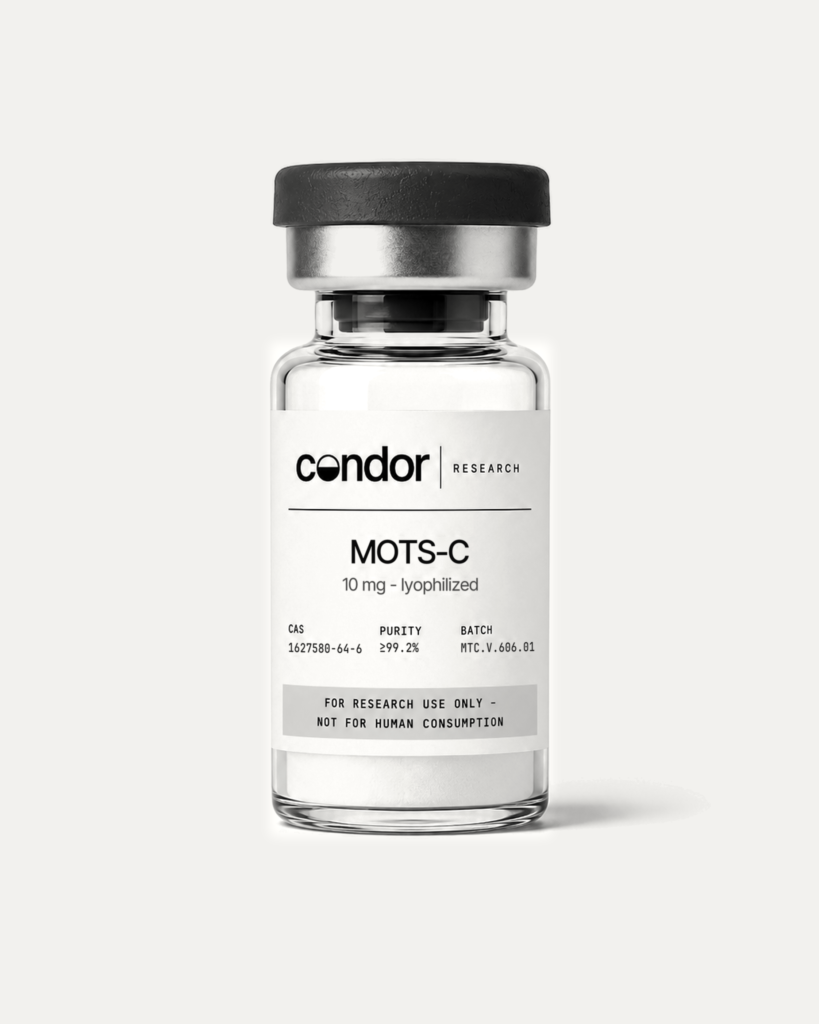
Lyophilised · ≥99% (HPLC) ·
Supplied lyophilised. Reconstitution typically uses bacteriostatic water.
MOTS-C (Mitochondrial Open Reading Frame of the 12S rRNA-c) is a 16-amino-acid mitochondria-derived peptide encoded within the 12S rRNA gene of the mitochondrial genome, studied for its roles in metabolic regulation, insulin sensitisation, and cellular stress response. Sequence MRWQEMGYIFYPRKLR; CAS 1627580-64-6; molecular weight 2174.6 g/mol; molecular formula C101H152N28O22S2; supplied lyophilised at ≥99% purity by HPLC. For laboratory research use only; not for human or veterinary use.
Encoded not in the cell nucleus but within the mitochondrial genome itself, MOTS-c (mitochondrial open-reading-frame of the twelve-S rRNA type-c) is a 16-amino-acid mitochondrial-derived peptide that has become a focal point of metabolism and ageing research. Its discovery helped establish an entire class of small peptides written into mitochondrial DNA — molecules that appear to signal between the mitochondrion and the rest of the cell.
A microprotein from the mitochondrial genome. MOTS-c belongs to a growing family of mitochondrial-derived microproteins now studied as secreted regulators of cellular metabolism (Amado et al., 2026). Because circulating levels shift with metabolic and disease states, it is also being evaluated as a candidate biomarker as well as a research tool for probing mitochondrial-to-nuclear communication (Sivakumar et al., 2026).
What the research explores. Across cell-culture and animal systems, MOTS-c has been investigated along several converging lines:
The activity described here is drawn from in-vitro and animal studies; it characterises biological behaviour in experimental models and does not establish efficacy or safety in humans. Full citations are listed under the Scientific References tab.
Physicochemical profile. CAS No. 1627580-64-6 · Molecular formula C101H152N28O22S2 · Molecular weight 2174.62 g/mol · Sequence Met-Arg-Trp-Gln-Glu-Met-Gly-Tyr-Ile-Phe-Tyr-Pro-Arg-Lys-Leu-Arg · Appearance: white lyophilized powder · Solubility: soluble in sterile water.
Specification & quality. Each individually sealed vial contains 10 mg of MOTS-c as a white lyophilized powder at ≥99% purity by HPLC. Every batch is third-party tested, and a Certificate of Analysis (COA) is available. Store at −20 °C, protected from light and moisture; shelf life 24 months from the manufacture date.
This product is intended for laboratory research use only (RUO). It is not a drug, food, cosmetic, or dietary supplement, and is not for human or veterinary use, ingestion, or diagnostic application. Handling is restricted to qualified research professionals operating in an appropriately equipped laboratory.
Supplied for in-vitro laboratory research use only (RUO). Not a drug, food or supplement; not for human or veterinary use.
Certificate of Analysis — lot-specific COA ships with every order and is available on request.
Each lot is tested by an independent third-party laboratory for identity (mass spectrometry) and purity (HPLC). The Certificate of Analysis for your specific batch ships with the order and is available on request — no house data, no exceptions.
References are illustrative of the research literature surrounding this compound. All claims relate to in-vitro and animal models only.
MOTS-c (mitochondrial open-reading-frame of the twelve-S rRNA type-c) is a 16-amino-acid mitochondrial-derived peptide encoded within the mitochondrial genome rather than the cell nucleus. It is a focal point of metabolism and longevity research. Condor supplies it strictly as a Research Use Only reference compound for in vitro and animal studies.
MOTS-c is a 16-amino-acid mitochondrial-derived peptide studied as a signaling molecule in metabolism and longevity research. NAD+ is a small-molecule coenzyme central to cellular energy metabolism and redox reactions. One is a peptide signal, the other a fundamental cofactor, so they probe different aspects of metabolism. Research use only.
MOTS-c is a 16-residue mitochondrial-derived peptide studied as a metabolic signaling molecule. SS-31 (Elamipretide) is a short four-residue peptide studied for binding cardiolipin in the inner mitochondrial membrane. Both relate to mitochondrial biology but act differently, so they serve distinct research questions. Both are supplied as research-use-only reference compounds.
MOTS-c is a 16-amino-acid mitochondrial-derived peptide studied as a metabolic signaling molecule. AICAR is a small-molecule activator of AMP-activated protein kinase (AMPK), the cell's energy sensor. They differ in chemical class and mechanism, giving researchers complementary tools for studying energy metabolism. Both are supplied strictly for research use only.
Unlike most peptides, which are encoded in nuclear DNA, MOTS-c is a mitochondrial-derived peptide encoded within a short open reading frame in the mitochondrial 12S rRNA gene. This unusual origin is part of why it is studied as a signal linking mitochondria to whole-cell metabolism. Research use only, in vitro and animal models.
Yes. Condor Research supplies MOTS-c strictly as a Research Use Only (in vitro) reference compound to professionals and institutions, not as a medicine, supplement or product for human or veterinary use. Buyers are responsible for confirming import legality in their own country. Questions: info@condorresearch.com.
MOTS-c is listed as soluble in sterile water, which is the diluent reference for laboratory preparation of this peptide. Sterile (non-preserved) water is commonly chosen for assays sensitive to preservatives. This data is for in vitro research preparation only; it is not guidance for human or veterinary use. Questions: info@condorresearch.com.
For laboratory preparation, MOTS-c is reconstituted in sterile water; for example, adding 10 mL to the 10 mg vial gives a 1 mg/mL solution, scaled for other target concentrations. Store the sealed vial at -20C, protected from light; shelf life is 24 months. For research preparation only, not human use.
This MOTS-c has the molecular formula C101H152N28O22S2 and a molecular weight of 2174.62, with a 16-residue sequence beginning Met-Arg-Trp-Gln-Glu (CAS 1627580-64-6). Identity and purity (>=99%) are confirmed by HPLC on each batch and documented in the lot-specific Certificate of Analysis.
Yes. Every MOTS-c batch is tested by an independent third-party laboratory by HPLC for identity and purity (>=99%), with mass spectrometry confirmation of this 16-residue peptide, and ships with a lot-specific Certificate of Analysis. To request the COA for a specific lot before ordering, contact info@condorresearch.com.
Condor Research supplies MOTS-C directly, dispatched from our EU facility in Slovakia to the EU, EEA, UK and Switzerland. Deliveries to EU destinations clear no third-country customs, and shipping is calculated at checkout. Supplied strictly as a research-use-only reference material — not for human or veterinary use.
No verified reviews yet.
Leave a reviewCookies
We use strictly necessary cookies to run the store. With your consent we also use analytics (order attribution) and marketing (Omnisend) cookies. Read our Cookie Policy.