
What Is MOTS-c? The Hormone-Like Signal Written Into Your Mitochondria
MOTS-c is a 16-amino-acid peptide encoded inside the mitochondrial genome itself, studied as an exercise-responsive metabolic signal. The biology is genuinely striking — but the evidence is overwhelmingly preclinical.
MOTS-c is a 16-amino-acid mitochondrial-derived peptide encoded within the mitochondrial 12S rRNA region, studied as an exercise-responsive metabolic signal that engages the AMPK pathway. Its record is overwhelmingly preclinical plus human association data, with no intervention trials establishing benefit. It is a research-use-only material, not an approved medicine.
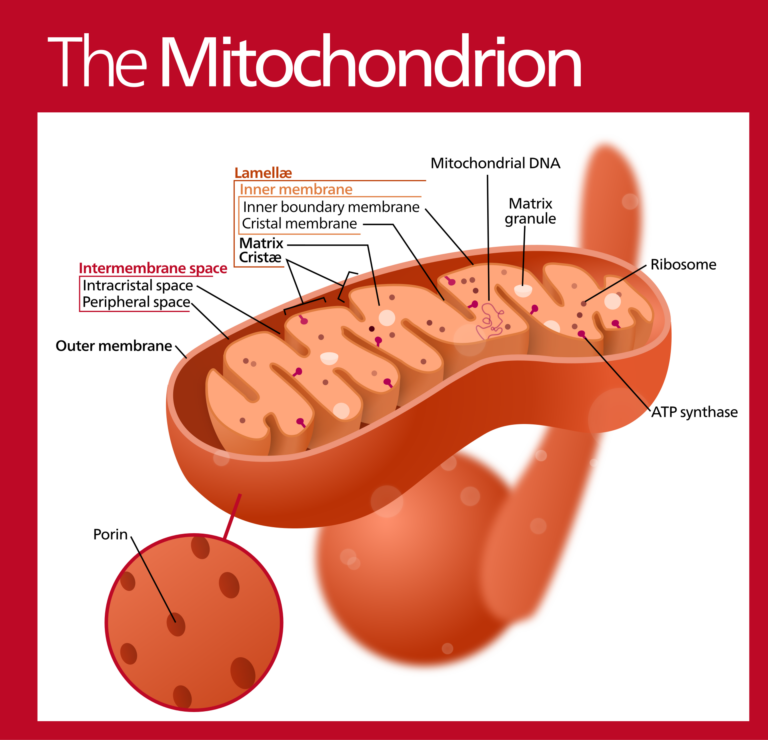
For more than a century, the rule was simple: your genes live in the nucleus, and the mitochondria — the bean-shaped power plants humming inside every cell — were demoted long ago to mere battery packs, carrying a vestigial scrap of their own DNA. Then, in 2015, researchers reading that scrap noticed something hiding in plain sight. Tucked inside a region of the mitochondrial genome that codes for ribosomal RNA was a second, overlapping message — a tiny peptide that the powerhouse could secrete to talk back to the rest of the cell. They named it MOTS-c. The powerhouse, it turned out, had been writing letters all along.
What exactly is MOTS-c?
MOTS-c is a mitochondrial-derived peptide: a short protein, just sixteen amino acids long, encoded not in the cell’s nuclear DNA but within the mitochondrial 12S rRNA region of the organelle’s own circular genome.1 Its name is an acronym — mitochondrial open-reading-frame of the twelve-S rRNA, type-c — which is a mouthful, but the idea underneath it is elegant. These microproteins represent a class of signalling molecules that emerge from the genome of the powerhouse rather than the command centre, and reviews now treat them as a genuinely new layer of cellular communication.23
The reason MOTS-c captured the imagination of metabolism researchers is what it appears to do. Under metabolic stress, the peptide is thought to translocate into the nucleus and influence gene expression there — a retrograde signal, running backwards from the mitochondria to the nuclear DNA that supposedly outranks it.4 One of its central handles in the literature is the AMPK pathway, the cell’s master fuel gauge, which flips on when energy runs low and orchestrates how glucose and fats are burned.1 That places MOTS-c squarely in the conversation about exercise physiology, insulin sensitivity and ageing.
MOTS-c is just 16 amino acids long, encoded inside the mitochondrial 12S rRNA region — a hormone-like signal written into the powerhouse’s own DNA, only described in 2015.1
Why is a peptide from the mitochondria so interesting to researchers?
The appeal is partly conceptual and partly practical. Conceptually, MOTS-c rewires a textbook hierarchy: it suggests the mitochondria are not silent subordinates but active broadcasters, sending peptides out to coordinate the cell’s response to stress.2 Practically, the preclinical record has grown remarkably broad. In animal and cell models, MOTS-c has been studied in cardiac ischemia-reperfusion injury, where one study reported it preserved mitochondrial bioenergetics and genome integrity in the heart.10 In diabetic rats, it was investigated for repairing myocardial damage through a specific signalling cascade.5 Other groups have explored engineered variants of the peptide against radiation-induced lung injury8 and its protective role in models of cachexia, the muscle-wasting that accompanies cancer.12
The list keeps lengthening. Researchers have probed MOTS-c in neonatal cardiac injury,7 in atrial fibrillation alongside its sibling peptide Humanin,15 in the survival of transplanted soft tissue,11 and even in spermatogenesis.9 A 2026 review went so far as to frame the secreted microprotein as a potential avenue for inflammatory lung disease.1 It is a strikingly versatile molecule on paper — which is exactly the point where honesty becomes essential.
Is there any human evidence for MOTS-c?
This is where the story narrows sharply. The dramatic experiments above are almost entirely preclinical — conducted in rodents, transplant models or cultured cells. The human data that exist are of a fundamentally different and weaker kind: association studies, which measure how much MOTS-c is circulating in people’s blood and ask whether that level tracks with a disease state. Lower circulating MOTS-c has been reported in patients with Hashimoto’s thyroiditis, where the authors read it as a marker of combined autoimmune and metabolic dysregulation.13 A pilot study in peritoneal dialysis patients linked MOTS-c levels to oxidative stress and arterial stiffness.14 And in breast-cancer patients treated with metformin, circulating MOTS-c was measured as part of a metabolic readout.6
The distinction matters enormously. An association tells you two things move together; it cannot tell you that giving someone MOTS-c will change their health. To know that, you need an intervention trial — you administer the compound, compare against placebo, and measure an outcome. For MOTS-c, no such trials establish benefit in humans. The molecule that looks like a metabolic Swiss Army knife in mice remains, in people, a number found floating in the bloodstream that correlates with how sick someone is.
| Dimension | MOTS-c | What the evidence is |
|---|---|---|
| Origin | Encoded in mitochondrial DNA (12S rRNA region) | Well-characterised molecular biology1 |
| Proposed mechanism | AMPK / metabolic signalling; mitochondria-to-nucleus retrograde signal | Supported in cell & animal models4 |
| Disease models | Cardiac, diabetic, lung, cachexia, fertility | Preclinical only (rodents, cells)108 |
| Human evidence | Circulating levels vs. disease states | Associations, not trials1314 |
MOTS-c at a glance: a molecule with deep mechanistic interest and a broad preclinical record, but human data limited to correlations.
What does the evidence honestly support — and what doesn’t it?
It is worth being blunt, because mitochondrial-peptide research sits adjacent to a great deal of longevity and metabolism hype. What the literature genuinely supports is that MOTS-c is a real, structurally defined peptide with a plausible and increasingly well-mapped role in cellular-energy signalling.23 What it does not support is any claim of established human benefit. There are no approved uses of MOTS-c, no intervention trials demonstrating that supplying it improves a clinical outcome, and the human findings are correlations that can run in either causal direction.1314
The same reviews that celebrate these microproteins also flag the complexity. The mitochondrial-derived-peptide family is implicated in cancer and neurodegeneration biology, where signalling that protects in one context can behave very differently in another — a reminder that “active in many models” is not the same as “safe and beneficial”.3 Much of the most eye-catching recent work, moreover, uses engineered variants of the peptide with delivery modifications, not native MOTS-c.8 The right posture is the scientist’s: fascinated by the biology, sceptical of the leap to people. If you are mapping this field, our editorial on exercise mimetics and the broader NAD+ metabolic story sit in the same intellectual neighbourhood.
Why does identity and purity matter for a research peptide like this?
Precisely because MOTS-c is early-stage science, the integrity of the reference material is not a luxury — it is the experiment. A sixteen-residue peptide is only useful to a lab if what is in the vial is actually MOTS-c, at a known purity, free of the truncated sequences and contaminants that confound a result. Condor supplies MOTS-c strictly as a research-use-only reference material: a lyophilised peptide characterised by reversed-phase HPLC and accompanied by a batch Certificate of Analysis. It is not for human or veterinary use, not a supplement, and not an approved medicine for any indication. The compound’s value here is as a clean, identity-verified tool for in-vitro and animal research — the kind of honest input that lets the next study actually mean something. To understand what those documents certify, see our guide on how to read a Certificate of Analysis.
- MOTS-c is a 16-amino-acid peptide encoded not in the cell nucleus but within the mitochondrial genome's 12S rRNA region — only described in 2015.
- It is studied as a retrograde mitochondria-to-nucleus stress signal that engages the AMPK metabolic pathway.
- The preclinical record spans cardiac ischemia-reperfusion, diabetic myocardium, radiation lung injury and cachexia models — all in animals or cells.
- Human data are associations: circulating MOTS-c tracks with states such as Hashimoto's thyroiditis and dialysis, but these are correlations, not intervention trials.
- There are no trials establishing benefit and no approved use; Condor supplies MOTS-c strictly as a research-use-only reference material with a Certificate of Analysis.
What is MOTS-c?
MOTS-c is a 16-amino-acid mitochondrial-derived peptide encoded within the mitochondrial 12S rRNA region of the organelle's own genome, rather than in nuclear DNA. First described in 2015, it is studied as a metabolic, exercise-responsive signal that engages the AMPK pathway. It is supplied strictly as a research-use-only material, not an approved medicine.
Where is MOTS-c made in the cell?
Unusually, MOTS-c is encoded inside the mitochondrial genome itself — specifically within the 12S rRNA region — not in the cell nucleus where most genes reside. This makes it a mitochondrial-derived peptide and part of a newly recognised class of microproteins that appear to let mitochondria signal to the rest of the cell.
Is there human clinical evidence that MOTS-c works?
No. The human data are association studies, which show that circulating MOTS-c levels correlate with certain disease states such as Hashimoto's thyroiditis and dialysis-related oxidative stress. These are correlations, not intervention trials. No clinical trial has established that administering MOTS-c produces a benefit in humans, and it has no approved use.
What has MOTS-c been studied for in the lab?
In preclinical animal and cell models, researchers have investigated MOTS-c in cardiac ischemia-reperfusion injury, diabetic myocardial damage, radiation-induced lung injury, cancer-related muscle wasting (cachexia), atrial fibrillation and other contexts. All of this work is preclinical; none of it constitutes evidence of safety or efficacy in humans.
How is MOTS-c sold by Condor Research?
Condor supplies MOTS-c as a lyophilised reference peptide characterised by reversed-phase HPLC and accompanied by a batch Certificate of Analysis, strictly for laboratory research use only. It is not a drug, supplement, food or cosmetic, and is not for human or veterinary use, ingestion or diagnostic application.