
Tesamorelin: The Only GH-Axis Peptide With an FDA Licence — And What That Doesn’t Mean
A stabilised GHRH(1-44) analogue is the one growth-hormone secretagogue in this catalogue with a regulatory approval behind it. That approval is narrow, conditional, and routinely misread.
Tesamorelin is a stabilised synthetic GHRH(1-44) analogue and the only growth-hormone secretagogue in this category approved by the FDA, licensed solely to reduce excess visceral fat in HIV-associated lipodystrophy. Pivotal trials showed roughly 15% visceral-fat reduction at 26 weeks that partly reversed on discontinuation. Approval for one indication is not evidence of anti-ageing safety.
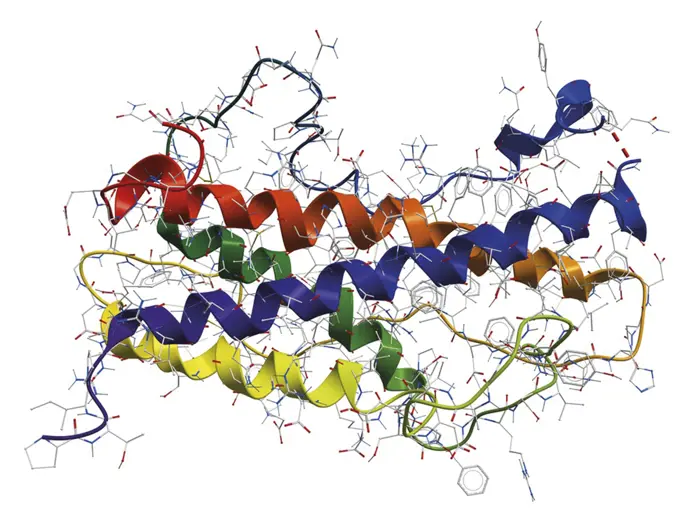
Of every growth-hormone secretagogue in this catalogue, exactly one has cleared a regulator’s bar: Tesamorelin, approved by the FDA in 2010 under the brand Egrifta.23 That single fact is doing an enormous amount of unearned work across the rest of the category. Ipamorelin, CJC-1295 and Sermorelin are routinely sold in the warm glow of Tesamorelin’s licence — yet none of them shares its evidence base, and Tesamorelin’s own approval is far narrower than the borrowed credibility implies.
What exactly is Tesamorelin, mechanistically?
Tesamorelin is a synthetic analogue of human growth-hormone-releasing hormone, specifically the full 44-amino-acid GHRH(1-44) sequence, with an N-terminal trans-3-hexenoyl modification that stabilises the molecule against rapid enzymatic degradation.67 This matters because native GHRH has a half-life measured in minutes; the stabilising group confers resistance to dipeptidyl-peptidase-IV and is what makes a GHRH analogue pharmacologically tractable at all.67 Critically, it does not supply growth hormone. It acts upstream, binding the GHRH receptor on the anterior pituitary and prompting the somatotrophs to release the body’s own GH.56
The distinction is not pedantic. Endogenous GH is secreted in pulses, and a secretagogue that nudges the native axis preserves more of that physiological rhythm7 — and, in principle, more of its feedback braking — than a bolus of recombinant GH would. Tesamorelin’s downstream effects are mediated substantially through insulin-like growth factor 1 (IGF-1), which the liver produces in response to GH and which rises measurably with treatment.35
What did the pivotal human trials actually show?
Tesamorelin’s licence rests on two phase-3 randomised controlled trials in people with HIV who had developed excess visceral abdominal fat35 — a recognised lipodystrophy of long-term antiretroviral therapy.45 The primary endpoint was the change in visceral adipose tissue measured by CT, and the result was consistent: visceral fat fell by roughly 15% over the 26-week treatment period relative to placebo, rising to around 18% across the 52-week data.15 The effect was selective — there was no comparable change in subcutaneous fat or BMI.112 Triglycerides improved alongside it, consistent with the metabolic profile of visceral-fat loss.13 IGF-1 rose, confirming the axis was being engaged as intended.
~15% reduction in CT-measured visceral adipose tissue versus placebo at 26 weeks in the pivotal HIV-lipodystrophy RCT15 — the basis for the FDA approval.
Two features of those trials deserve emphasis because they are routinely omitted. First, the benefit was specific to visceral fat; this was not a general body-recomposition or subcutaneous-fat result. Second, the effect was maintenance-dependent. In the extension phase, patients switched from Tesamorelin to placebo showed partial re-accumulation of visceral fat53, indicating the compound’s action is sustained only while it is continued rather than curative.45
| Compound | Class | Regulatory status | Phase-3 RCT evidence |
|---|---|---|---|
| Tesamorelin | Stabilised GHRH(1-44) analogue | FDA-approved (HIV lipodystrophy) | Yes — two pivotal trials35 |
| Sermorelin | GHRH(1-29) analogue | No current approval in this use | No comparable base |
| CJC-1295 | Long-acting GHRH analogue | Not approved | No comparable base |
| Ipamorelin | Ghrelin/GHS-receptor agonist | Not approved | No comparable base |
Within the GH-secretagogue hub, only Tesamorelin carries a phase-3 evidence base and a marketing authorisation — and only for one narrow indication.
An approval for one disease in one population is the floor of Tesamorelin’s evidence, not a licence to extrapolate it to wellness.
Where is the evidence thin, mixed, or actively concerning?
Here is the honest appraisal the category usually skips. The most-discussed caveat is metabolic: GH is counter-regulatory to insulin, and glucose intolerance is listed among Tesamorelin’s recognised potential adverse effects.34 The picture is genuinely mixed rather than alarmist — the pooled phase-3 analysis reported no clinically meaningful between-group differences in glucose parameters over the trial period15, and a later dedicated study in patients with type 2 diabetes found no deterioration in glucose control.10 The tension is the point: a compound that raises GH and IGF-1 carries a plausible mechanism for worsening the very metabolic dysfunction it was studied in, which is precisely why glucose handling was monitored in the licensed population.4
The boundaries of the evidence are equally important. The pivotal data come from a specific clinical group: people with HIV-associated visceral adiposity. There is no comparably powered phase-3 evidence that the visceral-fat effect generalises to healthy adults seeking body recomposition58, nor any rigorous long-term safety dataset supporting an anti-ageing or longevity application. Raising GH and IGF-1 chronically in otherwise healthy people carries theoretical risks — proliferative and oncological signalling among them, given IGF-1’s role in cell survival and growth67 — that the lipodystrophy trials were never designed to resolve. The re-accumulation of visceral fat on discontinuation further undercuts any framing of a lasting structural benefit.
And the rest of the class? Ipamorelin, CJC-1295 and Sermorelin are frequently presented as interchangeable “GH secretagogues,” but they differ in mechanism — Ipamorelin acts at the ghrelin/GH-secretagogue receptor rather than the GHRH receptor6 — and, more to the point, none carries Tesamorelin’s regulatory standing or trial portfolio. The credibility transfer is rhetorical, not evidential.
So what should a researcher take from the FDA label?
Precisely what it says and no more. Tesamorelin is a real, approved medicine — Egrifta — indicated to reduce excess visceral abdominal fat in HIV-associated lipodystrophy34, prescribed and monitored by clinicians in that defined population.25 “FDA-approved” describes that specific, narrow authorisation; it is not a synonym for “proven safe anti-ageing therapy,” and conflating the two is the single most common error in how this molecule is discussed. The reference material handled in a research setting is not that licensed clinical product, and is not a substitute for it.
This article describes Tesamorelin strictly as a research-use-only reference compound, and reports only what defined studies and named clinical trials observed in their own populations911 — not outcomes any reader should expect. For laboratory work, the integrity of the result depends on the integrity of the material: a 44-residue stabilised peptide is only as trustworthy as its documentation. Identity and purity verification — a Certificate of Analysis with HPLC and mass-spectrometry confirmation of sequence1314, N-terminal modification and purity — is what separates reproducible research from noise, and is the appropriate baseline for any analytical reference of this kind.
- Tesamorelin is a stabilised GHRH(1-44) analogue that drives pulsatile endogenous GH release rather than supplying exogenous GH, and is the only FDA-approved compound in this secretagogue class.
- Its licence is narrow: reduction of excess visceral adipose tissue in HIV-associated lipodystrophy, not general fat loss, body recomposition, or anti-ageing.
- Pivotal RCTs showed visceral-fat reductions of roughly 15% at 26 weeks alongside triglyceride improvements and a rise in IGF-1, but the visceral fat re-accumulated after stopping.
- The metabolic picture is mixed: glucose intolerance is a recognised potential adverse effect of raising GH, even though the pivotal pooled analysis found no clinically meaningful between-group glucose differences.
- Ipamorelin, CJC-1295 and Sermorelin borrow rhetorical credibility from Tesamorelin's approval but have no comparable phase-3 evidence base.
- An approval for one disease in a defined population is not proof of safety as a wellness or longevity intervention; the honest reading is much narrower than the marketing.
Is research-grade Tesamorelin the same thing as Egrifta?
No. Egrifta is the FDA-approved, manufactured-and-monitored medicine prescribed for HIV-associated visceral adiposity in a defined clinical population. A research-use-only reference compound is an analytical material for laboratory work, not a licensed therapeutic. They may share a sequence on paper but differ entirely in regulatory status, intended use, and the quality framework around them. The research material is not a substitute for the medicine.
What does the strongest human evidence for Tesamorelin actually show?
Two phase-3 randomised controlled trials in people with HIV-associated lipodystrophy showed roughly a 15% reduction in CT-measured visceral abdominal fat at 26 weeks versus placebo, with improved triglycerides and a rise in IGF-1 confirming engagement of the GH axis. The effect was specific to visceral fat and partly reversed once treatment stopped. The evidence is solid but narrow; it does not extend to healthy adults or anti-ageing use.
What adverse effects were documented in the trials?
Glucose intolerance is a recognised potential adverse effect mechanistically, because growth hormone is counter-regulatory to insulin, though the pooled phase-3 analysis found no clinically meaningful between-group glucose differences over the studied period. The lipodystrophy trials were not designed to characterise long-term risks of chronically elevated GH and IGF-1 in healthy people, so the broader safety picture beyond the licensed indication remains unestablished rather than reassuring.
Why is Tesamorelin treated differently from Ipamorelin, CJC-1295 and Sermorelin?
Tesamorelin is the only compound in this secretagogue group with an FDA approval and a phase-3 trial portfolio behind it. The others are frequently marketed alongside it as equivalent GH secretagogues, but they differ mechanistically — Ipamorelin acts at the ghrelin receptor, not the GHRH receptor — and none has comparable regulatory standing or rigorous human evidence. The shared category label transfers credibility that the data do not support.