
Tesamorelin vs CJC-1295 vs Sermorelin: The GHRH-Analog Family, Ranked by Evidence
Three peptides chase the same idea — stabilise growth-hormone-releasing hormone so it drives pulsatile GH at the pituitary. They are not three equal options. Sorted by evidence and regulatory status, the hierarchy is steep and worth understanding before equating them.
All three are GHRH analogues meant to drive pulsatile GH release. Tesamorelin is the only FDA-approved agent, backed by randomised trials. Sermorelin had a genuine but narrow regulatory past, withdrawn commercially. CJC-1295 is grey-market, its human data resting essentially on one widely cited 2006 pharmacokinetic study. They are siblings, not equals.
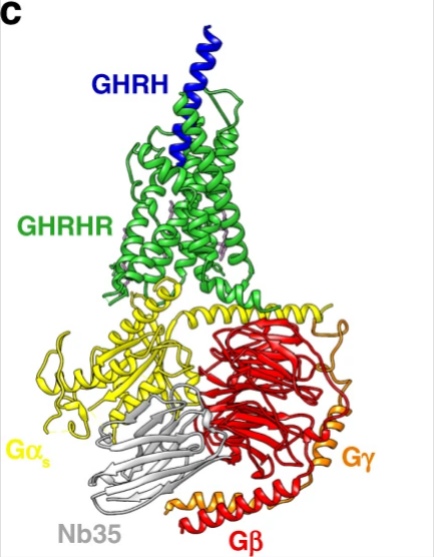
Search any forum and the three names get used interchangeably, as though picking among them were a matter of taste or price. That framing collapses a real hierarchy. Tesamorelin, CJC-1295 and Sermorelin are three generations of one chemical idea — but they sit at wildly different points on the curve that runs from a regulator’s approval letter to a single, decade-old pharmacokinetic paper. The interesting question is not which is “best” but how far the evidence actually travels for each.
What does the GHRH family actually do?
Native growth-hormone-releasing hormone is a hypothalamic peptide that binds the GHRH receptor on pituitary somatotrophs and prompts the synthesis and pulsatile release of growth hormone. Its weakness, pharmacologically, is fragility: the full-length 44-amino-acid hormone is cleaved rapidly in plasma, principally by dipeptidyl peptidase-4 (DPP-4), giving it a half-life measured in minutes.6 The bioactive core was localised to the first 29 residues — GRF(1-29), the fragment from which this whole family descends.1314 Every compound here is an attempt to take that core and make it last, while preserving the crucial feature that distinguishes GHRH analogues from exogenous GH itself: they act upstream, so GH output remains pulsatile and still answerable to negative feedback.
How do the three backbones differ chemically?
The chemistry is where the generations separate. Sermorelin is GRF(1-29) — the unmodified bioactive fragment, the most literal translation of native GHRH into a shorter peptide.14 Tesamorelin is a stabilised analogue of full-length GRF(1-44), carrying an N-terminal acyl modification that resists enzymatic degradation while retaining receptor agonism.63 CJC-1295 is built on Modified GRF(1-29): the 1-29 core with amino-acid substitutions that blunt DPP-4 cleavage.11 The defining fork within CJC-1295 is the optional Drug Affinity Complex (DAC) — a linker designed to bind circulating albumin, dragging the half-life from minutes (no-DAC, “Mod GRF 1-29”) to roughly a week (with-DAC).1110 That single design choice explains why the same name covers two profoundly different kinetic objects.
| Property | Tesamorelin | CJC-1295 | Sermorelin |
|---|---|---|---|
| Backbone | Stabilised GRF(1-44) analogue | Modified GRF(1-29) ± DAC | GRF(1-29), unmodified |
| Mechanism | GHRH-receptor agonist | GHRH-receptor agonist | GHRH-receptor agonist |
| Half-life | Short-acting (minutes) | Minutes (no-DAC) vs ~a week (DAC) | Short-acting (minutes) |
| Regulatory status | FDA-approved (Egrifta) | None; not approved | Formerly approved (Geref), withdrawn |
| Evidence depth | Randomised controlled trials | Essentially one human PK study | Narrow, dated clinical record |
| WADA status | Prohibited at all times (S2) | Prohibited at all times (S2) | Prohibited at all times (S2) |
Head-to-head: the same receptor target, three very different positions on chemistry, kinetics and the strength of the documentary record behind each.
Which one is actually approved?
Only one. Tesamorelin is approved by the FDA as Egrifta for the reduction of excess visceral adipose tissue in HIV-infected patients with lipodystrophy34 — a tightly drawn indication, not a general anti-ageing or body-composition licence. That approval rested on a phase-3 randomised, double-blind, placebo-controlled programme in which the active arm showed reductions in visceral adipose tissue versus placebo.15 This is the deepest evidence base in the family by a wide margin.
Sermorelin’s history is more poignant. As Geref it was a genuinely approved product, used as a diagnostic agent to test pituitary GH reserve14 and, in some markets, as therapy for paediatric GH deficiency.1413 Crucially, it was discontinued for commercial reasons — not because of a safety signal.13 The evidence base is real but narrow and dated, concentrated in diagnostic and paediatric contexts rather than the adult applications it is now informally associated with.
Tesamorelin earned a regulator’s signature; Sermorelin once held one and lost it to the market; CJC-1295 never had one to lose.
CJC-1295 sits outside the regulatory system entirely. It is a research peptide that became a grey-market staple, and no medicines authority has approved it for human therapeutic use.715
How thin is the human evidence for CJC-1295?
Thinner than its popularity implies. The keystone human data point is a single widely cited 2006 study: a phase-1 pharmacokinetic and pharmacodynamic evaluation of CJC-1295 with DAC in healthy adults.11 It reported sustained elevations in GH and IGF-1 consistent with the albumin-binding half-life extension11 — a clean kinetic result. But one phase-1 study is not a programme. There are no large randomised efficacy or long-term safety trials of CJC-1295 in any approved indication, which is precisely why it remains a research compound rather than a medicine. The no-DAC (“Mod GRF 1-29”) variant that dominates informal use has even less dedicated human trial data behind it.79
1 widely cited human pharmacokinetic study underpins CJC-1295 — against a full phase-3 randomised programme for tesamorelin.
What is the honest evidence and safety picture?
Be blunt about the gradient. Tesamorelin carries trial-derived safety characterisation: in its randomised programme the most consistently reported signals concerned injection-site reactions, fluid-related effects and modest impacts on glucose handling, all documented in its labelling.35 Because the GHRH class raises IGF-1, the theoretical concerns that attach to any GH-axis stimulation — glucose tolerance, and the long-running question of IGF-1 and proliferative risk21 — apply across all three, but they are only systematically studied for tesamorelin. Sermorelin’s older record was generally tolerated in its diagnostic and paediatric uses1412, though that evidence does not transfer cleanly to other populations. For CJC-1295, long-term safety in humans is simply not characterised; the single PK study cannot stand in for it.1516
One status they share without nuance: prohibition in sport. Growth-hormone secretagogues and releasing factors fall under the peptide-hormone class (S2) of WADA’s Prohibited List, which means all three — tesamorelin, CJC-1295 and sermorelin alike — are prohibited at all times, in and out of competition.8 There is no in-competition-only carve-out here; for anyone in a tested sport, the GHRH family is uniformly off-limits.89
Are they interchangeable?
No — and that is the point of laying them side by side. They converge on one receptor and one downstream effect, but they diverge on everything that determines confidence: kinetic profile, regulatory standing, and the sheer volume of human data. Treating CJC-1295’s single PK study as equivalent to tesamorelin’s trial programme is a category error1516, not a shortcut. The family resemblance is real; the evidentiary distance between the eldest and youngest sibling is enormous.
Everything described here is supplied strictly as research-use-only reference material for in-vitro and laboratory investigation, and is not the licensed medicine to which any approval above refers. Where tesamorelin is approved as Egrifta, that authorisation attaches to a finished pharmaceutical product, not to research-grade peptide. Each lot supplied for research carries a Certificate of Analysis with HPLC and mass-spectrometric confirmation of identity and purity10, so that the material in the vial matches the sequence on the label — the minimum standard for any work that hopes to be reproducible.
- All three are synthetic analogues of growth-hormone-releasing hormone (GHRH) designed to bind the pituitary GHRH receptor and provoke pulsatile GH secretion.
- Tesamorelin (Egrifta) is the only one with FDA approval and randomised controlled trial evidence, licensed narrowly for HIV-associated visceral fat.
- Sermorelin (GRF 1-29) was once marketed as Geref for diagnostic and paediatric use and withdrawn for commercial, not safety, reasons; its evidence base is narrow.
- CJC-1295 (Modified GRF 1-29) is the grey-market favourite; the DAC variant extends half-life from minutes to roughly a week, but human evidence rests largely on a single 2006 study.
- The honest caveat: depth of evidence diverges sharply across the three, and an approved licensed medicine is not the same thing as research-grade reference material.
- All three are growth-hormone secretagogues and so prohibited at all times in sport under the WADA Code's S2 category.
Which of these three is actually approved by regulators?
Tesamorelin is the only one with current approval, granted by the FDA as Egrifta for HIV-associated visceral fat. Sermorelin was formerly approved as Geref but was withdrawn for commercial, not safety, reasons. CJC-1295 has never been approved for human therapeutic use anywhere.
Are tesamorelin, CJC-1295 and sermorelin interchangeable?
No. They share the same GHRH-receptor target and produce pulsatile GH release, but they differ sharply in chemistry, half-life, regulatory status and depth of human evidence. Equating them ignores that one has randomised trial backing while another rests on a single pharmacokinetic study.
What is the main safety difference between them?
Tesamorelin has trial-derived safety characterisation in its approved population. Sermorelin's older diagnostic and paediatric record was generally tolerated but narrow. CJC-1295's long-term human safety is essentially uncharacterised. Class-level questions around glucose handling and IGF-1 apply to all three but are only systematically studied for tesamorelin.
What is the half-life difference, and why does the DAC matter for CJC-1295?
Native GHRH lasts minutes. Tesamorelin and sermorelin remain short-acting. CJC-1295's Drug Affinity Complex (DAC) binds albumin and extends the half-life from minutes to roughly a week, which is why "CJC-1295" can describe two very different kinetic profiles depending on whether DAC is present.
Are these compounds permitted in tested sport?
No. The GHRH-analog class is prohibited under the WADA Code as growth-hormone secretagogues and releasing factors in the S2 category. That means all three are prohibited at all times, in and out of competition — there is no in-competition-only distinction among them.