Encapsulated · ≥99% (HPLC) ·
Supplied as encapsulated research material. Laboratory preparation depends on the experimental protocol.
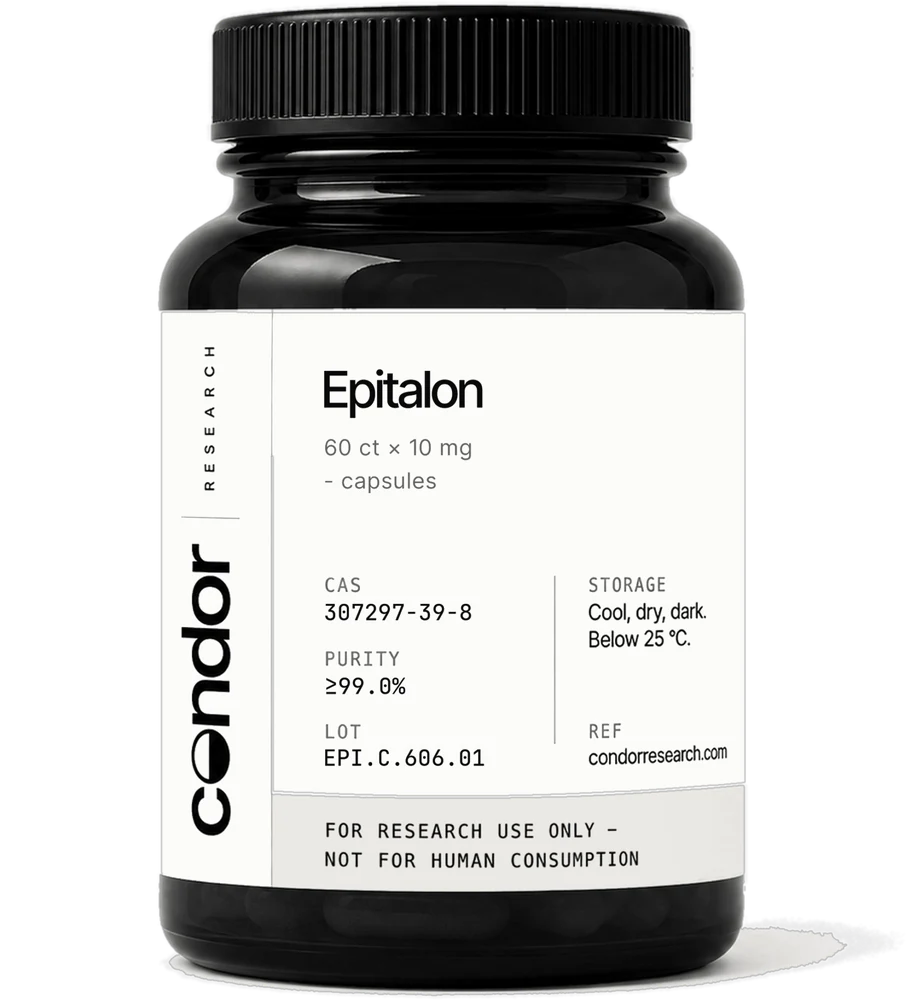
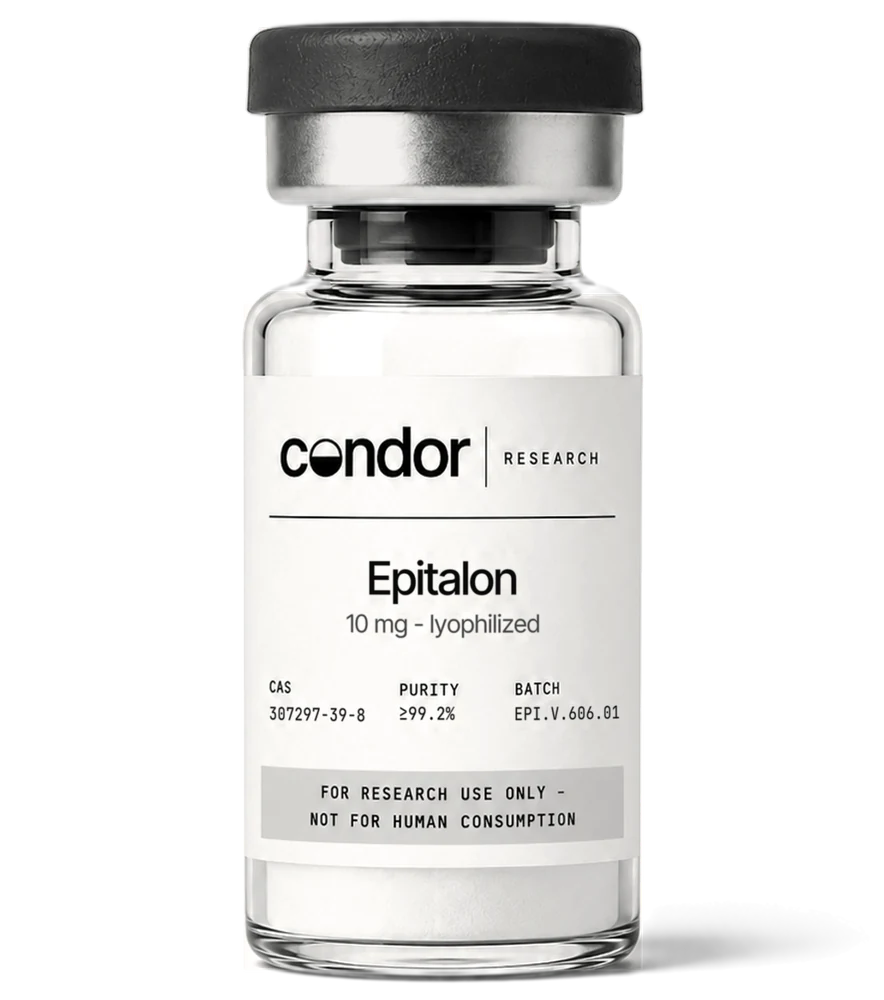
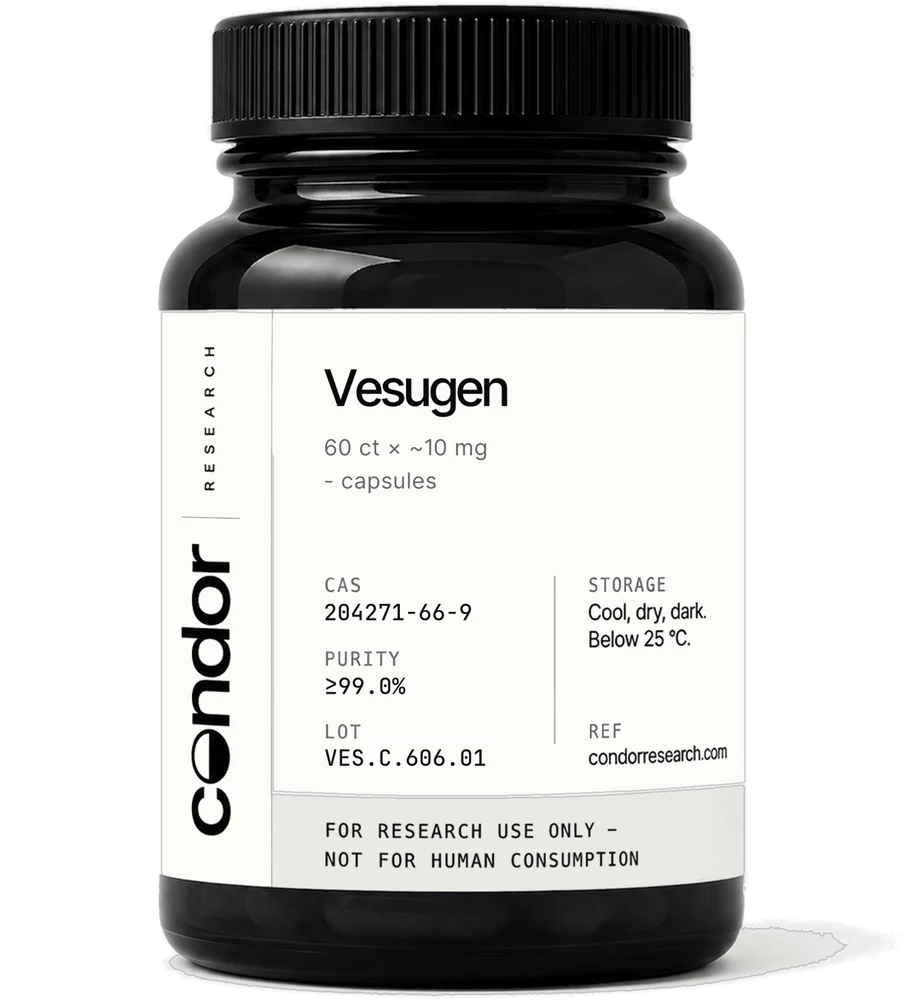
Format: pre-weighed capsules, 60 × 10 mg. Each HPMC capsule seals the same 10 mg of solid Epitalon, so every unit in the bottle (600 mg in total) is an identical analytical reference quantity. If your work starts from a single bulk quantity in solution, the separate Epitalon 10 mg lyophilised vial is the format to use. For laboratory research use only. Not for human or veterinary use.
Epitalon (Epithalon) is a synthetic tetrapeptide (Ala-Glu-Asp-Gly) analogue of the endogenous pineal polypeptide complex epithalamin, studied for its role in telomerase activation, telomere elongation, and neuroendocrine regulation in in vitro and animal models. CAS 307297-39-8; molecular formula C14H22N4O9; molecular weight 390.35 g/mol. For laboratory research use only; not for human or veterinary use.
In the centre of the brain sits the pineal gland, a structure that shrinks and slows with age. From an extract of that gland — epithalamin — Soviet researchers distilled a sequence of just four amino acids and synthesised it anew. That sequence is Epitalon (AEDG), a tetrapeptide that has since become one of the most-studied tools in the laboratory science of cellular ageing.
A synthetic peptide modelled on the pineal gland. Epitalon's appeal to researchers lies in its smallness: four residues, Ala-Glu-Asp-Gly, short enough to be a clean experimental probe yet biologically active in cell and animal systems. A dedicated review has catalogued it as a highly bioactive pineal tetrapeptide of broad research interest (Araj et al., 2025), and its place within the wider field of peptide bioregulators studied for healthy-ageing endpoints has been mapped in the gerontology literature (Mavrych et al., 2026).
What the research explores. Across cell-culture and animal systems, Epitalon has been investigated along several converging lines:
The activity described here is drawn from in-vitro and animal studies; it characterises biological behaviour in experimental models and does not establish efficacy or safety in humans. Full citations are listed under the Scientific References tab.
Physicochemical profile. CAS No. 307297-39-8 · Molecular formula C14H22N4O9 · Molecular weight 390.35 g/mol · Sequence Ala-Glu-Asp-Gly (4 aa) · Appearance: White lyophilized powder · Solubility: Soluble in water.
Specification & quality. Each bottle contains 60 HPMC (vegan) capsules, each providing 10mg of Epitalon at ≥99% (HPLC). Encapsulated — no reconstitution required. Every batch is independently third-party tested, and a Certificate of Analysis (COA) is available. Store at -20°C, protect from light and moisture; shelf life 24 months from the manufacture date. EU warehoused.
This product is intended for laboratory research use only (RUO). It is not a drug, food, cosmetic, or dietary supplement, and is not for human or veterinary use, ingestion, or diagnostic application. Handling is restricted to qualified research professionals operating in an appropriately equipped laboratory.
Quantities are analytical reference quantities (mass per unit), not doses, and the capsule format is not intended for ingestion. Working from one bulk quantity in solution instead? See the Epitalon 10 mg lyophilised vial. For laboratory research use only. Not for human or veterinary use.
| Parameter | Specification |
|---|---|
| Format | Hard capsule, solid fill, no liquid phase |
| Content per unit | See the product specification above (Content per unit) |
| Shell | HPMC (hypromellose, plant-derived) |
| Excipient or filler | Not stated in the product record |
| Compound | Ala-Glu-Asp-Gly (4 residues) |
| CAS number / formula | 307297-39-8 / C14H22N4O9 |
| Purity as listed | ≥99% (HPLC) |
| Reconstitution | None; the capsule is a solid format |
| Storage | −20 °C, protected from light and moisture; 24-month shelf life from manufacture |
| Corresponding vial | Epitalon lyophilised vial |
Content per unit is a specification of the material, not a recommendation of any use.
A pre-weighed solid unit is characterised differently from a bulk vial. In a vial, the analytical question is the composition of one sealed quantity and the behaviour of the reconstituted solution. In a capsule it is also the variation between units. The compendial methods below are the reference procedures a laboratory can apply to this format; this table describes the methods and does not report results.
| Attribute | Reference method | What it establishes for a capsule | Vial counterpart |
|---|---|---|---|
| Uniformity of content between units | Ph. Eur. 2.9.40 Uniformity of dosage units; USP <905> Uniformity of Dosage Units | Spread of individual unit content around the nominal value, by assay of individual units (content uniformity) or by mass variation | Not applicable; one unit per vial |
| Release of the content into a medium | Ph. Eur. 2.9.3 Dissolution test for solid dosage forms; USP <711> Dissolution | Rate and extent to which the fill enters a defined medium under defined apparatus and agitation; shell opening is part of the measurement | Reconstitution behaviour, which is a solubility observation rather than a release profile |
| Identity and purity of the content | HPLC with UV detection; LC-MS for mass identity | Retention behaviour, peak purity and measured molecular mass of the fill, together with related substances | Same methods apply to the lyophilised cake |
| Water content | Karl Fischer titration (Ph. Eur. 2.5.12 Water: semi-micro determination; USP <921> Water Determination) | Residual water in the fill, which bears on the storage stability of a solid peptide | Same method applies to the lyophilised cake |
| Shell and unit integrity | Visual inspection, unit mass and closure check | Intact, correctly closed units of uniform appearance | Seal and cake appearance |
Method. PubMed was searched on 2026-10-18 for the names and sequence of Epitalon combined with simulated gastric fluid, simulated intestinal fluid, gastric juice, INFOGEST, in vitro digestion, Caco-2, intestinal permeability and oral administration (title and abstract). Records were classified from the abstract by model and by what was reported. Quantities administered were not extracted. The results describe laboratory and animal models and are not a statement about people.
| Model | Records | What was reported | n |
|---|---|---|---|
| Simulated gastric or intestinal fluid; static or dynamic in vitro digestion (INFOGEST-type) | 0 | No study found | — |
| Caco-2 monolayer or other intestinal permeability model | 0 | No study found | — |
| Animal studies with the oral route stated | 3 | Rat studies of host intestinal enzyme activity and transport; the peptide itself was not measured. Stability or absorption of the peptide: not reported. Khavinson et al., 2002, Bull Exp Biol Med (PMID 12360355); Khavinson et al., 2002, Bull Exp Biol Med (PMID 12420071); Khavinson et al., 2002, Bull Exp Biol Med (PMID 12660839) | Not stated in abstracts |
| Animal studies of gastrointestinal endpoints, route not stated in the abstract | 3 | Enzyme activity or tissue morphology; peptide not measured. Not counted as oral. Morozov et al., 2015, Bull Exp Biol Med (PMID 26519279); Svechkina et al., 2006, Adv Gerontol (PMID 17152723); Khavinson et al., 2001, Bull Exp Biol Med (PMID 11427924) | Not stated in abstracts |
Under this query no study reports the stability of epitalon in simulated gastric or intestinal fluid, in a digestion model or in Caco-2 monolayers. The only studies with a stated oral route are rat studies of the host's intestinal enzymes and transport, which did not measure the peptide. Gastrointestinal stability of this tetrapeptide is therefore undocumented in the indexed literature. That is a gap, not evidence of stability or of instability.
Reference methods for designing such a study: the INFOGEST static in vitro digestion protocol (Brodkorb et al., 2019, Nat Protoc; PMID 30886367; doi:10.1038/s41596-018-0119-1) and the Caco-2 permeability protocol (Hubatsch et al., 2007, Nat Protoc; PMID 17853866; doi:10.1038/nprot.2007.303). The INFOGEST protocol was developed for food digestion, so its use with a peptide reagent is an adaptation, not a validated standard for this compound.
| Design requirement | Vial (bulk, reconstituted) | Capsule (identical solid units) |
|---|---|---|
| Concentration series or titration in solution | Suited: one quantity is dissolved and diluted to any concentration | Each unit fixes the mass; a series needs several units or a stock prepared from them |
| Cell-culture work needing a sterile stock | Suited: a stock is prepared directly from the vial | Requires the fill to be recovered and dissolved; the shell is a further variable |
| Replicates from identical units | Replicates depend on repeated aliquoting of one solution | Suited: identical units of fixed nominal content |
| Release or digestion models that start from a solid unit | Not representative of a unit format | Suited: the experiment starts from a solid unit with a defined shell |
| Gravimetric standardisation of small quantities | Weighing is repeated by the user | Mass per unit is fixed in advance |
| Stability of the compound as a bulk solid | Lyophilised cake in a sealed vial | Solid in a shell; depends on the shell and closure |
Search date for this block: 2026-10-18. For laboratory research use only. Not for human or veterinary use.
Supplied for in-vitro laboratory research use only (RUO). Not a drug, food or supplement; not for human or veterinary use.
Certificate of Analysis — lot-specific COA ships with every order and is available on request.
Each lot is tested by an independent third-party laboratory for identity (mass spectrometry) and purity (HPLC). The Certificate of Analysis for your specific batch ships with the order and is available on request — no house data, no exceptions.
References are illustrative of the research literature surrounding this compound. All claims relate to in-vitro and animal models only.
Choose the capsules when a protocol needs identical, pre-weighed units — 10 mg each, 600 mg per bottle — for example in replicate or blinded designs. Choose the separate 10 mg lyophilised vial when the work starts from one bulk quantity reconstituted to a chosen concentration. For laboratory research use only. Not for human or veterinary use.
Epitalon (AEDG) is a synthetic tetrapeptide modelled on the natural pineal extract epithalamin, investigated for telomerase activity, gene-expression and ageing-related endpoints in cell and animal models. Its short four-residue sequence makes it a widely used experimental probe in laboratory ageing research. Condor Research supplies it strictly as a Research Use Only reference compound for in vitro and animal studies, not as a medicine, supplement or product for human or veterinary use.
Epitalon is a four-residue tetrapeptide (Ala-Glu-Asp-Gly) studied mainly for telomerase and cellular-ageing endpoints, while Pinealon is a three-residue tripeptide (Glu-Asp-Arg) studied chiefly for neuroprotection and antioxidant defence in neuronal models. They are related members of the short-peptide bioregulator field but have distinct sequences and research focuses. Both are supplied only as research-use-only reference compounds.
Epitalon is studied for systemic ageing markers such as telomere length and pineal/circadian regulation, whereas Cortagen (AEDP) is a cytogen-class peptide associated in research with peripheral nerve and connective tissue. Each bioregulator is investigated for tissue- or pathway-specific questions rather than a single shared effect. All are offered exclusively for laboratory research use, not for human or veterinary use.
No — they belong to entirely different chemical classes. Epitalon is a four-amino-acid peptide studied for telomerase and gene-expression endpoints, while NMN is a nucleotide precursor studied in NAD+ metabolism pathways. They probe different mechanistic questions in ageing-related research and are not interchangeable. Both are supplied solely as Research Use Only reference compounds.
Yes. Condor Research supplies Epitalon strictly as a Research Use Only reference compound to professionals and institutions, not as a medicine, supplement or product for human or veterinary use. Buyers are responsible for confirming import legality in their own country. Questions: info@condorresearch.com.
The capsule is a pre-weighed, encapsulated solid format that makes a fixed quantity of reference compound convenient to store, inventory and handle in the laboratory. Each HPMC (vegan) capsule holds an accurately measured amount of material with no reconstitution required. This format is purely a research handling convenience and does not imply or permit any form of consumption. For laboratory research use only. Not for human or veterinary use.
No. The compound is already encapsulated as a solid lyophilized powder, so no reconstitution is needed for storage or handling. Researchers preparing experimental solutions follow their own validated protocols; Epitalon is described as water-soluble. It is a laboratory reference material for research use only and not for human or veterinary use.
Each bottle contains 60 HPMC (vegan) capsules, with 10mg of Epitalon per capsule at ≥99% HPLC purity. Every batch is independently third-party tested. The per-capsule quantity is the mass of reference compound for laboratory measurement only and is not a dose for human or veterinary use.
Epitalon has CAS No. 307297-39-8, molecular formula C14H22N4O9 and a molecular weight of 390.35 g/mol, with the sequence Ala-Glu-Asp-Gly (4 aa). It presents as a white lyophilized powder that is soluble in water. These specifications are provided for research characterisation purposes only.
Yes. Every Epitalon batch is tested by an independent third-party laboratory by HPLC for identity and purity (≥99%), and each lot ships with a lot-specific Certificate of Analysis. To request the COA for your batch, contact info@condorresearch.com. The COA documents analytical quality for research use only.
Store at -20°C, protected from light and moisture, to preserve compound integrity across the stated 24-month shelf life from the manufacture date. The product is EU warehoused to support stability in transit. It is supplied for laboratory research use only and is not for human or veterinary use, ingestion, or diagnostic application.
Condor Research supplies Epitalon Capsules directly, dispatched from our EU facility in Slovakia to the EU, EEA, UK and Switzerland. Deliveries to EU destinations clear no third-country customs, and shipping is calculated at checkout. Supplied strictly as a research-use-only reference material — not for human or veterinary use.
No verified reviews yet.
Leave a review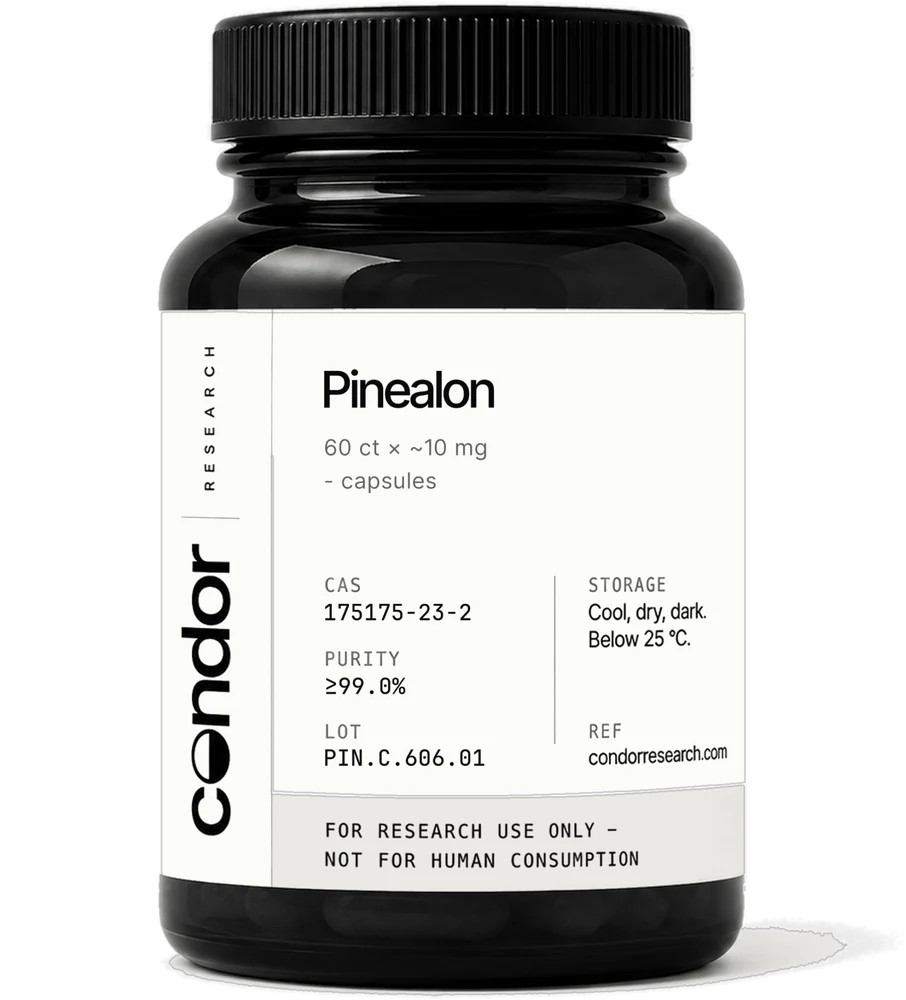
Cookies
We use strictly necessary cookies to run the store. With your consent we also use analytics (order attribution) and marketing (Omnisend) cookies. Read our Cookie Policy.