Lyophilised · ≥99% (HPLC) ·
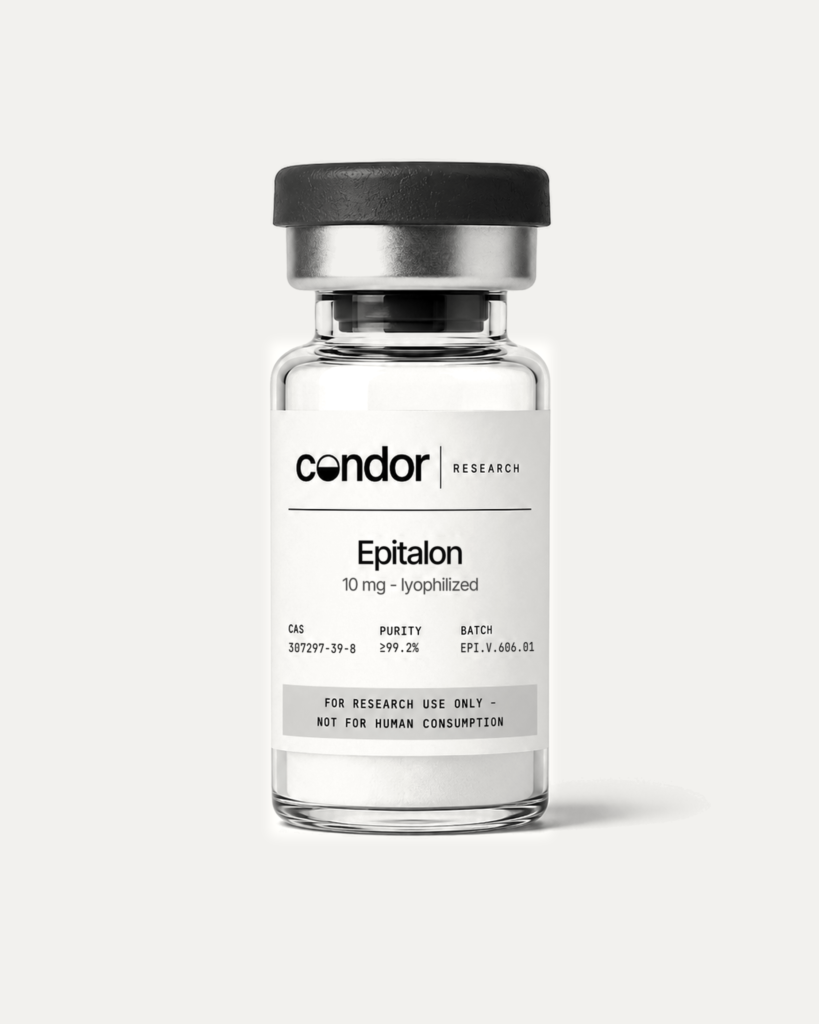
Supplied lyophilised. Reconstitution typically uses bacteriostatic water.
Vesugen is a synthetic tripeptide bioregulator (Lys-Glu-Asp; sequence L-Lysyl-L-glutamyl-L-aspartic acid) derived from the vascular wall, developed within the Khavinson peptide bioregulator programme and studied in models of vascular endothelium function, angiogenesis, and cardiovascular tissue regulation. Molecular formula C15H26N4O8; molecular weight 390.39 g/mol; purity HPLC ≥99%. Supplied as encapsulated powder for laboratory research use only; not for human or veterinary use.
The shortest peptides in the cytogen family encode their proposed selectivity in just three letters. Vesugen is the tripeptide Lys-Glu-Asp (KED), a short peptide bioregulator that research has associated specifically with the vascular wall. Like its cytogen relatives, it sits in a small, early-stage literature, and we present it plainly as an experimental reference compound rather than a proven one.
A vascular-associated cytogen peptide. The interest in KED rests on the broader hypothesis that very short peptides can act as tissue-selective regulators of gene expression. The sequence has been examined for molecular-genetic effects on neurogenesis-related signalling in disease models (Khavinson et al., 2021), and KED appears within wider studies of how short peptides modulate gene expression in ageing human mesenchymal stem-cell cultures (Ashapkin et al., 2020). These remain mechanistic, model-system observations.
What the research explores. Across cell-culture and animal systems, Vesugen has been investigated along several converging lines:
The activity described here is drawn from in-vitro and animal studies; it characterises biological behaviour in experimental models and does not establish efficacy or safety in humans. Full citations are listed under the Scientific References tab.
Physicochemical profile. Molecular formula C15H26N4O8 · Molecular weight 390.39 g/mol · Sequence Lys-Glu-Asp (3 aa) · Appearance: White lyophilized powder · Solubility: Soluble in water.
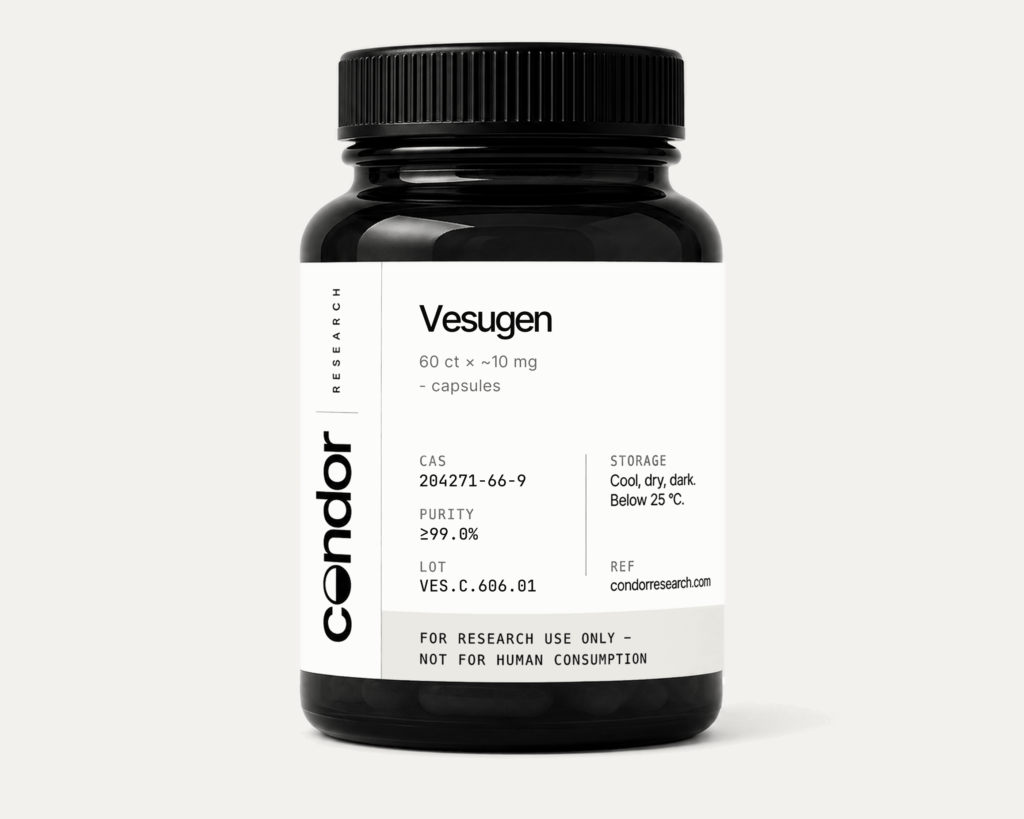
Specification & quality. Each bottle contains 60 HPMC (vegan) capsules, each providing 10mg of Vesugen at ≥99% (HPLC). Encapsulated — no reconstitution required. Every batch is independently third-party tested, and a Certificate of Analysis (COA) is available. Store at -20°C, protect from light and moisture; shelf life 24 months from the manufacture date. EU warehoused.
This product is intended for laboratory research use only (RUO). It is not a drug, food, cosmetic, or dietary supplement, and is not for human or veterinary use, ingestion, or diagnostic application. Handling is restricted to qualified research professionals operating in an appropriately equipped laboratory.
Supplied for in-vitro laboratory research use only (RUO). Not a drug, food or supplement; not for human or veterinary use.
Certificate of Analysis — lot-specific COA ships with every order and is available on request.
Each lot is tested by an independent third-party laboratory for identity (mass spectrometry) and purity (HPLC). The Certificate of Analysis for your specific batch ships with the order and is available on request — no house data, no exceptions.
References are illustrative of the research literature surrounding this compound. All claims relate to in-vitro and animal models only.
Vesugen (KED) is a short three-amino-acid peptide of the cytogen bioregulator class, associated in research with the vascular wall and studied for endothelial gene-expression and tissue-maintenance endpoints in experimental models. Its published literature is small and preclinical in character. Condor Research supplies it strictly as a Research Use Only reference compound for in vitro and animal studies, not as a medicine, supplement or product for human or veterinary use.
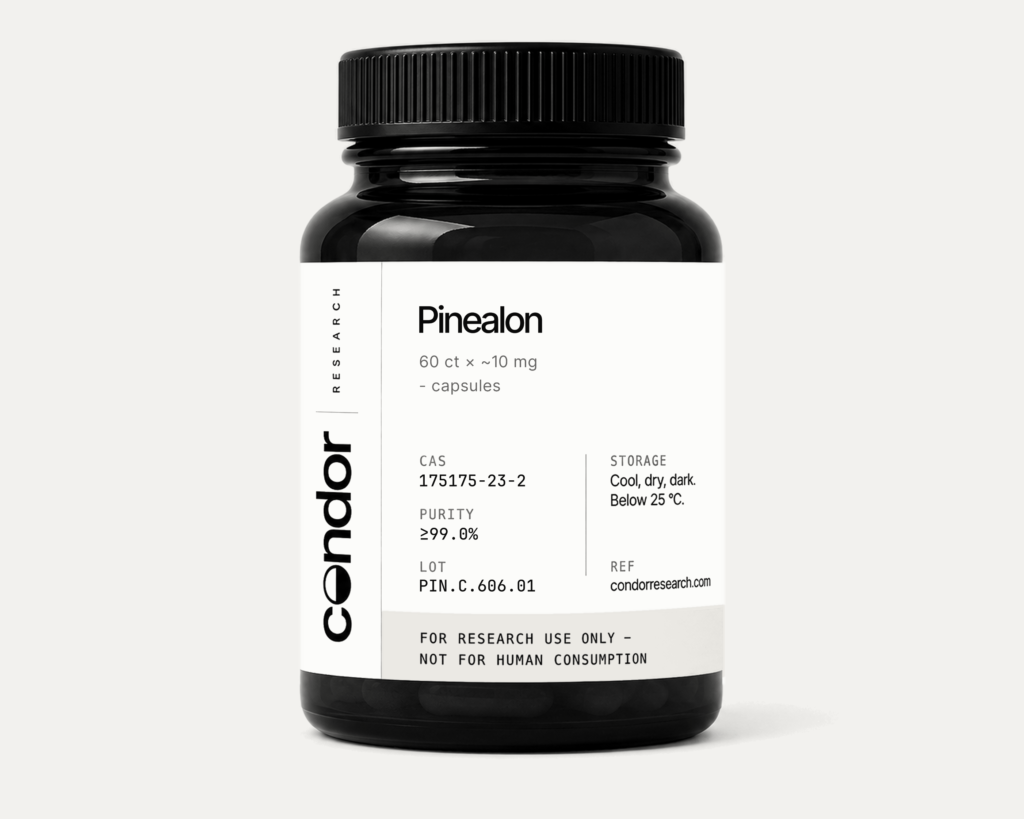
Both are three-residue cytogen-class peptides studied in early-stage models, but their proposed tissue associations differ: Vesugen (KED, Lys-Glu-Asp) is linked in research to the vascular wall, while Pinealon (EDR, Glu-Asp-Arg) is examined in neuronal and brain-ageing models. They probe different research questions despite a shared peptide class. Both are supplied only as research-use-only reference compounds.
Vesugen (KED) is a tripeptide associated in research with vascular tissue, whereas Cortagen (AEDP) is a tetrapeptide associated with peripheral nerve and connective tissue. Each is investigated for tissue- and pathway-specific gene-expression endpoints rather than a single shared effect, and both rest on narrow preclinical literatures. Each is offered exclusively for laboratory research use, not for human or veterinary use.
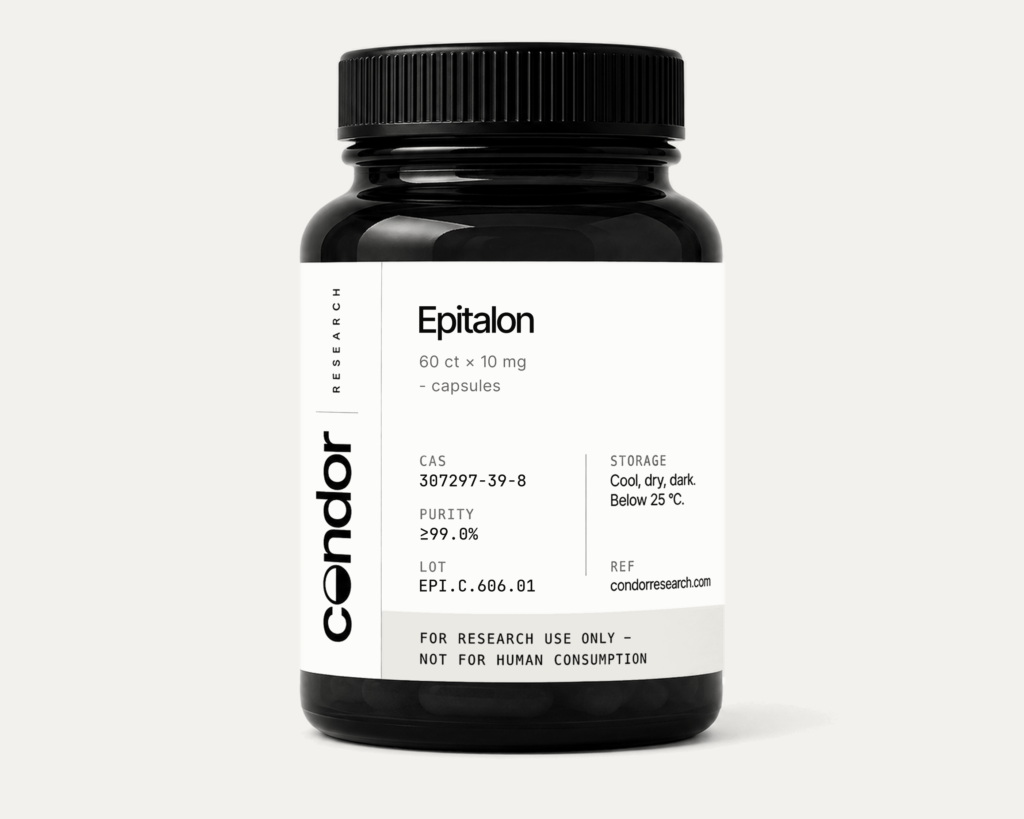
No. Vesugen is a three-residue vascular-associated cytogen peptide, while Epitalon is a four-residue pineal-derived tetrapeptide studied for telomerase and ageing endpoints. They differ in sequence, proposed tissue selectivity and research focus, and address distinct experimental questions. Both are supplied solely as Research Use Only reference compounds.
Yes. Condor Research supplies Vesugen strictly as a Research Use Only reference compound to professionals and institutions, not as a medicine, supplement or product for human or veterinary use. Buyers are responsible for confirming import legality in their own country. Questions: info@condorresearch.com.
Vesugen is an experimental peptide with a narrow, predominantly preclinical literature focused on cell-culture and gene-expression model systems (Khavinson et al., 2021; Ashapkin et al., 2020). Its proposed vascular selectivity is a research hypothesis, not an established effect in humans. We describe it honestly as a research probe, supplied for laboratory research use only and not for human or veterinary use.
The capsule is a pre-weighed, encapsulated solid format that makes a fixed quantity of reference compound convenient to store, inventory and handle in the laboratory. Each HPMC (vegan) capsule holds an accurately measured amount of material with no reconstitution required. The format is a research handling convenience and does not imply or permit any form of consumption. For laboratory research use only. Not for human or veterinary use.
Each bottle contains 60 HPMC (vegan) capsules, with 10mg of Vesugen per capsule at ≥99% HPLC purity. Every batch is independently third-party tested. The per-capsule quantity is the mass of reference compound for laboratory measurement only and is not a dose for human or veterinary use.
Vesugen has the molecular formula C15H26N4O8 and a molecular weight of 390.39 g/mol, with the sequence Lys-Glu-Asp (3 aa). A verified CAS number is not assigned for this compound, so none is listed. It presents as a white lyophilized powder that is soluble in water, and these specifications are provided for research characterisation purposes only.
Yes. Every Vesugen batch is tested by an independent third-party laboratory by HPLC for identity and purity (≥99%), and each lot ships with a lot-specific Certificate of Analysis. To request the COA for your batch, contact info@condorresearch.com. The COA documents analytical quality for research use only.
Store at -20°C, protected from light and moisture, to preserve compound integrity across the stated 24-month shelf life from the manufacture date. The product is EU warehoused to support stability in transit. It is supplied for laboratory research use only and is not for human or veterinary use, ingestion, or diagnostic application.
Condor Research supplies Vesugen Capsules directly, dispatched from our EU facility in Slovakia to the EU, EEA, UK and Switzerland. Deliveries to EU destinations clear no third-country customs, and shipping is calculated at checkout. Supplied strictly as a research-use-only reference material — not for human or veterinary use.
No verified reviews yet.
Leave a reviewCookies
We use strictly necessary cookies to run the store. With your consent we also use analytics (order attribution) and marketing (Omnisend) cookies. Read our Cookie Policy.