
What is Epitalon? The microgram hypothesis and the dose the internet keeps getting wrong
A four-letter peptide carries a decades-old case of mistaken identity. A 2026 re-examination argues the famous dose was never Epitalon's at all — and that the difference is a lesson in why what is in the vial matters more than the label on it.
Epitalon (AEDG; Ala-Glu-Asp-Gly) is a synthetic tetrapeptide studied in cell and animal models for telomere, circadian and antioxidant biology. It is a Research Use Only reference compound — not a medicine, and not for human or veterinary use. It is frequently confused with Epithalamin, a crude pineal extract.
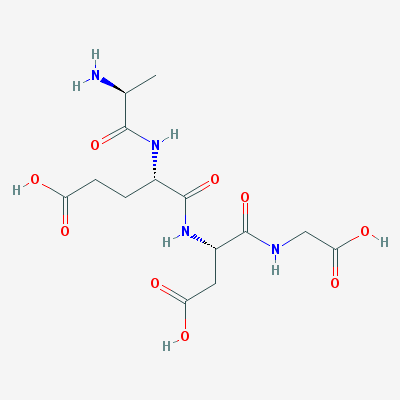
Somewhere on the internet, a number is being copied. “5 to 10 milligrams.” It appears on forums, in supplement explainers, in the confident voice of people who have never seen a chromatogram. It is presented as the Epitalon dose — the figure for a synthetic peptide just four amino acids long. There is only one problem. That number did not come from Epitalon. It came from something else entirely: a crude, brownish soup of bovine glandular tissue that Soviet gerontologists were injecting into rats half a century ago. The peptide and the soup have been treated as the same thing for so long that almost nobody stops to notice they are not. A 2026 paper finally did.16
What is Epitalon?
Epitalon — also written AEDG, sometimes Epithalon — is a synthetic tetrapeptide with the sequence Ala-Glu-Asp-Gly. That is the whole molecule: four amino acid residues strung in a defined order, with the formula C14H22N4O9, a molecular weight of 390.34, and a CAS number, 307297-39-8, that points to one substance and no other (chemical registry data). It is small enough to write on a fingernail and specific enough to be identified unambiguously by a mass spectrometer.1
In the laboratory it has been a curiosity for years. Researchers have studied AEDG in cell and animal models for its effects on telomere and telomerase biology, on the expression of genes that govern circadian rhythm in the pineal gland, and on antioxidant and free-radical processes.11012 In human cell lines it has been reported to lengthen telomeres, apparently by upregulating telomerase or engaging the alternative ALT pathway;6 in bovine oocytes it has been linked to telomerase activation and improved post-thaw embryo development;8 in an in-vitro diabetic-retinopathy model it has been described as enhancing delayed wound healing.7 All of this is preclinical — cells in dishes, gametes in cryostraws, rodents in cages. None of it is a clinical fact about people.
Epitalon vs Epithalamin: what is the difference?
To understand the dose confusion you have to go back to the lineage. In the 1970s and 1980s, Russian researchers — Anisimov, Khavinson, Morozov and colleagues — were working with Epithalamin, a crude polypeptide extract of the bovine pineal gland.24 Crude is the operative word. Epithalamin is not a molecule; it is a preparation, a mixture of many peptides and proteins pulled from glandular tissue, most of which is biologically inert ballast. The geroprotective and antioxidant effects they catalogued over twenty years — in rats, in humans, against free-radical oxidation — were all observed with this mixture.34515
Epitalon is what you get when you distil that lineage down to a single hypothesised active fragment and make it cleanly, synthetically: the defined AEDG tetrapeptide.110 Think of it as the difference between a whole orange and a few milligrams of purified vitamin C. You would not dose the pill the way you dose the fruit. Yet for Epitalon, that is precisely the error that propagated.
| Epithalamin | Epitalon (AEDG) | |
|---|---|---|
| What it is | Crude bovine pineal-gland extract | Pure synthetic tetrapeptide |
| Composition | Many peptides and proteins, mostly inactive | One defined sequence: Ala-Glu-Asp-Gly |
| Origin | Original Russian/Soviet extract studies | Distilled, chemically synthesised form |
| Why the dose differs | Large mass, mostly inert ballast | Small mass, defined active peptide |
A crude tissue extract and a single purified peptide are not interchangeable — and their meaningful quantities are not the same order of magnitude.16
Where did the famous dose come from?
This is the heart of the 2026 paper by Jung, bluntly titled The microgram hypothesis: a translational dosing error in Epitalon peptide research.16 Its argument is forensic. The “5–10 mg” convention that circulates as Epitalon’s dose, Jung shows, derives from the Epithalamin literature — from milligram quantities of crude extract, the overwhelming majority of which was never the peptide in question.16 Carry that figure across to a purified tetrapeptide and you are, in effect, quoting the weight of the whole orange while holding a single vitamin tablet.
Using comparative potency analysis and allometric scaling of the effective murine research dose, the paper estimates a human-equivalent in the microgram range — roughly 190 to 230 micrograms per treatment day for a 70-kg human — explicitly as a translational estimate to guide future dose-finding studies, not as guidance for anyone to take.16 The gap is roughly a thousandfold. If Jung is right, a great deal of what has been said about this peptide rests on a number that was off by three orders of magnitude from the start, simply because nobody distinguished the extract from the molecule.
The 2026 re-examination estimates a microgram-range human-equivalent (about 190–230 µg/day for a 70-kg human) against the milligram convention — an apparent thousandfold gap rooted in confusing a crude extract with a pure peptide. The figure is a translational estimate for future dose-finding research only.16
Why might more not be better?
Here the paper turns from arithmetic to biology, and finds something that should give any “more is better” instinct pause. In an in-vitro telomere assay, Jung reports a non-monotonic concentration-response: telomere elongation rose with concentration, peaked at around 0.2 micrograms per millilitre, and then declined as the concentration climbed higher.16 The dose-response curve is not a ramp but a hill. Past the summit, adding more does less.
This is the opposite of the intuition that built the milligram convention. It suggests — in this one in-vitro system — that the effect lives in a narrow window, and that overshooting it may blunt the very response you were chasing. It is one more reason the identity question is not pedantry. If the active quantity is small and the window is narrow, then knowing precisely how much of the actual peptide is present stops being a footnote and becomes the whole experiment.
How strong is the human evidence, honestly?
Thin, and we should say so plainly. The Jung paper is a hypothesis-generating re-examination — a re-analysis and a translational estimate, not a clinical result.16 No human trials have established any dose of Epitalon for anything. The microgram figure is a modelled projection for future dose-finding work; the milligram figure it critiques was a misattribution from the extract era. No dosing guidance for people follows from any of this.
The substantive literature is overwhelmingly preclinical: human and animal cell lines, rodent and bovine models, in-vitro systems for telomerase, oocyte maturation, neurogenesis and circadian gene regulation.6891011 The older human-relevant observations belong to the Epithalamin extract, not the purified peptide.23 Recent reviews place Epitalon in the broader landscape of peptides examined in gerontology research, but contextually, not as a settled therapy.117 The honest summary is that this is an interesting molecule with a tangled provenance and a long way to go before any human claim is earned.
Why identity and purity decide everything
There is a small, telling detail in the record. In 2015, forensic analysts identified the research tetrapeptide Epitalon in two illegal pharmaceutical preparations — meaning that what reaches the grey market and what the label claims are frequently two different things.13 The entire Epithalamin-versus-Epitalon mix-up is the same problem written large: a failure of identity. A crude extract and a defined peptide got the same name, and a thousandfold error rode along for decades.
That is why, for Research Use Only work, what is in the vial is the only question that matters. Condor Research supplies Epitalon as a reference compound for laboratory research only — not a medicine, not for human or veterinary use, with no consumption implied. Each vial contains 10 mg of the defined AEDG tetrapeptide, ≥99% by HPLC, stored at −20°C, with identity confirmed by mass spectrometry, purity quantified by HPLC, and a per-batch Certificate of Analysis documenting both. The historical confusion happened precisely because nobody could say, with certainty, what was in the preparation. Being able to say exactly that — one sequence, characterised, batch by batch — is not a marketing line. It is the difference between doing science and repeating a number.
- Epitalon is a single, defined synthetic tetrapeptide — sequence Ala-Glu-Asp-Gly (AEDG), CAS 307297-39-8, molecular weight 390.34 per chemical registry data — not a mixture.<sup><a href="#references">1</a></sup>
- The widely repeated milligram dose figure traces to Epithalamin, a crude bovine pineal-gland extract containing many peptides, not to the purified peptide.<sup><a href="#references">16</a></sup>
- A 2026 peer-reviewed re-examination argues the milligram convention is a translational dosing error and proposes a microgram-range human-equivalent estimate for future dose-finding studies only.<sup><a href="#references">16</a></sup>
- In an in-vitro telomere assay the same paper reports a non-monotonic response: telomere elongation peaked near 0.2 µg/mL and declined at higher concentrations.<sup><a href="#references">16</a></sup>
- The episode is a case study in identity and purity: Research Use Only work depends on knowing exactly what is in the vial — identity by mass spectrometry, purity by HPLC, per-batch COA.
Is Epitalon the same as Epithalamin?
No. Epithalamin is a crude bovine pineal-gland extract — a mixture of many peptides, most of them inactive — used in the original Russian/Soviet gerontology studies. Epitalon is a single, pure synthetic tetrapeptide (Ala-Glu-Asp-Gly) distilled from that lineage. Treating them as identical is the root of the long-standing dose confusion, as a 2026 re-examination argues.
What is the right Epitalon dose?
There is no established human dose, and nothing here is dosing guidance. The widely quoted milligram figure actually comes from the Epithalamin extract, not the pure peptide. A 2026 paper re-analyses the research data and proposes a microgram-range human-equivalent estimate strictly to inform future dose-finding studies. No human trials have established any dose, and Epitalon is Research Use Only — not for human or veterinary use.
Where does the 5–10 mg Epitalon figure come from?
From the Epithalamin literature. Those milligram quantities described a crude pineal extract whose mass was mostly inert ballast, not the purified tetrapeptide. The 2026 re-examination argues that carrying that figure over to Epitalon is a translational dosing error of roughly a thousandfold.
What does the research say Epitalon does?
In cell and animal models, AEDG has been studied for effects on telomere and telomerase biology, circadian and pineal gene regulation, antioxidant activity, oocyte maturation and neurogenesis. This evidence is preclinical — in vitro and in animals — and does not establish any effect in people. Epitalon is a laboratory reference compound only.
Why does identity and purity matter so much for Epitalon?
Because the entire historical confusion came from not knowing exactly what was in a preparation — a crude extract and a defined peptide carried the same name. Knowing the vial contains one characterised sequence (AEDG), with identity confirmed by mass spectrometry, purity by HPLC, and a per-batch Certificate of Analysis, is what separates reproducible research from repeating a misattributed number.