
Epitalon and Telomerase: What the Replication Record Actually Shows (2026)
For 20 years the epitalon telomerase claim rested on one lab. In 2025 an independent UK group reproduced it in human cells. What that does and doesn't settle.
Epitalon's telomerase claim originated with Khavinson's St Petersburg group in cultured human cells. In 2025 an independent UK lab at Brunel University London reproduced dose-dependent telomere extension via telomerase in normal human cells. It is one recent in-vitro replication carrying a published correction, with no human clinical telomere data.
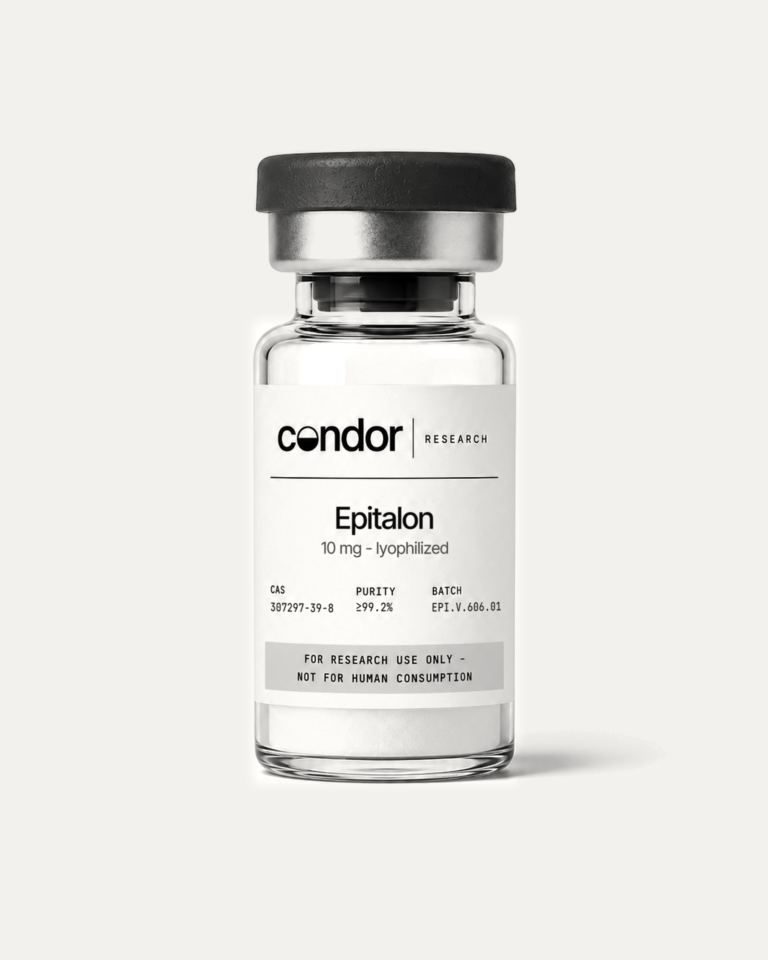
The telomerase story around epitalon has always had a structural weakness that most write-ups skip over: for about twenty years, nearly every positive result in human somatic cells came from one group. That changed in 2025, when an unrelated laboratory reproduced the core finding. This page walks the actual replication record — what was claimed, by whom, and how independent the confirming evidence really is. Everything below describes cell-line, animal, and literature findings, not use in people.
What is epitalon, and where did the telomerase claim come from?
Epitalon — also written Epithalon or Epithalone — is a synthetic tetrapeptide, Ala-Glu-Asp-Gly (AEDG), CAS 307297-39-8. It was designed from the amino-acid composition of Epithalamin, a peptide preparation extracted from bovine pineal gland. An independent 2025 review from the Medical University of Warsaw confirms this chemistry and lineage, while explicitly flagging how thin the physicochemical and structural characterization of the molecule still is6. That caveat matters: a four-residue peptide with a well-known sequence is easy to synthesize (it is the basis of the epitalon research material Condor supplies), but “easy to make” is not the same as “mechanism understood.”
The telomerase claim itself traces to a specific 2003 paper. Khavinson and colleagues at the St Petersburg Institute of Bioregulation and Gerontology added epitalon to telomerase-negative human fetal fibroblasts and reported induction of the hTERT catalytic subunit, measurable telomerase activity, and telomere elongation1. A follow-up from the same lab pushed the framing further: treated fibroblasts reportedly made roughly ten extra population doublings (44 versus 34 passages), described as overcoming the Hayflick limit2. Both studies came from the same lineage, in the same journal.
~20 years the human somatic-cell telomerase claim rested almost entirely on a single laboratory’s output.
What did the 2025 independent replication actually report?
The gap in that record was independence. A finding reproduced only by its originators is a hypothesis with staying power, not a settled result. In September 2025, Al-Dulaimi, Thomas, Matta and Roberts at Brunel University London published the first replication with no Khavinson author on it3. In normal epithelial and fibroblast cells, they reported dose-dependent telomere extension driven by increased hTERT mRNA and telomerase upregulation — the same mechanistic axis the original 2003 paper proposed. In breast-cancer lines (21NT and BT474), extension instead proceeded through the alternative lengthening of telomeres (ALT) pathway rather than telomerase, which is itself a biologically coherent split.
One independent lab, two decades later, saw the same core effect in human cells — and that is genuinely new information, not marketing.
There is an honesty flag attached to this paper, and skipping it would undercut the point of citing it. The Brunel study carries a published erratum from November 20254. An erratum is a correction, not a retraction: the paper remains indexed for MEDLINE and its conclusions stand. Corrections are routine in the literature and do not, by themselves, invalidate a result. But a replication that itself required a correction is a single data point that wants further confirmation before anyone treats it as closed.
| Line of evidence | Source / lab | What it shows | Independence |
|---|---|---|---|
| Original telomerase induction | Khavinson, St Petersburg (2003–2004) | hTERT, telomerase, telomere elongation in human fetal fibroblasts | Originating lab |
| Human ex-vivo lymphocytes | Khavinson lab (2019) | Bidirectional telomere change, n=11, “normalization” pattern | Originating lab |
| Independent human-cell replication | Brunel University London (2025) | Dose-dependent telomere extension via telomerase / ALT | Independent (one study, corrected) |
| Bovine oocytes / embryos | Gyeongsang National Univ., Korea (2025) | Raised telomerase activity, maturation, blastocyst hatching | Independent (non-human) |
All entries are in-vitro or animal findings from the cited literature. None describes use in people, and none is a human clinical telomere-outcome trial.
What is the proposed mechanism, and how solid is it?
Two mechanistic hypotheses appear repeatedly. The first treats epitalon as a transcription-factor mimic: molecular modelling suggests it binds an ATTTTC motif present in the telomerase promoter, thereby acting like a sequence-specific regulator8. A companion paper from the same group identified putative epitalon binding sites across the promoter regions of telomerase and other genes12. The second hypothesis is epigenetic: modelling suggests AEDG binds histones H1/3 and H1/6 near DNA-interacting sites, upregulating differentiation genes by roughly 1.6–1.8-fold in human stem cells7.
Both are worth stating clearly because both are largely computational, and both originate with the lab that made the primary claim. In-silico binding predictions are a legitimate way to generate hypotheses, but they are not direct biochemical proof that epitalon activates the telomerase promoter in a living cell. The mechanism, as of 2026, is a plausible and internally consistent model rather than a demonstrated pathway.
An honest read of the evidence
Here is the state of play without the gloss. For about twenty years, essentially all positive human somatic-cell telomerase data traced to a single lineage — Khavinson and the St Petersburg Institute — frequently published in the low-visibility journal Bulletin of Experimental Biology and Medicine, with small sample sizes and heavy reliance on modelling for mechanism. The strongest mechanistic papers, the promoter-binding and histone-binding work, are computational rather than direct biochemical proof. That is the weak side, and it is significant.
The one independent Western replication, the Brunel study, is a real and meaningful development — but it is a single 2025 in-vitro study across a handful of cell lines, and it required a published correction4. It narrows the single-lab gap; it does not close it. The human data that do exist are equivocal: an ex-vivo lymphocyte study from the origin lab changed telomere length in 7 of 11 donors, with significant increases in five (some large, +41–156%) but decreases in two5. The authors framed this as “normalization” rather than uniform elongation, which is a fair description of a mixed, bidirectional, low-n result — not evidence of reliable lengthening.
Independent 2025–2026 work confirms the peptide is bioactive without directly replicating telomerase activation in normal aging human somatic cells. A Korean group reported epitalon raised telomerase activity and improved oocyte maturation and post-thaw embryo development in cattle9 — independent, but bovine and reproductive rather than somatic-aging. A 2026 Chinese group used epitalon as a senolytic-adjacent tool compound in lymphoma models11 — again, ongoing independent use, not a telomerase-in-normal-human-cells replication. And a 2026 gerontology review from Alfaisal University places epitalon among non-FDA-approved investigational peptides with promising preclinical but limited clinical evidence and no long-term safety or systematic validation10. No randomized human clinical trial demonstrates telomere lengthening, healthspan, or lifespan benefit in people. The popular anti-aging framing outruns the clinical record by a wide margin.
For related bioregulator material, see what is epitalon, epitalon vs pinealon, and the Khavinson bioregulators catalog.
All materials supplied by Condor Research are Research Use Only (RUO). The findings summarized here are drawn from in-vitro and animal studies and the published literature only. Nothing on this page is a dosing protocol, clinical guidance, or a safety assessment for any organism, and none of it should be read as describing use in humans or animals. Material is characterized as ≥99% by HPLC, confirmed by MS, third-party tested at an independent EU laboratory in the Czech Republic; a lot-specific COA is available on request.
Condor Research · Scientific desk
Atrio Sciences s.r.o., IČO 57 669 651, Nitra (SK) · info@condorresearch.com
- Epitalon (Epithalon / Epithalone) is the synthetic tetrapeptide Ala-Glu-Asp-Gly (AEDG), CAS 307297-39-8, derived from the amino-acid composition of the bovine pineal extract Epithalamin.
- The original telomerase claim came from Khavinson's St Petersburg lab: added to telomerase-negative human fetal fibroblasts, epitalon reportedly induced hTERT expression, telomerase activity and telomere elongation (2003).
- For roughly two decades essentially all supporting human somatic-cell data traced to that single lineage, often in a low-visibility journal, with small n and mechanism argued largely from in-silico modelling.
- In 2025 an independent group at Brunel University London reproduced the core result: dose-dependent telomere extension via hTERT/telomerase upregulation in normal human cells, and via ALT in breast-cancer lines.
- That Brunel paper carries a routine published erratum (Nov 2025) — a correction, not a retraction; its conclusions stand and it remains indexed.
- No randomized human clinical trial has demonstrated telomere lengthening, healthspan, or lifespan benefit in people; the evidence base is in-vitro and animal.
Is epitalon the same thing as Epithalon or Epithalamin?
"Epitalon" and "Epithalon" are two spellings of the same synthetic tetrapeptide, Ala-Glu-Asp-Gly. Epithalamin is different: it is the crude bovine pineal-gland peptide extract from which the AEDG sequence was originally derived. Epitalon is the defined single-peptide synthetic version.
How many independent labs have replicated the telomerase result in human cells?
One, recently. The 2025 Brunel University London study is the first replication of the core telomerase claim in human cells by a group with no Khavinson authors. Before that, the positive human somatic-cell data came essentially from a single lineage. One independent replication is meaningful but not a robust body of confirming work.
Why does the erratum on the Brunel paper matter?
It matters only for honesty and calibration, not for validity. The November 2025 erratum is a correction, not a retraction; the paper remains indexed and its conclusions stand. It is worth noting simply because the strongest independent data point in the whole file is a single study that itself needed correcting — which is a reason to await further confirmation, not to dismiss it.
Is the proposed telomerase-promoter mechanism proven?
No. The transcription-factor-mimic model, in which epitalon binds an ATTTTC motif in the telomerase promoter, comes from in-silico modelling by the originating lab. The epigenetic histone-binding hypothesis is likewise computational. These are plausible mechanistic models, not direct biochemical demonstrations in living cells.
Does any of this apply to humans?
Not in any validated sense. The only human data are ex-vivo lymphocytes from cultured blood, with mixed bidirectional results in a small sample. There are no randomized clinical trials showing telomere lengthening or any aging-related outcome in people, and 2026 reviews classify epitalon as investigational with limited clinical evidence.
Is epitalon a drug or supplement I can rely on for anti-aging?
No. It is not an FDA- or EMA-approved drug, and current gerontology reviews describe it as an investigational peptide lacking long-term safety data and systematic clinical validation. Condor supplies it strictly as Research Use Only material for laboratory work, not for consumption.