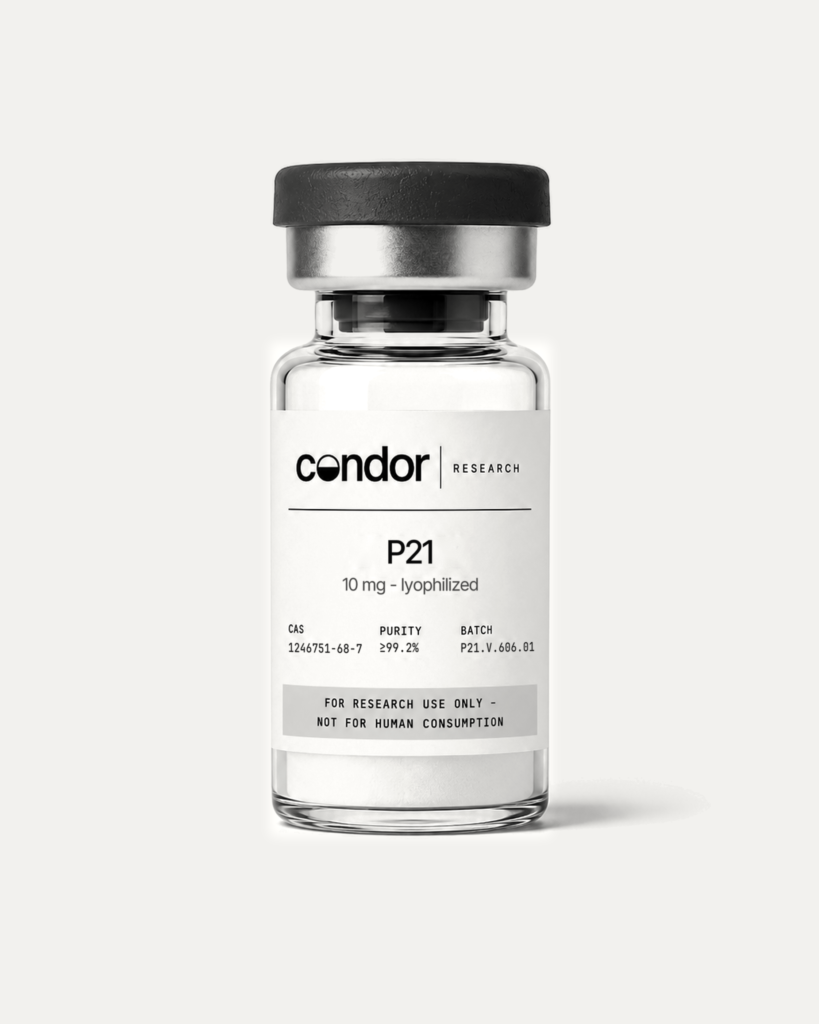
Lyophilised · ≥99% (HPLC) ·
Supplied lyophilised. Reconstitution typically uses bacteriostatic water.
P21 (P021) is a synthetic peptidomimetic cognitive enhancer (CAS 1246751-68-7; molecular formula C27H42N6O8; MW 578.7 g/mol) based on the acetylated Asp-Gly-Gly-Leu sequence conjugated to an adamantyl-amide group at the C-terminus (Ac-DGGL-AdNH2). It was designed to mimic the neurotrophic activity of CNTF (Ciliary Neurotrophic Factor) by targeting its receptor signalling axis, and has been studied in preclinical models of neurogenesis, synaptic plasticity, and age-related cognitive decline. Purity: HPLC ≥99%. For laboratory research use only; not for human or veterinary use.
Distilled from the active core of a natural nerve-growth factor into a fragment small enough to reach the brain, P21 (P021) is a synthetic neurotrophic peptide mimetic widely used in neurodegeneration research. It is an acetylated, adamantylated tetrapeptide (Ac-DGGL-Ψ(CH₂-NH)-AG) engineered from the biologically active region of human ciliary neurotrophic factor (CNTF), and has been studied across more than a decade of neurotrophic and cognitive-aging models.
A small molecule built from a large neurotrophin. Native neurotrophic proteins such as CNTF are powerful but impractical research tools: they are large, unstable, and cannot cross the blood-brain barrier. P021 was designed to overcome those limits by reproducing a short active motif of CNTF (residues 148–151), then adding an adamantane group and a reduced peptide bond to boost metabolic stability and lipophilicity. The result is a compact, orally stable peptidergic compound that researchers report enhances brain-derived neurotrophic factor (BDNF) expression and modulates leukemia-inhibitory-factor signalling — the mechanistic threads that run through most studies of the molecule.
What the research explores. Investigations in cellular and animal models have examined several dimensions of neurotrophic biology:
These results derive from in vitro and animal studies conducted in controlled research settings; they describe the compound's biology and do not constitute evidence of benefit for any non-investigational purpose. Full citations are listed under the Scientific References tab.
Physicochemical profile. CAS 1246751-68-7 · Molecular formula C₂₇H₄₂N₆O₈ · Molecular weight 578.7 · Sequence: Ac-DGGL-Ψ(CH₂-NH)-AG · Appearance: white lyophilized powder · Solubility: soluble in water.
Specification & quality. Each individually sealed vial contains 10 mg of P21 (P021) as a white lyophilized powder, verified at ≥99% purity by HPLC. Every batch is third-party tested, and a Certificate of Analysis (COA) is available. Store at −20 °C, protected from light and moisture.
This product is intended for laboratory research use only (RUO). It is not a drug, food, cosmetic, or dietary supplement, and is not for human or veterinary use, ingestion, or diagnostic application. Handling is restricted to qualified research professionals operating in an appropriately equipped laboratory.
Supplied for in-vitro laboratory research use only (RUO). Not a drug, food or supplement; not for human or veterinary use.
Certificate of Analysis — lot-specific COA ships with every order and is available on request.
Each lot is tested by an independent third-party laboratory for identity (mass spectrometry) and purity (HPLC). The Certificate of Analysis for your specific batch ships with the order and is available on request — no house data, no exceptions.
References are illustrative of the research literature surrounding this compound. All claims relate to in-vitro and animal models only.
P21 (P021) is a synthetic neurotrophic peptide mimetic, a small peptide derived from the active core of a natural neurotrophic factor and widely used as a tool in neurodegeneration research. It is supplied for laboratory research use only (in vitro). It is not a medicine, food, supplement or medical device, and is not for human or veterinary use, administration or consumption.
P21 (P021) is a single, defined synthetic neurotrophic peptide mimetic with a known structure, whereas Cerebrolysin is a defined mixture of many short peptides and amino acids. One is a single characterised molecule; the other is a multi-component preparation. Both are studied in neuroprotection research and are supplied strictly for laboratory research use only (in vitro).
P21 (P021) is a synthetic neurotrophic peptide mimetic designed to mimic neurotrophic-factor activity, while Semax is a heptapeptide analogue of the ACTH(4-10) sequence. They originate from different biology and have distinct structures, so they serve as different research tools. Both are supplied as synthetic peptides for laboratory research use only and are not for human or veterinary use.
P21 (P021) is a neurotrophic peptide mimetic studied in neurodegeneration research, while Pinealon is a short tripeptide bioregulator studied in neuroprotective contexts. They differ in size, design and origin, making them distinct research reagents within the neuroprotective space. Both are offered strictly for laboratory research use only (in vitro), with no human or veterinary application.
P21 (P021) is a single, structurally defined peptide, which lets researchers work with one characterised molecule and control it as a single variable; Cerebrolysin is a multi-component mixture. The choice depends on whether a defined single compound or a complex preparation suits the study. Both are supplied strictly for laboratory research use only (in vitro), not for human or veterinary use.
P21 (P021) is a synthetic neurotrophic peptide mimetic studied in neurodegeneration research, while DSIP (Delta Sleep-Inducing Peptide) is a naturally occurring nonapeptide investigated in sleep and neuro contexts. They have different structures, origins and research focuses. Both are supplied as synthetic peptides for laboratory research use only and are not for human or veterinary use, administration or consumption.
Yes. Each batch is tested by an independent third-party laboratory, with identity confirmed by mass spectrometry and purity verified at ≥99% by HPLC, documented in a per-lot Certificate of Analysis. The product lists CAS 1246751-68-7 and molecular weight ~578.7 for reference. For detailed structural data, contact info@condorresearch.com. Supplied for laboratory research use only.
Yes. Every lot is tested by an independent third-party laboratory and ships with a per-batch Certificate of Analysis confirming identity by mass spectrometry and ≥99% purity by HPLC. Manufacturer documentation is not published, to preserve supply-chain integrity. To request the COA for a specific batch, contact info@condorresearch.com. P21 (P021) is supplied for laboratory research use only.
P21 (P021) is listed as soluble in water, so it is reconstituted with an aqueous diluent for analytical laboratory preparation; the vial contains 10 mg of lyophilised peptide. Store the unopened vial at -20°C, protected from light (24-month shelf life). Any reconstitution data is for in-vitro laboratory use only, never for human or animal use, and no dosing guidance is provided.
Yes. P21 (P021) is sold strictly for laboratory research use only (in vitro) and is explicitly not a medicine, food, supplement, cosmetic or medical device, and not for human or veterinary use, administration or consumption. All handling is laboratory preparation; no human or animal use guidance is provided. For further detail, contact info@condorresearch.com.
Condor Research supplies P21 (P021) directly, dispatched from our EU facility in Slovakia to the EU, EEA, UK and Switzerland. Deliveries to EU destinations clear no third-country customs, and shipping is calculated at checkout. Supplied strictly as a research-use-only reference material — not for human or veterinary use.
No verified reviews yet.
Leave a reviewCookies
We use strictly necessary cookies to run the store. With your consent we also use analytics (order attribution) and marketing (Omnisend) cookies. Read our Cookie Policy.