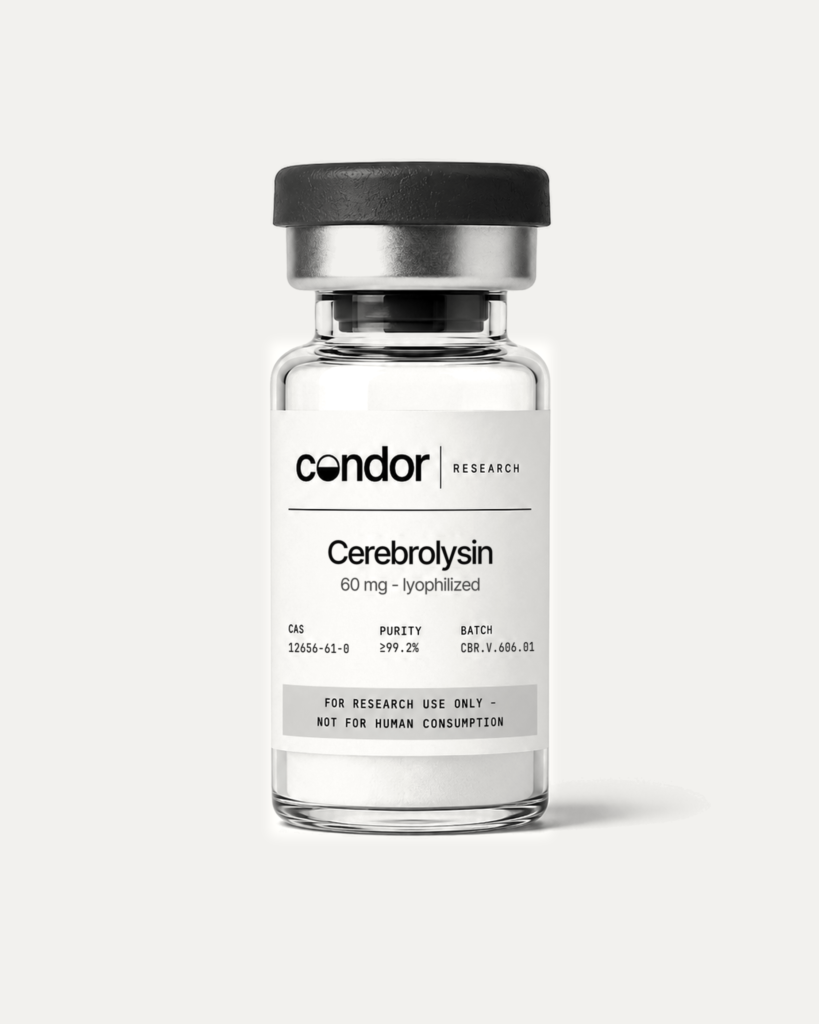
Lyophilised · ≥99% (HPLC) ·
Supplied lyophilised. Reconstitution typically uses bacteriostatic water.
Cerebrolysin is a standardised porcine brain-derived peptide mixture produced by controlled enzymatic digestion of porcine brain proteins, containing low-molecular-weight neuropeptides and free amino acids with neurotrophic-like activity studied in research models of neurodegeneration, neuroprotection, and cognitive function; its biological activity is attributed to novel cryptic peptides rather than to intact fragments of endogenous neurotrophic factors. CAS 12656-61-0. For laboratory research use only; not for human or veterinary use.
Not every research compound is a single molecule — some are carefully prepared biological mixtures. Cerebrolysin is a peptide preparation derived from purified porcine brain tissue, composed of low-molecular-weight neuropeptides and free amino acids produced by standardized enzymatic breakdown. Because it is a complex mixture rather than a defined chemical entity, it has no single CAS number or molecular formula, and it is studied as a multi-component neurotrophic preparation in neuroscience research.
A cocktail of brain-derived peptides. The rationale behind Cerebrolysin is that its mixture of small neuropeptides may mimic the actions of endogenous neurotrophic factors, supporting neuronal survival and plasticity. Reviews describe how the preparation is proposed to modulate neurotrophic signaling relevant to neuroprotection and neurorecovery (Rejdak et al., 2023), positioning it as a tool for studying multi-target neurotrophic strategies rather than a single receptor interaction.
What the research explores. The literature is concentrated in neurological injury and recovery models:
These findings derive from clinical trials, meta-analyses, and laboratory research describing biological activity; they are provided for scientific context and do not constitute human use guidance from this listing. Full citations are listed under the Scientific References tab.
Composition note. Cerebrolysin is a porcine brain-derived peptide and amino acid mixture, not a single defined molecule; accordingly, no CAS number, molecular formula, or single sequence applies. Appearance: white lyophilized powder · Soluble in water.
Specification & quality. Each individually sealed vial contains 60 mg of Cerebrolysin peptide preparation as a white lyophilized powder. Every batch is third-party tested, with a Certificate of Analysis (COA) available. Store at −20 °C, protected from light and moisture.
This product is intended for laboratory research use only (RUO). It is not a drug, food, cosmetic, or dietary supplement, and is not for human or veterinary use, ingestion, or diagnostic application. Handling is restricted to qualified research professionals operating in an appropriately equipped laboratory.
Supplied for in-vitro laboratory research use only (RUO). Not a drug, food or supplement; not for human or veterinary use.
Certificate of Analysis — lot-specific COA ships with every order and is available on request.
Each lot is tested by an independent third-party laboratory for identity (mass spectrometry) and purity (HPLC). The Certificate of Analysis for your specific batch ships with the order and is available on request — no house data, no exceptions.
References are illustrative of the research literature surrounding this compound. All claims relate to in-vitro and animal models only.
Cerebrolysin is a defined peptide mixture, not a single molecule. It is a preparation of low-molecular-weight peptides and free amino acids supplied for laboratory research use only (in vitro). Because it is a complex biological mixture rather than one compound, it is characterised at the mixture level rather than as a single ≥99% pure substance. It is not a medicine.
Cerebrolysin is intentionally a mixture: it consists of multiple short peptides and free amino acids prepared together, so its identity is the defined composition rather than one chemical structure. This is why no single CAS number, molecular formula or sequence is listed. Each batch is controlled for consistency at the mixture level. For full datasheet details, contact info@condorresearch.com.
A mixture is controlled by composition and batch consistency rather than a single ≥99% purity figure. Each lot is tested by an independent third-party laboratory, and a Certificate of Analysis (COA) is issued per batch. The single-component ≥99% HPLC criterion applies to individually defined compounds; Cerebrolysin is assessed as a defined peptide mixture. Contact info@condorresearch.com for batch documentation.
Cerebrolysin is a defined peptide mixture of many short peptides and amino acids, whereas Semax is a single, fully defined heptapeptide with a known sequence, CAS number and molecular formula. One is a multi-component preparation; the other is one characterised molecule. Both are supplied strictly for laboratory research use only and are not for human or veterinary use.
Cerebrolysin is a complex peptide mixture studied broadly in neuroprotection research, while P21 (P021) is a single synthetic neurotrophic peptide mimetic with a defined structure. The contrast is a multi-component biological preparation versus one well-characterised molecule. Both are offered for in-vitro research use only, with no human or veterinary application and no dosing guidance provided.
Both contain multiple peptides, but in different senses: Cerebrolysin is a single defined mixture of many short peptides, while Semax + Selank is a co-formulated blend of two specific, individually characterised neuropeptides (10 mg each). One is an inherent mixture; the other combines two known molecules. All are for laboratory research use only.
No. The material supplied here is sold strictly as a research compound for laboratory use only (in vitro) and is explicitly not a medicine, food, supplement, cosmetic or medical device. It is not for human or veterinary use, administration or consumption. Any clinical associations of the name are outside the scope of this product, which is a research reagent.
Cerebrolysin is supplied as 60 mg per vial and is water-soluble. Store the unopened vial at -20°C, protected from light. As with all catalog reagents it is provided for laboratory research only; any reconstitution data is for analytical laboratory preparation, not for human or animal use. For batch-specific handling details, contact info@condorresearch.com.
Yes. Every batch is tested by an independent third-party laboratory and ships with a per-lot Certificate of Analysis. Because Cerebrolysin is a defined peptide mixture, the COA characterises it at the mixture/composition level rather than as a single-compound purity value. Manufacturer documentation is not published, to protect supply-chain integrity. Request the COA via info@condorresearch.com.
Those fields are blank because Cerebrolysin is a multi-component peptide mixture, not a single molecule, so no one CAS number, molecular formula or amino-acid sequence can describe it. Its identity is defined by composition and verified by batch testing instead. This is expected for a defined biological mixture. For composition details, contact info@condorresearch.com.
Condor Research supplies Cerebrolysin directly, dispatched from our EU facility in Slovakia to the EU, EEA, UK and Switzerland. Deliveries to EU destinations clear no third-country customs, and shipping is calculated at checkout. Supplied strictly as a research-use-only reference material — not for human or veterinary use.
No verified reviews yet.
Leave a reviewCookies
We use strictly necessary cookies to run the store. With your consent we also use analytics (order attribution) and marketing (Omnisend) cookies. Read our Cookie Policy.