Lyophilised · ≥99% (HPLC) ·
Supplied lyophilised. Reconstitution typically uses bacteriostatic water.
AOD-9604 is a synthetic 16-amino-acid peptide corresponding to Tyr-hGH(177–191) — the tyrosylated C-terminal fragment of human growth hormone — stabilised by an intramolecular disulfide bond. CAS 221231-10-3; molecular formula C78H123N23O23S2; molecular weight approximately 1815.1 g/mol; supplied in encapsulated form at ≥99% purity by HPLC. Investigated in preclinical models for its role in lipid metabolism, adipogenesis inhibition, and fat oxidation. For laboratory research use only; not for human or veterinary use.
Take the very tail of human growth hormone, trim it to sixteen residues, and bolt a tyrosine onto the front — and you have a peptide engineered to keep one of hormone's jobs while shedding the rest. AOD-9604 is a modified analogue of the C-terminal fragment of human growth hormone (residues 177–191), studied specifically because it appears to engage lipid-metabolism pathways without the IGF-1-driven, growth-promoting signalling of the full hormone.
A growth-hormone fragment, by design. AOD-9604 was developed from the hGH 177–191 region as one of a wave of candidate anti-obesity agents that aimed to isolate growth hormone's metabolic, fat-mobilising activity from its anabolic effects, and it features in reviews charting that class of compounds in metabolic research (Khan et al., 2012; Zieba, 2007).
Because of its hGH-fragment origin, the peptide has also become a reference analyte in anti-doping science, where analytical groups have characterised its detection and in-vitro metabolism and confirmed that it does not interfere with the WADA hGH isoform immunoassay (Cox et al., 2015; Orlovius et al., 2013).
What the research explores. Across cell-culture and animal systems, AOD-9604 has been investigated along several converging lines:
The activity described here is drawn from in-vitro and animal studies; it characterises biological behaviour in experimental models and does not establish efficacy or safety in humans. Full citations are listed under the Scientific References tab.
Physicochemical profile. CAS No. 221231-10-3 · Molecular formula C78H123N23O23S2 · Molecular weight 1815.08 g/mol · Sequence Tyr-Leu-Arg-Ile-Val-Gln-Cys-Arg-Ser-Val-Glu-Gly-Ser-Cys-Gly-Phe (hGH 177-191 analogue, disulfide Cys7-Cys14) · Appearance: White lyophilized powder · Solubility: Soluble in water.
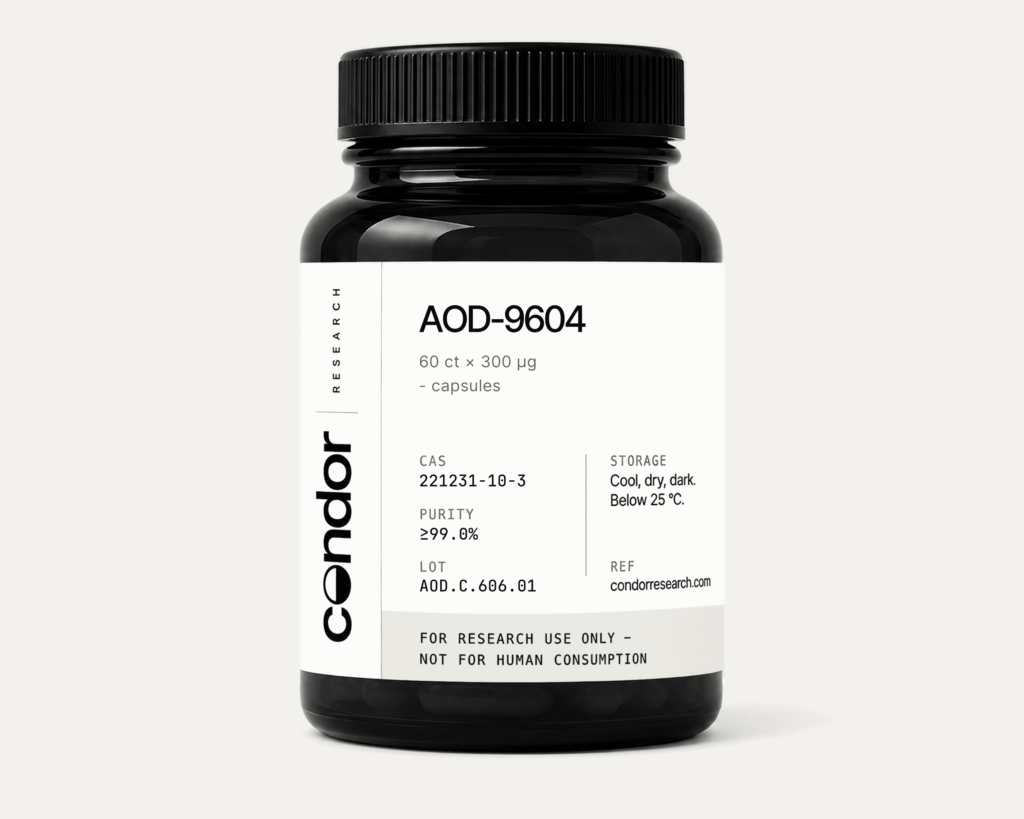
Specification & quality. Each bottle contains 60 HPMC (vegan) capsules, each providing 300mcg of AOD-9604 at ≥99% (HPLC). Encapsulated — no reconstitution required. Every batch is independently third-party tested, and a Certificate of Analysis (COA) is available. Store at -20°C, protect from light and moisture; shelf life 24 months from the manufacture date. EU warehoused.
This product is intended for laboratory research use only (RUO). It is not a drug, food, cosmetic, or dietary supplement, and is not for human or veterinary use, ingestion, or diagnostic application. Handling is restricted to qualified research professionals operating in an appropriately equipped laboratory.
Supplied for in-vitro laboratory research use only (RUO). Not a drug, food or supplement; not for human or veterinary use.
Certificate of Analysis — lot-specific COA ships with every order and is available on request.
Each lot is tested by an independent third-party laboratory for identity (mass spectrometry) and purity (HPLC). The Certificate of Analysis for your specific batch ships with the order and is available on request — no house data, no exceptions.
References are illustrative of the research literature surrounding this compound. All claims relate to in-vitro and animal models only.
AOD-9604 is a synthetic peptide based on the C-terminal fragment of human growth hormone (residues 177–191) with an added N-terminal tyrosine. It is studied in cell and animal models for lipid-metabolism endpoints, positioned apart from the IGF-1-mediated growth effects of the full hormone. Condor Research supplies it strictly as a Research Use Only reference compound for in vitro and animal studies, not for human or veterinary use.
AOD-9604 corresponds only to the hGH 177–191 C-terminal region, the part associated in research with fat-mobilising activity, and was designed to be studied separately from the anabolic, IGF-1-driven signalling of the complete hormone (Khan et al., 2012). Analytical work has also confirmed it does not interfere with the WADA hGH isoform immunoassay (Orlovius et al., 2013). It is supplied for research use only, not for human or veterinary use.
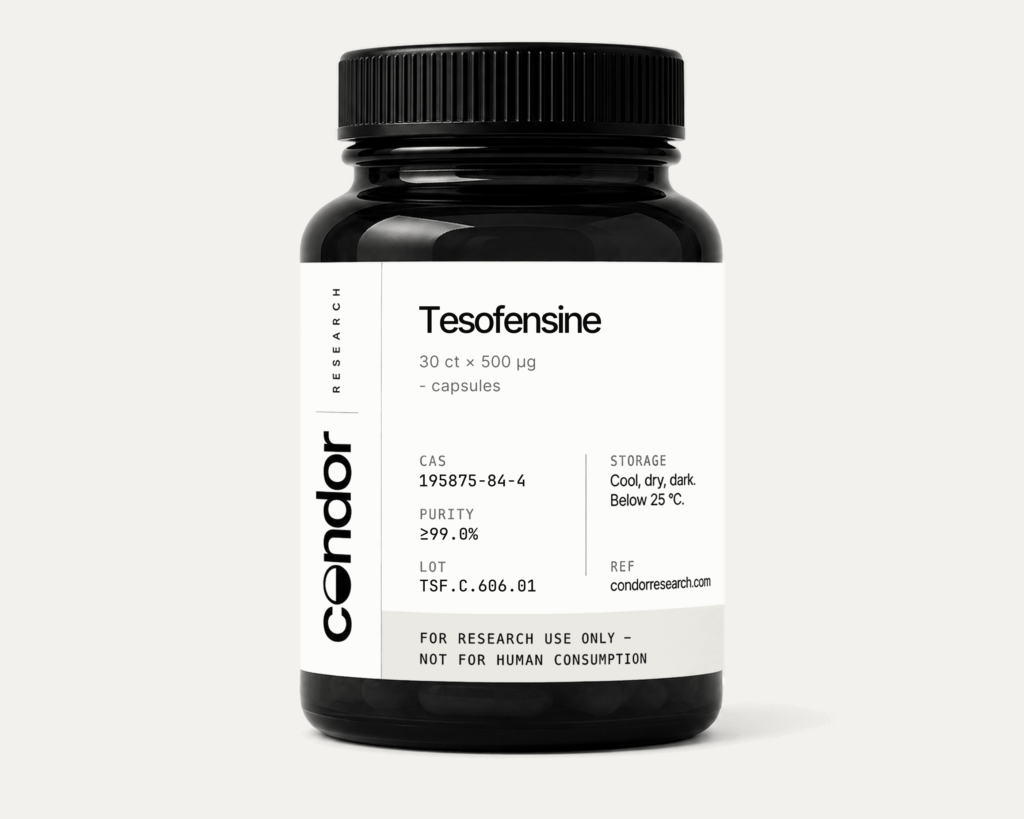
AOD-9604 is a peptide fragment of growth hormone studied for lipid-metabolism pathways in adipose models, while Tesofensine is a small-molecule triple monoamine-reuptake inhibitor studied through central nervous-system mechanisms. They are entirely different chemical classes acting on different pathways and serve distinct research questions. Both are supplied strictly as research-use-only reference compounds.
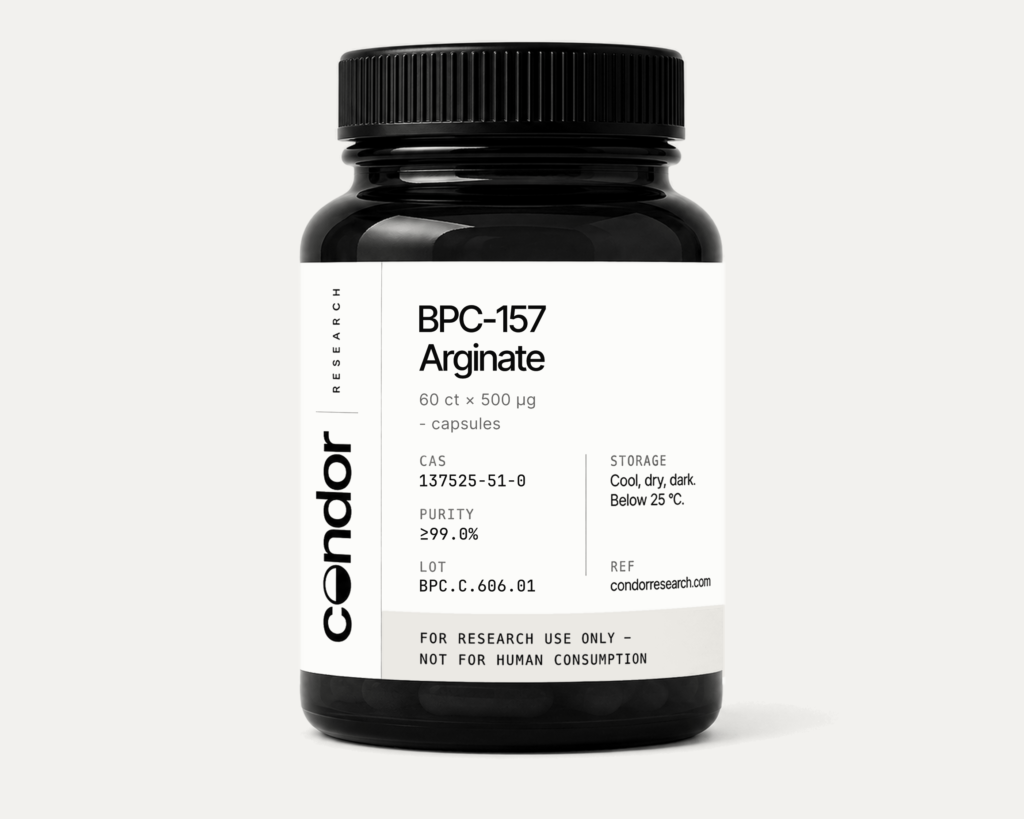
AOD-9604 is a 16-residue growth-hormone-fragment analogue studied for lipid metabolism, and has also been examined in a rabbit joint model (Kwon & Park, 2015). BPC-157 is a separate 15-residue gastric-derived peptide investigated mainly in soft-tissue and gastrointestinal injury paradigms. They share no sequence and address different experimental questions. Both are supplied for research use only.
AOD-9604 is a growth-hormone-fragment peptide studied around lipolytic pathways in adipose tissue, whereas NMN is a small-molecule NAD+ precursor studied around mitochondrial and NAD+ metabolism. They approach metabolic research from different mechanistic directions — peptide-receptor signalling versus cofactor biosynthesis — and are complementary research tools. Both are supplied for research use only.
Yes. Condor Research supplies AOD-9604 strictly as a Research Use Only reference compound to professionals and institutions, not as a medicine, supplement or product for human or veterinary use. Buyers are responsible for confirming import legality in their own country. Questions: info@condorresearch.com.
The capsule is a pre-weighed solid format that simplifies laboratory handling and storage of a fixed quantity of the peptide inside an HPMC (vegan) shell, protecting light- and moisture-sensitive material. It is a measured solid format, not a dose, and does not imply consumption of any kind. For laboratory research use only. Not for human or veterinary use.
No. These are encapsulated — no reconstitution required. Each HPMC (vegan) capsule contains a fixed 300mcg quantity of AOD-9604 in solid form for laboratory handling. The format is for research use only and is not intended for ingestion or human use.
Each bottle contains 60 HPMC (vegan) capsules, each providing 300mcg of AOD-9604 at ≥99% (HPLC) purity. The capsules are independently third-party tested. The stated quantity is a pre-weighed laboratory reference format, not a human dose, and the material is for research use only.
Our AOD-9604 has CAS No. 221231-10-3, molecular formula C78H123N23O23S2 and a molecular weight of 1815.08 g/mol, with the sequence Tyr-Leu-Arg-Ile-Val-Gln-Cys-Arg-Ser-Val-Glu-Gly-Ser-Cys-Gly-Phe (hGH 177-191 analogue, disulfide Cys7-Cys14). It is supplied as a white lyophilised powder, soluble in water. For laboratory research use only.
Yes. Every AOD-9604 batch is tested by an independent third-party laboratory by HPLC for identity and purity (≥99%), and each lot ships with a lot-specific Certificate of Analysis. To request the COA for your batch, contact info@condorresearch.com. For laboratory research use only. Not for human or veterinary use.
Condor Research supplies AOD-9604 Capsules directly, dispatched from our EU facility in Slovakia to the EU, EEA, UK and Switzerland. Deliveries to EU destinations clear no third-country customs, and shipping is calculated at checkout. Supplied strictly as a research-use-only reference material — not for human or veterinary use.
No verified reviews yet.
Leave a reviewCookies
We use strictly necessary cookies to run the store. With your consent we also use analytics (order attribution) and marketing (Omnisend) cookies. Read our Cookie Policy.