
What Is AOD-9604? The Growth-Hormone Fragment That Failed Its Own Weight-Loss Trial
AOD-9604 is a synthetic fragment of human growth hormone, engineered to keep a fat-metabolising signal while shedding the growth. It became a famous “fat-burning peptide” — then its human obesity trials missed the mark.
AOD-9604 is a synthetic peptide copying the C-terminal fragment (residues 177–191, with an added N-terminal tyrosine) of human growth hormone, designed to keep a lipolytic signal without growth-hormone’s growth and glucose effects. Studied in obesity and cartilage models, its human weight-loss programme did not produce dose-dependent benefit over placebo on the primary endpoint. It is a research-use-only reference material, not an approved medicine.
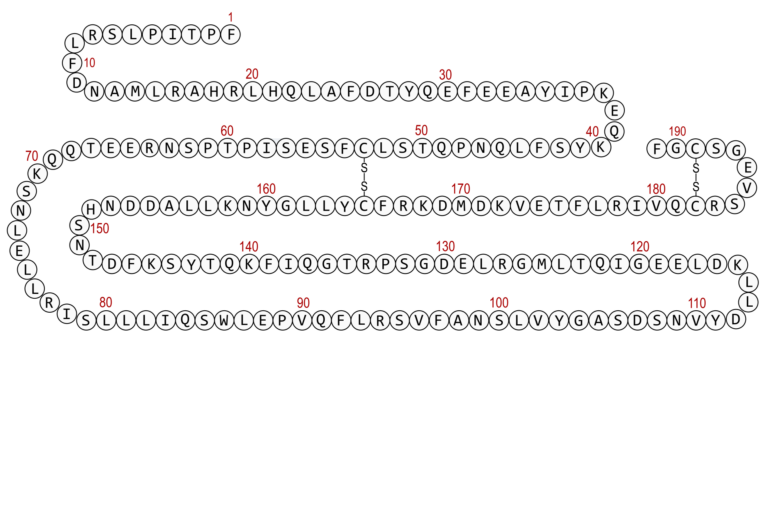
Take the most famous hormone in sports biology, slice off the very end of its molecule, and throw away the rest. What you keep — a short string of amino acids — was supposed to carry growth hormone’s fat-burning talent without any of its bulk-building, blood-sugar-bending baggage. That fragment was named AOD-9604, the letters standing for “anti-obesity drug.” For the better part of two decades it has been sold online as a fat-loss shortcut. The trouble is that the molecule was given a real chance to prove itself in humans, and the data that came back were not the data the marketing promised.1
AOD-9604 is one of the clearest case studies in research peptides of a recurring pattern: an elegant mechanism, a persuasive animal story, and a human trial that quietly declines to cooperate. Understanding why is worth more than any sales page, because it teaches you how to read the evidence behind every “metabolic” compound that follows.
What is AOD-9604, and where did it come from?
Human growth hormone (hGH) is a 191-amino-acid protein with several jobs bundled into one chain: it tells tissues to grow, nudges the liver to release IGF-1, raises blood glucose, and — in a region near its tail end — appears to influence how fat is mobilised and burned.1 In the 1990s, researchers working from Monash University and the Australian company Metabolic Pharmaceuticals asked a deceptively simple question: could the fat-metabolism signal be separated from everything else?2
Their answer was AOD-9604, a synthetic peptide corresponding to the C-terminal region of growth hormone — residues 177–191, with an added N-terminal tyrosine, giving a 16-residue chain stabilised by a disulfide bridge.2 The design logic was surgical: keep the proposed lipolytic domain, drop the parts that drive growth, raise IGF-1, or disturb glucose handling.1 If the fragment worked, you would get fat metabolism without the metabolic side effects that make full growth hormone a blunt and risky instrument.2 It was a clever piece of molecular editing — the pharmacological equivalent of quoting a single line from a long speech and hoping it still means what you want.
AOD-9604 is just sixteen amino acids — the 177–191 C-terminal tail of the 191-residue human growth-hormone molecule plus an N-terminal tyrosine, engineered to carry a fat-metabolism signal while leaving growth hormone’s growth-promoting and glucose effects behind.2
How is AOD-9604 supposed to work?
The proposed mechanism is the whole reason the molecule exists. Early metabolic studies of the synthetic C-terminal domain reported that it stimulated lipolysis — the breakdown of stored fat — and inhibited lipogenesis, the laying down of new fat, without the insulin-resistance signature that intact growth hormone tends to produce.2 In a much-cited 2001 study, chronic treatment of obese mice with growth hormone or with its modified C-terminal fragment increased fat oxidation and reduced body weight.3
That same experiment sharpened the picture. Researchers tested the fragment in obese mice and in mice genetically lacking the β3-adrenergic receptor — the receptor through which classic “fat-burning” signals often act — and reported that the changes in body weight and lipolysis seen in normal animals failed to appear when that pathway was knocked out.3 On paper, this is a tidy story: a fragment that mobilises fat, spares glucose control, and leans on a recognisable lipolytic pathway. The catch, as always, is the gap between a mouse’s adipose tissue and a human standing on a scale.
Did AOD-9604 ever work in humans?
This is the question that matters, and the honest answer is the reason the compound is no longer a clinical contender. AOD-9604 did not stay in mice. It was advanced into human obesity trials — the precise scenario its name advertised. And in that programme it did not produce dose-dependent weight loss over placebo on the primary endpoint.1 The molecule that had been engineered, named, and marketed as an anti-obesity drug failed the single test that an anti-obesity drug must pass.1
This is what makes AOD-9604 such an instructive object. The preclinical narrative was genuinely attractive; the mechanism was plausible; the marketing was confident. Then a controlled human programme returned a result that the promotional language never absorbed.1 The peptide has continued to circulate online for years, its sales copy frozen at the optimism of the animal data, as though the clinical chapter were never written. It is marketing outrunning the evidence, preserved in amber.
Why does AOD-9604 keep appearing in anti-doping research?
One of the strangest tells in the AOD-9604 literature is where the molecule shows up most: not in clinical pharmacology journals, but in the pages of anti-doping science. Laboratories have published methods to detect AOD-9604 and characterise how it is metabolised, precisely because it surfaces where unapproved performance-and-physique compounds change hands.4 Researchers have checked whether it interferes with the WADA growth-hormone isoform immunoassay — and found it does not — the kind of question you only ask about a substance people are actually using off-label.5
The gray-market footprint is explicit elsewhere. Belgian authorities seized unlabelled pharmaceutical preparations that, on analysis, turned out to contain AOD-9604.6 Doping-control method papers list it among the non-approved substances that detection science must keep pace with.4 A compound’s presence in seizure reports and assay-development studies is a quiet but reliable signal: it tells you the molecule moves through unregulated channels, not pharmacy shelves.
What about the joint and cartilage research?
AOD-9604’s second research life has nothing to do with weight at all. A 2015 study injected AOD9604 — alone or combined with hyaluronic acid — directly into the joints of a rabbit model of osteoarthritis, exploring whether the peptide might influence cartilage.7 It is a genuinely separate line of inquiry, and an interesting one. But it is also a single intra-articular animal study, and it should be read as exactly that: an early preclinical signal in rabbits, not evidence of a joint therapy for humans.7 Reaching for it as a fallback “use” when the weight-loss story collapses would repeat the very error the obesity trials exposed.
| Aspect | The marketed claim | What the research actually shows |
|---|---|---|
| Origin | A “fat-burning peptide” | Synthetic hGH 177–191 C-terminal fragment with an added tyrosine, engineered to drop growth and glucose effects2 |
| Fat-loss effect | Burns fat in humans | Reduced fat mass and raised fat oxidation in mice3; no dose-dependent advantage over placebo on the primary endpoint in human obesity trials1 |
| Regulatory status | A weight-loss solution | Not an approved weight-loss drug anywhere; appears in anti-doping and seizure literature6 |
AOD-9604 at a glance: the gap between the sales narrative and the published evidence is the whole story.
What does the honest evidence say?
Stripped of enthusiasm, the AOD-9604 record reads like this. The animal and in-vitro data are real and were published in peer-reviewed journals; the fragment did appear to mobilise fat and spare glucose handling in rodent models.2 The mechanism is coherent.3 But the rodent-to-human leap — the leap that ends careers in obesity pharmacology — did not succeed: the human obesity programme failed to deliver dose-dependent weight loss over placebo on its primary endpoint.1 AOD-9604 is not an approved medicine for weight loss, or anything else, in the EU, the US, or elsewhere.1
That candour matters because AOD-9604 sits beside compounds with very different evidence profiles, and conflating them does readers a disservice. Some metabolic research molecules — like tesofensine — produced real human weight loss but stalled over safety questions; others are purely preclinical exercise-style signals, a landscape we map in our editorial on exercise mimetics. AOD-9604 belongs to a third category entirely: a molecule that was tested fairly in humans and simply did not deliver on its headline claim.1 Treating it as a proven fat-loss tool is not optimism; it is ignoring the most important experiment ever run on it.
How does Condor handle AOD-9604?
None of this changes what AOD-9604 is as a laboratory reagent: a precisely defined peptide with a known sequence, formula (C₇₈H₁₂₃N₂₃O₂₃S₂) and molecular weight near 1815 g/mol, useful for in-vitro and animal research into lipid metabolism and growth-hormone-fragment biology.2 Its scientific value lies in being studied honestly — including studying why its clinical promise did not hold.
For that work, identity and purity are everything. A small cysteine-containing fragment is exactly the kind of molecule that gray-market channels misrepresent, as the seizure literature shows.6 Condor supplies AOD-9604 strictly as a research-use-only reference material — not for human or veterinary use, not a medicine, and not a weight-loss product — with a Certificate of Analysis documenting what is actually in the vial. The mechanism may be elegant and the history instructive, but the only claim we will ever make about this peptide is the one we can verify: this is the molecule, this is its purity, and this is the evidence — no more, no less.
- AOD-9604 is a synthetic copy of the C-terminal 177–191 fragment of human growth hormone (a 16-residue peptide with an added N-terminal tyrosine), built to isolate a proposed fat-metabolism signal from growth hormone’s growth-promoting and glucose-altering actions.
- Animal work reported reduced fat mass and increased fat oxidation, and a separate rabbit study explored intra-articular use in osteoarthritis — but these are preclinical models, not human outcomes.
- The decisive evidence is human: AOD-9604 went through obesity trials and did not produce dose-dependent weight loss over placebo on the primary endpoint, a textbook case of marketing outrunning the data.
- It appears repeatedly in anti-doping detection and seized-product literature, a marker of its gray-market circulation rather than clinical adoption.
- AOD-9604 is not an approved weight-loss drug anywhere; Condor supplies it strictly as a research-use-only reference material with a Certificate of Analysis.
Is AOD-9604 approved for weight loss?
No. AOD-9604 is not an approved weight-loss drug in the EU, the US, or anywhere else. It was tested in human obesity trials and did not produce dose-dependent weight loss over placebo on the primary endpoint. It is supplied strictly as a research-use-only reference material, not a medicine.
What is AOD-9604 made of?
It is a synthetic peptide copying the C-terminal fragment (residues 177–191) of human growth hormone with an added N-terminal tyrosine, giving a 16-residue chain. It was engineered to keep a proposed fat-metabolism signal while removing growth hormone’s growth-promoting, IGF-1-raising and glucose effects.
Did AOD-9604 actually burn fat in studies?
In animal models, chronic treatment reduced fat mass and increased fat oxidation, and in-vitro work suggested lipolytic activity. However, those preclinical effects did not translate into a successful human result: the obesity programme showed no dose-dependent weight-loss advantage over placebo on the primary endpoint.
Why is AOD-9604 mentioned in anti-doping research?
Because it circulates through unregulated, off-label channels. Laboratories developed methods to detect it and to check whether it interferes with growth-hormone assays, and authorities have seized unlabelled preparations containing it — all markers of gray-market use rather than clinical adoption.
What is the difference between AOD-9604 and growth hormone?
Growth hormone is the full 191-amino-acid protein with growth-promoting, IGF-1-raising and glucose-altering actions. AOD-9604 is essentially its C-terminal tail (residues 177–191 with an added tyrosine), designed to isolate a proposed fat-metabolism signal while discarding the rest of the hormone’s activity.