
What Is Tesofensine? The Triple Reuptake Inhibitor That Stalled
Tesofensine (NS2330) is a small-molecule triple monoamine reuptake inhibitor that produced some of the largest weight-loss figures of the pre-GLP-1 era in human obesity research — then never reached the market. This is the story of why, and why honesty about its safety record matters.
Tesofensine is a small-molecule triple monoamine reuptake inhibitor (serotonin, noradrenaline and dopamine), first developed for neurodegenerative disease and later studied for obesity, where human trials showed large weight loss. Development stalled over cardiovascular-safety signals and a published adverse-event-reporting controversy. It is not an approved medicine; Condor supplies it strictly as a research-use-only reference material with a Certificate of Analysis verifying identity and purity.
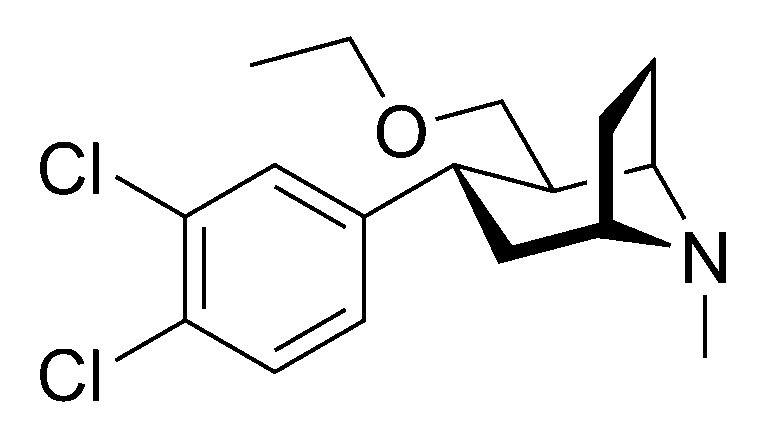
Before semaglutide rewired the obesity field, there was a compound that, on paper, looked almost too good. In human trials it stripped away more weight than nearly anything available at the time — a molecule born to treat failing brains, redirected to treat expanding waistlines. And then it stalled. Not for lack of effect, but because of what showed up alongside the effect. Tesofensine is the anti-obesity candidate that worked, by one important measure, and still never reached a pharmacy shelf.1 Its story is less a triumph than a cautionary tale about reading a clinical record honestly.
What is tesofensine and where did it come from?
Tesofensine, also catalogued as NS2330, is a small-molecule triple monoamine reuptake inhibitor. That single phrase carries the whole mechanism: it simultaneously blocks the reuptake transporters for serotonin, noradrenaline and dopamine, so all three neurotransmitters linger longer in the synapse.11 The compound emerged from neuroscience drug discovery as a centrally acting agent — one of a long line of brain-targeting molecules studied across cognition, mood and, later, energy balance.3
It was in obesity research that the molecule found its defining role. Tesofensine sits squarely within the class of centrally acting agents that appetite pharmacology has chased for decades, where the recurring goal is to nudge the brain’s monoamine signalling toward eating less.3 A drug designed to work on the central nervous system turned out, in this line of work, to quiet the appetite — and that is the property researchers pursued.1
Tesofensine inhibits the reuptake of three monoamines at once — serotonin, noradrenaline and dopamine — a triple mechanism that distinguishes it from the single- or dual-target appetite agents that have dominated the field.11
How does tesofensine actually suppress appetite?
The intuitive story — “more monoamines, less hunger” — is broadly right, but the details are where the mechanism becomes interesting. Imaging work using PET demonstrated that tesofensine occupies the dopamine transporter in the living brain, confirming that its dopaminergic action is real and dose-related rather than incidental.11 Structural studies of triple reuptake inhibitors as a class have since mapped how such molecules engage their transporter targets at the atomic level, putting the “three-in-one” pharmacology on firmer mechanistic ground.7
Preclinical neuroscience pushed the picture further. Work in diet-induced obese rats traced tesofensine’s appetite effect partly to the restoration of low forebrain dopamine levels, linking the molecule’s transporter action to feeding behaviour.12 More recent work by Perez and colleagues went finer still, showing that in animal models tesofensine silences a population of GABAergic neurons in the lateral hypothalamus — the same neurons whose activity normally drives feeding.9 In other words, the drug does not merely blunt hunger in the abstract; in these models it dampens an identifiable circuit. Think of it as turning down a specific dial in the hypothalamic control room rather than flooding the whole system with noise.9
Why was tesofensine’s weight loss so striking?
This is the part of the story that made tesofensine famous in obesity-research circles. In human obesity research it produced weight reductions that, for the pre-GLP-1 era, were remarkable — placing it among the most effective small molecules studied for the indication up to that point.1 Against the modest single-digit losses typical of the appetite agents of its day, the magnitude looked like a step change, and it became a fixture in reviews charting the future of obesity pharmacotherapy.45
The efficacy signal was genuine and human, not a rodent curiosity — and that is precisely what makes the rest of the story so important, because a compound that works is the kind whose safety signals you cannot afford to wave away.1 A separate combination programme, studied as Tesomet (tesofensine paired with the beta-blocker metoprolol), was later explored in a randomised trial in hypothalamic obesity — a rare condition in which damage to the hypothalamus drives intractable weight gain — an attempt to harness the appetite effect while taming the cardiovascular one.10
What went wrong — and why isn’t tesofensine approved?
Here the narrative turns. Tesofensine’s mechanism is a double-edged sword: the same noradrenergic and dopaminergic signalling that curbs appetite also stimulates the cardiovascular system. Studies surfaced increases in heart rate and blood pressure, the kind of signal regulators scrutinise intensely in any chronic-use weight compound.15 Preclinical work in rats suggested these effects could be partly blunted by co-treatment with anti-hypertensive agents while preserving the appetite suppression — useful mechanistically, but also an admission that the cardiovascular effect was real and needed managing.15
Then came the controversy that defines tesofensine’s honest record. The Lancet published an expression of concern relating to a tesofensine obesity trial,13 and a separate published exchange followed alleging under-reporting of adverse effects — a dispute, with Astrup and colleagues among the correspondents, about whether the safety picture in the literature fully reflected what had been observed.14 For a compound whose efficacy was never seriously in doubt, this is not a footnote. It is a central reason the molecule’s development stalled and why, to this day, tesofensine is not an approved medicine for obesity in the EU or the US.1314
| Dimension | Tesofensine (NS2330) | What it means |
|---|---|---|
| Mechanism | Triple monoamine reuptake inhibitor (serotonin, noradrenaline, dopamine) | Broad appetite effect; also cardiovascular stimulation11 |
| Class | Centrally acting agent studied in obesity pharmacology | One of many monoamine-targeting appetite candidates3 |
| Human signal | Large weight loss in human obesity research | Notable for the pre-GLP-1 era1 |
| Regulatory status | Not approved; development stalled | Cardiovascular signals + adverse-event-reporting controversy1514 |
Tesofensine at a glance: a mechanism and an efficacy result that were never the problem — the safety and regulatory record was.
What does the honest evidence actually say?
Intellectual honesty here means holding two facts at once. First: tesofensine’s human weight-loss signal was real, and its mechanism is well characterised down to specific hypothalamic neurons in animal models.19 Second: that signal is inseparable from a cardiovascular profile that raised heart rate and blood pressure,15 and from a published controversy — a Lancet expression of concern13 and a separate under-reporting-of-adverse-effects exchange14 — that goes to the integrity of how the safety data were reported. A weight-loss figure read in isolation is a half-truth.
What tesofensine is not: it is not an approved obesity drug, not a substitute for the GLP-1 and dual/triple-agonist medicines that now define the field, and not a compound whose safety record has been settled in its favour.13 The Tesomet combination work in hypothalamic obesity is a narrow, distinct research line — an attempt to manage the cardiovascular liability — not evidence of general approval.10 Anyone reading about its weight-loss magnitude should read the safety chapter with equal attention. For broader context on how appetite pharmacology has evolved, our editorial on semaglutide vs tirzepatide vs retatrutide traces where the field went after molecules like this one; the AOD-9604 primer covers another compound whose obesity story ended in disappointment.
Why do identity and purity matter for a research-use compound?
Tesofensine is a research-use-only reference material. It is not for human or veterinary use, it is not an approved medicine, and nothing in this article is a protocol, a dose, or guidance for consumption — the historical research results described here are features of those studies’ designs, not instructions.1 For a triple-monoamine compound with a documented cardiovascular signal, the case for rigorous characterisation in the laboratory is self-evident: you cannot interpret an experiment if you cannot trust what is in the vial.15 That is why every Condor reference material ships with a Certificate of Analysis confirming identity and purity — the baseline of reproducible science. If you want to understand what those documents actually attest, read how to read a Certificate of Analysis. Tesofensine’s history is a reminder that in metabolic research, the most important figure is rarely the one in the headline.14
- Tesofensine (NS2330) blocks the reuptake of serotonin, noradrenaline and dopamine simultaneously — a triple-monoamine mechanism rare among compounds studied for energy balance.
- It belongs to the class of centrally acting agents long studied in appetite and obesity pharmacology, and its dopamine-transporter engagement has been confirmed by PET imaging.
- Human obesity research produced some of the largest weight-loss figures of the pre-GLP-1 era, but the compound never gained regulatory approval.
- Its honest record is defined by controversy: a Lancet expression of concern and a separate published exchange on under-reporting of adverse effects, alongside cardiovascular signals (raised heart rate and blood pressure).
- Not an approved medicine for weight loss in the EU or US; supplied research-use-only with a Certificate of Analysis confirming identity and purity.
Is tesofensine an approved weight-loss drug?
No. Despite producing large weight loss in human obesity research, tesofensine was never approved as a medicine in the EU or US. Development stalled over cardiovascular-safety signals (raised heart rate and blood pressure) and a published controversy over adverse-event reporting, including a Lancet expression of concern and a separate under-reporting exchange. It is supplied strictly as a research-use-only reference material.
How does tesofensine work?
Tesofensine is a triple monoamine reuptake inhibitor: it simultaneously blocks the reuptake of serotonin, noradrenaline and dopamine, raising the levels of all three in the synapse. PET imaging confirmed it occupies the dopamine transporter in the brain, and preclinical work links its appetite effect to restored forebrain dopamine and to silencing GABAergic neurons in the lateral hypothalamus in animal models.
What class of compound is tesofensine?
It is a small-molecule, centrally acting triple monoamine reuptake inhibitor (also catalogued as NS2330), studied within the broader class of centrally acting agents long examined in appetite and obesity pharmacology. Structural studies of triple reuptake inhibitors have mapped how such molecules engage their transporter targets.
What is the controversy around tesofensine's safety?
The Lancet published an expression of concern relating to a tesofensine obesity trial, followed by a separate published exchange alleging under-reporting of adverse effects, with Astrup and colleagues among the correspondents. Alongside documented increases in heart rate and blood pressure, this controversy — about whether the safety record was fully reflected in the literature — is central to why the compound's development stalled and why it remains unapproved.
What is Tesomet?
Tesomet is a combination of tesofensine with the beta-blocker metoprolol, studied in a randomised trial in hypothalamic obesity — a rare condition where hypothalamic damage drives weight gain. The pairing was an attempt to retain the appetite effect while blunting tesofensine's cardiovascular stimulation. It is a narrow research line, not evidence of general approval.