
Is Tesofensine Legal in Europe? Regulatory Status (2026)
Tesofensine has no EMA marketing authorisation and is not an EU-scheduled controlled substance — but it remains an unapproved investigational compound. The 2026 regulatory picture, from primary EU records.
Tesofensine holds no EMA marketing authorisation and is not approved by any EU member state; EU records show only orphan designation and completed trials. It is also not an EU-scheduled controlled substance. It remains an unapproved investigational compound, supplied strictly Research Use Only — not for human use.
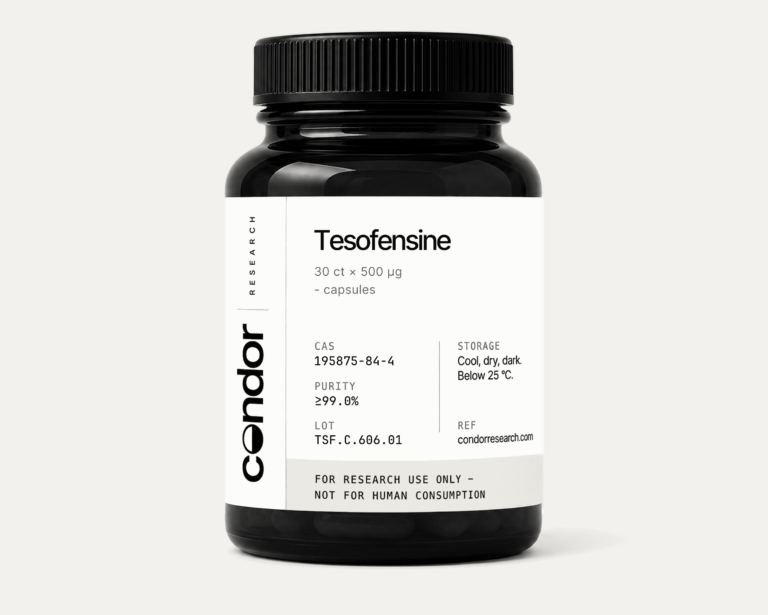
Tesofensine occupies an unusual regulatory space: a compound with two decades of clinical history, a genuine Phase II efficacy signal, and yet no marketing authorisation on any Western market. It is not a research chemical invented last year, and it is not a controlled substance either. For anyone trying to establish its status in Europe in 2026, the honest answer lives in primary regulatory records rather than vendor summaries. Everything below describes the regulatory record and the published literature, not use in people.
What is tesofensine, chemically and by history?
Tesofensine (development code NS2330; CAS 195875-84-4) is a small-molecule triple monoamine reuptake inhibitor of the phenyltropane class. In the transporter assays and imaging work that characterise it, the molecule blocks reuptake of noradrenaline, dopamine and serotonin — a pharmacology confirmed in overweight and obese men by Sjödin and colleagues1 and directly visualised in a human PET study measuring dopamine-transporter occupancy.2 It carries a very long half-life on the order of a week and an active metabolite, M1, both documented in population pharmacokinetic modelling of the compound in Alzheimer’s disease patients.3
The history explains the odd trajectory. NeuroSearch in Denmark originally developed NS2330 for central-nervous-system indications — a randomised trial ran the compound in early Parkinson’s disease, where it missed its neurological endpoint.4 During those Parkinson’s and Alzheimer’s programmes an incidental weight-loss signal appeared, reported by Astrup and colleagues, and that observation is what pivoted the molecule toward obesity.5 Rights later passed to Saniona, which pursued development for rare metabolic indications and, through a partner, for obesity outside Europe.
~9 days the approximate half-life reported for tesofensine — week-scale disposition, with an active metabolite contributing to its pharmacology.
Does tesofensine have an EMA marketing authorisation?
No. This is the load-bearing fact, and it comes from EU sources rather than commentary. The EU Clinical Trials Register entry for a tesofensine obesity trial (EudraCT 2006-002862-20, sponsored under protocol NS2330-001, with Denmark’s medicines authority as competent authority) states in its investigational-product record that the “IMP to be used in the trial has a marketing authorisation: No”, and that the product is not an orphan drug in the Community at that point.6 That is a completed, registered EU trial whose own paperwork confirms the compound was investigational.
The other EU footprint is an orphan designation. Tesofensine — in the fixed-dose Tesomet form — appears on the European Medicines Agency’s orphan-designations database for a rare indication (Prader-Willi syndrome, designated in November 2023).7 This is where careful reading matters. Orphan designation is a development-support status that grants incentives to sponsors working on rare diseases; it is explicitly not a marketing authorisation, and it does not mean the medicine is approved, available, or lawful to sell for use. Conflating designation with approval is one of the most common errors in circulating “legal status” write-ups, and it is simply wrong.
Where has approval actually been pursued?
Outside Europe. Saniona’s partner Medix ran a Phase 3 obesity trial in Mexico, and in February 2023 COFEPRIS’s new-molecules technical committee issued a favourable — importantly, non-binding — opinion for obesity in that market, per the company’s own regulatory disclosures.8 Approval was pursued in Mexico and Argentina, not in the EU. That single favourable technical opinion is the strongest regulatory signal tesofensine has ever received, and it does not translate to any European or other Western jurisdiction. The compound is not FDA-approved, not TGA- or Health Canada-approved, and remains investigational worldwide.
Orphan designation is a development incentive, not an authorisation — and the one favourable regulatory opinion anywhere was non-binding, in Mexico, for obesity.
Is tesofensine a controlled substance in Europe?
Generally, no. There is no blanket EU narcotic or psychotropic control of tesofensine, and its major member states do not schedule it; it is likewise not DEA-scheduled in the United States. Low predicted abuse liability is attributed partly to its slow onset — a consequence of that long half-life. But this is exactly the point where a factual statement gets misread as permission. “Not scheduled” describes the absence of controlled-substance restrictions; it says nothing about whether the compound may lawfully be sold or used in humans. It cannot: an unapproved medicine sits under member-state medicines and consumer-safety law regardless of scheduling. Research Use Only is a category for laboratory reagents, not a route around that.
| Regulatory dimension | Status (2026) |
|---|---|
| EMA marketing authorisation | None |
| EU member-state approval | None |
| EU orphan designation | Yes (rare indication; not an authorisation) |
| EU-scheduled controlled substance | No |
| US FDA approval / DEA schedule | Not approved / not scheduled |
| Only active approval pathway | Mexico (COFEPRIS non-binding favourable opinion, Feb 2023) |
Regulatory summary compiled from primary EU records and company disclosures. Tesofensine is an unapproved investigational compound; nothing here describes lawful human use, and Condor Research supplies it strictly Research Use Only.
An honest read of the evidence
The efficacy story is thinner than its reputation suggests. It rests largely on a single Phase II trial — TIPO-1, roughly two hundred participants, which reported dose-dependent placebo-subtracted weight loss reaching around 10 kg at the 0.5 mg dose over 24 weeks.9 Supporting mechanistic work shows reduced hunger and increased satiety,10 and an independent expert review framed the compound explicitly as investigational rather than established.11 The subsequent Mexican Phase 3 was reported mainly through company press releases rather than the peer-reviewed literature; there is no EMA- or FDA-reviewed pivotal dataset behind it. One well-powered Phase II plus a company-reported Phase 3 is a genuinely limited base for the confident claims that circulate online.
The safety signals are the other half of the honest picture, and they are unresolved. The pivotal trial itself documented dose-dependent rises in heart rate and blood pressure, and a 2013 Lancet correspondence raised specific concerns about under-reporting of adverse effects.12 Those cardiovascular and psychiatric signals are the principal reason Western development stalled; they are not a footnote. It is worth noting that Tesomet, the fixed-dose form under orphan designation, deliberately combines tesofensine with the beta-blocker metoprolol precisely to blunt the cardiovascular effect — a design choice that itself acknowledges the signal. Finally, a practical caution on sourcing your facts: most of the “legal status” and mechanism detail circulating online comes from vendor and SEO pages, not primary records. Only the PubMed papers and the official EMA and EudraCT entries should be treated as load-bearing.
If you are mapping the wider picture, our overview of the legal status of research compounds in Europe and the 2026 regulatory outlook for research peptides set the same distinctions in context, and the tesofensine primer covers the pharmacology in more depth. A direct comparison with enclomiphene is available for those weighing mechanisms. Material is offered only as a reference sample: tesofensine for research.
All materials supplied by Condor Research are Research Use Only (RUO). The regulatory facts and study findings above describe the published literature and official records only. Nothing here is a dosing protocol, a statement of legality for human or veterinary use, clinical guidance, or a safety assessment for any organism. Tesofensine is an unapproved investigational compound; “not scheduled” does not mean “approved,” and none of the weight-loss or appetite findings described are offered as claims about use in people.
Condor Research · Scientific desk
Atrio Sciences s.r.o., IČO 57 669 651, Nitra (SK) · info@condorresearch.com
- Tesofensine (development code NS2330, CAS 195875-84-4) is a phenyltropane-class triple monoamine reuptake inhibitor acting on noradrenaline, dopamine and serotonin transporters.
- It has no EMA marketing authorisation and no approval by any EU member state; the EU Clinical Trials Register record for an obesity trial explicitly states the investigational product has no marketing authorisation.
- Its only EU regulatory footprint is orphan designation (a development-support status for rare indications, granted 2023) plus completed clinical trials — designation is explicitly not authorisation.
- It is generally not a controlled or scheduled substance in the EU, its major member states, or the US, but 'not scheduled' is not the same as 'legal to sell or use in humans'.
- Efficacy evidence rests largely on a single Phase II trial (TIPO-1, Astrup 2008, Lancet); a Mexican Phase 3 was reported mainly through company disclosures, not EMA/FDA-reviewed.
- Dose-dependent increases in heart rate and blood pressure, plus adverse-effect-reporting concerns, are the principal reasons Western development stalled.
- The only active approval pathway ran in Mexico, where COFEPRIS's technical committee issued a favourable non-binding opinion in February 2023 — not an EU or Western authorisation.
Can I legally buy tesofensine in Europe?
It can be sold as a research reagent under Research Use Only framing, which is a category for laboratory use, not human consumption. There is no marketing authorisation permitting it as a medicine, and no lawful basis for human use in the EU. Member-state medicines and consumer-safety law continues to apply regardless of the absence of scheduling.
Why does tesofensine appear on the EMA website if it is not approved?
It appears under orphan designation, not authorisation. Orphan designation is an incentive granted to sponsors developing treatments for rare diseases; it supports development but does not mean the medicine is approved, available, or lawful to market. The distinction is explicit in EMA's own framework.
Is tesofensine a controlled substance anywhere in Europe?
There is no blanket EU narcotic or psychotropic control of tesofensine, and its major member states do not schedule it. Its predicted abuse liability is described as low, attributed partly to slow onset from its long half-life. That absence of scheduling is not equivalent to permission for human sale or use.
Has tesofensine been approved anywhere in the world?
No full marketing authorisation is in force in any Western market. The only active approval pathway ran in Mexico, where COFEPRIS's technical committee gave a favourable but non-binding opinion for obesity in February 2023. It is not FDA-, TGA-, Health Canada-, or EMA-approved.
How strong is the evidence behind tesofensine?
The main efficacy evidence is a single Phase II trial of roughly two hundred participants, supported by mechanistic and pharmacokinetic work. A Phase 3 trial was run in Mexico but reported largely through company disclosures rather than peer review, and no EMA- or FDA-reviewed pivotal dataset exists. The evidence base is real but limited.
Why did Western development stall if the trial showed weight loss?
Dose-dependent increases in heart rate and blood pressure, together with concerns about adverse-effect reporting, raised the cardiovascular and psychiatric risk profile. Those unresolved safety signals — not a lack of a weight-loss signal — are the main reason the compound did not advance through Western regulators.