Lyophilised · ≥98% (HPLC) ·
Supplied lyophilised. Reconstitution typically uses bacteriostatic water.
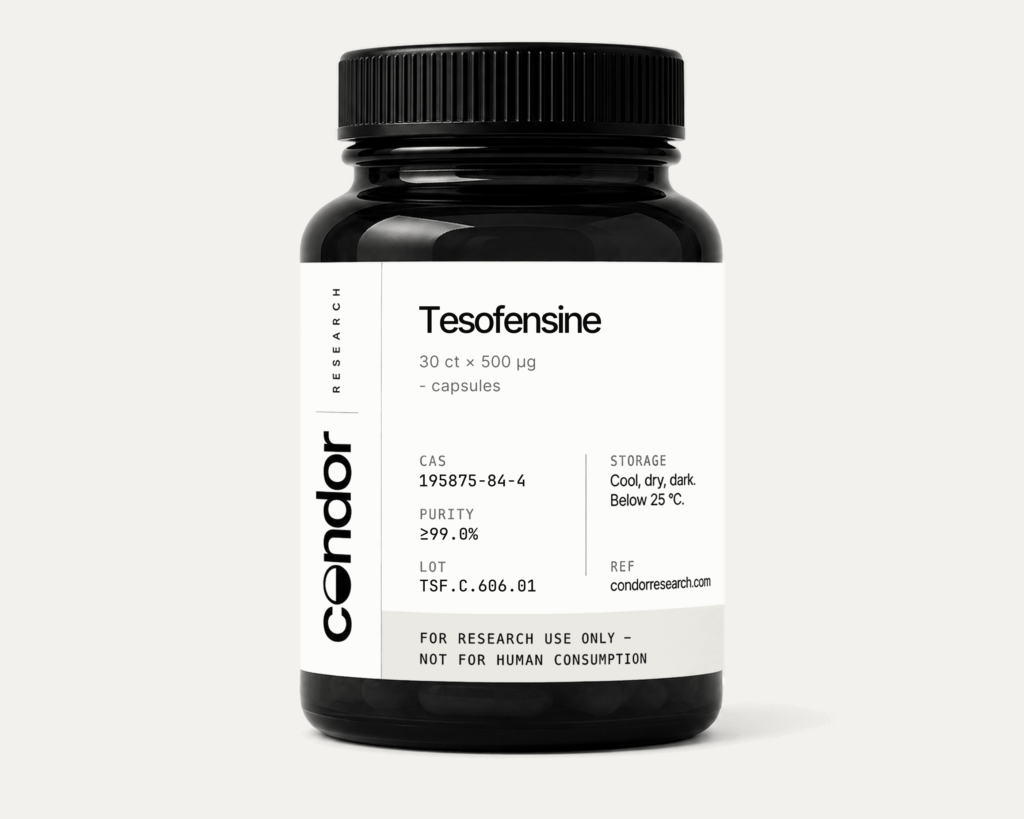
Tesofensine is a presynaptic monoamine reuptake inhibitor that blocks the reuptake of serotonin, dopamine, and noradrenaline, originally developed as a neurological compound and subsequently investigated in metabolic and appetite-regulation research models. CAS 195875-84-4; molecular formula C17H23Cl2NO; molecular weight 328.3 g/mol. Supplied as encapsulated compound. For laboratory research use only; not for human or veterinary use.
The brain regulates appetite and energy balance through a trio of chemical messengers — serotonin, noradrenaline and dopamine — and most experimental tools touch only one of them. Tesofensine (NS2330) is different: it is a small-molecule triple monoamine reuptake inhibitor, a research compound that engages all three transporters at once, which is precisely why it has become a recurring subject in central-nervous-system and energy-balance neuroscience.
One molecule, three transporters. By inhibiting the serotonin, noradrenaline and dopamine reuptake transporters in parallel, Tesofensine has been used in animal models to probe how converging monoamine signalling shapes hypothalamic circuits and feeding behaviour (Perez et al., 2024; Hansen et al., 2013). It belongs to the broader class of centrally acting compounds long studied in appetite and metabolic neuroscience (Coulter et al., 2018).
What the research explores. Across cell-culture and animal systems, Tesofensine has been investigated along several converging lines:
The activity described here is drawn from in-vitro and animal studies; it characterises biological behaviour in experimental models and does not establish efficacy or safety in humans. Full citations are listed under the Scientific References tab.
Physicochemical profile. CAS No. 195875-84-4 · Molecular formula C17H23Cl2NO · Molecular weight 328.29 g/mol · Appearance: White to off-white powder · Solubility: Soluble in DMSO; sparingly in water.
Specification & quality. Each bottle contains 30 HPMC (vegan) capsules, each providing 500mcg of Tesofensine at ≥98% (HPLC). Encapsulated — no reconstitution required. Every batch is independently third-party tested, and a Certificate of Analysis (COA) is available. Store at room temperature, protect from light and moisture; shelf life 24 months from the manufacture date. EU warehoused.
This product is intended for laboratory research use only (RUO). It is not a drug, food, cosmetic, or dietary supplement, and is not for human or veterinary use, ingestion, or diagnostic application. Handling is restricted to qualified research professionals operating in an appropriately equipped laboratory.
Supplied for in-vitro laboratory research use only (RUO). Not a drug, food or supplement; not for human or veterinary use.
Certificate of Analysis — lot-specific COA ships with every order and is available on request.
Each lot is tested by an independent third-party laboratory for identity (mass spectrometry) and purity (HPLC). The Certificate of Analysis for your specific batch ships with the order and is available on request — no house data, no exceptions.
References are illustrative of the research literature surrounding this compound. All claims relate to in-vitro and animal models only.
Tesofensine (NS2330) is a small-molecule triple monoamine reuptake inhibitor that engages the serotonin, noradrenaline and dopamine transporters, studied in central-nervous-system and energy-balance models (Appel et al., 2014). It is used in animal and in-vitro research to probe converging monoamine signalling. Condor Research supplies it strictly as a Research Use Only reference compound, never for human or veterinary use, and it is geo-restricted at checkout.
Triple reuptake inhibitors are a chemical class studied for simultaneous action on three monoamine transporters, and structural work continues to map how such compounds bind their targets (Li et al., 2025). Tesofensine is one of the most-referenced members and is frequently used as a probe of dopamine-transporter occupancy in mechanistic studies (Appel et al., 2014). It is supplied only as a research-use-only reference compound for in vitro and animal work.
Many centrally acting compounds studied in appetite neuroscience target a single neurotransmitter system, whereas Tesofensine is distinguished by acting on three monoamine transporters in parallel within hypothalamic circuit models (Perez et al., 2024; Coulter et al., 2018). This multi-transporter profile makes it a specific tool for energy-balance circuit questions. It is offered strictly for laboratory research use only.
They operate in completely different domains. Tesofensine is a CNS-acting monoamine-transporter inhibitor studied in appetite and energy-balance neuroscience (Hansen et al., 2013), while 5-Amino-1MQ is an NNMT enzyme inhibitor studied in peripheral NAD+/SAM metabolism. They answer unrelated research questions and are not interchangeable. Both are supplied only as research-use-only reference compounds, never for human or veterinary use.
Tesofensine availability is limited by region because its regulatory status varies between jurisdictions, so checkout applies geo-restriction and the buyer is responsible for verifying that import of this Research Use Only reference compound is permitted where they are located. It is supplied under a strict RUO framework, never as a medicine, supplement or product for human or veterinary use. For eligibility questions, contact info@condorresearch.com.
Yes. Condor Research supplies Tesofensine strictly as a Research Use Only reference compound to professionals and institutions, not as a medicine, supplement or product for human or veterinary use. Because it is geo-restricted, buyers are responsible for confirming import legality in their own country before ordering. Questions: info@condorresearch.com.
The capsule is a pre-weighed solid format that standardises the quantity of reference compound per unit, simplifying bench handling and inventory for laboratory work. Each is an HPMC (vegan) capsule containing the powder — no reconstitution is required, and the format does not imply or permit any form of consumption. For laboratory research use only. Not for human or veterinary use.
Each bottle contains 30 HPMC (vegan) capsules, with 500mcg of Tesofensine per capsule at ≥98% HPLC purity, and every batch is independently third-party tested. The per-capsule figure denotes only the pre-weighed quantity of reference compound for laboratory measurement — this product is for research use only and not for human or veterinary use, ingestion, or diagnostic application.
Tesofensine has CAS No. 195875-84-4, a molecular formula of C17H23Cl2NO and a molecular weight of 328.29 g/mol. It presents as a white to off-white powder, soluble in DMSO and sparingly soluble in water. These specifications are provided for laboratory identification and research use only.
Yes. Every Tesofensine batch is tested by an independent third-party laboratory by HPLC for identity and purity (≥98%), and each lot ships with a lot-specific Certificate of Analysis. To request the COA for your batch, contact info@condorresearch.com. The material is supplied strictly for research use only.
Condor Research supplies Tesofensine Capsules directly, dispatched from our EU facility in Slovakia to the EU, EEA, UK and Switzerland. Deliveries to EU destinations clear no third-country customs, and shipping is calculated at checkout. Supplied strictly as a research-use-only reference material — not for human or veterinary use.
No verified reviews yet.
Leave a reviewCookies
We use strictly necessary cookies to run the store. With your consent we also use analytics (order attribution) and marketing (Omnisend) cookies. Read our Cookie Policy.