
TAK-653 (Osavampator): The Evidence Dossier. A Forum Nootropic in a Phase 3 Depression Programme
TAK-653 (osavampator) evidence dossier: 13 PubMed records and 9 trials classified, 19 forum claims checked, and what phase 2 SAVITRI reported, source by source.
TAK-653 (osavampator) evidence dossier: 13 PubMed records and 9 trials classified, 19 forum claims checked, and what phase 2 SAVITRI reported, source by source.
TAK-653 is an experimental drug that Takeda discovered and Neurocrine Biosciences now develops under the name osavampator. It acts on the AMPA receptor, one of the brain’s main switches for fast signalling by glutamate. On nootropic forums it is discussed as a way to think faster or remember more. In clinical development it is being tested for something else: as an add-on to antidepressants in adults whose depression has not responded well. This dossier gathers every article, trial record, company filing and congress document that could be found at 25 October 2026, and checks what each claim about the compound rests on.
Evidence dossier version 1.4. Data cut-off 25 October 2026. Prepared by Condor Research Editorial. Declaration of interest at the end of the page. Dose amounts and schedules are omitted by editorial rule; trial arms are named only as lower and higher dose.
Central question. TAK-653 circulates on forums as a cognitive enhancer while it sits in a registrational phase 3 programme for depression. Which claims about it rest on published human data, which rest only on the developers’ own channels, and which rest on nothing; and what will the phase 3 trials be able to settle?
Key findings. (1) Of 19 forum claims, 1 is supported by a primary source, 1 has trial data without proven efficacy, 6 are partly supported, 4 are contradicted, 6 have no source and 1 cannot be assessed; the three cognition claims have no human data. (2) All four human studies with data were sponsored by the developers; two have journal articles. (3) The only trial in patients, SAVITRI (183 adults), compared each of two dose levels with placebo; the lower-dose comparison reached nominal significance and the higher did not. Its results are on the EU Clinical Trials Register and in company communications, not in a journal. (4) In the first-in-human study, serum BDNF was inconsistent across administration levels. (5) Takeda and Neurocrine hold direct payment terms; two further companies hold indirect royalty interests.
What this dossier adds, compared with the sources we reviewed. A 2025 systematic review states that no human depression trial was identified, and Wikipedia frames the compound around treatment-resistant depression. This page adds a double-coded census of all 13 PubMed records, all 9 ClinicalTrials.gov records plus the EU registries, a reconciliation of six SAVITRI sources, first-in-human data that appear only in a 2018 conference abstract, the patent families, a comparison with six other clinical-stage AMPA modulators, and 19 forum claims checked one by one (Table 12).
What does the evidence base look like at a glance?
| Evidence Index field | Value at 2026-10-25 | Definition |
|---|---|---|
| total | 13 | PubMed records naming the compound under any verified synonym (title/abstract) |
| humanos | 3 | PubMed records with original human data (2 trials) |
| ensayos_pm | 3 | PubMed records tagged as a clinical-trial publication type (one of them, a drug-interaction study, is tagged randomised but describes no randomisation) |
| ct_total / ct_intervencion | 9 / 9 | ClinicalTrials.gov records, all interventional |
| confianza | high | All three names resolve to PubChem CID 56655833; cross-check query returned the same 13 records |
| catalogo | no | Condor Research does not sell TAK-653 |
Table 1. Evidence Card row for TAK-653 / osavampator, new in the Condor Research Evidence Index. Source: this census; ClinicalTrials.gov API v2; PubChem.
Evidence level in one line: developer-run pharmacology in cells, rats and monkeys; short developer-run studies in healthy volunteers; one phase 2 trial in patients reported through a public registry and company communications; no independent human data.
What is TAK-653, chemically, and who holds patents on it?
TAK-653, NBI-1065845 and osavampator are one substance: all three names resolve to PubChem CID 56655833, a small molecule of formula C19H23N3O3S and molecular weight 373.5.7 Its systematic name describes a fused pyrazino-thiadiazine 2,2-dioxide carrying a cyclohexyloxy-phenyl group. Osavampator is its International Nonproprietary Name and its USAN.
| Field | Value |
|---|---|
| Names and codes | Osavampator (INN, USAN); TAK-653 (Takeda); NBI-1065845 (Neurocrine) |
| PubChem CID | 56655833 |
| CAS number | 1358751-06-0 |
| UNII | 9E3TOE5RIZ |
| ChEMBL | CHEMBL4594403 |
| Molecular formula | C19H23N3O3S |
| Molecular weight | 373.5 g/mol |
| IUPAC name | 9-(4-cyclohexyloxyphenyl)-7-methyl-3,4-dihydropyrazino[2,1-c][1,2,4]thiadiazine 2,2-dioxide |
| InChIKey | PXJBHEHFVQVDDS-UHFFFAOYSA-N |
| Computed properties (PubChem) | XLogP3 2.7; topological polar surface area 79.7 Ų; 0 hydrogen-bond donors; 5 acceptors |
| Class | Small molecule; positive allosteric modulator of the AMPA receptor with minimal agonist activity in the developer's assays. Not a peptide. |
Table 9. Chemical identity. Source: PubChem (CID 56655833) and Google Patents.7,8
Takeda’s compound patent family has a priority date of 10 August 2010; the compound’s systematic name appears in the text of WO2012020848A1, and the first US patent was granted in November 2013.8 A second Takeda family, with a 2020 priority date, covers methods of use in depression.9 PubChem also links the compound to third-party filings by Gilgamesh, Sage and Biora, in which it is one of many listed agents rather than the subject.10
| Family | Assignee | Earliest priority | Members (examples) | Principal subject |
|---|---|---|---|---|
| Takeda compound family | Takeda | 2010-08-10 (JP2010179577) | WO2012020848A1; US 8,575,154 B2 (granted 2013-11-05); US 10,654,874 B2; US 11,279,713 B2; CN104926837A; EP2603513B1 | A genus of heterocyclic compounds of formula (I), or salts, with AMPA receptor potentiating action; the compound's systematic name appears in the text8,10 |
| Takeda method-of-use family | Takeda | 2020-05-15 | WO2021229294A1; TW202207944A; EP4149478A1 | Methods of treating depression or preventing relapse with the compound (administration details omitted)9,10 |
| Third-party combination filings | Gilgamesh Pharmaceuticals; Sage Therapeutics | 2022-02-11 to 2022-02-28 | WO2023154450A2 (Gilgamesh); WO2023158668A1, WO2023159035A1, EP4479032A1, CN119072304A, WO2023163879A1 (Sage) | Compositions or combination methods (an AMPA PAM with an NMDA receptor antagonist; Sage's Compound (1) with an additional agent) in which the compound appears among candidate agents10 |
| Third-party delivery filings | Biora Therapeutics | 2019-12-13 | EP3870261B1; EP4309722A2; US 11,707,610 B2 | Ingestible devices for delivering therapeutic agents to the gastrointestinal tract; the compound appears among listed agents10 |
Table 13. Patent families linked to the compound. Takeda families from Google Patents and PubChem; third-party families as linked by PubChem, where the compound is one listed agent among many. Claim scope not assessed legally.
One discrepancy is worth flagging. The 2026 patent review in Expert Opinion on Therapeutic Patents groups TAK-653 among “benzoxathiazines” in its abstract,11 whereas the PubChem structure contains no benzoxathiazine ring. The full text is paywalled, so we cannot tell whether this reflects design lineage or a slip in the abstract.
In plain terms. It is a conventional drug-like molecule, not a peptide. Takeda has held patents on it since 2010, and the three names in circulation refer to the same compound.
How is it supposed to work?
Established in the developer’s laboratory work. In Takeda’s characterisation paper, TAK-653 bound the ligand-binding domain of recombinant AMPA receptors only in the presence of glutamate, at the interface between two subunits, and strengthened glutamate-induced calcium entry in cells while showing little activity on its own. The authors attribute the low intrinsic (“agonist”) activity to steric interference at serine 743 of the GluA1 subunit. In brain slices it enhanced evoked AMPA-mediated synaptic potentials more than a comparator potentiator with strong agonist activity.12 The developer’s 2023 review quantifies the difference in rat hippocampal neurons: without an agonist present, TAK-653 produced 4.8% of a reference calcium response against 88% for the comparator LY451646, and 1.7% of the maximal AMPA current against 39%. The same review reports no major selectivity among AMPA receptor subunits.13 The binding assay used Takeda’s earlier tool compound, HBT1, as the radioligand; we describe that compound in a separate dossier on HBT1. In rat cortical neurons TAK-653 increased phosphorylated mTOR, p70S6 kinase, Akt and ERK in the presence of AMPA, and increased BDNF protein only when AMPA was present; on its own it had no effect on BDNF.14
Established in humans, as target engagement only. In 24 healthy volunteers, the higher of two tested levels increased the amplitude of motor-evoked potentials elicited by transcranial magnetic stimulation (Dunnett-adjusted p = 0.0497), without changing the resting motor threshold; rats showed the same direction of effect at similar plasma concentrations.15 The first-in-human abstract reports a cerebrospinal fluid to plasma ratio of 0.056, close to the unbound fraction in plasma, which the authors read as brain penetration.16
Proposed but not shown in humans. The developers’ rationale is that ketamine’s antidepressant-like effect in animals depends on AMPA receptor activation followed by mTOR signalling and BDNF release, and that a potentiator could reach the same pathway without ketamine’s dissociative effects.13,14 The one human BDNF measurement gave an inconsistent serum signal: a rise at one single-administration level, transient falls at the others, and no reproduction with repeated administration. The authors propose a ceiling effect in healthy people as an explanation; that is their hypothesis, and serum BDNF in healthy volunteers neither establishes nor excludes central signalling.16 No study has measured AMPA receptor occupancy, receptor regulation or tolerance in humans.
The developer’s framing also explains why the compound exists. Earlier AMPA potentiators with marked agonist activity showed bell-shaped dose-response curves and a narrow margin against seizures; Takeda screened for low agonism to avoid both. In rats the margin against convulsion was 419-fold on peak plasma concentration and 1017-fold on exposure over time.12 The full text of the 2023 review defines that margin: the ratio between the exposure needed for the rat recognition-memory effect and the highest exposure without signs of seizures after a single administration. Calculated the same way, the margins were 42-fold and 122-fold for Takeda’s sister compound TAK-137 and 3.4-fold and 4.0-fold for LY451646, which caused seizures in rats at higher test levels.13 These are developer-run comparisons in one species, and the authors state that they do not have permission to share the data.
Animal behaviour. In the developer’s rat social-submission model, run at a contract laboratory with 10 pairs per group, repeated administration over a 3-week study reduced submissive behaviour from about the sixth or seventh day. The effect was also seen when rats were tested about a day after each administration, when plasma levels were effectively zero (rat plasma half-life 1.9 hours, against 33 to 48 hours reported in humans). Unlike ketamine, TAK-653 did not increase locomotor activity at the levels tested.14,16 The developer also reports improved sustained attention in poorly performing rats and reduced social deficits in a mouse developmental model.13,12 No independent laboratory has repeated these rodent experiments.
In plain terms. The drug turns up the response of AMPA receptors when glutamate is already present, rather than switching them on by itself. In volunteers, brain-stimulation tests changed in a way consistent with an effect in the brain; that shows the drug engages its target, not that it treats anything. The idea that it works like ketamine through BDNF comes from animal and cell experiments.
What happened when, from patent to phase 3?
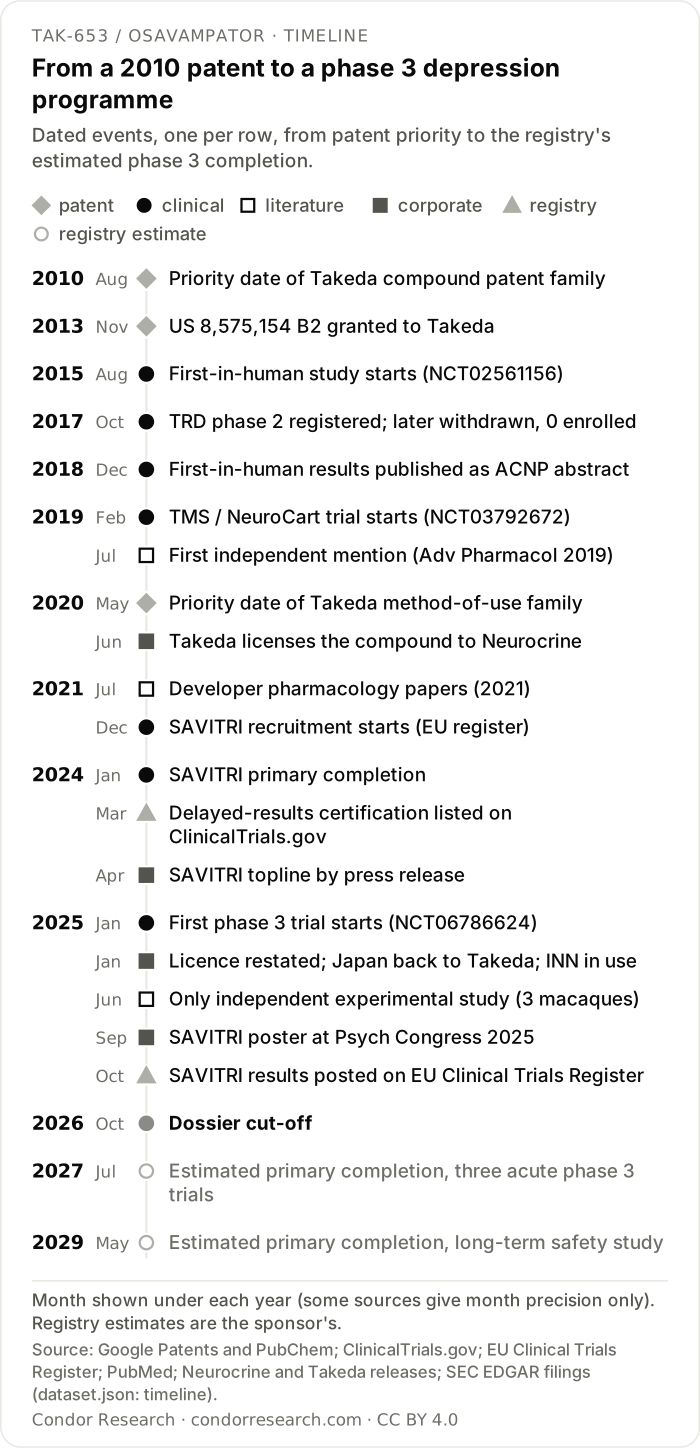
Takeda began the first-in-human study in the United Kingdom in August 2015 and registered a phase 2 trial in treatment-resistant depression in 2017, which was withdrawn before any participant enrolled.17,18 In June 2020 Takeda licensed the compound to Neurocrine, describing it as “Phase II study-ready” for treatment-resistant depression.19,20 Neurocrine ran SAVITRI from December 2021 to February 2024 and announced topline results in April 2024. In January 2025 the licence was restated: Takeda took back Japan and the profit share became a royalty-bearing licence.21,22 The first phase 3 trial started on 22 January 2025; the company expects topline results in 2027.23,24
In plain terms. The molecule is sixteen years old. Its human testing has been slow and almost entirely in company hands, and the decisive results are not due before 2027.
Research Use Only boundary. The next sections summarise human studies because they are part of the scientific record. They describe what trials registered and reported; they do not validate, recommend or describe any human use, and they contain no doses, regimens or instructions. Osavampator is an investigational substance with no marketing authorisation and is not supplied by Condor Research. Material Condor Research supplies is for laboratory research only.
What human studies have been registered and published?
Three units are kept apart here: articles (PubMed records), trials (registered or reported studies) and participants. Four trials have produced public data in humans, with 330 participants in total (88, 24, 35 and 183). Three PubMed articles report two of those trials: the TMS and NeuroCart trial is published twice, from the same 24 volunteers, and the drug-interaction study once.15,25,26 The first-in-human study has registry results and a 2018 conference abstract; SAVITRI has registry results in the EU and company communications. Neither has a journal article.17,16,3
| Trial (unit) | Phase | Population and n | Design | Endpoints | Result as reported | Where it is reported | Funder |
|---|---|---|---|---|---|---|---|
| NCT02561156 (first-in-human) 2015-2017, United Kingdom |
1 | 88 healthy adults | Randomised, quadruple-blind, placebo-controlled; 6 single-ascending and 5 multiple-ascending cohorts (repeated administration over 13 days) | Adverse events, laboratory, vital signs, ECG, EEG, C-SSRS; pharmacokinetics | No serious adverse events; no clinically significant EEG change; no suicidal ideation or behaviour. Half-life 33 to 48 h, 3- to 4-fold accumulation; CSF/plasma ratio 0.056. Serum BDNF signal inconsistent: a rise at one single-administration level, transient falls at others, not reproduced with repeated administration.17,16 | Registry results on ClinicalTrials.gov (posted 2019-02-08); conference abstract (ACNP 2018). No journal article. | Takeda (record now lists Neurocrine) |
| NCT03792672 (TMS / NeuroCart) 2019, Netherlands (CHDR, Leiden) |
1 | 24 healthy adults (23 men, 1 woman) | Randomised, double-blind, placebo-controlled, 3-period crossover with two single-administration levels; then an open-label ketamine period for assay sensitivity | Motor-evoked potential amplitude and resting motor threshold by TMS (registry primary); NeuroCart battery | Higher level increased motor-evoked potentials versus placebo (Dunnett-adjusted p = 0.0497); resting motor threshold and paired-pulse measures unchanged. NeuroCart: pattern the authors call 'psychostimulant-like', exploratory, no multiplicity correction. No seizure, dissociation or euphoria adverse events.15,25,27 | Two journal articles (2021, 2022); registry results (posted 2020-07-02). | Takeda |
| CYP3A interaction study (no registry number located) before 2024, United States |
1 | 35 healthy adults (18 in the midazolam arm, 17 women in the contraceptive arm) | Open-label, parallel-arm drug-interaction study | Geometric mean ratios of midazolam, ethinyl estradiol and levonorgestrel exposure | For these substrates under these conditions, no CYP3A induction by the authors' criteria. Midazolam and levonorgestrel AUC ratios fell outside the no-effect range without meeting the criteria for an interaction. Somnolence in 9 of 18 in the midazolam arm (a sedative was co-administered); headache in 6 of 17 in the contraceptive arm.26 | One journal article (2024). PubMed tags it 'Randomized Controlled Trial'; the article describes no randomisation. | Neurocrine |
| NCT05203341 / EudraCT 2021-003989-12 (SAVITRI) 2021-2024, United States, Bulgaria, Czechia, Poland, Slovakia, Sweden |
2 | 183 adults with MDD and inadequate antidepressant response | Randomised 2:1:1 (placebo and two dose levels), quadruple-blind, 8 weeks; most participants continued their antidepressant | Change in MADRS total score at day 28 (primary); day 56, response, remission, CGI-S, PHQ-9 (secondary) | Two separate comparisons with placebo, no dose-versus-dose comparison reported. Lower dose: day 28 -4.3 points (95% CI -7.8 to -0.8, nominal p = 0.0159); day 56 -7.5 (-12.1 to -2.9). Higher dose: -3.0 (-6.4 to 0.4, p = 0.0873) and -3.6 (-8.0 to 0.8, p = 0.1082). No serious adverse events or deaths.3,28,21,29,30 | EU Clinical Trials Register results (posted 2025-10-26); press releases (2024-04-23, 2025-09-22); congress abstract and poster (Psych Congress 2025). No journal article; no results on ClinicalTrials.gov. | Neurocrine |
| Phase 3 programme (5 trials) 2025-2030 (estimated), 23 countries on ClinicalTrials.gov; 16 EU member states in CTIS |
3 | 2,000 estimated across records (not additive: the long-term study may enrol participants from the others) | Three acute randomised placebo-controlled add-on trials, one randomised-withdrawal maintenance trial, one open-label long-term safety study | MADRS change at day 56 (acute); time to relapse (maintenance); adverse events (long-term) | Recruiting; no results. Topline data expected in 2027 according to the company.2,4,31,24 | Registry protocols (ClinicalTrials.gov, CTIS); press releases; SEC filings. | Neurocrine |
Table 2. Every human study of the compound located at the cut-off, one row per trial. Doses are omitted by editorial rule. ‘Lower’ and ‘higher’ dose refer to the two active arms. Sources as cited in each row.
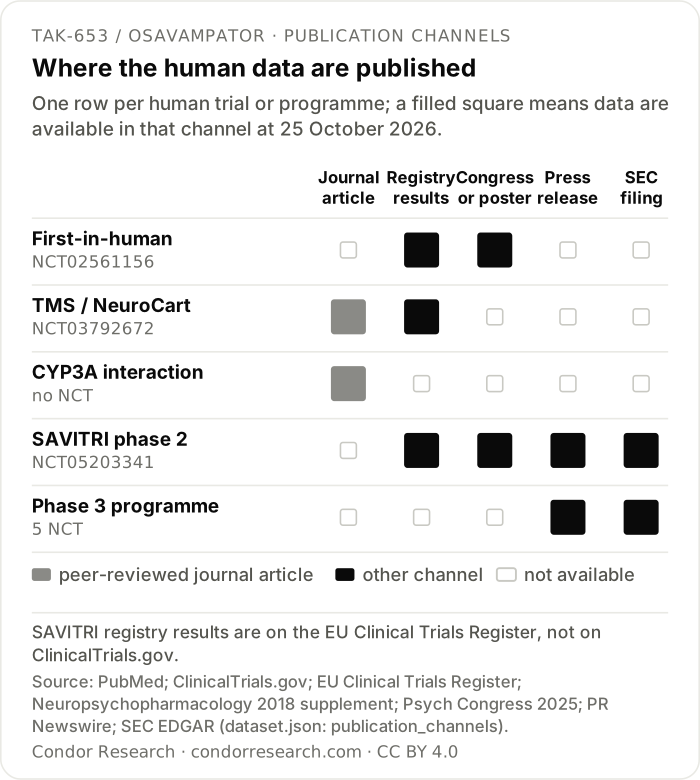
Three further features bear on how this record can be read. Both Takeda-era phase 1 records state a restrictive agreement: the research organisation may not publish or present results without Takeda’s prior written consent.17,27 Two studies excluded people at risk of seizures or with a history of neurological abnormality, which limits what their clean seizure record can say about wider populations.16,30 And the interaction study found no CYP3A induction for midazolam, ethinyl estradiol and levonorgestrel under the conditions studied; the midazolam and levonorgestrel exposure ratios fell outside the no-effect range without meeting the authors’ criteria for a clinically relevant interaction. It says nothing about other substances.26 PubMed tags that article as a “Randomized Controlled Trial”, although it describes an open-label, parallel-arm design without randomisation.
In plain terms. About 330 people have received the compound in studies with public data, and all of those studies were paid for by the developers. Only part of that work has been through peer review.
What did SAVITRI report, and why is it hard to read?
SAVITRI (NCT05203341; EudraCT 2021-003989-12) randomised 183 adults with major depressive disorder and an inadequate response to at least one antidepressant to placebo or one of two dose levels, in a 2:1:1 ratio, for 8 weeks; over 90% continued an antidepressant.28 The primary endpoint was the change in MADRS total score at day 28.30 The EU register results, posted on 26 October 2025, are the only registry source for its outcomes.3
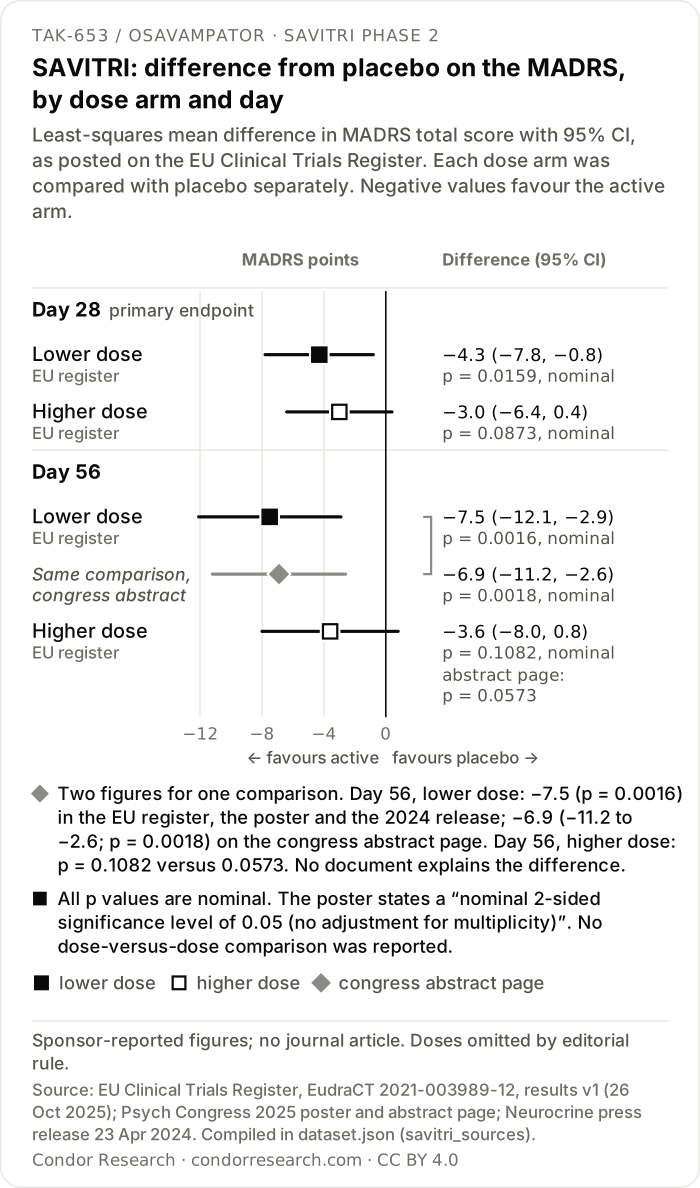
What was reported. The trial made two separate comparisons with placebo, one per dose level; no dose-versus-dose comparison was reported. For the lower dose the day-28 difference was -4.3 MADRS points (95% CI -7.8 to -0.8; p = 0.0159) and the day-56 difference -7.5 (-12.1 to -2.9; p = 0.0016). For the higher dose the differences were -3.0 (-6.4 to 0.4; p = 0.0873) and -3.6 (-8.0 to 0.8; p = 0.1082).3 There were no deaths and no serious adverse events in any arm.3
Why it is hard to read.
- Nominal p values. The poster states that “a nominal 2-sided significance level of 0.05 (no adjustment for multiplicity)” was used for primary and secondary endpoints.28 The April 2024 release headlined that the study “Met Primary Endpoint” without naming the dose.21 In our own check, not a pre-specified analysis, splitting the 0.05 threshold between the two dose comparisons leaves the lower-dose day-28 result below 0.025 and the higher-dose results above it. That split covers only the two dose comparisons; it does not adjust for the further time points and secondary endpoints, which remain nominal.
- The higher dose did not separate. With about 45 people per active arm, and without a direct comparison between the arms, the trial cannot show that the lower dose is better than the higher one. The company’s post hoc exposure-response analysis was used to choose the lower dose for phase 3.32
- Different day-56 figures by source. For the lower dose at day 56, the EU register, the poster and the 2024 release give -7.5 (p = 0.0016); the congress abstract page gives -6.9 (95% CI -11.2 to -2.6; p = 0.0018). For the higher dose at day 56, the register and poster give p = 0.1082, the abstract page p = 0.0573.3,28,29 None of the documents explains the difference.
- Baseline imbalances. Women made up 57.1% of the placebo arm and 73.3% and 68.1% of the active arms; two or more failed antidepressants in the current episode were reported for 35.2%, 35.6% and 19.1%. The poster also states that at day 28 remission was lower on the lower dose than on placebo, and higher on the higher dose.28
- Counts depend on the definition. The poster reports any adverse event in 42.9%, 55.6% and 44.7% of the three arms; the EU register lists non-serious events reaching a 5% threshold in 23.1%, 20.0% and 17.0%. The poster’s “161 completed treatment” and the register’s “164 completed the study” also measure different things.28,3
| Item | ClinicalTrials.gov | EU Clinical Trials Register (2025-10-26) | Press release 2024-04-23 | Congress abstract page (2025-10-17) | Poster PDF (Sept 2025) |
|---|---|---|---|---|---|
| Primary analysis | MADRS change at day 28 (protocol) | Each dose versus placebo, ANCOVA, both labelled pre-specified | 'Study met primary endpoint'; dose not named | Lower dose significant; p values called nominal | 'Nominal 2-sided significance level of 0.05 (no adjustment for multiplicity)' |
| Day 28, lower dose | No results posted | -4.3 (-7.8, -0.8), p = 0.0159 | -4.3, p = 0.0159 | -4.3 (-7.8, -0.8), p = 0.0159 | -4.3 (-7.8, -0.8), p = 0.0159, effect size 0.53 |
| Day 28, higher dose | No results posted | -3.0 (-6.4, 0.4), p = 0.0873 | -3.0, p = 0.0873 | Not given | -3.0 (-6.4, 0.4), p = 0.0873 |
| Day 56, lower dose | No results posted | -7.5 (-12.1, -2.9), p = 0.0016 | -7.5, p = 0.0016 | -6.9 (-11.2, -2.6), p = 0.0018, effect size 0.73 | -7.5 (-12.1, -2.9), p = 0.0016, effect size 0.73 |
| Day 56, higher dose | No results posted | -3.6 (-8.0, 0.8), p = 0.1082 | -3.6, p = 0.1082 | p = 0.0573 | -3.6 (-8.0, 0.8), p = 0.1082 |
| Conduct dates | Start 2022-02-21; primary completion 2024-01-10 | Recruitment from 2021-12-06; end of trial 2024-02-21 | Not given | Not given | 2021-12-06 to 2024-02-21 |
| Completion | 183 enrolled | 164 completed the study (79, 42, 43) | 183 enrolled | 161 of 183 completed treatment | 161 of 183 completed treatment |
| Results status | None posted; delayed-results certification listed | Results v1 posted | – | – | – |
Table 6. SAVITRI in six sources: two public registries and four sponsor communications. Differences are least-squares mean differences in MADRS total score versus placebo (negative favours the active arm), with 95% confidence intervals where given. Discrepant figures are reproduced as published.30,3,21,29,28
In plain terms. In one company-run trial of 183 people, the sponsor reported a difference of about 4 points on a 0-60 depression scale versus placebo at 4 weeks for the lower-dose arm; the sponsor reported no clear difference for the higher-dose arm. The analysis was not adjusted for its many comparisons and has not appeared in a journal.
What do the trial registries list?
| NCT | Phase | Title | Status | Enrolment | Start | Primary completion | Primary endpoint (registry) | Results in registry |
|---|---|---|---|---|---|---|---|---|
| NCT02561156 | 1 | TAK-653 Escalating Single and Multiple Dose Study in Healthy Participants | Completed | 88 | 2015-08-26 | 2017-09-11 | Part 1: Percentage of Participants Who Experience at Least One Treatment Emergent Adverse Event (TEAE); Part 2: Percentage of Participants Who Experience at Least One TEAE; Part 1:… | Yes, 2019-02-08 |
| NCT03312894 | 2 | Efficacy and Safety of TAK-653 in Treatment-Resistant Depression | Withdrawn (Business decision) | 0 | 2018-02-15 | 2019-02-28 (est.) | Cohort 1: Time to Relapse of Depressive Symptoms Postdose as Measured by Montgomery Åsberg Depression Rating Scale (MADRS) Total Score | No |
| NCT03792672 | 1 | A Study to Evaluate Central Nervous System (CNS) Pharmacodynamic Activity of TAK-653 in Healthy Participants Using Transcranial Magnetic Stimulation (TMS) | Completed | 24 | 2019-02-11 | 2019-05-15 | Change from baseline in motor-evoked potential amplitude with single-pulse TMS (timing relative to administration omitted); Change from baseline in resting motor threshold with sin… | Yes, 2020-07-02 |
| NCT05203341 | 2 | Study to Assess the Efficacy and Safety of NBI-1065845 in Adults With Major Depressive Disorder (MDD) | Completed | 183 | 2022-02-21 | 2024-01-10 | Change from Baseline in Total Montgomery Åsberg Depression Rating Scale (MADRS) Score at Day 28 | No; delay certification posted 2024-03-25 |
| NCT06786624 | 3 | Study to Assess the Efficacy and Safety of NBI-1065845 as an Adjunctive Treatment in Participants With Major Depressive Disorder (MDD) | Recruiting | 200 (est.) | 2025-01-22 | 2027-07 (est.) | Change from Baseline in Total Montgomery-Åsberg Depression Rating Scale (MADRS) Score at Day 56 | No |
| NCT06911112 | 3 | NBI-1065845-MDD3025: Study to Assess the Efficacy and Safety of NBI-1065845 as an Adjunctive Treatment in Participants With Major Depressive Disorder (MDD) | Recruiting | 200 (est.) | 2025-03-31 | 2027-07 (est.) | Change from Baseline in Total Montgomery-Åsberg Depression Rating Scale (MADRS) Score at Day 56 | No |
| NCT06966401 | 3 | Long-Term Study to Assess the Safety and Tolerability of NBI-1065845 as an Adjunctive Treatment in Participants With Major Depressive Disorder (MDD) | Recruiting | 850 (est.) | 2025-04-16 | 2029-05 (est.) | Number of Participants with Treatment-emergent Adverse Events (TEAEs) | No |
| NCT06963021 | 3 | NBI-1065845-MDD3026: Study to Assess the Efficacy and Safety of NBI-1065845 as an Adjunctive Treatment in Participants With Major Depressive Disorder (MDD) | Recruiting | 200 (est.) | 2025-05-30 | 2027-07 (est.) | Change from Baseline in Total Montgomery-Åsberg Depression Rating Scale (MADRS) Score at Day 56 | No |
| NCT07196501 | 3 | A Study to Evaluate the Maintenance Effect of Osavampator as an Adjunctive Treatment in Participants With Major Depressive Disorder (MDD) | Recruiting | 550 (est.) | 2025-08-18 | 2028-07 (est.) | Time from Randomization to Relapse | No |
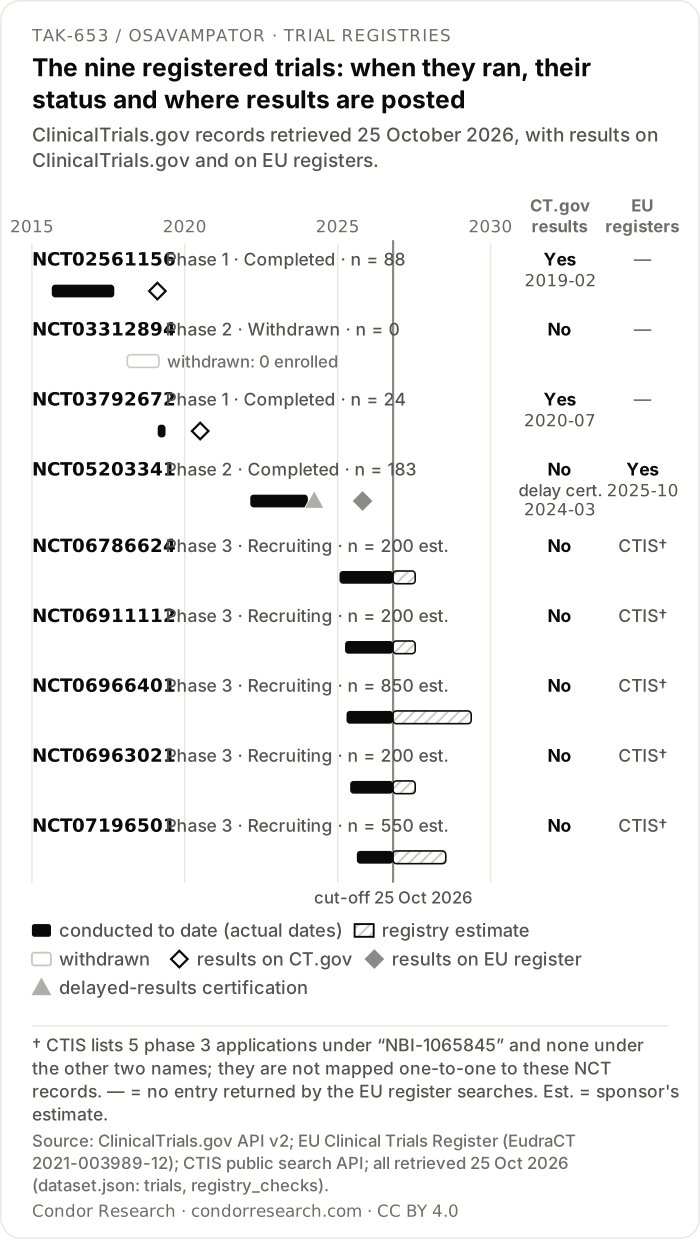
Table 3. All 9 ClinicalTrials.gov records, retrieved 2026-10-25 with the three names. Enrolment marked est. is the sponsor’s estimate. Source: ClinicalTrials.gov API v2.2
What would phase 3 need to show?
Each of the three acute phase 3 trials plans about 200 participants in two arms, with MADRS change at day 56 as primary endpoint.2 SAVITRI’s EU-register results give, for each comparison, a confidence interval and the number of participants analysed (91, 45 and 47 at day 28; 79, 39 and 40 at day 56, for placebo, lower and higher dose). From them we back-calculated the residual standard deviation of its adjusted (ANCOVA) analysis: about 9.7 MADRS points at day 28 and 11.8 at day 56. This is the spread left after adjusting for baseline, the quantity a power calculation for a similar trial needs, not the raw variation between participants. We then calculated, for one trial randomising 100 per arm and keeping SAVITRI’s day-56 retention (86.3 analysed per arm), the chance of a significant result on a two-sided 5% test for different true effects (Figure 5).
- Detectable effect. An 80% chance of success needs a true difference of about 5.0 MADRS points at the day-56 spread, or 4.1 at the day-28 spread.
- If SAVITRI’s lower-dose estimate holds (7.5 points at day 56), each trial would almost certainly succeed (99%).
- If the true effect is nearer the edge of that estimate’s confidence interval (2.9 points), the chance per trial is 36% at the day-56 spread and 50% at the day-28 spread; the chance that at least two of the three succeed is 30% and 50% respectively.
- At the higher dose’s day-56 estimate (3.6 points) the chance per trial is 52% (68%); at two points, 20% (27%).
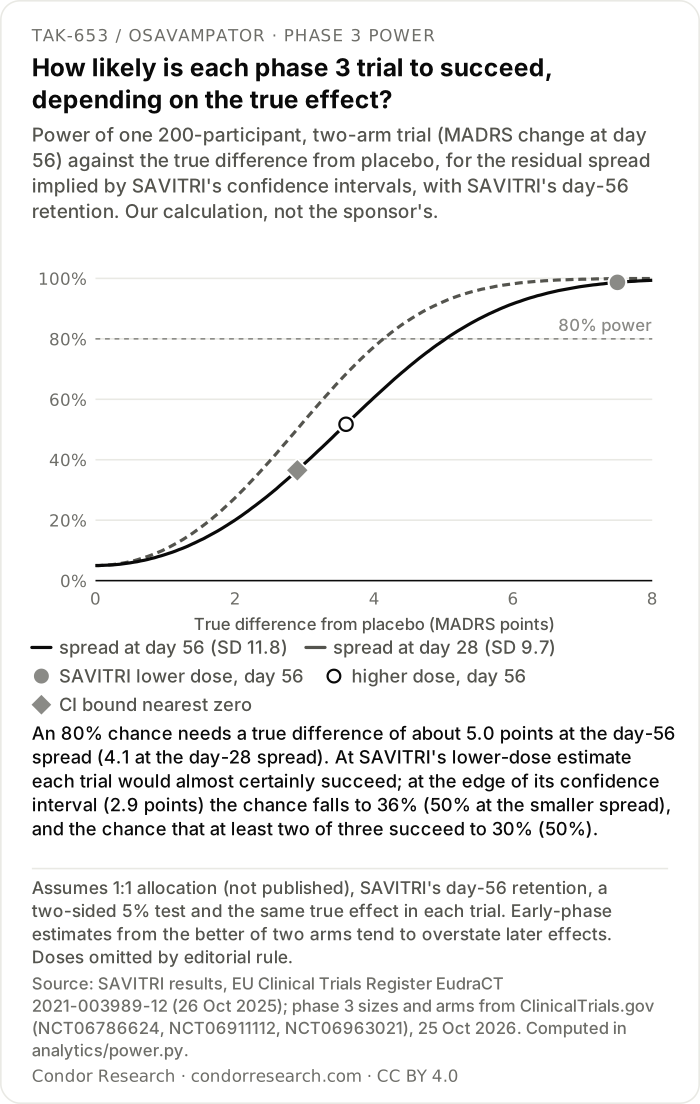
Three cautions apply. The allocation ratio and the sponsor’s own assumptions are not published. The lower dose was the better of two arms in a single phase 2 trial, a selection that tends to overstate the effect seen later. The dose carried into phase 3 is not stated in the registry records. These numbers describe the trials’ sensitivity, not a forecast of their results.
In plain terms: the phase 3 trials are large enough to detect an effect the size SAVITRI reported, but not reliably one half that size. If the true benefit is modest, one or more of the three could miss even if the drug does something.
The SAVITRI record on ClinicalTrials.gov shows no results at the cut-off, 1019 days after its primary completion date, and lists a delayed-results certification (first posted 25 March 2024 according to the API).30 ClinicalTrials.gov uses this label when a sponsor submits a certification or extension request; the label alone does not show whether or under what terms a delay applies.33 The same trial’s results are public on the EU Clinical Trials Register.3
The phase 3 programme comprises three acute placebo-controlled add-on trials with MADRS change at day 56 as primary endpoint, a randomised-withdrawal trial measuring time to relapse, and an open-label long-term safety study with an estimated 850 participants that runs to 2029 for its primary endpoint.2,31 Across the five ClinicalTrials.gov records, sites are listed in 23 countries, 16 of them EU member states. CTIS lists the five EU applications under “NBI-1065845” and returns nothing for “TAK-653” or “osavampator”; a manual jRCT search for Japan returned no record under either name.4,34
Retrieval depends on the name. On ClinicalTrials.gov, “TAK-653”, the name used on forums, misses the maintenance trial; “osavampator” finds only that trial; “NBI-1065845” finds the six Neurocrine-era records but not the three Takeda-era ones (NCT02561156, NCT03312894, NCT03792672).
In plain terms. The early studies and SAVITRI have results in a public registry, though not all in the same one. Five large trials are under way, and a search under a single name misses part of the record.
Who produced the published literature?
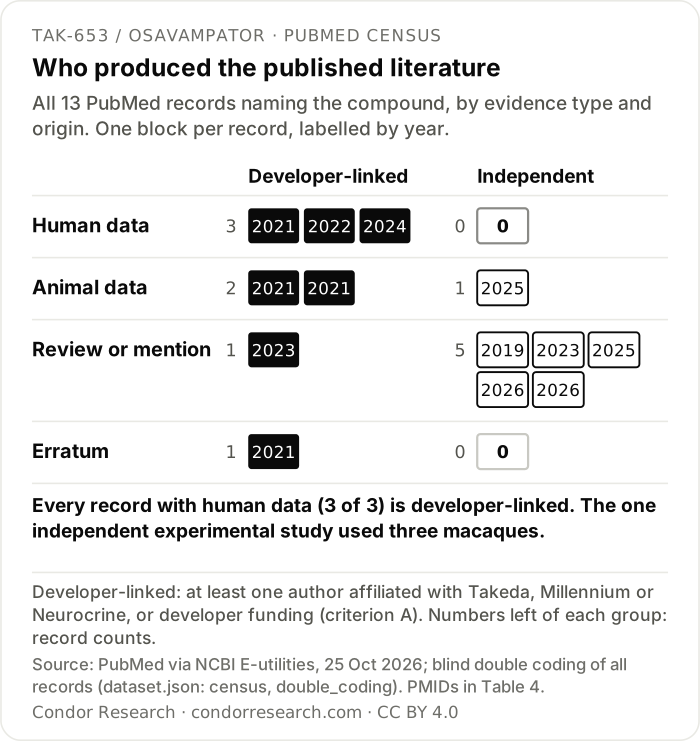
We name this metric by what it measures: authorship concentration, the share of records with a developer-affiliated author or developer funding. It does not measure the quality of the experiments. On the main criterion, 7 of 13 records are developer-linked, 5 of the 6 with original data and 3 of 3 with human data (Table 11). Restricting the criterion to first or last authors moves the Leiden NeuroCart article into the independent column, although Takeda sponsored that trial and four of the nine co-authors were Takeda employees.25
| PMID | Year | Journal | Title | Evidence type | Role | Origin | Developer-affiliated authors | Country |
|---|---|---|---|---|---|---|---|---|
| 31378256 | 2019 | Advances in pharmacology (San Diego, Calif.) | Rapid-acting antidepressants. | Review or mention | Mention only | Independent | 0/5 | EE. UU. |
| 34045439 | 2021 | Translational psychiatry | Transcranial magnetic stimulation as a translational biomarker for AMPA receptor modulation. | Human | Original data | Developer-linked | 8/18 | EE. UU. (Takeda Cambridge MA) |
| 34267258 | 2021 | Scientific reports | Strictly regulated agonist-dependent activation of AMPA-R is the key characteristic of TAK-653 for robust syna… | Animal | Original data | Developer-linked | 12/12 | Japón |
| 34290388 | 2021 | Scientific reports | Author Correction: Strictly regulated agonist-dependent activation of AMPA-R is the key characteristic of TAK-… | Erratum | None | Developer-linked | 12/12 | Japón |
| 34655652 | 2021 | Pharmacology, biochemistry, and behavior | TAK-653, an AMPA receptor potentiator with minimal agonistic activity, produces an antidepressant-like effect … | Animal | Original data | Developer-linked | 6/6 | Japón |
| 36153330 | 2022 | Translational psychiatry | Central nervous system effects of TAK-653, an investigational alpha-amino-3-hydroxy-5-methyl-4-isoxazole recep… | Human | Original data | Developer-linked | 4/9 | Países Bajos (CHDR) con coautores Takeda |
| 36341809 | 2023 | Neuropharmacology | Role of the AMPA receptor in antidepressant effects of ketamine and potential of AMPA receptor potentiators as… | Review or mention | Review of own data | Developer-linked | 3/3 | Japón |
| 38868733 | 2023 | PCN reports : psychiatry and clinical neurosciences | Emerging trends in antipsychotic and antidepressant drug development: Targeting nonmonoamine receptors and inn… | Review or mention | Mention only | Independent | 0/2 | Japón |
| 38700236 | 2024 | Clinical and translational science | Effects of the selective AMPA modulator NBI-1065845 on the pharmacokinetics of midazolam or ethinyl estradiol-… | Human | Original data | Developer-linked | 6/7 | EE. UU. |
| 40564108 | 2025 | Biomedicines | TAK-653 Reverses Core Depressive Symptoms in Chronic Stress-Induced Monkey Model. | Animal | Original data | Independent | 0/6 | China |
| 40840695 | 2025 | Pharmacological research | All roads lead to glutamate: NMDA and AMPA receptors as targets for rapid-acting antidepressants. | Review or mention | Mention only | Independent | 0/5 | Alemania |
| 42645703 | 2026 | CNS drugs | Next-Generation Pharmacotherapies for Unipolar Mood Disorders: A Leading Article on Phase II/III Drug Developm… | Review or mention | Mention only | Independent | 0/4 | EE. UU. |
| 42867279 | 2026 | Expert opinion on therapeutic patents | Positive allosteric modulators of AMPA receptors: advances and emerging trends. | Review or mention | Mention only | Independent | 0/3 | Bélgica |
Table 4. The full PubMed census (13 records), classified by hand and double-coded. ‘Developer-linked’ = at least one author affiliated with Takeda, Millennium or Neurocrine, or developer funding. Source: PubMed via NCBI E-utilities, 2026-10-25.
| Criterion for 'developer-linked' | All records | Records with original data | Records with human data |
|---|---|---|---|
| A. Any author affiliated with Takeda, Millennium or Neurocrine, or developer funding (main) | 7/13 | 5/6 | 3/3 |
| A, excluding the erratum | 6/12 | 5/6 | 3/3 |
| B. First or last author affiliated with the developer | 6/13 | 4/6 | 2/3 |
| Unit = human trial instead of article | 4 trials | 4 trials | 0 of 4 independent |
Table 11. Authorship concentration with sensitivity analysis. Under criterion B, the Leiden NeuroCart article counts as independent although Takeda sponsored the trial and four of its nine authors worked for Takeda.
The single independent experimental study, from Shenzhen, gave the compound to 3 male macaques after 12 weeks of chronic unpredictable mild stress and compared behaviour and plasma markers before and after, without a vehicle group; the authors list the small number among their limitations. The compound was bought from a catalogue supplier, with purity as stated by that supplier.1 The developer’s own monkey memory experiment also used 3 animals.12 Two conflict-of-interest statements stand as published: the 2021 Scientific Reports paper states that all authors are Takeda employees and declares no competing interests,12 and the 2018 first-in-human abstract, from Takeda authors, reads “Nothing to disclose”.16 The independent reviews add little primary information. The 2019 Advances in Pharmacology chapter names TAK-653 as a clinical-stage AMPA potentiator whose structure was “not yet disclosed”.35 The 2025 Pharmacological Research review describes SAVITRI from the 2024 press release, notes that the day-7 MADRS result was not reported, and places the phase 3 trials in treatment-resistant depression; one co-author discloses a leadership role at a company developing another AMPA modulator.36 These reviews count as independent under our criterion, which concerns links to Takeda or Neurocrine only. A Europe PMC full-text search returns 43 hits; the extra 29 name the compound only in body text and are listed in the dataset but not counted.37
In plain terms. Most of what is known was written by the companies that own the drug. Outside them, one laboratory has tested it, in three monkeys.
Where TAK-653 sits among clinical-stage AMPA PAMs
TAK-653 is not the first AMPA receptor potentiator to reach human trials. Six other compounds reached phase 2 or later in depression, ADHD, schizophrenia, Alzheimer’s disease, fragile X syndrome or hearing loss. In the published and registered results located, none produced a clear separation from placebo on its primary endpoint in more than one trial, and for most no reason for stopping was stated.
| Compound | Developer | Highest phase | Indications tested (n) | Reported result | Documented reason for stopping |
|---|---|---|---|---|---|
| Org 26576 (MK-8777) | Organon / Merck | Phase 2 | Major depressive disorder (phase 1b/2, n = 54); adult ADHD (n = 67) | Depression: numerical MADRS improvement in an exploratory study. ADHD: one fixed-dose arm differed from placebo on the primary scale (p = 0.0147), the rising-dose arm did not (p = 0.59).38,39 | No reason for discontinuation located |
| S 47445 (tulrampator) | Servier | Phase 2 | Alzheimer's disease with depressive symptoms (n = 520); adjunctive treatment in major depressive disorder (n = 400) | Alzheimer's trial: no difference from placebo on cognition, function or depressive symptoms at 24 weeks. Depression trial (n = 414): no difference from placebo on HAM-D change, with Holm adjustment for multiplicity (EU register results, 8 March 2018).40,41,42,36 | No reason located |
| PF-04958242 / BIIB104 (pesampator) | Pfizer, then Biogen | Phase 2 | Age-related hearing loss (n = 44, crossover); ketamine-induced cognitive impairment in healthy men (n = 29); cognitive impairment associated with schizophrenia | Hearing loss: no change versus placebo. Healthy volunteers: reduced ketamine-induced memory impairment. Schizophrenia phase 2 (n = 195): no difference on the MATRICS composite (p = 0.85 and 0.81).43,44,45,46 | Earlier schizophrenia phase 2 terminated in 2016 for 'internal portfolio prioritization' |
| LY451395 (mibampator) | Eli Lilly | Phase 2 | Cognition in Alzheimer's disease (n = 181); agitation and aggression in Alzheimer's disease (n = 132) | No difference from placebo on cognition (ADAS-Cog) or on the primary agitation scale.47,48 | No reason located |
| CX516 (Ampalex) | Cortex Pharmaceuticals (now RespireRx) | Phase 2 | Cognition in schizophrenia, add-on (n = 105); fragile X syndrome (n = 49) | Schizophrenia: no difference from placebo on the cognitive composite. Fragile X: no improvement in memory, the primary outcome; allergic rash in 12.5% of the active group.49,50 | No reason located |
| CX717 | Cortex Pharmaceuticals (now RespireRx) | Phase 2a | Adult ADHD (n = 68, crossover); sleep deprivation in healthy men (n = 16) | ADHD: primary analysis not significant (trend), a secondary analysis significant for one arm. Sleep deprivation: no consistent improvement in pre-specified analyses; reduced slow-wave sleep at the highest level.51,52 | No reason located |
Table 14. Clinical-stage AMPA receptor positive modulators other than TAK-653, from PubMed and ClinicalTrials.gov (2026-10-25). Doses omitted. ‘No reason located’ means no stated reason was found in these sources.
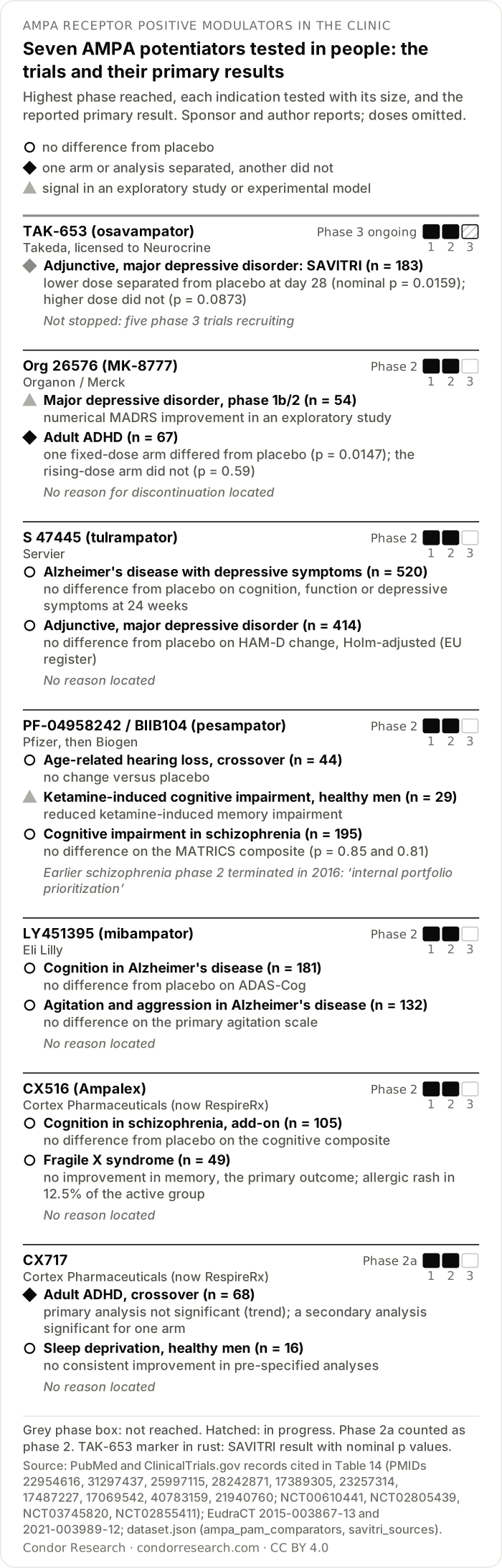
Two points of contact with TAK-653 stand out. PF-04958242 reduced ketamine-induced memory impairment in healthy volunteers but did not improve cognition in its schizophrenia phase 2 trial, a gap between a healthy-volunteer model and a patient outcome.44,45 The Org 26576 ADHD trial, like SAVITRI, reported one active arm separating from placebo and another not.39 Servier’s depression trial of S 47445, the closest design to SAVITRI (adjunctive, inadequate response, n = 414), found no difference from placebo under a Holm adjustment for multiplicity.42 In Takeda’s own assays, LY451395 and PF-04958242 behaved like the high-agonism comparator LY451646 in vitro, while TAK-653 did not; that classification comes from the developer.13 The class record does not predict TAK-653’s phase 3 results; it shows how often early signals in this class have failed to carry through.
In plain terms. Drugs that work this way have been tried in people for over twenty years, and none of those in this table has been approved. In this set, TAK-653 is the only one with a dedicated phase 3 programme.
What do the forums claim, and what does the evidence show?
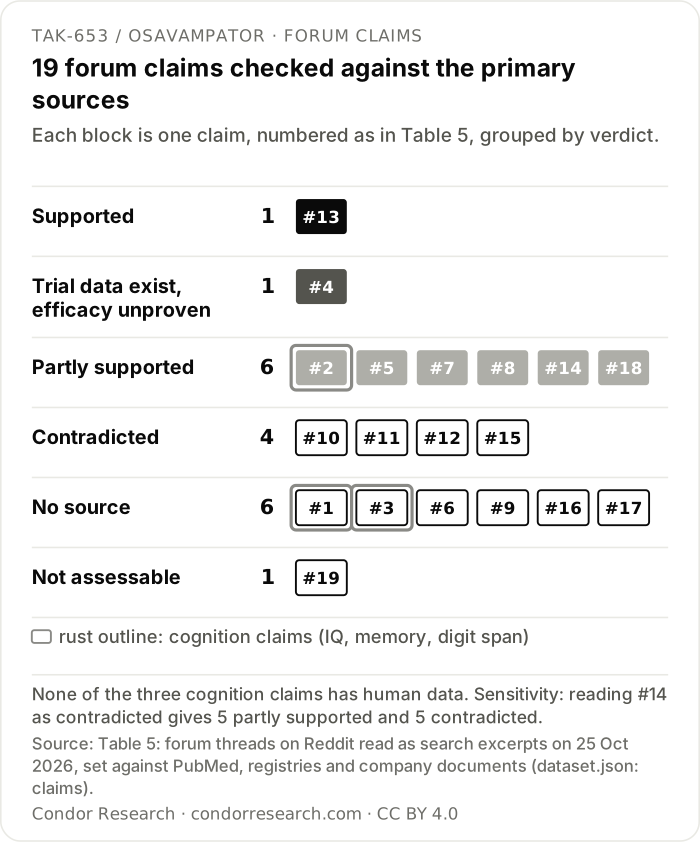
We collected 19 distinct claims from public threads on Reddit and from vendor-facing pages in search results, paraphrased them, and checked each against the primary sources in this dossier.53 The unit is the claim, not the thread, and we did not measure how often each appears. “Partly supported” has one meaning throughout: part of the claim matches what a primary source reports, in a named species or population. Trial data reported for a population are not, by themselves, evidence of benefit.
| # | Claim (paraphrased) | Where it circulates | Verdict | What the primary sources show |
|---|---|---|---|---|
| 1 | Raises IQ by several points (figures of 6 to 7 points circulate) | r/NooTopics threads, 2022 and 2024 | No source | No registered trial or article measures IQ. Registered human endpoints: safety, pharmacokinetics, TMS motor-evoked potentials, a NeuroCart battery, CYP3A interaction and MADRS.2,25 |
| 2 | Improves working memory and recognition memory | r/NooTopics, r/cognitiveTesting | Partly supported | Partial match in rats and 3 monkeys only (developer study): novel object recognition, a radial-arm maze after a drug-induced deficit, and a delayed match-to-sample task at one delay interval. The 24-volunteer NeuroCart study included no memory test.12,25 |
| 3 | Digit-span scores rise (self-report) | r/cognitiveTesting, 2025 | No source | A single uncontrolled, unblinded self-report. No study of the compound measures digit span.2 |
| 4 | Described on forums as an antidepressant | r/NooTopics, r/antidepressants | Trial data exist (efficacy unproven) | Trial data exist in adults with major depressive disorder, one sponsor trial (SAVITRI, n = 183): in a separate comparison with placebo, the lower dose arm showed a nominally significant MADRS difference at day 28; the higher dose arm did not. These are trial data from one phase 2 study, not established evidence of benefit. Anhedonia was not a registered endpoint.3,28,30 |
| 5 | It does not cause seizures | r/Nootropics; vendor pages | Partly supported | Partial match in rats (convulsion margin 419-fold on Cmax, 1017-fold on AUC) and in short human studies of 24, 35, 88 and 183 participants (no seizure adverse events; no clinically significant EEG change in the 88). People with seizure risk or neurological history were excluded; long-term data are pending.12,25,26,17,16,28 |
| 6 | No tolerance and no AMPA receptor down-regulation | r/NooTopics | No source | No human study measures tolerance, receptor regulation or withdrawal. Rat repeated-administration data cover a 3-week behavioural study, without receptor measurements. Reported human half-life 33 to 48 hours with 3- to 4-fold accumulation on repeated administration.14,16 |
| 7 | It is a stimulant (or, in other threads, that it is not) | r/NooTopics | Partly supported | Partial match in 24 healthy volunteers (single administrations): the authors describe a 'psychostimulant-like' NeuroCart profile; subjective drug-effect scales did not change. No abuse-liability study located.25 |
| 8 | Disturbs sleep (insomnia, vivid dreams) | r/NooTopics | Partly supported | Partial match in adults with major depressive disorder (SAVITRI): insomnia reported in 2.2% on placebo and 2.2% and 6.4% in the two active arms. Dreams were not recorded; no sleep study.3,28 |
| 9 | Claims about combining it with other substances | r/NooTopics, r/Nootropics | No source | No data on co-administration with any substance named in forums. The only interaction study tested two prescription CYP3A substrates under controlled conditions.26 |
| 10 | There are no safety data on repeated use | r/cognitivescience | Contradicted | Contradicted: repeated-administration safety data exist for 13 days in healthy volunteers, 8 weeks in 183 patients and a 35-person interaction study. They are short, and the patient data are not in a journal; the long-term study runs to 2029.17,3,26,2 |
| 11 | It is a peptide ('TAK peptide') | vendor SEO pages | Contradicted | Contradicted: C19H23N3O3S, molecular weight 373.5, a small molecule.7 |
| 12 | It is one of the best-researched nootropics | forums | Contradicted | Contradicted: 13 PubMed records, 6 with original data, 5 of them developer-linked; never registered as a cognitive-enhancement trial in humans.54 |
| 13 | Neurocrine has five phase 3 trials running | r/NooTopics, 2025 | Supported | Five phase 3 records on ClinicalTrials.gov (and five in CTIS), all recruiting or authorised at the cut-off.2,4,32 |
| 14 | It is being developed for treatment-resistant depression | Wikipedia, forums | Partly supported | Partial match with the past: Takeda registered a treatment-resistant depression trial in 2017 (withdrawn, 0 enrolled) and described that target in 2020. The current programme enrols adults with major depressive disorder and inadequate response to at least one antidepressant.18,19,31 |
| 15 | It is legal or approved as a nootropic | forums, vendors | Contradicted | Contradicted for approval: no marketing authorisation located at the FDA or the EMA; the developers describe it as investigational. National rules on possession or sale are not assessed here.5,6,32 |
| 16 | It is anxiolytic | r/NooTopics | No source | No human study has an anxiety endpoint. The only animal anxiety-like observations come from 3 stressed monkeys without a concurrent control group.1 |
| 17 | It sharpens sensory perception or introspection | r/NooTopics | No source | Anecdotal. No endpoint in any registered trial.2 |
| 18 | Ketamine-like antidepressant effect without psychotomimetic effects | forum posts citing the rat paper | Partly supported | Partial match in rats (antidepressant-like behaviour in a social-submission model over 3 weeks, including when tested a day after administration; no hyperlocomotion at the levels tested) and in 24 healthy volunteers (no dissociation or euphoria adverse events). No comparison with ketamine in patients; the trial's open-label ketamine period was not compared statistically.14,25,15 |
| 19 | What research-chemical vendors sell is the correct compound at high purity | r/Nootropics and similar | Not assessable | Outside this literature. The one independent animal study bought material from a catalogue supplier and reports the supplier's purity; no independent analytical study of market material was located in PubMed.1 |
Table 5. Nineteen claims that circulate in forums, set against the primary sources. Verdict scale: Supported (a primary source states the claim directly); Trial data exist (efficacy unproven) (results of a trial are reported, but they do not establish benefit); Partly supported (part of the claim matches what a primary source reports, in the species or population named in the cell; trial data reported are not, by themselves, evidence of benefit); Contradicted (a primary source states the opposite); No source (no published or registered data); Not assessable from this literature. Claims are paraphrased; personal regimens posted in threads are not reproduced.53
The claims that drive forum interest, more IQ, better memory, longer digit span, no tolerance, rest on developer animal work or on single self-reports. The best-supported claims concern the programme itself. Several mix a correct fact with an out-of-date frame, such as the treatment-resistant depression label, which describes a trial that never enrolled anyone.18 Reading claim 14 strictly as a statement about the current programme would move it to “contradicted”, giving 5 partly supported and 5 contradicted. Claim 4 is classed separately: trial data exist, but efficacy is unproven.
In plain terms. What forums say about thinking and memory has not been tested in people. What they say about the drug’s development is mostly accurate but often out of date.
Who has a financial stake in the outcome?
SEC filings show two layers. Direct: Takeda, as licensor, is eligible for event-based milestones and royalties on Neurocrine’s sales, and Neurocrine expensed a USD 37.5 million milestone when phase 3 began. Indirect: XOMA Royalty holds a share of certain payments Takeda receives on a basket of development-stage assets that includes osavampator, and Ligand Pharmaceuticals acquired XOMA on 14 July 2026.55,56,57 Not all of the figures below are specific to osavampator.
| Type | Party | Role | Disclosed terms |
|---|---|---|---|
| Direct | Takeda | Discoverer; patent families from 2010 and 2020; licensor; holds Japan since January 2025 | Eligible for up to USD 742.5 million in event-based milestones under the restated licence (the filing gives this figure for the agreement and does not break it down by compound), plus tiered royalties on Neurocrine's net sales of osavampator: mid-to-upper teens in the US and low double digits elsewhere, blended55,22 |
| Direct | Neurocrine Biosciences | Licensee outside Japan; sponsor of SAVITRI and the phase 3 programme | Expensed a USD 37.5 million milestone when phase 3 began (Q1 2025); entitled to royalties on Takeda's sales in Japan55,31 |
| Indirect | XOMA Royalty | Takeda Revenue Share Agreement over a basket of development-stage Takeda assets, of which osavampator is one | A low to mid-single-digit share of certain payments Takeda receives; USD 101 million is the aggregate potential milestone figure for three late-stage assets together (mezagitamab, osavampator, volixibat), not for osavampator alone56 |
| Indirect | Ligand Pharmaceuticals | Acquired XOMA Royalty on 14 July 2026 | Holds the XOMA portfolio, and with it the indirect interest above57 |
Table 7. Financial interests disclosed in SEC filings. Direct: payment terms tied to the osavampator licence. Indirect: a share in a basket of Takeda assets, or ownership of the company that holds that share. Figures are the companies’ own and are not all specific to osavampator.
In plain terms. Two companies are paid directly if the drug succeeds, and two more indirectly. That is normal in drug development and is why independent data matter.
What is its regulatory status?
| Jurisdiction or body | Status at 2026-10-25 | Basis |
|---|---|---|
| United States (FDA) | Investigational; no approval located | openFDA Drugs@FDA query for 'osavampator' returned no match on 2026-10-25. Company reports an End-of-Phase 2 meeting completed by January 2025.5,58 |
| European Union (EMA) | No authorisation or application located | Not in the EMA medicines report downloaded 2026-10-25 (control: esketamine present).6 |
| EU trial registries | SAVITRI results posted; 5 phase 3 trials authorised | EU Clinical Trials Register: EudraCT 2021-003989-12 (SAVITRI), results v1 published 2025-10-26. CTIS public search (2026-10-25): 5 phase 3 entries for 'NBI-1065845', 0 for 'TAK-653' or 'osavampator'.3,4 |
| Japan | Rights with Takeda since January 2025; no jRCT record | jRCT (jrct.mhlw.go.jp) searched manually on 2026-10-25 for "TAK-653" and "osavampator": 0 records for each.58,34 |
| World Anti-Doping Agency | Not named in the 2026 Prohibited List | S0 prohibits at all times any pharmacological substance not addressed by another section and without current approval for human therapeutic use, including drugs under clinical development; on that wording an investigational substance such as this falls within S0.59 |
| Names | INN and USAN: osavampator | Listed as [INN], [USAN] and [WHO-DD] in PubChem; used by Neurocrine from 27 January 2025.7,58 |
Table 8. Regulatory and naming status, from primary sources consulted on 2026-10-25. Not a legal opinion.
In plain terms. No regulator has approved osavampator for anything. National rules on laboratory supply are outside the scope of this page.
How does this compare with the sources we reviewed?
| Source | What it says or omits (checked 2026-10-25) | What this dossier adds |
|---|---|---|
| Wikipedia, revision of 2026-08-2060 | Describes the compound as investigated for treatment-resistant depression; no SAVITRI figures; no phase 3 programme; no forum claims. | Current indication and programme; SAVITRI figures from five sources; 19 claims checked. |
| IsHak et al., BMC Psychiatry 2025 (systematic review of pipeline phase 3 medicines)61 | States that no trials investigating the compound in depression in humans were identified, 18 months after the SAVITRI topline release. | The SAVITRI results and their channels, including the registry’s delay certification. |
| Ziemichód et al., Pharmacol Rep 2026 (review of AMPA modulation in depression)62 | Summarises the chronic-stress evidence as an ‘in vivo rodent’ model while citing the macaque study. | Species, n and design of every animal study, and who funded it. |
| Freudenberg et al., Pharmacol Res 2025 (review of NMDA and AMPA targets)36 | Describes SAVITRI from the 2024 press release only, notes that day-7 MADRS was not reported, and places the phase 3 trials in treatment-resistant depression. | The EU register and poster results, the registered phase 3 population and the review’s competing-interest context. |
| King et al., CNS Drugs 2026 (phase II/III mood pipeline)63 | Lists NBI-1065845 among 24 candidates; full text paywalled, not assessed. | Trial-level table with registry status and result channels. |
| Neurocrine press releases and poster21,28 | Report SAVITRI as having met its primary endpoint. | Both dose comparisons, the nominal status of the p values, the EU register results and the abstract’s divergent day-56 figure. |
Table 12. Comparison with the sources reviewed for this dossier, not a ranking of all sources.
What will the phase 3 trials be able to settle?
If the three acute trials report as registered, they will test whether a single dose level separates from placebo at day 56 as an add-on, in about 200 participants per trial according to registry estimates. The maintenance trial will test whether any effect persists after randomised withdrawal, and the long-term study will add exposure data over a much longer period than anything public so far.2 As registered, they will not address cognition in healthy people, tolerance, interactions with other psychoactive substances or sleep architecture, none of which is an endpoint.
What this literature allows, and does not allow, us to say
- TAK-653, osavampator and NBI-1065845 are one small molecule, a low-agonism AMPA receptor potentiator in the developer’s assays, and not a peptide.
- The first-in-human abstract reports a cerebrospinal fluid to plasma ratio of 0.056, which its authors read as brain penetration, and TMS motor-evoked potentials in 24 volunteers changed in a way consistent with a central effect. Both show target engagement, not a therapeutic effect.
- In short studies totalling about 330 participants, no seizure, serious adverse event or suicidality signal was reported. This does not extend to long-term exposure or to people with seizure risk, who were excluded.
- No human study has tested memory, IQ or other cognition as an outcome; no statement about cognitive effects in humans is possible.
- One sponsor phase 2 trial reported a nominally significant MADRS difference for one of two separate dose comparisons with placebo. That is a trial result to be tested in phase 3, not an established effect.
- Tolerance, receptor regulation, withdrawal, co-administration with other substances, anxiety, perception and sleep architecture have not been measured in humans.
- Five of six records with original data and all human trials come from Takeda or Neurocrine.
What is not known
- SAVITRI’s pre-specified testing hierarchy, if any, and the data cut behind the congress abstract’s day-56 figure.
- Whether the lower-dose result reproduces in phase 3, and how the two dose levels compare directly.
- Whether the first-in-human results, including BDNF and EEG data, will appear in a journal with full tables.
- Whether repeated exposure produces tolerance or receptor regulation in any species; the longest animal study, 3 weeks in rats, measured behaviour only.
- Whether the macaque findings replicate in a controlled primate study with a vehicle group and blinded scoring.
- Whether market material sold as TAK-653 is the compound described here; no peer-reviewed analytical study has addressed it.
Answer to the central question
Claims about the development programme are well supported by registry and company sources. The cognitive claims that made the compound popular on forums rest on developer animal experiments and personal reports. The antidepressant claim rests on one sponsor trial whose primary comparison reached nominal significance for one dose level. The phase 3 trials, expected to report from 2027, can test that result; they are not designed to settle anything about cognition in healthy people.
Methods
Synonyms first. PubChem confirmed that TAK-653, osavampator and NBI-1065845 resolve to CID 56655833 and supplied CAS 1358751-06-0 and UNII 9E3TOE5RIZ. Supplier catalogue codes were not used as search terms.7
PubMed. Query, run through NCBI E-utilities on 2026-10-25: "TAK-653"[tiab] OR "TAK653"[tiab] OR "TAK 653"[tiab] OR osavampator[tiab] OR "NBI-1065845"[tiab] OR "NBI1065845"[tiab] OR "NBI 1065845"[tiab] OR "1358751-06-0"[tiab] OR "9E3TOE5RIZ"[tiab], 13 records. A cross-check in all fields returned the same 13. Every cited PMID was re-verified with esummary at build time. Comparator compounds were searched by code and INN in the same way.
Registries. ClinicalTrials.gov API v2 with each name separately and as an intervention term (union 9 records); EU Clinical Trials Register search and results page; CTIS public search API with each name; jRCT (Japan Registry of Clinical Trials, now served at jrct.mhlw.go.jp) searched manually for “TAK-653” and “osavampator”, 0 records for each, screenshots archived. All on 2026-10-25.2,3,4
Company, patent and regulatory documents. SEC EDGAR full-text search for “osavampator” from 2025-01-01 to the cut-off (40 hits), fetched under a declared user agent; company releases; the SAVITRI poster and abstract page from the congress publisher; the ACNP 2018 abstract supplement (open access); PubChem patent records and Google Patents; openFDA; the EMA medicines report; the WADA 2026 List. No paywall was bypassed and no unofficial copy was used.
Classification. Each PubMed record was coded for evidence type, origin (criterion A in Table 11) and data role, from title, abstract, affiliations, grants and the full text, which was read for 11 of the 13 records (all except PMID 42645703 and 42867279, classified from their abstracts). Because the census has fewer than 40 records, the whole census was double-coded: coder 1 froze codes before coder 2, a separate language-model instance, coded blind from the codebook and the records alone. Agreement was 100% on all three variables (Cohen’s kappa 1.00, n = 13). Perfect agreement on 13 largely unambiguous records shows the codebook is applied consistently; it says little about harder cases.
Independent recoding. A third coder from a different model family (Codex), given titles and author affiliations but not abstracts or our labels, recoded the census after codes were frozen. Agreement was 9/13 on evidence model (Cohen’s kappa 0.59) and 12/13 on sponsor link (kappa 0.85). The model disagreements are titles that do not name the system studied (review versus other; in vitro versus animal); the one sponsor disagreement is the second report of the Leiden TMS / NeuroCart trial (PMID 36153330), which the third coder would class as independent from its title; our developer-linked code rests on Takeda sponsorship and four Takeda co-authors of nine, listed in the PubMed affiliations that coder did not see. Under the independent coding, developer-linked human records would be 2 rather than 3, and independent human records 1 rather than 0.
| Variable | Records | Agreement | Cohen's kappa |
|---|---|---|---|
| evidence_type | 13 | 100.0% | 1.00 |
| origin | 13 | 100.0% | 1.00 |
| data_role | 13 | 100.0% | 1.00 |
Table 10. Blind double coding of the whole census (13 records, below the 40-record minimum, so every record was coded twice). Coder 1 froze codes before coder 2 started; coder 2 saw only the codebook and the records.
Forum claims. Searches on 2026-10-25 for the compound with “nootropic”, “reddit”, “IQ”, “tolerance” and “seizure”; claims paraphrased from public search excerpts; no vendor page followed. Verdicts follow the scale in the caption of Table 5.
Limitations. Two records were classified from abstracts because their full text was not available to us. The SAVITRI figures come from the sponsor, including those in the EU register. “Not located” means not found in the sources named above at 2026-10-25. Claim prevalence was not measured.
Data and code. The dataset (dataset.json, CC BY 4.0) contains the census with codes, all trials, every table on this page, the claim table, the SAVITRI reconciliation, patent families, comparators, the registry checks, the search log, the changelog and a data dictionary. The scripts that rebuild the census, figures and page are published with it. Editorial standards: editorial policy.
Glossary
- AMPA receptor: a glutamate-gated ion channel that carries most fast excitatory signalling in the brain.
- Positive allosteric modulator (PAM): a molecule that binds away from the main binding site and strengthens the receptor’s response to its natural signal.
- Agonist activity: the ability to activate a receptor without the natural signal.
- MADRS: Montgomery-Åsberg Depression Rating Scale, a clinician-rated scale from 0 to 60.
- TMS and motor-evoked potential: a magnetic pulse over the motor cortex produces a muscle twitch whose size indexes cortical excitability.
- NeuroCart: a battery of computerised tests of eye movement, tracking, sway and attention used in early drug studies.
- Nominal p value: a p value not adjusted for the number of comparisons made.
- Multiplicity: the inflation of false-positive risk when several doses, time points or endpoints are tested.
- Delayed-results certification: a ClinicalTrials.gov field recording that a sponsor submitted a certification or extension request concerning the timing of results.
- EU Clinical Trials Register and CTIS: the EU’s legacy and current public registries of clinical trials.
- CYP3A: the liver enzyme family that metabolises many drugs; an inducer speeds their breakdown.
- INN: International Nonproprietary Name assigned by the World Health Organization.
- Research Use Only (RUO): material supplied for laboratory research, not for human or veterinary use.
How to cite, version and changes
Condor Research Editorial. TAK-653 (osavampator) Evidence Dossier, version 1.4, data cut-off 25 October 2026. https://condorresearch.com/research/tak-653-osavampator-evidence/
Version 1.4 (25 October 2026). Phase 3 power analysis added (Figure 5); jRCT checked manually (0 records); independent recoding by a third coder added to Methods; author figures redrawn or added (SAVITRI forest plot, trial Gantt chart, AMPA modulator panel); target-engagement wording narrowed; Takeda co-author count of the Leiden article corrected to four of nine.
Version 1.3 (25 October 2026). Full texts of four further records read; rat social-submission study corrected from 6 days to a 3-week study; agonist activity, BDNF dependence on AMPA, seizure-margin definition and comparator margins added from the developer review; S 47445 depression trial results added; independent reviews characterised.
Version 1.2 (25 October 2026), RUO review. Patent and registry endpoint wording stripped of administration details; claim 4 reclassified as “trial data exist (efficacy unproven)” (count: 1 supported, 1 trial data, 6 partly supported, 4 contradicted, 6 no source, 1 not assessable); SAVITRI summary attributed to the sponsor; declaration of interest and RUO box state that Condor Research does not sell or supply TAK-653.
Version 1.1 (25 October 2026). SAVITRI results located on the EU Clinical Trials Register and added as a sixth source; SAVITRI described as two separate comparisons with placebo, with nominal p values; ClinicalTrials.gov certification presented as a registry fact; BDNF and CYP3A statements narrowed to what was measured; financial interests split into direct and indirect; forum verdict scale made strict and uniform (count unchanged); visible Research Use Only boundary; CTIS and jRCT checks, patent families and AMPA modulator comparison added; repetition removed. Full list in the dataset.
Version 1.0-rc (25 October 2026). First release candidate.
Related reading: non-peptide nootropics explained.
References
- Li L, Zhang Z, Liu X et al. TAK-653 Reverses Core Depressive Symptoms in Chronic Stress-Induced Monkey Model. Biomedicines. 2025;13(6). PMID 40564108. DOI 10.3390/biomedicines13061389.
- ClinicalTrials.gov API v2: the 9 records retrieved with TAK-653, osavampator and NBI-1065845 (NCT numbers in Table 3). Source. Accessed 25 October 2026.
- EU Clinical Trials Register. EudraCT 2021-003989-12 (NBI-1065845-MDD2024, SAVITRI): clinical trial results, version 1, published 26 October 2025. Source. Accessed 25 October 2026.
- Clinical Trials Information System (CTIS), public search API, 25 October 2026: 'NBI-1065845' returns 5 phase 3 trials (2024-519418-29-00, 2024-519420-25-00, 2024-519421-37-00, 2024-519423-24-00, 2025-520541-72-00); 'TAK-653' and 'osavampator' return 0. Source. Accessed 25 October 2026.
- US Food and Drug Administration. openFDA Drugs@FDA endpoint, queries openfda.generic_name and products.active_ingredients.name = osavampator (no match, 25 October 2026). Source. Accessed 25 October 2026.
- European Medicines Agency. Medicines output: medicines report (xlsx), downloaded 25 October 2026; no entry for osavampator, TAK-653 or NBI-1065845. Source. Accessed 25 October 2026.
- PubChem. Osavampator, CID 56655833: synonyms and computed properties. National Library of Medicine. Source. Accessed 25 October 2026.
- Takeda Pharmaceutical Co Ltd. Heterocyclic compound and use thereof. WO2012020848A1; priority 10 August 2010, published 16 February 2012 (US 8,575,154 B2 granted 5 November 2013). Source. Accessed 25 October 2026.
- Takeda Pharmaceutical Co Ltd. Treatment for depression. WO2021229294A1; priority 15 May 2020, published 18 November 2021. Source. Accessed 25 October 2026.
- PubChem patent records linked to CID 56655833 (titles, assignees, priority dates and abstracts), retrieved via PUG-View 25 October 2026. Source. Accessed 25 October 2026.
- Colson T, Pirotte B, Francotte P. Positive allosteric modulators of AMPA receptors: advances and emerging trends. Expert Opin Ther Pat. 2026:1-19. PMID 42867279. DOI 10.1080/13543776.2026.2748595.
- Suzuki A, Kunugi A, Tajima Y et al. Strictly regulated agonist-dependent activation of AMPA-R is the key characteristic of TAK-653 for robust synaptic responses and cognitive improvement. Sci Rep. 2021;11(1):14532. PMID 34267258. DOI 10.1038/s41598-021-93888-0.
- Suzuki A, Hara H, Kimura H. Role of the AMPA receptor in antidepressant effects of ketamine and potential of AMPA receptor potentiators as a novel antidepressant. Neuropharmacology. 2023;222:109308. PMID 36341809. DOI 10.1016/j.neuropharm.2022.109308.
- Hara H, Suzuki A, Kunugi A et al. TAK-653, an AMPA receptor potentiator with minimal agonistic activity, produces an antidepressant-like effect with a favorable safety profile in rats. Pharmacol Biochem Behav. 2021;211:173289. PMID 34655652. DOI 10.1016/j.pbb.2021.173289.
- O'Donnell P, Dijkstra FM, Damar U et al. Transcranial magnetic stimulation as a translational biomarker for AMPA receptor modulation. Transl Psychiatry. 2021;11(1):325. PMID 34045439. DOI 10.1038/s41398-021-01451-2.
- Asgharnejad M, Zicha S, Xu L, et al. M148. Pharmacokinetic and pharmacodynamic properties of the investigational AMPA receptor positive allosteric modulator TAK-653 after single and multiple rising doses in healthy volunteers. ACNP 57th Annual Meeting: Poster Session I. Neuropsychopharmacology. 2018;43(Suppl 1):S157. DOI 10.1038/s41386-018-0266-7. Source. Accessed 25 October 2026.
- ClinicalTrials.gov record NCT02561156, posted results (first posted 2019-02-08). Source. Accessed 25 October 2026.
- ClinicalTrials.gov record NCT03312894 (withdrawn, 0 participants, 'Business decision'). Source. Accessed 25 October 2026.
- Takeda Pharmaceutical Company. Neurocrine Biosciences and Takeda Announce Collaboration to Develop and Commercialize Potential Therapies for Psychiatric Disorders. Press release, 16 June 2020. Source. Accessed 25 October 2026.
- Neurocrine Biosciences. Exclusive License Agreement with Takeda dated 12 June 2020, Exhibit 10.3 to Form 10-Q filed 3 August 2020 (portions redacted). SEC EDGAR. Source. Accessed 25 October 2026.
- Neurocrine Biosciences. Neurocrine Biosciences Reports Positive Phase 2 Data for NBI-1065845 in Adults with Major Depressive Disorder. Press release, 23 April 2024. Source. Accessed 25 October 2026.
- Neurocrine Biosciences. Form 8-K: Amended and Restated License Agreement with Takeda, filed 27 January 2025. SEC EDGAR. Source. Accessed 25 October 2026.
- Neurocrine Biosciences. Neurocrine Biosciences Announces Initiation of Phase 3 Registrational Program for Osavampator. Press release, 28 January 2025. Source. Accessed 25 October 2026.
- Neurocrine Biosciences. Neurocrine Biosciences Reports Second Quarter 2026 Financial Results. Press release, 30 July 2026. Source. Accessed 25 October 2026.
- Dijkstra F, O'Donnell P, Klaassen E et al. Central nervous system effects of TAK-653, an investigational alpha-amino-3-hydroxy-5-methyl-4-isoxazole receptor (AMPAR) positive allosteric modulator in healthy volunteers. Transl Psychiatry. 2022;12(1):408. PMID 36153330. DOI 10.1038/s41398-022-02148-w.
- Lin S, Ionescu A, Maynard-Scott J et al. Effects of the selective AMPA modulator NBI-1065845 on the pharmacokinetics of midazolam or ethinyl estradiol-levonorgestrel in healthy adults. Clin Transl Sci. 2024;17(5):e13791. PMID 38700236. DOI 10.1111/cts.13791.
- ClinicalTrials.gov record NCT03792672, posted results (first posted 2020-07-02). Source. Accessed 25 October 2026.
- Singh JB, Ge T, Ionescu A, et al. Osavampator (NBI-1065845/TAK-653) demonstrates statistically significant and clinically meaningful improvements in depression severity and is well tolerated in adults with major depressive disorder: phase 2 SAVITRI results. Poster 33, Psych Congress, San Diego, 17-21 September 2025 (PDF hosted by HMP Global Learning Network). Source. Accessed 25 October 2026.
- Singh JB. Osavampator (NBI-1065845/TAK-653) Demonstrates Meaningful Improvements in Depression Severity and Is Well Tolerated in Adults With Major Depressive Disorder: Phase 2 SAVITRI Results. Psych Congress 2025 abstract page, HMP Global Learning Network, published 17 October 2025. Source. Accessed 25 October 2026.
- ClinicalTrials.gov record NCT05203341 (SAVITRI), version of 2025-01-15, including the certification/extension (delayed results) fields; no results posted at 25 October 2026. Source. Accessed 25 October 2026.
- Neurocrine Biosciences. Form 10-K for fiscal year 2025, filed 11 February 2026. SEC EDGAR. Source. Accessed 25 October 2026.
- Neurocrine Biosciences. Neurocrine Biosciences Presents Positive New Data from Phase 2 Study of Osavampator in Adults with Major Depressive Disorder. Press release, 22 September 2025. Source. Accessed 25 October 2026.
- ClinicalTrials.gov API v2 data dictionary: dispFirstSubmitDate, 'Certification/Extension (aka Delayed Results) First Submitted Date'. Source. Accessed 25 October 2026.
- Japan Registry of Clinical Trials (jRCT). Manual search for TAK-653 and osavampator, 25 October 2026: 0 records each; screenshots archived. Source. Accessed 25 October 2026.
- Witkin JM, Martin AE, Golani LK et al. Rapid-acting antidepressants. Adv Pharmacol. 2019;86:47-96. PMID 31378256. DOI 10.1016/bs.apha.2019.03.002.
- Freudenberg F, Reif-Leonhard C, Dawson GR et al. All roads lead to glutamate: NMDA and AMPA receptors as targets for rapid-acting antidepressants. Pharmacol Res. 2025;220:107918. PMID 40840695. DOI 10.1016/j.phrs.2025.107918.
- Europe PMC REST search for TAK-653, osavampator, NBI-1065845 and TAK653 in full text, 25 October 2026 (43 hits). Source. Accessed 25 October 2026.
- Nations KR, Dogterom P, Bursi R et al. Examination of Org 26576, an AMPA receptor positive allosteric modulator, in patients diagnosed with major depressive disorder: an exploratory, randomized, double-blind, placebo-controlled trial. J Psychopharmacol. 2012;26(12):1525-39. PMID 22954616. DOI 10.1177/0269881112458728.
- ClinicalTrials.gov records NCT00610649 (Org 26576 in major depressive disorder) and NCT00610441 (Org 26576 in adult ADHD, posted results). Source. Accessed 25 October 2026.
- Bernard K, Gouttefangeas S, Bretin S et al. A 24-week double-blind placebo-controlled study of the efficacy and safety of the AMPA modulator S47445 in patients with mild to moderate Alzheimer's disease and depressive symptoms. Alzheimers Dement (N Y). 2019;5:231-240. PMID 31297437. DOI 10.1016/j.trci.2019.04.002.
- ClinicalTrials.gov records NCT02626572 and NCT02805439 (S 47445, Servier). Source. Accessed 25 October 2026.
- EU Clinical Trials Register. EudraCT 2015-003867-13 (S 47445 as adjunctive treatment in major depressive disorder, Servier): clinical trial results, published 8 March 2018. Source. Accessed 25 October 2026.
- Bednar MM, DeMartinis N, Banerjee A et al. The Safety and Efficacy of PF-04958242 in Age-Related Sensorineural Hearing Loss: A Randomized Clinical Trial. JAMA Otolaryngol Head Neck Surg. 2015;141(7):607-13. PMID 25997115. DOI 10.1001/jamaoto.2015.0791.
- Ranganathan M, DeMartinis N, Huguenel B et al. Attenuation of ketamine-induced impairment in verbal learning and memory in healthy volunteers by the AMPA receptor potentiator PF-04958242. Mol Psychiatry. 2017;22(11):1633-1640. PMID 28242871. DOI 10.1038/mp.2017.6.
- ClinicalTrials.gov record NCT03745820 (BIIB104 in cognitive impairment associated with schizophrenia, posted results). Source. Accessed 25 October 2026.
- ClinicalTrials.gov record NCT02855411 (PF-04958242, terminated 22 September 2016, 'internal portfolio prioritization'). Source. Accessed 25 October 2026.
- Chappell AS, Gonzales C, Williams J et al. AMPA potentiator treatment of cognitive deficits in Alzheimer disease. Neurology. 2007;68(13):1008-12. PMID 17389305. DOI 10.1212/01.wnl.0000260240.46070.7c.
- Trzepacz PT, Cummings J, Konechnik T et al. Mibampator (LY451395) randomized clinical trial for agitation/aggression in Alzheimer's disease. Int Psychogeriatr. 2013;25(5):707-19. PMID 23257314. DOI 10.1017/S1041610212002141.
- Goff DC, Lamberti JS, Leon AC et al. A placebo-controlled add-on trial of the Ampakine, CX516, for cognitive deficits in schizophrenia. Neuropsychopharmacology. 2008;33(3):465-72. PMID 17487227. DOI 10.1038/sj.npp.1301444.
- Berry-Kravis E, Krause SE, Block SS et al. Effect of CX516, an AMPA-modulating compound, on cognition and behavior in fragile X syndrome: a controlled trial. J Child Adolesc Psychopharmacol. 2006;16(5):525-40. PMID 17069542. DOI 10.1089/cap.2006.16.525.
- Radin DP, Cerne R, Smith JL et al. Low-impact ampakine CX717 exhibits promising therapeutic profile in adults with ADHD – A phase 2A clinical trial. Eur J Pharmacol. 2025;1005:178047. PMID 40783159. DOI 10.1016/j.ejphar.2025.178047.
- Boyle J, Stanley N, James LM et al. Acute sleep deprivation: the effects of the AMPAKINE compound CX717 on human cognitive performance, alertness and recovery sleep. J Psychopharmacol. 2012;26(8):1047-57. PMID 21940760. DOI 10.1177/0269881111405353.
- Public threads on Reddit (r/NooTopics, r/Nootropics, r/cognitiveTesting, r/antidepressants, r/cognitivescience, r/Biohackers), read as search excerpts on 25 October 2026; URLs in the dataset. Source. Accessed 25 October 2026.
- Condor Research census of PubMed records, this dossier (dataset.json). Source. Accessed 25 October 2026.
- Neurocrine Biosciences. Form 10-Q for the quarter ended 30 June 2026, filed 31 July 2026. SEC EDGAR. Source. Accessed 25 October 2026.
- XOMA Royalty Corp. Form 10-K for fiscal year 2025, filed 18 March 2026 (Takeda Revenue Share Agreement). SEC EDGAR. Source. Accessed 25 October 2026.
- Ligand Pharmaceuticals. Form 10-Q for the quarter ended 30 June 2026, filed 7 August 2026 (XOMA acquisition completed 14 July 2026). SEC EDGAR. Source. Accessed 25 October 2026.
- Neurocrine Biosciences. Neurocrine Biosciences Announces Amendment to Strategic Collaboration with Takeda to Develop and Commercialize Osavampator. Press release, 27 January 2025. Source. Accessed 25 October 2026.
- World Anti-Doping Agency. International Standard: Prohibited List 2026, in force 1 January 2026, section S0 (Non-approved substances). Source. Accessed 25 October 2026.
- Wikipedia. Osavampator (revision of 20 August 2026). Source. Accessed 25 October 2026.
- IsHak WW, Hirsch D, Renteria S et al. Depressive disorders: systematic review of approved psychiatric medications (2009-April 2025) and pipeline phase 3 medications. BMC Psychiatry. 2025;25(1):939. PMID 41057811. DOI 10.1186/s12888-025-07141-3.
- Ziemichód W, Kajka N, Kister K et al. AMPA receptor modulation in depression: from molecular mechanisms of plasticity to therapeutic translation. Pharmacol Rep. 2026;78(4):1045-1057. PMID 42284011. DOI 10.1007/s43440-026-00871-5.
- King A, Hardy M, Rhee TG et al. Next-Generation Pharmacotherapies for Unipolar Mood Disorders: A Leading Article on Phase II/III Drug Development Across Diverse Mechanisms. CNS Drugs. 2026;40(11):1429-1444. PMID 42645703. DOI 10.1007/s40263-026-01330-8.
Declaration of interest. Condor Research sells research-use-only compounds, including nootropic research compounds. It does not sell TAK-653. The page was prepared by Condor Research Editorial without external funding, and every count can be rebuilt from the published dataset and scripts. Osavampator is an investigational substance with no marketing authorisation and is not supplied by Condor Research. Material Condor Research supplies is for laboratory research use only: not for human or veterinary use, and not for diagnostic application. See the Research Use Only disclaimer.
What is TAK-653?
TAK-653, now named osavampator (INN) and also coded NBI-1065845, is a small-molecule positive allosteric modulator of the AMPA glutamate receptor discovered by Takeda (PubChem CID 56655833, C19H23N3O3S). Neurocrine Biosciences holds rights outside Japan and is running a phase 3 programme in major depressive disorder. It is not a peptide and is not approved anywhere.
Is osavampator approved?
No. At 25 October 2026 no FDA approval and no EMA authorisation or application were located. Five phase 3 trials are recruiting; the company expects the first topline results in 2027.
Has TAK-653 been studied for cognition in humans?
No registered or published human study has cognition as an endpoint. Memory findings come from rat and monkey experiments run by the developer. The one healthy-volunteer battery (24 people) had no memory test, and no trial has measured IQ.
What did the SAVITRI phase 2 trial report?
In 183 adults with major depressive disorder, each of two dose arms was compared separately with placebo. The lower-dose comparison reached nominal significance on the MADRS at day 28 (about 4 points) and day 56; the higher-dose comparison did not. Results are on the EU Clinical Trials Register and in company communications; there is no journal article.
Is there independent research on TAK-653?
Very little. Of 6 PubMed records with original data, 5 are linked to Takeda or Neurocrine. The independent one used 3 macaques without a concurrent control group. Every human study was sponsored by the developers.