
What Is Semax? A Stress-Hormone Fragment Re-Tuned for the Brain
Semax is a synthetic heptapeptide derived from a fragment of the stress hormone ACTH, developed in Russia and studied as a nootropic and neuroprotective compound. Here, strictly a research-use-only material.
Semax is a synthetic seven-amino-acid peptide based on the ACTH(4-10) fragment, studied mainly in rodents for cognitive, neuroprotective and antistress effects. It is a registered medicine in Russia but is not approved in the EU or US; here it is a research-use-only material, not a medicine.
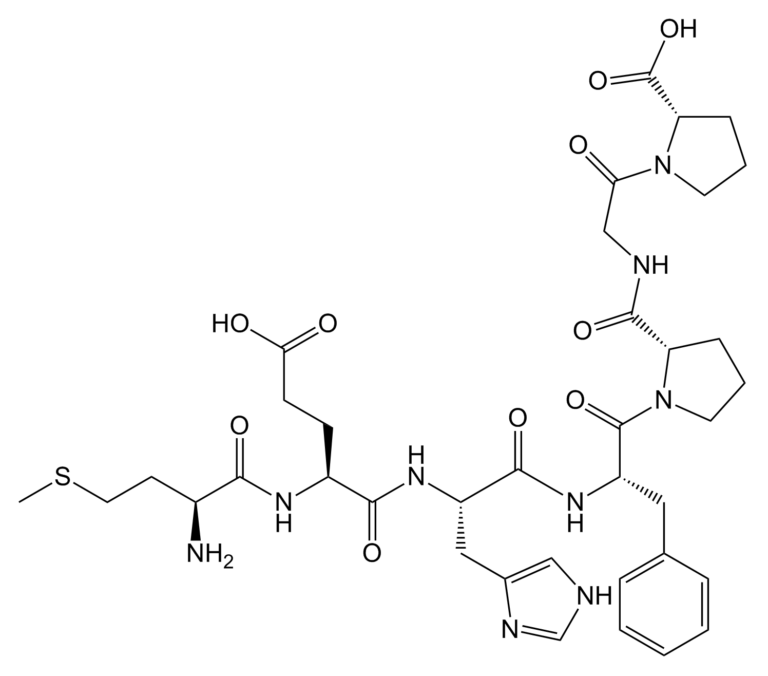
In the early 1980s, Russian researchers took a fragment of one of the body’s most famous stress hormones — adrenocorticotropic hormone, or ACTH — and began re-engineering it. They were not interested in the hormone’s headline job, the cascade that floods the body with cortisol. They were chasing a quieter, stranger property buried in a short stretch of its amino-acid sequence: a signal that seemed to speak directly to the brain. The result of that work, after a series of chemical modifications, was Semax — a seven-residue peptide that keeps the neuro-active whisper of a stress hormone while discarding the hormonal shout.
What exactly is Semax?
Semax is a synthetic heptapeptide — a chain of just seven amino acids, sequence Met-Glu-His-Phe-Pro-Gly-Pro. The first four of those residues correspond to the ACTH(4-10) fragment of adrenocorticotropic hormone; the trailing Pro-Gly-Pro tail is a design feature intended to make the short peptide more robust than the bare fragment alone. In the literature it is described as an ACTH(4-10) analogue with nootropic properties, and that lineage is the whole point: ACTH-derived fragments have long been known to influence learning and attention independently of the adrenal-stimulating action that makes ACTH a stress hormone in the first place.2
Think of ACTH as a single instruction shouted down two corridors at once — one leading to the adrenal glands, one leading to the brain. Semax is what you get when you keep only the brain-facing message and amplify it. Crucially, the N-terminal end of the peptide matters: modifying it changes the nootropic effect, which tells researchers the activity is structurally specific rather than a generic peptide artefact.3
Semax is built from just seven amino acids, four of them inherited from the ACTH(4-10) fragment of a stress hormone — a compact scaffold re-tuned away from hormonal action and toward the brain.2
What does the research on Semax actually show?
The bulk of the Semax literature lives in rodent models, and within that world it is unusually well characterised. On the cognitive side, Semax has been reported to activate dopaminergic and serotonergic systems in the brain, the neurotransmitter circuits most associated with motivation, mood and attention — the mechanistic basis for its description as a nootropic.2
The most developed body of work, though, concerns neuroprotection. In rat models of cerebral ischaemia and stroke, Semax and related ACTH-like peptides appear to compensate for ischaemia-disrupted gene expression, nudging the injured brain’s transcriptional programme back toward a protective state.79 Proteomic profiling has reinforced this, with brain-protein signatures consistent with a protective effect after ischaemia-reperfusion injury,14 and Semax has been shown to suppress transcripts for pro-inflammatory mediators after reversible brain ischaemia.15 A related inflammatory thread runs through spinal-cord-injury models, where the peptide has been reported to raise anti-inflammatory cytokines such as IL-4, IL-10 and IL-1311 while modulating pro-inflammatory IL-6 and IL-8,12 sketching a consistent picture of an immunomodulatory tilt toward repair.
A separate and intriguing thread links Semax to Alzheimer’s-model research. The peptide can act as a copper chelator, and because copper catalyses the formation of reactive oxygen species and influences the aggregation of amyloid-beta (Aβ), this chemistry matters: Semax has been reported to decrease copper-catalysed ROS and Aβ cytotoxicity,8 to affect copper-induced Aβ aggregation in membrane models,13 and, with a derivative, to correct impairments in an animal model of Alzheimer’s disease.5 There is also evidence for antidepressant-like and antistress effects in chronically stressed male rats,10 alongside more recent work probing intracellular calcium dynamics in neurons6 and recovery after spinal cord injury in mice.4
| Property | Semax | What is studied |
|---|---|---|
| Parent fragment | ACTH(4-10) analogue | Neuro-active fragment of a stress hormone |
| Class | ACTH-analogue nootropic heptapeptide | Met-Glu-His-Phe-Pro-Gly-Pro, 7 residues |
| Research focus | Cognition, neuroprotection, mood | Dopaminergic/serotonergic activation; ischaemia gene-expression; copper/Aβ chemistry; antistress effects |
| Regulatory status | Registered in Russia; not approved EU/US | Research-use-only material outside Russia |
Semax at a glance: an ACTH(4-10)-derived heptapeptide studied across cognition, neuroprotection and mood — predominantly in animal models.
Is Semax approved as a medicine?
This is where the picture demands honesty. Semax is a registered medicine in Russia, where it has seen clinical use for years. But it is not approved in the EU or the US. In Europe and North America it has no marketing authorisation and exists purely as a research-use-only material. Its regulatory profile is also actively in flux: Semax is among the peptides slated for review by the FDA’s Pharmacy Compounding Advisory Committee in July 2026, a process that may further clarify its status in the US compounding landscape.
How strong is the evidence really?
Here is the honest accounting that a scientifically literate reader deserves. The preclinical case for Semax is extensive and mechanistically coherent: independent labs publishing in peer-reviewed Western journals — the British Journal of Pharmacology,4 Acta Naturae,5 ACS Chemical Neuroscience,13 and several others781014 — continue to report effects on neuroprotection, copper chemistry and stress behaviour. That is more than can be said for many fashionable peptides.
But two caveats are essential. First, the evidence is overwhelmingly animal-model and in-vitro; the cognitive and neuroprotective findings describe rodents and cell systems, not humans. Second, much of the foundational work — and the clinical experience that underpins Russian registration — originates from Russian research groups and Russian-language literature, with comparatively limited independent Western clinical validation. None of this makes the work unserious. It does mean Semax should be treated as investigational, a compound whose human profile remains far less settled than its preclinical CV suggests. For comparison, you can read our primer on its close relative Selank, or the broader nootropic-peptides hub for how these molecules sit relative to one another.
What should a researcher actually care about?
For laboratory work, the decisive variables are not marketing claims but molecular reality: is the material in the vial actually the Met-Glu-His-Phe-Pro-Gly-Pro heptapeptide, at the stated purity, free of the truncated sequences and process impurities that plague poorly made peptides? A seven-residue chain leaves little room for ambiguity — either the sequence is correct or it is not — and that is exactly why identity and purity verification matter so much. Every batch should arrive with a Certificate of Analysis documenting HPLC purity and mass-spectrometric confirmation of identity. Semax is supplied strictly for research use only: it is not a medicine, not for human or veterinary use, and not intended for consumption. Its value to a researcher lies entirely in being precisely, verifiably what the label says — the same standard we apply to every compound, including our Semax research material.
- Semax is a synthetic heptapeptide analogue of the ACTH(4-10) fragment (Met-Glu-His-Phe-Pro-Gly-Pro), engineered to keep the brain-relevant signalling of a stress hormone while shedding its classic hormonal action.
- Preclinical work, mostly in rodents, reports nootropic effects via dopaminergic and serotonergic systems, neuroprotection in cerebral ischaemia models, anti-inflammatory and antidepressant-like effects, and copper-chelation activity relevant to Alzheimer's models.
- Much of the evidence originates from Russian research groups and Russian clinical use; independent Western replication remains limited.
- Semax is registered as a medicine in Russia but is NOT approved in the EU or US, and is one of the peptides under FDA PCAC review scheduled for July 2026.
- As a research-use-only material, what matters most is verified identity and purity, documented by a Certificate of Analysis.
What is Semax derived from?
Semax is a synthetic heptapeptide derived from the ACTH(4-10) fragment of adrenocorticotropic hormone, a stress hormone. Its sequence is Met-Glu-His-Phe-Pro-Gly-Pro, with the Pro-Gly-Pro tail added as a design feature to make the short peptide more robust. It retains the brain-relevant signalling of the ACTH fragment without the hormone's adrenal-stimulating action.
Is Semax approved as a medicine in Europe or the US?
No. Semax is a registered medicine in Russia but it is not approved in the EU or the US. Outside Russia it exists only as a research-use-only material with no marketing authorisation, and it is one of the peptides scheduled for review by the FDA's Pharmacy Compounding Advisory Committee in July 2026.
What does Semax research show?
Mostly in rodent models, Semax has been studied for nootropic effects via dopaminergic and serotonergic systems, neuroprotection in cerebral ischaemia and stroke models through gene-expression compensation, anti-inflammatory cytokine modulation in spinal-cord-injury models, copper-chelation activity relevant to Alzheimer's amyloid-beta models, and antidepressant-like and antistress effects. Human evidence is far more limited.
How reliable is the evidence for Semax?
The preclinical evidence is extensive and mechanistically coherent, published across peer-reviewed journals. However, it is overwhelmingly animal-model and in-vitro, and much of the foundational and clinical work originates from Russian research groups with limited independent Western validation. Semax should be regarded as investigational.
What is the difference between Semax and Selank?
Both are Russian-developed synthetic peptides studied as nootropics, but they differ in origin and emphasis. Semax is an ACTH(4-10) analogue studied for cognition and neuroprotection, while Selank is derived from the immunomodulatory peptide tuftsin and studied more for anxiolytic and antistress effects. Both are research-use-only materials outside Russia.