
What Is Selank? The Russian Tuftsin Peptide Studied for “Calm Without Sedation”
Selank is a synthetic heptapeptide derived from the natural immune molecule tuftsin, developed in Russia and studied in animal models as an anxiolytic and nootropic peptide. Registered in Russia, it is not approved in the EU or US, and is supplied strictly for research use only.
Selank is a synthetic seven-amino-acid peptide based on the immune molecule tuftsin, developed in Russia and studied preclinically as an anxiolytic and nootropic compound. It is registered in Russia but not approved in the EU or US. Here it is a research-use-only reference material, not a medicine.
Most of pharmacology is a war against the clock. A natural signalling molecule does its job, then enzymes pounce and dismantle it within minutes. Tuftsin — a short immune-activating fragment that the body produces and then rapidly destroys — is one of those fleeting messengers. In the late twentieth century, researchers at the Institute of Molecular Genetics of the Russian Academy of Sciences asked a deceptively simple question. What if you took tuftsin’s active core and bolted extra amino acids onto it to slow the enzymes down? The answer they synthesised was Selank: a stabilised synthetic cousin of a natural immune peptide, studied not for immunity at all, but for something stranger — calm without sedation.
What exactly is Selank?
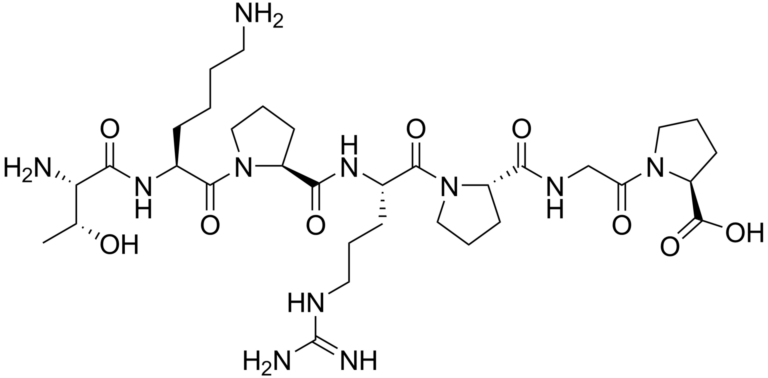
Selank is a synthetic heptapeptide with the sequence Thr-Lys-Pro-Arg-Pro-Gly-Pro — seven amino acids, three of them proline.312 The core Thr-Lys-Pro-Arg is tuftsin; the trailing Pro-Gly-Pro is the engineered tail, a sequence chosen precisely because proline-rich peptides resist the proteases that would otherwise shred the molecule. The same design philosophy produced the related glyprolines studied for their effects on coagulation and tissue protection.1 Selank belongs to a small Russian family of “regulatory peptides” engineered the same way, the most famous sibling being Semax, an analogue of the stress hormone ACTH. Both are short, both are Russian, and both occupy the curious category of compounds that are registered as drugs in Russia but unapproved anywhere in the EU or United States.
Selank’s first four residues are tuftsin itself — Thr-Lys-Pro-Arg — the active fragment of a natural immune peptide, extended with a proline-rich tail to survive the enzymes that destroy the parent molecule.312
How is Selank thought to work?
The mechanism that put Selank on the map is elegant and indirect. In 2001, two papers from the same Russian circle reported that Selank inhibits enkephalin-degrading enzymes in human serum — the proteases that chew up enkephalins, the body’s own opioid-like “feel-settled” peptides.23 One line of work proposed this enzyme inhibition as the basis of its anxiolytic activity: rather than flooding the brain with a sedative, Selank may simply let endogenous enkephalins linger.3 Think of it less as adding water to a reservoir and more as partly closing the drain.
That is not the whole story. Later mechanistic work framed Selank as a positive allosteric modulator of GABA receptors — the brain’s main inhibitory system, and the same target benzodiazepines hit — which is partly why it surfaces in reviews of GABA-active agents.512 Other rodent studies link it to serotonergic signalling and to measurable changes in stress physiology, including cytokine levels under social stress.612 A functional-connectivity study in healthy human volunteers even attempted to map how Selank and Semax shift activity across brain networks.8 The honest summary: several plausible, partly overlapping mechanisms, none yet settled.
What has the research actually shown — and where?
Beyond that resting-state imaging work in volunteers, almost everything published sits in rodent models. In a study of ethanol-induced memory impairment, Selank protected against the deficit while regulating BDNF — a key growth factor for neurons — in the hippocampus and prefrontal cortex, the regions most associated with memory and executive control.9 Electrophysiology work probed its effect on spontaneous synaptic activity in hippocampal CA1 neurons.15 A separate strand follows the gut–brain axis: under chronic restraint or foot-shock stress, rats showed morphological changes in the large intestine and shifts in colon microbiota that Selank appeared to modulate, with parallel reports on liver and hepatocyte status under the same stressors.7101113 It has been studied in models of morphine withdrawal4 and, alongside Semax, in a 6-OHDA model of Parkinsonism.14
| Feature | Semax | Selank |
|---|---|---|
| Natural template | ACTH(4–7) fragment | Tuftsin (immune peptide) |
| Size | Heptapeptide | Heptapeptide |
| Primary research focus | Cognition, neuroprotection | Anxiolytic, stress modulation |
| Most-cited mechanism | BDNF / neurotrophic signalling | Enkephalinase inhibition; GABA modulation |
| Regulatory status | Registered in Russia, not EU/US | Registered in Russia, not EU/US |
Two Russian heptapeptides, two natural templates: Semax descends from a stress hormone, Selank from an immune peptide. See our Semax primer for the cognition side of the family.
How strong is the evidence really?
This is where intellectual honesty matters more than enthusiasm. The Selank literature is genuinely substantial in volume, and the compound has years of clinical use inside Russia behind it. But three caveats should travel with every claim. First, the evidence is overwhelmingly preclinical — rats, cell preparations, enzyme assays — not the large, blinded, placebo-controlled human trials that Western regulators require. Second, the body of work is heavily concentrated in a small number of Russian research groups, with limited independent replication in Western laboratories; a finding gains weight when strangers in another country reproduce it, and that cross-validation is thin here. Third, Selank is not approved by the EMA or FDA. Its Russian registration is real, but registration in one jurisdiction is not the global green light it is sometimes presented as. None of this means the science is wrong — the enkephalinase mechanism in particular is a clean, testable idea.23 It means Selank remains investigational, and any responsible discussion of it has to say so plainly.
Why does this matter for research use only?
For a peptide whose entire interest lies in subtle, mechanism-level effects, the quality of the molecule in the vial is not a footnote — it is the experiment. A seven-residue, proline-rich peptide can carry truncation products, deletion sequences or residual synthesis reagents, and any of those can quietly confound a result. That is why Selank supplied by Condor Research — including our catalogue listing — is a research-use-only reference material, documented by a certificate of analysis confirming identity and purity. It is not a medicine, not a supplement, and not for human or veterinary use. The compelling preclinical story of a stabilised tuftsin analogue is exactly the kind of question that deserves clean reagents and careful methods — and exactly the kind of compound that should never be confused with an approved therapy.
- Selank is a synthetic heptapeptide (Thr-Lys-Pro-Arg-Pro-Gly-Pro) engineered as a stabilised analogue of the natural immunomodulatory peptide tuftsin, developed in Russia.
- Its most-studied proposed mechanism is inhibition of enkephalin-degrading enzymes, letting the body’s own enkephalins persist longer — alongside signals touching GABA and serotonin systems in rodent models.
- Preclinical work spans anxiety and stress models, BDNF and memory under ethanol stress, cytokine and microbiome changes under chronic stress, and a Parkinsonism model studied alongside Semax; a small amount of brain-imaging work has been done in healthy volunteers.
- The evidence base is substantial but heavily preclinical and concentrated in Russian research groups, with limited independent Western replication; it is registered in Russia but not approved in the EU/US.
- Condor Research supplies Selank strictly as a research-use-only reference material, with identity and purity documented on a certificate of analysis — never for human or veterinary use.
Is Selank approved as a medicine in the EU or US?
No. Selank is registered as a drug in Russia but has not been approved by the European Medicines Agency or the US FDA. Outside Russia it is an investigational compound. Condor Research supplies it strictly as a research-use-only reference material, never as a medicine or for human or veterinary use.
What is the difference between Selank and Semax?
Both are short Russian heptapeptides modelled on natural molecules. Semax derives from the stress hormone ACTH and is studied mainly for cognition and neuroprotection; Selank derives from the immune peptide tuftsin and is studied mainly as an anxiolytic and stress modulator. Both are registered in Russia but unapproved in the EU and US.
How is Selank thought to produce anxiolytic effects in animal models?
The most-cited mechanism is inhibition of enkephalin-degrading enzymes, which may let the body’s own enkephalins persist longer rather than adding an external sedative. Later studies also describe Selank as a positive allosteric modulator of GABA receptors and link it to serotonergic signalling. These findings come from preclinical and enzyme-assay work.
Is the scientific evidence for Selank strong?
It is substantial in volume but heavily preclinical, mostly conducted in rodents and enzyme systems, and concentrated in a small number of Russian research groups with limited independent Western replication. Combined with its lack of EU/US approval, this means Selank should be treated as an investigational, research-use-only compound.
What is tuftsin, and how does it relate to Selank?
Tuftsin is a natural immunomodulatory peptide fragment. Selank’s first four residues (Thr-Lys-Pro-Arg) are tuftsin itself, extended with a proline-rich Pro-Gly-Pro tail engineered to resist the enzymes that rapidly degrade the parent molecule, giving a more stable synthetic analogue.