
GB-115 (Ranquilon): Evidence Card. A Regulatory and Literature Dossier
GB-115 / Ranquilon dossier: 52 sources in English and Russian, 90% co-authored by one lineage, 7 human studies, weak binding data in one abstract. v1.4.
GB-115 / Ranquilon dossier: 52 sources in English and Russian, 90% co-authored by one lineage, 7 human studies, weak binding data in one abstract. v1.4.
GB-115 is a small synthetic molecule, two amino acids capped with a phenylhexanoyl tail, designed in Moscow in the early 2000s as a mirror-image analogue of CCK-4, a brain peptide that provokes anxiety in experimental settings. In December 2023 Russia registered it as a prescription medicine under the brand name Ranquilon; no registration elsewhere was located. This page is a regulatory and literature dossier, not information for patients. It presents a census of the sources consulted up to 25 October 2026: 52 publications, patents and abstracts in English and Russian, located through searches that were incomplete in two Russian databases. Ninety per cent of the empirical records carry at least one author from the institute that designed the compound, a measure of co-authorship, not of control. Seven studies in people have been reported, all by the originating institute, the authorisation holder or both. The only receptor-binding data located are in a 2011 congress abstract by the developers, which reports weak, micromolar affinity for CCK1, kappa-opioid and bombesin BB3 receptors and none for CCK2.
Version 1.4, 25 October 2026. Condor Research Editorial. Last reviewed: 25 October 2026. Counts, identifiers, registry entries and regulatory status were checked against primary databases on that date; literal queries are in the method note, and the classified census can be downloaded as dataset.json (CC BY 4.0).
Central question. What does the published record on GB-115 (Ranquilon) report, how was it produced, and how much of it comes from anyone other than the institute that designed the compound and the company that holds its Russian registration?
What does the published record on GB-115 consist of?
Evidence level, in one line: one placebo-controlled phase II and one phase III trial in a Russian diagnostic category, both run and reported by the authorisation holder, on top of a preclinical programme from a single institute; no replication by an unaffiliated group was located in the sources consulted.
| Measure (unit) | Condor census, 25 Oct 2026 |
|---|---|
| Unique records in the sources consulted, both languages (record) | 52 (one duplicate publication removed) |
| Records indexed in PubMed (record) | 24 |
| Records reporting data from people (publication) | 10 |
| Distinct human studies (cohort) | 7: 3 in healthy volunteers, 4 in patients |
| Placebo-controlled trials (trial) | 2 (phase II, n=168; phase III, n=220) |
| Trials on ClinicalTrials.gov (registry entry) | 2, both sponsored by Valenta Pharm; 0 with posted results |
| Empirical records with a Zakusov-lineage co-author (record) | 36 of 40 (90.0%); sensitivity 85.0% to 100% (human publications 70%, human cohorts 57.1%; 100% counting the holder) |
| Records with no originator or holder author (record) | 2 of 52; neither studies GB-115 itself (one studies the D-enantiomer, one uses GB-115 as a worked example) |
| Sources with receptor binding constants (Ki, IC50) (source) | 1: a 2011 congress abstract by the developers (45 receptors screened); no full peer-reviewed report located |
| Classification agreement, blind second coder (40 of 52 records) | Evidence type 95.0%, kappa 0.93; origin 67.5%, kappa 0.36 overall, 100% on the 27 records with visible affiliations |
The Condor Evidence Card for GB-115 / Ranquilon, version 1.4. Publications, cohorts and registry entries are counted separately and never mixed in one figure. Sources: dataset.json; ClinicalTrials.gov API v2; PubMed E-utilities. All checked 2026-10-25.
90.0% of the 40 empirical records on GB-115 have at least one Zakusov-lineage co-author. This measures co-authorship, not control of the data. Counting the authorisation holder as well, the share is 97.5%; the remaining record studies the D-enantiomer.
7 human studies, reported in 10 articles and abstracts, all run by the originating institute, the authorisation holder or both.
61 µM is the CCK1 inhibition constant (Ki) reported in the developers’ 2011 binding screen, a congress abstract that also reports no CCK2 affinity. It is the only binding figure located for the receptor named on the Russian label.
In plain terms: two placebo-controlled trials have been published, and their sponsor reports that both reached their main goal. Every study, in animals or people, comes from the team that designed the molecule or the company that registered it, and no outside group has repeated any of it in the sources we could check.
What exactly is GB-115, and what is it not?
GB-115 is N-(6-phenylhexanoyl)glycyl-L-tryptophan amide, written in the literature as Ph(CH2)5CO-Gly-L-Trp-NH2.1 It was designed at the V.V. Zakusov Research Institute of Pharmacology in Moscow from the C-terminal tetrapeptide of cholecystokinin, CCK-4 (Trp-Met-Asp-Phe-NH2), a peptide that provokes panic-like anxiety. The designers applied the “topochemical” principle of Shemyakin, Ovchinnikov and Ivanov: reverse the sequence, keep the spatial arrangement of the key side chains, and aim for the opposite biological effect.12 It is a dipeptide only in a loose sense: the N-terminal phenylhexanoyl group replaces two residues of the parent peptide. The Zakusov programme that produced it also produced Noopept and Dilept.34
| Field | Value |
|---|---|
| Literature name | N-(6-phenylhexanoyl)glycyl-L-tryptophan amide (Russian: амид N-(6-фенилгексаноил)глицил-L-триптофана) |
| Code and brand | GB-115 (ГБ-115); Ranquilon, also transliterated Rankvilon (Ранквилон) |
| Formula, molecular weight | C25H30N4O3, 434.5 g/mol |
| Identifiers | PubChem CID 11281948; CAS 678996-63-9; UNII G5YT2F7SG8; InChIKey ZBIQNIJICMOVKN-QFIPXVFZSA-N |
| Stereochemistry | L-tryptophan (2S); the D-tryptophan isomer is a different, anxiogenic compound |
| Computed lipophilicity | XLogP3 3.0 (PubChem); 3.15 reported by the originating group |
| Russian ATC group | N05BX, other anxiolytics |
| International non-proprietary name | None located; the Russian label uses the chemical name as a grouping name |
Identity of GB-115. Sources: PubChem CID 11281948 computed properties and synonyms; the design paper; the originating group’s blood-brain-barrier paper; Vidal.ru entry. All accessed 2026-10-25.5167
Four naming problems change what a search returns.
- D-GB-115 is the opposite compound. The design paper reports that the L-tryptophan members of the series were anxiolytic and the D-tryptophan members anxiogenic.1 A 2023 Moscow State University study of protozoan behaviour used “D-GB-115”, which it calls a CCK-4 agonist.8 It is the only record in the census with no link to the originators, and it is not about GB-115. A naive count of “GB-115” in PubMed includes it. The two enantiomers have the same formula and the same mass (monoisotopic 434.2318 Da, [M+H]+ 435.2391, our RDKit calculation), so mass spectrometry cannot tell them apart; only a chiral method, such as chiral chromatography against a reference standard, can.
- Errors in indexed text. The English abstract indexed in PubMed for a 2011 Russian study prints GB-115 as “Ph(CH2)5CO-Gly-D-Trp-NH2”, the D-isomer formula, while naming the compound GB-115 throughout.9 Our blind second coder flagged the same line independently. This confirms an error in the indexed abstract; we did not see the Russian full text, and we do not conclude that the study used the D-isomer. The 2019 blood-brain-barrier paper calls the compound “N-hexanoyl-L-glycyl-L-tryptophan amide” in its abstract, dropping the phenyl ring, but gives the correct molecular weight (434.52) in the body.6
- PubChem does not know the brand. On 25 October 2026 the synonym list of CID 11281948 contained “GB-115” and “GB115” but not “Ranquilon”, and its title is a flat name without stereochemistry; one synonym, “N-6-Phenylhexanoyl-glycyl-L-tryptophan”, omits the amide.5 Searches that start from the brand name in PubChem find nothing.
- “GB-115” collides with unrelated terms. In PubMed the Cyrillic “ГБ-115” is not parsed as a phrase and returns over 260,000 irrelevant records; the Latin form returns 23.
In plain terms: GB-115 is one specific molecule. Its mirror image, D-GB-115, was reported to act in the opposite direction in animals, and at least one indexed abstract prints the wrong formula. Anyone counting studies has to read them, not just search the name.
How did GB-115 get from a design paper to a Russian medicine?
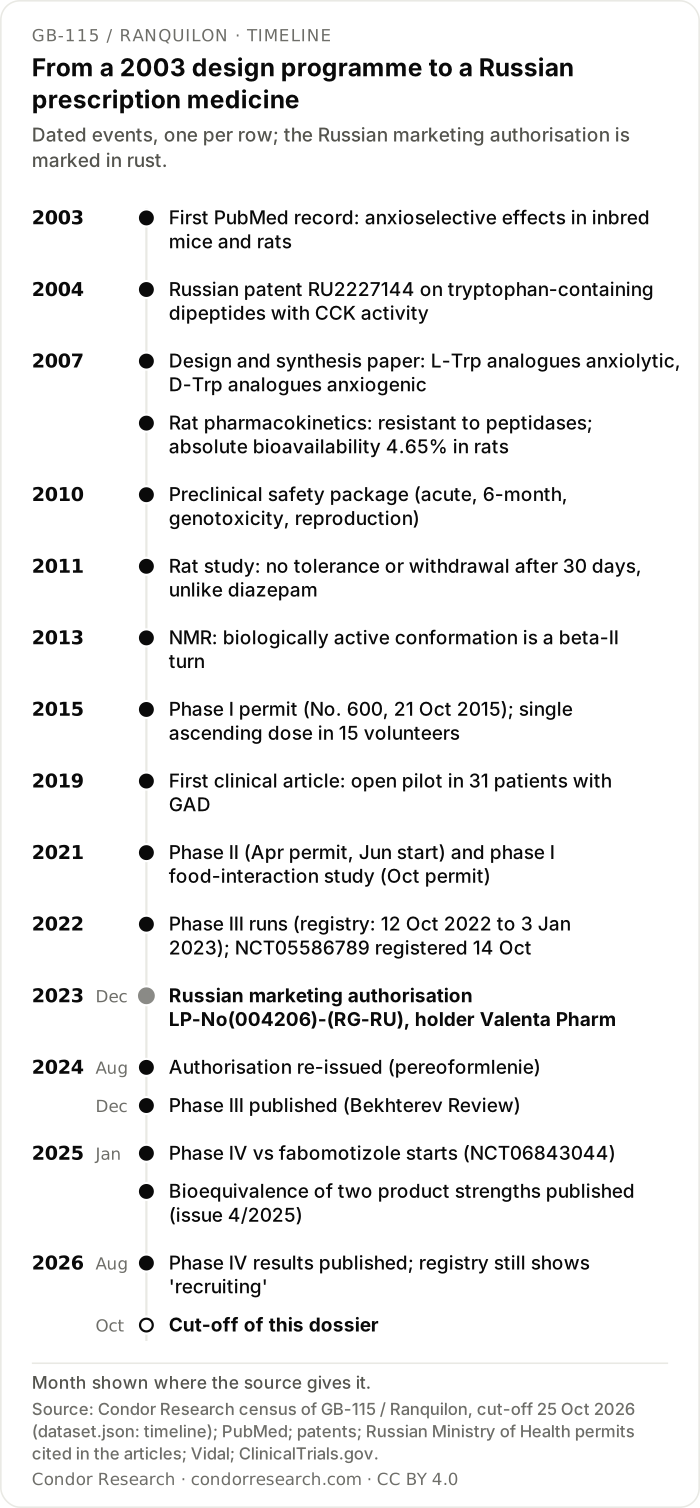
The first PubMed record, in 2003, reports “anxioselective” effects of two candidate compounds in inbred mice and rats.10 A Russian patent on tryptophan-containing dipeptides with CCK activity followed in 2004, and the full design and structure-activity paper in 2007.1 The preclinical programme ran from 2007 to 2016: rat pharmacokinetics, a toxicology package, tolerance and withdrawal studies, and work on pain, inflammation, immunity and alcohol models.111213 A phase I permit was issued on 21 October 2015, with Maluna-Pharm JSC as an industrial co-author.14 The authorisation holder, Valenta Pharm JSC, appears as sponsor from 2021. Phase II and a food-interaction study ran in 2021, phase III in late 2022, and the Russian Ministry of Health registered Ranquilon on 29 December 2023 (registration LP-No(004206)-(RG-RU), valid to 29 December 2028 in the state register); the certificate was re-issued on 23 August 2024.1572 An open-label phase IV against fabomotizole started in January 2025 and was published in August 2026.16
In plain terms: about twenty years passed between the first animal paper and Russian registration, almost all of it inside one Moscow institute; a pharmaceutical company ran the later clinical studies.
What has been published, and by whom?
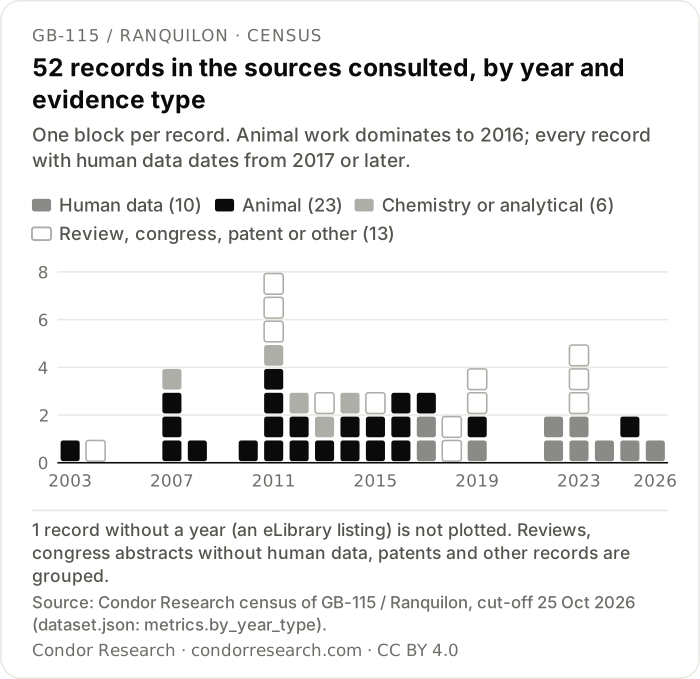
| Evidence type (unit: record) | Records |
|---|---|
| Animal studies | 23 |
| Human data (articles and congress abstracts) | 10 |
| Reviews and methods papers | 7 |
| Chemistry, structure and analytical methods | 6 |
| Patents | 3 |
| Congress abstracts without human data | 2 |
| Other (D-enantiomer in a protozoan) | 1 |
| Total | 52 |
Census of the GB-115 literature by evidence type, coded with the published codebook. 24 of the 52 records are in PubMed; the clinical articles of 2023-2025 appear in Russian journals that MEDLINE does not index. Source: dataset.json.
Authorship concentration (co-authorship, not control)
We call this metric authorship concentration, because that is what it measures: the share of records carrying at least one author from a given group. It is not a measure of experimental independence, and a co-author is not proof of influence. Unit: unique publication record. Headline criterion: at least one author affiliated with the Zakusov Institute or its successor, the Federal Research Center for Original and Promising Biomedical and Pharmaceutical Technologies (FRC OPBPT), among the 40 empirical records (original data on the compound; reviews, patents and congress abstracts without human data excluded).
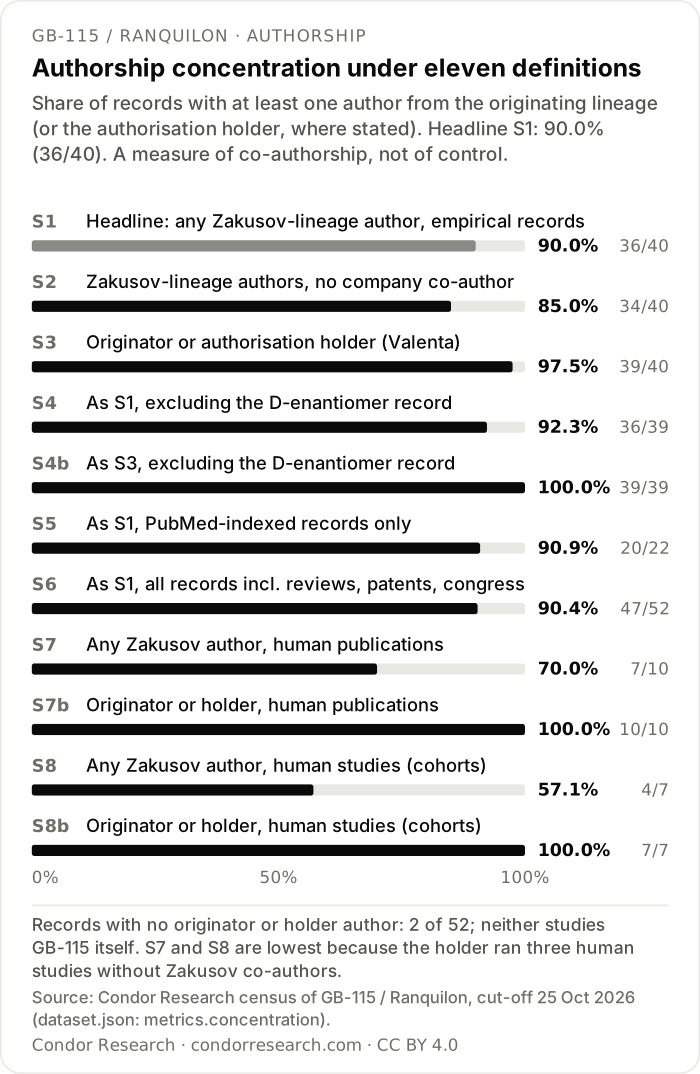
| Definition | Unit | Share |
|---|---|---|
| S1 Any Zakusov-lineage author (headline) | empirical record | 36/40 (90.0%) |
| S2 Zakusov-lineage, no company co-author | empirical record | 34/40 (85.0%) |
| S3 Originator or authorisation holder | empirical record | 39/40 (97.5%) |
| S4 S1 / S3 excluding the D-enantiomer record | empirical record | 36/39 (92.3%) / 39/39 (100%) |
| S5 S1, PubMed-indexed only | empirical record | 20/22 (90.9%) |
| S6 S1, all records including reviews, patents, congress | record | 47/52 (90.4%) |
| S7 Any Zakusov author / originator or holder | human publication | 7/10 (70.0%) / 10/10 (100%) |
| S8 Any Zakusov author / originator or holder | human study (cohort) | 4/7 (57.1%) / 7/7 (100%) |
| S9 Records with neither originator nor holder author | record | 2/52 (D-enantiomer study; methods paper using GB-115 as an example); 0 of those study GB-115 itself |
Sensitivity analysis of authorship concentration. Inter-coder agreement on origin was 67.5% (kappa 0.36) overall, because the second coder could not decide 13 records without visible affiliations; it was 100% on the 27 records with affiliations. The two records without originator or holder authors are the D-enantiomer study and a pharmacokinetic methods paper that uses GB-115 only as a worked example. No author outside Russia appears in any record. Source: raw/metrics.json.
In plain terms: however you count, most of these papers have at least one author from the inventors, and every study of the compound in people involves the inventors or the company. Co-authorship does not show who controlled the data, and it does not make a result right or wrong; it shows that no outside group has tested the findings.
Is that unusual for a Russian compound? To compare like with like we applied one simple rule to GB-115 and four other compounds developed in Moscow: the share of PubMed records in which at least one author’s printed affiliation names the originating institution. This rule sees only PubMed affiliations, so it gives GB-115 a different figure from the lineage count above.
| Compound | Originator | PubMed records | With affiliations | Originator affiliation | 95% CI | Adding Moscow State University |
|---|---|---|---|---|---|---|
| GB-115 (Ranquilon) | Zakusov Institute / Valenta Pharm | 24 | 14 | 12/14 (85.7%) | 60–96% | 92.9% |
| Fabomotizole (Afobazole) | Zakusov Institute | 142 | 90 | 59/90 (65.6%) | 55–75% | 68.9% |
| Omberacetam (Noopept, GVS-111) | Zakusov Institute | 107 | 77 | 38/77 (49.4%) | 38–60% | 50.6% |
| Semax | Institute of Molecular Genetics (now NRC Kurchatov Institute) / Peptogen | 210 | 139 | 57/139 (41.0%) | 33–49% | 62.6% |
| Selank | Institute of Molecular Genetics (now NRC Kurchatov Institute) / Peptogen | 68 | 44 | 19/44 (43.2%) | 30–58% | 52.3% |
Originator share of the PubMed literature for GB-115 and four comparators, by one rule. Title/abstract queries run 25 October 2026; affiliations from PubMed XML; records with no affiliation excluded from the denominator. Wilson 95% intervals, shown as a measure of imprecision for small counts. The Institute of Molecular Genetics now publishes as part of the Kurchatov Institute, and Moscow State University co-developed Semax and Selank, hence the last column. Queries, rules and per-record codes: analytics/authorship_benchmark.py and the dataset.
By this rule GB-115 has the highest originator share of the five, 12 of 14 records (85.7%), against 65.6% for fabomotizole, from the same institute, and 41–49% for Semax, Selank and omberacetam. The comparison is limited by GB-115’s size: only 14 of its records carry affiliations, and its confidence interval (60–96%) overlaps fabomotizole’s (55–75%). These records are a census of what the queries retrieve, not a random sample, so the intervals indicate how imprecise a share based on so few records is; they are not a test of the difference. What the comparison supports is that GB-115 sits at the concentrated end of an already concentrated field; it does not establish that GB-115 differs from fabomotizole.
In plain terms: for drugs designed in Moscow, a large share of the research comes from the people who designed them, and GB-115 is the most extreme case among the five we checked; but with so few papers, we cannot say it is more concentrated than its sister drug Afobazole.
What do the published human studies report?
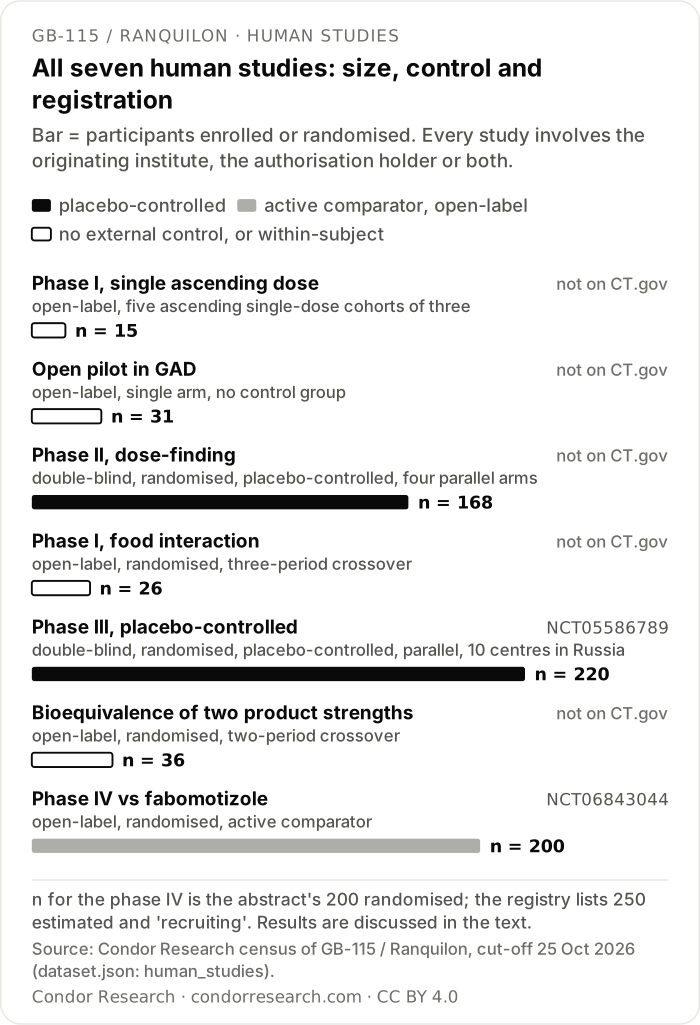
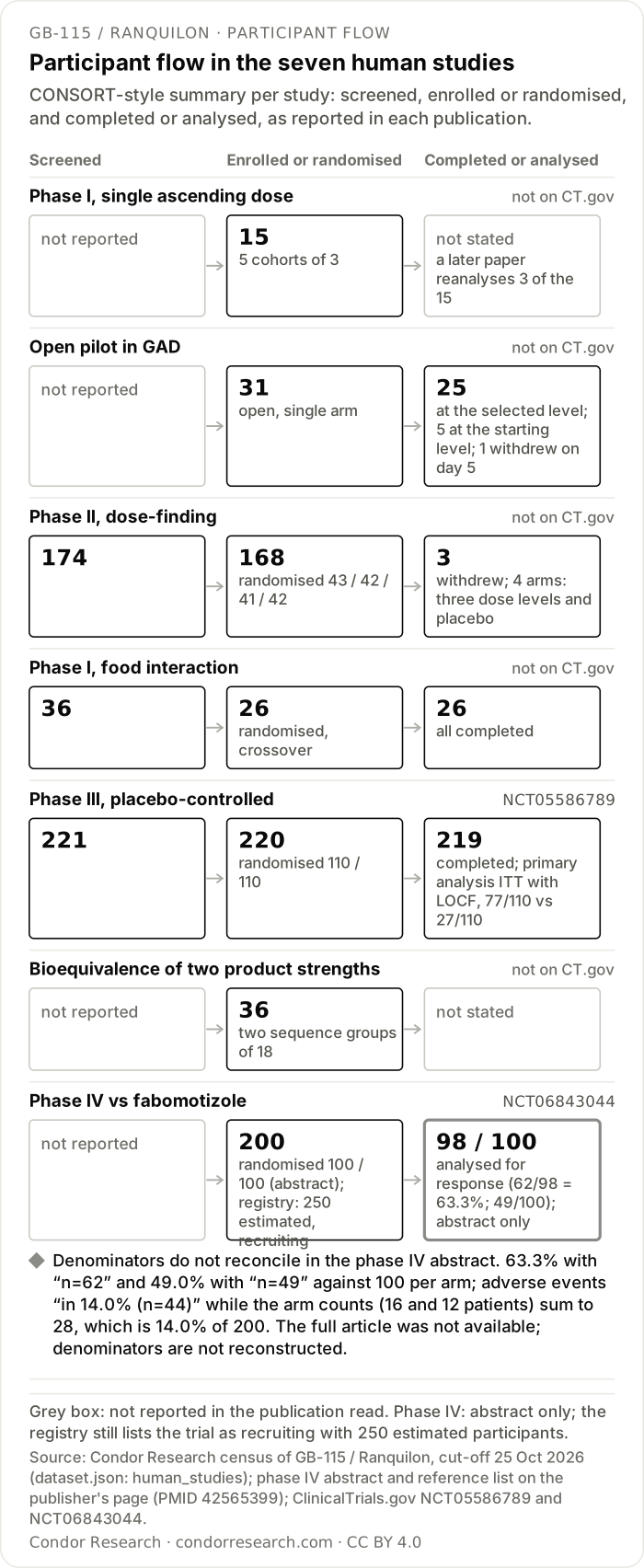
Ten publications report data from people. They describe seven distinct studies: the 2019 pilot article and two 2022 congress abstracts describe one cohort (the abstracts analyse the 25 patients treated at the level selected in the article’s dose-finding stage),171819 and two 2017 articles describe the same phase I volunteers (the second reanalyses 3 of the 15).2014 The table describes design, size, duration, endpoint and the result as reported by the authors, and states whether we read it in the full text or only in the abstract. It is a summary of published reports, not an assessment of efficacy. In keeping with this site’s research-use-only policy it does not report dose amounts, schedules or routes; designs are described only by the number of arms and periods.
| Study | Design | n | Duration | Primary endpoint and result as reported | Read in | Registration, sponsor |
|---|---|---|---|---|---|---|
| Open pilot (phase IIa), GAD (2019 article; 2022 abstracts)1718 | Open, single arm, no control; protocol-defined dose-finding stage in successive cohorts of five, then the remaining patients at the selected level | 31 enrolled; 1 withdrew on day 5; 25 analysed at the selected level | 21 days | No declared primary endpoint. The article reports mean HAM-A 22.2 to 6.3 and MFI-20 64.3 to 36.0 (n=25, within-patient tests) and CGI much or very much improved in 92% at day 21; the authors call the results preliminary and list the pilot nature, open design and small sample as limitations. 5 adverse events in 4 of 31 patients (12.9%) | full text | Permit No. 616 (2016); not on ClinicalTrials.gov; Zakusov Institute |
| Phase I, single ascending dose (2017)2014 | Open, five cohorts of three healthy volunteers | 15 | Single administration | Pharmacokinetics: compound detected in all volunteers; exposure proportional across the range studied | full text | Permit No. 600 (2015); Zakusov with Maluna-Pharm |
| Phase I, food interaction (2023)21 | Open, randomised, three-period crossover, healthy volunteers | 26 | Single administration per period | Pharmacokinetics: food effect on exposure of roughly a quarter, judged minor by the authors; one adverse event | full text | Permit No. 623 (2021); Valenta Pharm, Zakusov co-author |
| Phase II, dose-finding (2023)22 | Double-blind, randomised, placebo, three active arms, 8 centres | 168 | 28 days | CGI-I much or very much improved at day 29: authors report the endpoint met in the middle arm only, 57.1% vs 28.6% placebo (p=0.0148); other arms 39.5% and 43.9%, not significant | full text | Permit No. 208 (2021); not on ClinicalTrials.gov; Valenta Pharm |
| Phase III (2024)2 | Double-blind, randomised, placebo, 10 centres | 220 | 28 days | At least 50% fall in HARS at day 29: authors report 70.0% (77/110) vs 24.5% (27/110), p<0.0001, and all secondary endpoints significant | full text | NCT05586789, no posted results; Valenta Pharm, originator co-author |
| Bioequivalence (2025)23 | Open, randomised, two-period crossover, healthy volunteers | 36 | Single administration per period | Two product strengths bioequivalent (90% CI within 80-125%); 22 mild adverse events in 13 volunteers | full text | Not on ClinicalTrials.gov; Valenta Pharm |
| Phase IV vs fabomotizole (2026)16 | Open-label, randomised, active comparator, multicentre | 200 | 28 days | At least 50% fall in HARS at day 29: 63.3% vs 49.0% (p<0.043), per the abstract; the abstract’s adverse-event figures are internally inconsistent (see below) | abstract and reference list | NCT06843044, still “recruiting”, cited by the article; Valenta Pharm |
Human studies of GB-115 located in the sources consulted to 25 October 2026. Results are the authors’ reported findings. The pilot was read in full (publisher web version, OCR checked against the page images); for the phase IV only the publisher’s page with the abstract and reference list was available, and abstract findings may differ from the full article. HARS: Hamilton Anxiety Rating Scale. CGI-I: Clinical Global Impression, Improvement. MFI-20: Multidimensional Fatigue Inventory. Phase II and III enrolled adults with anxiety in neurasthenia (ICD-10 F48.0) or adjustment disorder (F43.2) and excluded generalised anxiety disorder, depression and panic disorder. Sources: full texts, except the phase IV, for which only the abstract was available.
What our recalculations show
We recomputed the main comparisons from the counts printed in the articles. The recomputation reproduces the reported p-values, which supports the counts, and raises three reporting questions. None of them, on its own, says anything about the conduct of the trials.
- Phase III: a mislabelled statistic. Responders were 77 of 110 on the drug and 27 of 110 on placebo. Risk difference = 77/110 − 27/110 = 0.700 − 0.245 = 0.455, that is 45.5 percentage points (our 95% CI 32.8 to 56.0, Newcombe method). Odds ratio = (77 × 83) / (33 × 27) = 6,391 / 891 = 7.17 (our 95% CI 3.95 to 13.0, Woolf method). The article reports an “odds ratio with 95% CI 0.452 (0.3197-0.5843)” and, in the next sentence, calls 32% (0.3197) “the lower bound of the 95% CI for the difference between groups”.2 The values given as an odds ratio therefore correspond to the risk difference expressed as a proportion. The article does not define how its “odds ratio” was computed, so we describe this as a mislabelled statistic, not as a calculation error. The reported p=0.063 for the share of patients with adverse events (25.5% vs 14.6%) is reproduced by Fisher’s exact test.
- Phase III: planned versus observed attrition. The sample-size section planned for about 12% screen failure and about 15% drop-out after randomisation. The results report 221 screened, 1 excluded, 220 randomised and 219 completing.2 The registry lists a study start of 12 October 2022 and a primary completion of 22 November 2022, 41 days apart; with a 28-day treatment period, these dates are compatible with randomisation within about two weeks. Registry dates are not recruitment dates and the article gives none, so the recruitment period is not established. The trial was first submitted to the registry on 14 October 2022, two days after the listed start.24
- Phase II. Counts of 24/42 and 12/42 reproduce both the reported percentages and p=0.0148 (Fisher). One of three active arms separated from placebo and the response across arms was not monotonic. No adjustment for three comparisons is described; under a Bonferroni threshold of 0.0167 (our calculation) the reported result would remain below the threshold.22
- Phase IV abstract: an internal inconsistency, resolved arithmetically. The abstract reports 200 randomised (100 per arm), responders “63.3% (n=62)” on Ranquilon and “49.0% (n=49)” on fabomotizole, and “29 adverse events in 14.0% (n=44) of patients”: 16 events in 16.0% (n=16) on Ranquilon and 13 in 12.0% (n=12) on fabomotizole.16 The arithmetic is consistent everywhere except one figure: 62/98 = 63.3%, so the Ranquilon response rate uses 98 analysed patients rather than 100, while 49/100 = 49.0%; 16 + 13 = 29 events; 16 + 12 = 28 patients, and 28/200 = 14.0%. The printed “n=44” is the only number that fits none of the others and is most likely a typographical error for 28. We checked the Russian abstract on the publisher’s page against the page image. The full article (sold by the publisher) was not read, so the reason two Ranquilon patients are missing from the response denominator is not known. The publisher’s reference list cites NCT06843044 and a phase IV clinical study report dated 30 September 2025 (protocol RAN-04-05-2024), while the registry still lists the trial as recruiting with 250 estimated participants.
Placebo and comparator response rates differ across studies: 28.6% on placebo in phase II (CGI-I), 24.5% on placebo in phase III (HARS) and 49.0% on fabomotizole in the open-label phase IV. The endpoints and designs differ, and we draw no inference about bias from these figures.
In plain terms: when we redo the arithmetic, the published p-values come out the same. One statistic in the phase III paper carries the wrong label, one adverse-event number in the phase IV abstract fits none of its other figures, and the registry dates alone cannot tell us how long recruitment took.
Which trials are registered, and what is missing?
| Registry entry | Status (checked 2026-10-25) | Dates | Results posted | Published |
|---|---|---|---|---|
| NCT05586789, phase III, quadruple-masked, placebo, n=220 actual | COMPLETED; last update 2023-07-25 | Start 2022-10-12; primary completion 2022-11-22; completion 2023-01-03; first submitted 2022-10-14 | No | December 2024, about 23 months after completion; registered and published primary outcome match |
| NCT06843044, phase IV, open-label, fabomotizole, n=250 estimated | RECRUITING; last update 2025-07-02 | Start 2025-01-13; estimated completion 2027-12-31 | No | Results for 200 patients published August 2026 while the registry still shows recruitment |
Registered trials of GB-115. ClinicalTrials.gov API v2 searches for “GB-115”, “GB115” and “ranquilon” returned these two studies (plus one unrelated hit); both list Valenta Pharm as sponsor and are marked as not FDA-regulated. ISRCTN returned 0 for “ranquilon” and “GB-115”. EU CTIS and the clinical-trial section of the Russian GRLS were not queried; the GRLS medicines register was (see Regulatory status). Sources: ClinicalTrials.gov; ISRCTN.242526
The phase I and phase II studies do not appear on ClinicalTrials.gov; the articles cite Russian Ministry of Health permits instead. Whether the phase IV publication is an interim analysis of NCT06843044 or a separate study is not stated in the abstract: arms, entry criteria, duration and primary endpoint match, the sample size does not.
In plain terms: the two trials in the international registry are the company’s. The larger one is marked complete since January 2023, with results published in a Russian journal and none posted to the registry.
What mechanism does the literature describe?
What the sources report from experiments
- Design logic (2007, full text). The design paper takes as its premise that CCK-4 is “a minimal fragment capable of binding to CCK2-type receptors” and that CCK2 antagonists are candidate anxiolytics. It spaces the phenyl and indole rings 13 sigma bonds apart, as in CCK-4, and reports that this spacing gave the most potent compounds in the series.1 Its figure of receptor interactions is labelled “presumed”. The paper contains synthesis, NMR and elemental analysis and rat elevated plus-maze tests; it contains no receptor-binding or functional receptor assay.
- Stereochemistry (2007, full text). In the rat plus-maze, L-tryptophan analogues were anxiolytic and their D-tryptophan enantiomers anxiogenic. The authors read this inversion as evidence of a “stereoselective interaction with the receptor”; that is an inference from behaviour, not a receptor measurement.1
- Active shape. NMR and rigid analogues indicate a beta-II turn as the biologically active conformation.27
- Phenotype dependence in rodents. Effects were seen in strains that “freeze” under stress (BALB/c mice, MR rats) and not, or less, in active-responding strains.1028
- Functional antagonism in rodents (2012, full text). CCK-4 and the D-enantiomer analogue GB-104 each abolished the effect of GB-115 in behavioural tests (open field in BALB/c mice, elevated plus-maze in rats; 6-11 animals per group); GB-115 did not alter yohimbine-induced anxiety in C57Bl/6 mice. The introduction frames CCK2 as the central receptor and the discussion speaks of probable CCK2 blockade, but the authors’ stated conclusion is broader: the effects “depend on its interaction with CCK receptors”, and CCK-4 and GB-115 “have a common pharmacological target”.29 These are behavioural pharmacology experiments, not binding measurements. The manuscript was submitted in April 2011 and does not mention the binding screen below.
- Exposure. In rats the compound resisted peptidases, had an absolute bioavailability of 4.65% and reached brain tissue (brain-to-plasma ratio 1.41).116 In people it is detected in plasma in the pharmacokinetic studies.20
The only binding data located (2011 congress abstract)
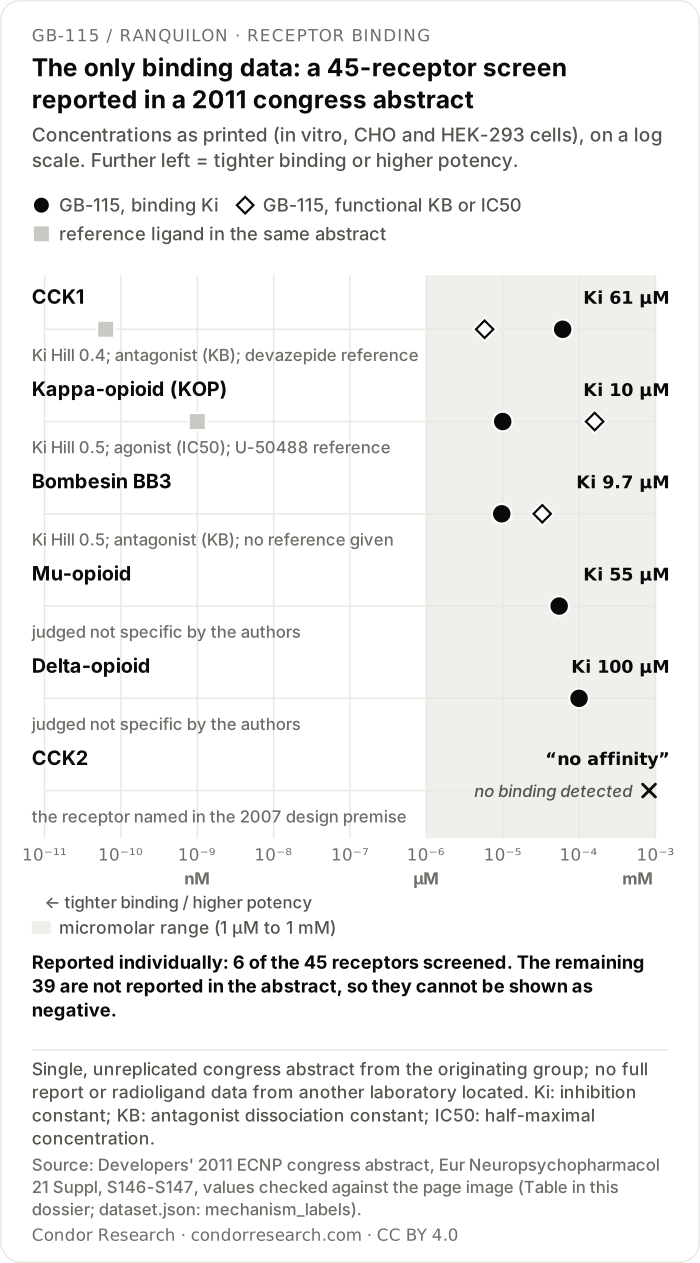
The developers screened GB-115 against 45 human and rat recombinant receptors in CHO and HEK-293 cells and reported the results only as a congress abstract.30 Values as printed (checked against the page image):
| Target | Binding (Ki) | Functional assay | Comparator in the same abstract |
|---|---|---|---|
| CCK1 | 6.1 × 10⁻⁵ M (61 µM), Hill 0.4 | Prevented CCK1 agonist effects, KB 5.8 × 10⁻⁶ M | Devazepide KB 6.3 × 10⁻¹¹ M |
| Kappa-opioid (KOP) | 1.0 × 10⁻⁵ M, Hill 0.5 | Agonist, IC50 1.6 × 10⁻⁴ M | U-50488 IC50 1.0 × 10⁻⁹ M |
| Bombesin BB3 | 9.7 × 10⁻⁶ M, Hill 0.5 | Blocked BB3 agonist effects, KB 3.3 × 10⁻⁵ M | none given |
| CCK2 | “no affinity” | not reported | |
| Mu- and delta-opioid | Ki 5.5 × 10⁻⁵ and 1.0 × 10⁻⁴ M; judged not specific by the authors | not reported |
Receptor data for GB-115 from the 2011 ECNP congress abstract (Eur Neuropsychopharmacol 21 Suppl, S146-S147). Concentrations are in vitro assay values. The authors describe the interactions as “weak”, suggest a “multitarget action” and explain the missing CCK2 affinity by possible CCK2 receptor subtypes. No full report, replication or radioligand data from another laboratory was located.
How the receptor label changed, and what supports each label
- Central CCK (2003), from rodent behaviour: “peptide antagonist of central cholecystokinin receptors” (PubMed abstract).10
- CCK2 (2007), from the design premise and rat behaviour (design paper) and from opioid/CCK behavioural work: “short peptide antagonist of CCK2-receptors” (PubMed English abstract).131
- CCK1, kappa-opioid and BB3, no CCK2 (2011), from the binding and functional screen, congress abstract only.30
- “CCK receptors”, common target with CCK-4 (2012), from behavioural functional antagonism; CCK2 in the framing, not in the conclusion.29
- “Low-affinity blocker of central cholecystokinin receptors” (2019), pilot article; “low affinity” is consistent with the micromolar values of 2011; the article gives no binding values.17
- CCK1 (2022-2025): “central antagonist of cholecystokinin-1 receptors” (congress abstract, 2022); “low-affinity blocker of type 1 cholecystokinin receptors (CCK1)” (Russian label via Vidal, our translation); “antagonistic properties in relation to CCK1 receptors” (2025 abstract).18732
- Reading. The CCK1 label matches the only binding data located; the earlier CCK2 label rested on a design premise and behavioural pharmacology. The historical renaming of CCK-A and CCK-B as CCK1 and CCK2, recalled in the phase III article,2 does not explain the change. Kappa-opioid and BB3 interactions of similar or higher reported affinity than CCK1 are not mentioned on the label. The binding data are a single, unreplicated congress abstract from the originating group.
- Other effects. Antinociceptive, anti-inflammatory, immunomodulating, antidepressant-like and alcohol-related effects come from single rodent studies by the same group and have not been replicated.3334935
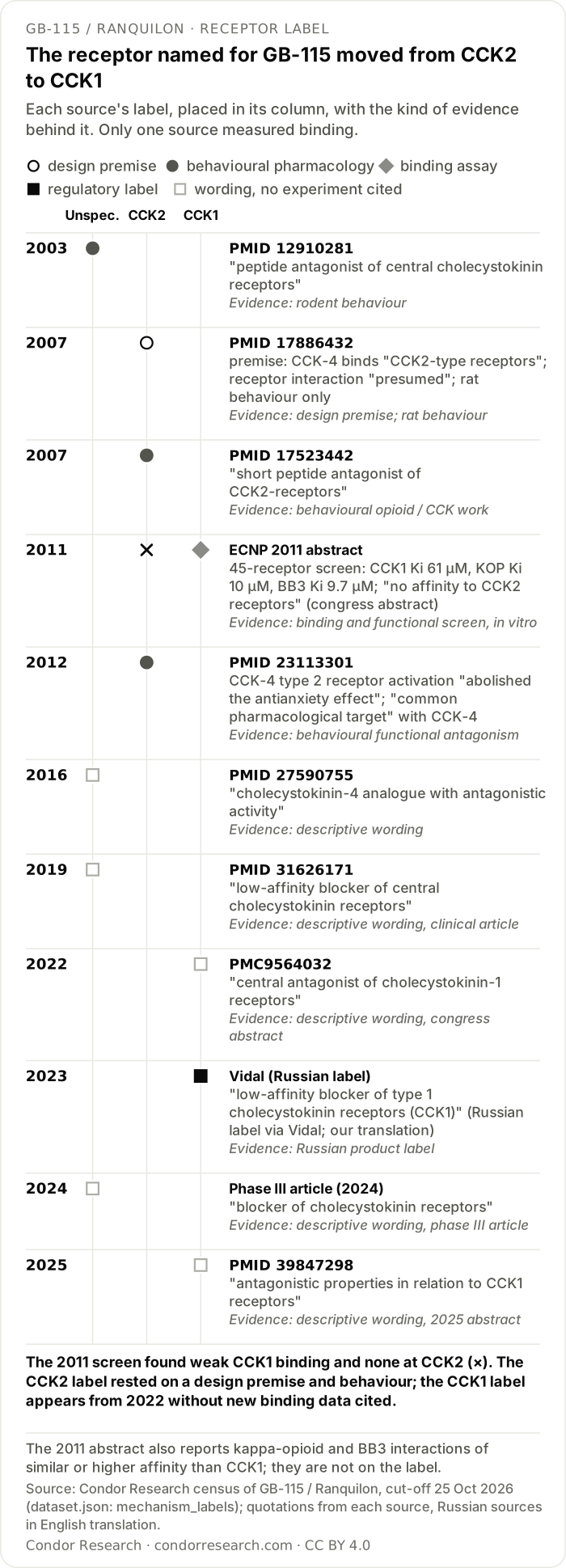
In plain terms: GB-115 was designed to block the receptor that CCK-4 uses (CCK2), and the developers’ mouse experiments fit that idea. Their own 2011 test of 45 receptors, reported only in a short congress abstract, found weak binding to three other receptors and none to CCK2. The official label now names one of those three, CCK1. Nobody else has measured it.
What is reported on safety?
Preclinical: no animal deaths at the highest acute doses tested in mice and rats, no irreversible organ changes in 6-month studies in rats and rabbits, and no mutagenic, allergenic or reproductive effects, all from the originating institute.1236 Rats given the compound for 30 days showed no behavioural or convulsive withdrawal signs, unlike diazepam.13 In people, follow-up is limited to 28 days of exposure plus 1-2 weeks. In phase III, 25.5% of patients on the drug and 14.6% on placebo had adverse events, all mild, most often headache, dizziness and somnolence; none was serious.2 Phase II recorded 155 adverse events in 50 of 168 patients, more often on placebo, and one case of proteinuria whose outcome was not known.22 The Russian label lists irritability, sleep disturbance, somnolence, headache, dizziness, tremor, dysgeusia, reversible loss of visual acuity, nausea, diarrhoea, arthralgia, proteinuria and asthenia, all at unknown frequency, and contraindicates pregnancy, breastfeeding and age under 18.7 No human study of dependence, abuse liability or discontinuation was located.
In plain terms: the trial reports describe mild adverse events, somewhat more often on the drug than on placebo in phase III, over four weeks. Nothing is reported about longer exposure in people.
What is claimed online, and what do the primary sources say?
| # | Claim circulating online | Verdict | What the primary sources report |
|---|---|---|---|
| 1 | It was approved in Russia in 2022. | Contradicted | The Russian marketing authorisation LP-No(004206)-(RG-RU) is dated 29 December 2023; 2022 is the year the phase III trial ran.7224 |
| 2 | It is approved for generalised anxiety disorder. | Contradicted | The registered indication is anxiety states in neurasthenia and adjustment disorder. The only GAD data are an open, uncontrolled pilot of 31 patients (25 analysed at the selected level); the phase II and III trials excluded GAD.71722 |
| 3 | It is a CCK-B (CCK2) antagonist. | Not supported by the binding data located | Early papers by the developers labelled it a CCK2 antagonist on the basis of design and behavioural pharmacology. Their 2011 binding screen of 45 receptors, published only as a congress abstract, reports weak micromolar affinity for CCK1, kappa-opioid and bombesin BB3 receptors and no affinity for CCK2; the Russian label says CCK1.129307 |
| 4 | It has a molecular weight of about 410 Da and crosses the blood-brain barrier easily. | Partly contradicted | Molecular weight is 434.5 g/mol (PubChem). Brain penetration has been reported in rats by the originating group; no human brain-exposure data exist.56 |
| 5 | It causes no tolerance and no withdrawal. | Animal data only | Shown in rats after 30 days of administration, compared with diazepam, by the originating group. Human trials lasted 28 days at most; no dependence, abuse-liability or discontinuation study in people was located.1337 |
| 6 | It has no side effects and replaces benzodiazepines. | Contradicted | The phase III report gives adverse events in 25.5% of patients on the drug and 14.6% on placebo (p=0.063); the Russian label lists adverse reactions including proteinuria and reversible loss of visual acuity. No human comparison with a benzodiazepine was located; the only one is in four rhesus monkeys.2732 |
| 7 | It is a nootropic that improves cognition and fatigue. | Not shown | Attention and reaction time improved from baseline in the uncontrolled pilot (n=25) and fatigue scores fell in controlled trials, where fatigue was an entry criterion; no trial had a cognitive primary endpoint.192 |
| 8 | It helps depression, panic, social anxiety, ADHD or insomnia. | No human data | Antidepressant-like effects were reported in mice by the originating group; panic disorder and depression were exclusion criteria in the controlled trials. No study in ADHD, social anxiety or insomnia was located.922 |
| 9 | It helps with opioid dependence. | No human data | Rat studies by the originating group report that it altered morphine analgesia and tolerance; no human study of opioid use or withdrawal was located.3839 |
| 10 | Russian trials show it is effective and well tolerated. | Reported by the sponsor; not replicated | The sponsor-run phase II (n=168) and phase III (n=220) report meeting their primary endpoints and mild adverse events over 28 days; no trial by an unaffiliated group was located. This table records what the reports say; it is not an assessment of efficacy.222 |
| 11 | It works better than standard anxiolytics and antidepressants. | Not shown | The only active-comparator trial is open-label against fabomotizole (Afobazol), a drug used mainly in Russia; its abstract reports 63.3% vs 49.0% responders (p<0.043) and contains unresolved internal discrepancies. No comparison with an SSRI, SNRI, buspirone or benzodiazepine was located.16 |
| 12 | Peptide-like molecules are always degraded before reaching plasma. | Contradicted | Pharmacokinetic studies report the parent compound in plasma in humans.2021 |
Twelve claims found in Reddit threads (titles and search snippets), a LongeCity thread and vendor pages reviewed for this dossier on 25 October 2026, checked against the primary literature. Forum posts are cited as claims, not as evidence; verdicts describe what the sources report and are not recommendations. Verdicts apply to evidence located by the cut-off.
In plain terms: the claims that match the sources are narrow ones: it is registered in Russia, and two Russian sponsor-run trials report beating placebo. Broader claims (no side effects, a nootropic, better than standard drugs) have no human data behind them in the sources we consulted.
What is GB-115’s regulatory status?
| Jurisdiction | Status | Checked |
|---|---|---|
| Russia | Prescription-only medicine since 2023-12-29 (LP-No(004206)-(RG-RU)), re-issued 2024-08-23; holder Valenta Pharm JSC, manufacturer Dalkhimfarm JSC (Khabarovsk); ATC N05BX; indication: anxiety states in neurasthenia and adjustment disorder1572 | 2026-10-25 |
| European Union (centralised) | No match for GB-115, Ranquilon, phenylhexanoyl or cholecystokinin among 2,754 records of the EMA medicines dataset (timestamp 2026-10-24)40 | 2026-10-25 |
| EU member states | No national authorisation was located; national registers were not searched one by one | 2026-10-25 |
| United States | No match in Drugs@FDA (openFDA, brand and ingredient queries). The substance has an FDA UNII (G5YT2F7SG8), which identifies a substance and is not an approval. ClinicalTrials.gov marks both registered trials as not FDA-regulated41524 | 2026-10-25 |
| WADA | Not named on the 2026 Prohibited List. Section S0 covers substances with no current approval by any governmental health authority for human therapeutic use; Ranquilon holds a Russian approval. No WADA or RUSADA statement on the compound was located, so its S0 status is a reading of the text, not a confirmed classification42 | 2026-10-25 |
| Trial registries | ClinicalTrials.gov: 2 studies (NCT05586789, NCT06843044), both sponsored by Valenta Pharm, neither with posted results. ISRCTN: 0 for 'ranquilon' and 'GB-115'. EU CTIS and the clinical-trial section of the Russian GRLS were not queried (the GRLS medicines register was searched manually; see Russia)242526 | 2026-10-25 |
Regulatory status of GB-115 / Ranquilon by jurisdiction, from primary or stated secondary sources, all checked on 25 October 2026. Negative findings are limited to the databases named.
Ranquilon’s Russian status is confirmed in the state register GRLS, searched manually on 25 October 2026: registration LP-No(004206)-(RG-RU) of 29 December 2023, valid to 29 December 2028, holder Valenta Pharm, record last modified 23 July 2026. The same number appears in the Vidal entry and the phase III article.15 The label describes a prescription medicine for a defined indication. Outside Russia, no assessment by a regulator was located in the registers checked.
In plain terms: it is a registered prescription medicine in Russia; in the other registers we checked it does not appear.
What this literature allows, and does not allow, us to say
- GB-115 is a defined synthetic molecule, distinct from its anxiogenic D-enantiomer; counts that include “D-GB-115” overstate the evidence.
- Two placebo-controlled trials in Russian patients with anxiety in neurasthenia or adjustment disorder, both run and reported by the authorisation holder, report meeting their primary endpoints over 28 days. This dossier records what they report; it does not evaluate or endorse efficacy, and the results have not been reproduced by an unaffiliated group.
- The record has a single origin: 90.0% of empirical records have a Zakusov-lineage co-author (57.1% to 100% under other definitions), and every human study involves the originator or the holder. Co-authorship does not measure control; it does mean that no finding has been replicated by an unaffiliated group in the sources consulted.
- Generalised anxiety disorder, the indication most often named online, has only an uncontrolled pilot behind it: 31 enrolled, 25 analysed at the selected level, no control group, results described by the authors as preliminary.
- The receptor mechanism is not established: the developers’ label changed from CCK2 to CCK1, and the only binding data are a 2011 congress abstract reporting weak micromolar affinity at CCK1, kappa-opioid and BB3 receptors and none at CCK2, without a full report or independent replication.
- Safety data in people cover 28 days of exposure; there are no data on long-term use, dependence or discontinuation.
- Reporting has gaps: no results on ClinicalTrials.gov for the completed phase III, a statistic labelled as an odds ratio that matches the risk difference, and an adverse-event figure in the phase IV abstract (“n=44”) that fits none of its other numbers.
- Nothing in this literature supports claims about cognition enhancement, other psychiatric conditions or superiority over standard anxiolytics.
What is not known
- Would a full, independently replicated binding and functional panel confirm the 2011 abstract values at CCK1, kappa-opioid and BB3 receptors and the absence of CCK2 affinity?
- Does the effect replicate in a placebo-controlled trial run by an investigator independent of Valenta Pharm and the Zakusov lineage, ideally outside Russia and in an internationally used diagnostic category?
- Is the phase IV publication an interim analysis of NCT06843044, and does the full text explain the 98-patient response denominator and the “n=44” adverse-event figure?
- What were the recruitment dates of the phase III trial by centre? The registry dates do not answer this; the clinical study report would.
- What is the absolute bioavailability in people, and are there active metabolites?
- What happens on discontinuation after longer exposure, and is there abuse liability?
- Do the kappa-opioid and BB3 interactions reported in 2011 contribute to any effect described in animals?
Method note
Searches (all on 2026-10-25). PubMed via NCBI E-utilities: “GB-115” (23), GB-115[tiab] (23), GB115[tiab] (22), ranquilon (1), “N-(6-phenylhexanoyl)glycyl-L-tryptophan amide” (1), plus modifier queries; union 24 records, all read. The resulting census covers the sources consulted to 25 October 2026 and is not exhaustive. Synonyms were taken from PubChem before counting. Europe PMC (“GB-115”, ranquilon, “phenylhexanoyl” AND tryptophan, Seredenin AND cholecystokinin) added two congress abstracts and two patents. CyberLeninka (public search, 22 queries in Russian and English; 180 candidates, 14 with a real mention), eLibrary.ru public listings (“Ранквилон” complete, 6 results; “ГБ-115” first page only, because a CAPTCHA appeared and was not bypassed) and Google Scholar (9 queries, first page each) added the remaining records. A manual check on 25 October 2026 returned more than 1,000 raw CyberLeninka hits for “ГБ-115” (an unfiltered full-text match that includes unrelated codes) and 2 for “Ранквилон”; eLibrary.ru returned HTTP 403 to that manual check from outside the CIS. The state register GRLS was searched manually for “Ранквилон”. Registries: ClinicalTrials.gov API v2 (query.term and query.intr), ISRCTN query API. Regulators: EMA medicines JSON (2,754 records), openFDA drugsfda, WADA 2026 List full text, Vidal.ru. Every PMID was re-verified with esummary and every DOI with Crossref on 25 October 2026.
Classification. Each record was coded for evidence type, origin and compound with a written codebook, from the title, abstract, affiliations or full text. Full texts were read for 19 records: 16 open access and, in version 1.3, three obtained legally by Condor Research (the 2007 design paper, the 2012 CCK-system paper and the 2019 pilot), plus the full 2011 congress abstract; for the phase IV only the publisher’s page with the abstract and reference list was available. Scanned pages were read with OCR (Russian and English) and every number used was checked against the page image; Russian PDFs carried a text layer, and every number used here was checked against the PDF. Origin follows author affiliations; where PubMed lacks them, affiliations come from the full text or, for older records, from author names (marked in the dataset).
Blind second coding. A random sample of 40 of the 52 records (77%; rule: at least 15% and at least 40) was coded by a separate language-model instance that saw only the codebook and the record fields, after the first coder’s codes were frozen. Agreement: evidence type 95.0% (Cohen’s kappa 0.93); compound 87.5% (kappa 0.50; all five disagreements were reviews or patents where GB-115 is one of several examples); origin 67.5% overall (kappa 0.36) because the second coder marked 13 records “undecidable” where no affiliations were given, and 100% (kappa 1.00) on the 27 records with visible affiliations. Disagreements are listed in doublecode/agreement.json.
Independent recoding. A third coder from a different model family (Codex) recoded all 53 census entries (the 52 unique records plus one duplicate publication) from titles and affiliations, without abstracts or our labels, after our codes were frozen. Agreement was 43/53 on evidence model (kappa 0.75) and 52/53 on whether a record is linked to the Zakusov institute or Valenta Pharm (kappa 0.79). Nine of the ten model disagreements are records we coded as “other” (congress abstracts, pharmacokinetic and methods papers) that the title-only coder placed in human or animal; the single origin disagreement is a record we left as unknown and the third coder linked to the developers. Applied to the headline metric, the third coder’s model codes would add nine records to the empirical set, eight of them with a Zakusov or Valenta affiliation, giving about 44 of 49 (90%) against our 36 of 40 (90.0%).
Translations. English titles of Russian articles are those printed by the journal or by PubMed, as marked in the references; quotations translated by us are marked “our translation”. In tables we separate what an abstract reports, what a full text reports and what the authors conclude.
Limitations. The eLibrary search for “ГБ-115” stopped at the first page because of a CAPTCHA that we did not bypass, and a later manual attempt was refused (HTTP 403) from outside the CIS; eLibrary-only records may be missing. The phase IV article was read as abstract and reference list only. The vendor, encyclopaedia and forum pages used for the claims table (Kimera, Peptide Select, RUPharma, Evipedia, 15 Reddit threads by title and snippet, one LongeCity thread) were read only to list claims. Search engines may miss Russian grey literature. Authorship concentration measures co-authorship, not control of data. Recalculations use counts reconstructed from published percentages.
Reproducibility. Scripts in scripts/ regenerate the double-coding sample, agreement, metrics, figures, this page and dataset.json from census.json and raw/.
Glossary
- CCK-4: the four-amino-acid end of cholecystokinin, a gut and brain peptide; given to people it can trigger panic-like anxiety.
- CCK1 / CCK2: the two cholecystokinin receptor subtypes, formerly CCK-A and CCK-B.
- Enantiomer: a mirror-image form of a molecule; GB-115 and D-GB-115 are enantiomers.
- HARS: Hamilton Anxiety Rating Scale, a clinician-rated anxiety score (0-56).
- CGI-I: Clinical Global Impression of Improvement, a clinician’s overall rating of change.
- Neurasthenia: an ICD-10 diagnosis (F48.0) of persistent mental or physical fatigue with related symptoms, used widely in Russia.
- Adjustment disorder: distress or impaired functioning following a stressful life event (ICD-10 F43.2).
- LOCF: last observation carried forward, a way of filling in missing trial data.
- Authorship concentration: our metric; the share of records with at least one author from a given group.
- Bioequivalence: two formulations producing statistically equivalent blood levels.
Frequently asked questions
What is GB-115 (Ranquilon)?
GB-115 is N-(6-phenylhexanoyl)glycyl-L-tryptophan amide (PubChem CID 11281948, CAS 678996-63-9), a synthetic analogue of the cholecystokinin fragment CCK-4 designed at the Zakusov Institute of Pharmacology in Moscow. Under the brand Ranquilon it has been registered as a prescription medicine in Russia since 29 December 2023 (registration LP-No(004206)-(RG-RU), holder Valenta Pharm). No authorisation outside Russia was located on 25 October 2026.
Is GB-115 the same as D-GB-115?
No. D-GB-115 is the D-tryptophan enantiomer. The original design paper (PMID 17886432) reports that the L-tryptophan analogues were anxiolytic and the D-tryptophan analogues anxiogenic in rodents. One 2023 PubMed record studies D-GB-115; it is not evidence about GB-115.
How many human studies of GB-115 have been published?
In the sources consulted to 25 October 2026: seven human studies in ten publications. They are an open pilot in 31 patients with generalised anxiety disorder, three studies in healthy volunteers (15, 26 and 36 participants), a placebo-controlled phase II (168), a placebo-controlled phase III (220, NCT05586789) and an open-label phase IV against fabomotizole (200). All were run by the Zakusov Institute, Valenta Pharm or both; no study by an unaffiliated group was located.
Which receptor is GB-115 reported to target?
The labels differ by source and date. A 2007 paper by the developers calls GB-115 a CCK2 antagonist, and a 2012 mouse experiment (indirect pharmacology, not a binding measurement) linked its effect to CCK2 receptors; the Russian label and papers from 2022 onward call it a low-affinity CCK1 blocker. The only binding data located are in the developers' 2011 congress abstract (45 receptors): weak micromolar affinity for CCK1 (Ki 61 uM), kappa-opioid and bombesin BB3 receptors, and no affinity for CCK2. No full report or independent replication was located as of 25 October 2026.
Is GB-115 approved in the EU or the US, and is it on the WADA list?
No EU or US authorisation was located: no match in the EMA medicines dataset (2,754 records) or Drugs@FDA on 25 October 2026. It is not named on the WADA 2026 Prohibited List. Section S0 covers substances without any current governmental approval for human therapeutic use; Ranquilon holds a Russian approval, and no WADA statement on its status was located.
Were the phase III results posted on ClinicalTrials.gov?
No. NCT05586789 is marked completed (January 2023) with no posted results as of 25 October 2026. The sponsor's results were published in December 2024 in a Russian journal, the V.M. Bekhterev Review of Psychiatry and Medical Psychology (DOI 10.31363/2313-7053-2024-1047), which reports 70.0% vs 24.5% responders on the Hamilton Anxiety Rating Scale.
How to cite this dossier
Condor Research Editorial. GB-115 (Ranquilon): Evidence Card and census of sources consulted. Version 1.4. 25 October 2026. https://condorresearch.com/research/gb-115-ranquilon-evidence-card/. Dataset: dataset.json, CC BY 4.0.
Changelog. 1.4 (2026-10-25): originator-share benchmark against four Moscow-developed compounds; mass identity of GB-115 and its D-enantiomer; state register GRLS checked manually; phase IV abstract figures reconciled arithmetically; manual CyberLeninka and eLibrary checks; independent recoding by a third coder; author figures added (participant flow, receptor binding screen, CCK label chronology). 1.3 (2026-10-25): full texts of the 2007 design paper, the 2012 CCK-system paper and the 2019 pilot, the full 2011 ECNP abstract and the publisher’s page of the phase IV added. The 2011 binding screen (weak CCK1, kappa-opioid and BB3 affinity, no CCK2) replaces “no binding data located”; receptor-label chronology now names the experiment behind each label; pilot row rebuilt from the full text (dose-finding stage, 25 of 31 analysed at the selected level, adverse events); phase IV discrepancy confirmed on the Russian abstract and left open; the article’s citation of NCT06843044 recorded. 1.2 (2026-10-25): RUO review. Claims table reduced to 12 (route claim removed; the plasma-exposure claim reworded without route); the rat bioavailability figure moved to the animal data without route; route wording removed from the mechanism, conclusions and open questions; permanent CyberLeninka links and “no DOI” marks in the references. 1.1 (2026-10-25): revised after adversarial review. Framed as a regulatory and literature dossier throughout; trial results attributed to their reports; declaration of interest corrected (Condor Research does not sell GB-115); phase III statistic described as mislabelled, with formulas; planned and observed attrition separated and registry dates treated as compatible, not conclusive; phase IV denominators no longer reconstructed; CCK1/CCK2 labels attributed by source and date; indexed-abstract error in PMID 21476266 no longer generalised to the article; authorship sensitivity and origin kappa shown next to the headline; “every record” replaced by “sources consulted”. 1.0-rc (2026-10-25): first release; 52 records, 7 human studies, blind second coding of 40 records.
Related reading on this site: Noopept, from the same Zakusov dipeptide programme; nootropic peptides explained; Selank, another Russian anxiolytic peptide; the Condor evidence ledger; what research use only means.
References
- Gudasheva TA, Kir'ianova EP, Kolik LG, et al. [Design and synthesis of cholecystokinin-4 dipeptide analogues with anxiolytic and anxiogenic activities]. Bioorg Khim. 2007. PMID 17886432. DOI 10.1134/s1068162007040036. Article in Russian; title as translated by PubMed.
- Karavaeva TA, Krupitsky EM, Barinov AN, Kolik LG, Ishchenko KA, Khacheva KK. Efficacy and safety of Ranquilon in the therapy of patients with anxiety associated with neurasthenia and adjustment disorder: results of the double-blind, randomized, placebo-controlled, multicenter phase 3 clinical trial. V.M. Bekhterev Review of Psychiatry and Medical Psychology. 2024;58(4-2):78-99. In Russian; English title as published by the journal; original title: «Эффективность и безопасность препарата Ранквилон® в терапии пациентов с тревожными состояниями при неврастении и расстройстве адаптации». DOI 10.31363/2313-7053-2024-1047. Link.
- Gudasheva TA. [Strategy for the development of dipeptide drugs]. Vestn Ross Akad Med Nauk. 2011. PMID 21899085. Article in Russian; title as translated by PubMed.
- Gudasheva TA, Ostrovskaya RU, Seredenin SB. Novel Technologies for Dipeptide Drugs Design and their Implantation. Curr Pharm Des. 2018. PMID 30295186. DOI 10.2174/1381612824666181008105641.
- National Center for Biotechnology Information. PubChem Compound Summary for CID 11281948 (GB-115): computed properties and synonyms. Accessed 2026-10-25. Link.
- Zherdev VP, Boyko SS, Shevchenko RV. The study of the permeability of the blood-brain barrier for new neurotropic peptide drugs. Farmakokinetika i Farmakodinamika. 2019. In Russian; English title as published by the journal; original title: «Изучение особенностей проницаемости гемато-энцефалического барьера для новых нейротропных пептидных лекарственных препаратов». DOI registered outside Crossref; open access via CyberLeninka. Link.
- Vidal.ru. Ranquilon (Ранквилон®) tablets: registration LP-No(004206)-(RG-RU) of 29.12.2023, re-issued 23.08.2024; holder Valenta Pharm JSC; entry updated 2024-09-09. Secondary reproduction of the Russian label. Accessed 2026-10-25. Link.
- Gruzdev GA, Soboleva LV, Kamensky AA. The Effect of the Agonist Cholecystokinin-4 D-GB-115 On the Character of Motor Activity of Paramecium caudatum. Dokl Biochem Biophys. 2023. PMID 37582869. DOI 10.1134/S1607672923700175.
- Kolik LG. [Experimental study of antidepressant effects of GB-115 dipeptide]. Eksp Klin Farmakol. 2011. PMID 21476266. Article in Russian; title as translated by PubMed.
- Kolik LG, Gudasheva TA, Seredenin SB. Pharmacogenetic study of anxiolytic effects of new cholecystokinin receptor antagonists in animals with different levels of emotionality. Bull Exp Biol Med. 2003. PMID 12910281. DOI 10.1023/a:1024907207370.
- Boyko SS, Kolyvanov GB, Zherdev VP, et al. Experimental study of the pharmacokinetics of a tryptophan-containing dipeptide GB-115. Bull Exp Biol Med. 2007. PMID 18457023. DOI 10.1007/s10517-007-0319-0.
- Sorokina AV, Alekseeva SV, Nemova EP, et al. [Preclinical safety investigation of GB-115 dipeptide]. Eksp Klin Farmakol. 2010. PMID 20726348. Article in Russian; title as translated by PubMed.
- Kolik LG, Garibova TL, Litvinova SA, et al. [The absence of tolerance and withdrawal syndrome after the treatment with the new L-tryptophane-containing dipeptide anxiolytic GB-115]. Vestn Ross Akad Med Nauk. 2011. PMID 21899090. Article in Russian; title as translated by PubMed.
- Raskin SYu, Kolyvanov GB, Litvin AA, et al. Pharmacokinetics of dipeptide anxiolytic GB-115 after oral administration in different animal species and humans. Farmakokinetika i Farmakodinamika. 2017;(3):20-25. In Russian; English title as published by the journal; original title: «Фармакокинетика дипептидного анксиолитика ГБ-115 после перорального введения у различных видов животных и человека». No DOI; open access via CyberLeninka. Link.
- State Register of Medicines (GRLS), Ministry of Health of the Russian Federation. Ranquilon, registration LP-No(004206)-(RG-RU), dated 29.12.2023, valid to 29.12.2028; holder Valenta Pharm JSC; INN entry “N-(6-phenylhexanoyl)glycyl-L-tryptophan amide”; record last modified 23.07.2026. Searched manually 2026-10-25 (CAPTCHA solved by a person; screenshot archived). Link.
- Karavayeva TA, Barinov AN, Egorov IV, et al. [Comparative study of the efficacy and safety of Ranquilon and Afobazol in the treatment of patients with anxiety associated with neurasthenia and adjustment disorders. (Results of an open, randomized, multicenter, phase IV clinical study)]. Zh Nevrol Psikhiatr Im S S Korsakova. 2026. PMID 42565399. DOI 10.17116/jnevro202612607151. Article in Russian; title as translated by PubMed.
- Neznamov GG, Dorofeeva OA, Metlina MV, et al. [Results of a clinical study of a new anxiolytic, a blocker of central cholecystokinin receptors]. Zh Nevrol Psikhiatr Im S S Korsakova. 2019. PMID 31626171. DOI 10.17116/jnevro201911908153. Article in Russian; title as translated by PubMed.
- Dorofeeva O, Syunyakov T, Metlina M, Ivashkina N. Clinical effects of central antagonist of cholecystokinin-1 receptors GB-115 in patients with Generalized Anxiety Disorder. Eur Psychiatry. 2022;65(S1):S388. Congress abstract, CC BY 4.0. PMC9564032. DOI 10.1192/j.eurpsy.2022.981. Link.
- Dorofeeva O, Metlina M, Chepeliuk A, Vinogradova M. Impact of central antagonist of cholecystokinin-1 receptors GB-115 on cognitive functions in patients with Generalized Anxiety Disorder. Eur Psychiatry. 2022;65(S1):S186. Congress abstract, CC BY 4.0. PMC9563656. DOI 10.1192/j.eurpsy.2022.490. Link.
- Zherdev VP, Kolyvanov GB, Litvin AA, et al. Clinical pharmacokinetics of a new original dipeptide anxiolytic GB-115. Farmakokinetika i Farmakodinamika. 2017;(1):52-55. In Russian; English title as published by the journal; original title: «Клиническая фармакокинетика оригинального дипептидного анксиолитика ГБ-115». No DOI; open access via CyberLeninka. Link.
- Dorofeeva OA, Zakharov KA, Grigoriev AV, et al. Evaluation of Ranquilon pharmacokinetics, safety profile and tolerability in healthy volunteers: results of a phase I clinical trial. Klinicheskaya farmakologiya i terapiya (Clin Pharmacol Ther). 2023;32(1):49-55. In Russian; English title as published by the journal; original title: «Оценка фармакокинетики, безопасности и переносимости препарата Ранквилон® у здоровых добровольцев: результаты клинического исследования I фазы». DOI 10.32756/0869-5490-2023-1-49-55. Link.
- Goncharov OV, Mavani DCh, Ledovskikh AA, et al. Optimal dosage regimen of Ranquilon for patients with anxiety associated with neurasthenia and adaptation disorders: phase II clinical trial. Klinicheskaya farmakologiya i terapiya (Clin Pharmacol Ther). 2023;32(4):36-40. In Russian; English title as published by the journal; original title: «Оптимальный режим дозирования препарата Ранквилон® для лечения пациентов с тревожными состояниями при неврастении и расстройствах адаптации: клиническое исследование II фазы». DOI 10.32756/0869-5490-2023-4-36-40. Link.
- Vasilyuk VB, Sinyavin SA, Globenko AA, Kapashin AV, Pasko MA. Pharmacokinetic and safety comparison of two dosage strengths of the drug Ranquilon: a bioequivalence study. Farmakokinetika i Farmakodinamika (Pharmacokinetics and Pharmacodynamics). 2025;(4):96-104. In Russian; English title as published by the journal; original title: «Сравнительная оценка фармакокинетики и безопасности двух дозировок лекарственного препарата Ранквилон®». DOI 10.37489/2587-7836-2025-4-96-104. Link.
- ClinicalTrials.gov. NCT05586789: A double-blind, randomized, placebo-controlled, multicenter phase III clinical trial of Ranquilon in patients with anxiety in neurasthenia and adjustment disorders. Sponsor Valenta Pharm JSC. API v2 record accessed 2026-10-25. Link.
- ClinicalTrials.gov. NCT06843044: An open-label, comparative, randomized, multicenter phase IV clinical study of Ranquilon. Sponsor Valenta Pharm JSC. API v2 record accessed 2026-10-25. Link.
- ISRCTN registry, query API, searches ‘ranquilon’ and ‘GB-115’ (0 results each). Accessed 2026-10-25. Link.
- Gudasheva TA, Lezina VP, Kir'ianova EP, et al. [The study of biologically active conformation of cholecystokinin-4 dipeptide analog GB-115]. Bioorg Khim. 2013. PMID 24397028. DOI 10.1134/s1068162013030060. Article in Russian; title as translated by PubMed.
- Kolik LG, Konstantinopolsky MA, Ryibina IV, et al. Anxiolytic activity of dipeptide GB-115 after oral administration. Bull Exp Biol Med. 2013. PMID 24130989. DOI 10.1007/s10517-013-2112-6.
- Kolik LG, Gudasheva TA, Seredenin SB. Role of the cholecystokinin system in anxiolytic activity of dipeptide GB-115. Bull Exp Biol Med. 2012. PMID 23113301. DOI 10.1007/s10517-012-1842-1.
- Kolik L, Gudasheva T, Seredenin S. P.4.004 Dipeptide anxiolytic GB-115: new receptor targets. Eur Neuropsychopharmacol. 2011;21(Suppl). Congress abstract, pp. S146-S147; English original. DOI 10.1016/s0924-977x(11)70177-8. Link.
- Kolik LG, Zhukov VN, Seredenin SB. [Manifestations of the antinociceptive and anxiolytic properties of the compound GB-115: interactions of cholecystokinin and opioid systems]. Eksp Klin Farmakol. 2007. PMID 17523442. Article in Russian; title as translated by PubMed.
- Panchenko AV, Panchenko AV, Pavlova LE, et al. Influence of Retrodipeptide Analogue of Cholecystokinin Tetrapeptide (GB-115) and Phenazepam on the Behavior of Rhesus Monkeys under Isolation Conditions. Dokl Biochem Biophys. 2025. PMID 39847298. DOI 10.1134/S1607672924701254.
- Kolik LG, Zhukov VN, Gudasheva TA, et al. Experimental study of antinociceptive potency of dipeptide GB-115 during chemical and thermal stimulation. Bull Exp Biol Med. 2012. PMID 22977846. DOI 10.1007/s10517-012-1742-4.
- Shipaeva EV, Kovalenko LP, Sorokina AV, et al. Study of anti-inflammatory effects of GB-115, a glycine-containing retropeptide cholecystokinin analog. Bull Exp Biol Med. 2011. PMID 22235394. DOI 10.1007/s10517-011-1200-8.
- Kolik LG, Gudasheva TA, Martyanov VA, et al. Pharmacological Correction of Alcohol Motivation Depends on the Phenotype of the Response to Emotional Stress. Bull Exp Biol Med. 2016. PMID 27590755. DOI 10.1007/s10517-016-3449-4.
- Sorokina AV, et al. Study of chronic toxicity of the GB-115 drug formulation. Farmakokinetika i Farmakodinamika. 2019;(4):37-44. In Russian; English title as published by the journal; original title: «Исследование хронической токсичности готовой лекарственной формы ГБ-115». DOI 10.37489/2587-7836-2019-4-37-44. Link.
- Kolik LG, Kadnikov IA, Zhukov VN, et al. [Effect of GB-115 dipeptide on anxiety in rats with model benzodiazepine withdrawal syndrome]. Eksp Klin Farmakol. 2011. PMID 22238979. Article in Russian; title as translated by PubMed.
- Kolik LG, Zhukov VN, Seredenin SB. Effect of compound GB-115 on morphine-induced analgesia. Bull Exp Biol Med. 2007. PMID 18239806. DOI 10.1007/s10517-007-0219-3.
- Konstantinopolsky MA, Chernyakova IV, Kolik LG. Experimental assessment of ladasten and GB-115 effects on the antinociceptive tolerance to morphine. Farmakokinetika i Farmakodinamika. 2016:40-45. In Russian; English title as published by the journal; original title: «Экспериментальная оценка влияния ладастена и ГБ-115 на развитие толерантности к анальгетическому действию морфина». No DOI; open access via CyberLeninka. Link.
- European Medicines Agency. Medicines data (JSON report, 2,754 records, timestamp 2026-10-24). Searched 2026-10-25. Link.
- US Food and Drug Administration. openFDA drugsfda endpoint, brand and ingredient queries (no match). Accessed 2026-10-25. Link.
- World Anti-Doping Agency. Prohibited List 2026, valid from 1 January 2026 (section S0; full text searched). Accessed 2026-10-25. Link.
GB-115 is discussed on this page as a laboratory reference compound for research use only (RUO): not for human or veterinary use, not for diagnostic or therapeutic application, and not for any food or cosmetic purpose. Ranquilon is a prescription medicine registered in the Russian Federation; its clinical trials and regulatory file are described here as published literature and a regulatory record, not as information for patients. Nothing on this page describes, recommends or implies human use, and no part of it should be read as a claim that GB-115 improves anxiety, fatigue, cognition or any other function in people.
What is GB-115 (Ranquilon)?
GB-115 is N-(6-phenylhexanoyl)glycyl-L-tryptophan amide (PubChem CID 11281948, CAS 678996-63-9), a synthetic analogue of the cholecystokinin fragment CCK-4 designed at the Zakusov Institute of Pharmacology in Moscow. Under the brand Ranquilon it has been registered as a prescription medicine in Russia since 29 December 2023 (registration LP-No(004206)-(RG-RU), holder Valenta Pharm). No authorisation outside Russia was located on 25 October 2026.
Is GB-115 the same as D-GB-115?
No. D-GB-115 is the D-tryptophan enantiomer. The original design paper (PMID 17886432) reports that the L-tryptophan analogues were anxiolytic and the D-tryptophan analogues anxiogenic in rodents. One 2023 PubMed record studies D-GB-115; it is not evidence about GB-115.
How many human studies of GB-115 have been published?
In the sources consulted to 25 October 2026: seven human studies in ten publications. They are an open pilot in 31 patients with generalised anxiety disorder, three studies in healthy volunteers (15, 26 and 36 participants), a placebo-controlled phase II (168), a placebo-controlled phase III (220, NCT05586789) and an open-label phase IV against fabomotizole (200). All were run by the Zakusov Institute, Valenta Pharm or both; no study by an unaffiliated group was located.
Which receptor is GB-115 reported to target?
The labels differ by source and date. A 2007 paper by the developers calls GB-115 a CCK2 antagonist, and a 2012 mouse experiment (indirect pharmacology, not a binding measurement) linked its effect to CCK2 receptors; the Russian label and papers from 2022 onward call it a low-affinity CCK1 blocker. The only binding data located are in the developers' 2011 congress abstract (45 receptors): weak micromolar affinity for CCK1 (Ki 61 uM), kappa-opioid and bombesin BB3 receptors, and no affinity for CCK2. No full report or independent replication was located as of 25 October 2026.
Is GB-115 approved in the EU or the US, and is it on the WADA list?
No EU or US authorisation was located: no match in the EMA medicines dataset (2,754 records) or Drugs@FDA on 25 October 2026. It is not named on the WADA 2026 Prohibited List. Section S0 covers substances without any current governmental approval for human therapeutic use; Ranquilon holds a Russian approval, and no WADA statement on its status was located.
Were the phase III results posted on ClinicalTrials.gov?
No. NCT05586789 is marked completed (January 2023) with no posted results as of 25 October 2026. The sponsor's results were published in December 2024 in a Russian journal, the V.M. Bekhterev Review of Psychiatry and Medical Psychology (DOI 10.31363/2313-7053-2024-1047), which reports 70.0% vs 24.5% responders on the Hamilton Anxiety Rating Scale.