
ACD856: The Evidence Card. A Trk Modulator Whose Structure Has Never Been Disclosed
ACD856 evidence card: every PubMed record and trial checked, the stopped ponazuril study, the undisclosed structure vendors sell, and 18 forum claims tested.
ACD856 evidence card: every PubMed record and trial checked, the stopped ponazuril study, the undisclosed structure vendors sell, and 18 forum claims tested.
ACD856 is an experimental drug from the Swedish company AlzeCure Pharma. It is designed to make the receptors for three of the brain’s growth signals, NGF, BDNF and NT-3, respond more strongly when those signals arrive. It is also discussed on nootropic forums, where material sold under its name has not been verified. In clinical development it has so far been given only to healthy volunteers, in studies of safety and of how the body handles it; a first trial in people with Alzheimer’s disease is planned but not yet registered. This dossier gathers every article, trial record, patent and company document that could be found at 26 October 2026 and checks what each claim about the compound rests on.
Evidence dossier version 1.1. Data cut-off 26 October 2026. Prepared by Condor Research Editorial. Declaration of interest at the end of the page. Dose amounts, schedules and routes are omitted by editorial rule. This page describes published research; ACD856 is not approved for any use and the material discussed here is for research use only (RUO), not for human consumption.
Central question. ACD856 is sold online under a name whose chemical structure its developer has never published, and is discussed as a cognitive enhancer although no human study has measured cognition. What does the evidence actually establish about the compound, who produced it, and is the powder sold under that name the molecule that was tested?
Key findings. (1) All 6 PubMed records that name ACD856 and all 5 human studies come from AlzeCure; no independent group has published original data. (2) Every human participant was a healthy volunteer: 86 in published studies, 40 more in a 2026 phase 1b reported only by press release. (3) Its predecessor, ACD855, is the veterinary drug ponazuril; its human half-life averaged 68 days, the study was stopped, according to the developers, and that study appears in no public registry. (4) AlzeCure has not disclosed ACD856’s structure; vendors sell under the name a compound attributed to a patent example (CAS 2375424-89-6); its identity with clinical ACD856 is unconfirmed. (5) Volunteers reported mostly mild adverse events and no serious one; our calculation shows the published data cannot exclude a serious event affecting up to 1 in 20 people. (6) Of 18 forum claims, 2 are supported and 2 contradicted.
What this dossier adds, compared with the sources we reviewed. Wikipedia and AlzeCure’s own 2024 review summarise the published pharmacology. This page adds a census of every PubMed record, all registry entries in the US and EU including a 2025-2026 phase 1b absent from ClinicalTrials.gov, the stopped ACD855 human study, five patent families, the gap between the name sold online and what has been disclosed, a comparison with five other neurotrophic modulators plus an independent retest of six reported TrkB activators, calculations of what the safety and EEG data can and cannot detect, and 18 forum claims checked one by one (Table 13).
What does the evidence base look like at a glance?
| Evidence Index field | Value at 2026-10-26 | Definition |
|---|---|---|
| total | 6 | PubMed records naming ACD856 in title or abstract |
| humanos | 2 | PubMed records with original human data (covering 3 ACD856 studies and the ACD855 study) |
| ct_total | 3 + 1 | 3 ClinicalTrials.gov records (all completed phase 0/1) plus 1 phase 1b registered only in CTIS |
| independientes | 0 | Records or studies with original data and no developer link |
| confianza | medium | Names unambiguous in PubMed; chemical identity not disclosed by the developer |
| catalogo | no | Condor Research does not sell ACD856 |
Table 1. Evidence Card row for ACD856 in the Condor Research Evidence Index. Source: this census; ClinicalTrials.gov; CTIS.
Evidence level in one line: developer-run pharmacology in cells, mice and rats; five developer-run studies in healthy volunteers measuring safety, drug levels and EEG; no study in patients and no independent data.
Research Use Only. ACD856 is an investigational compound with no approval anywhere. Nothing on this page is guidance on using it. Study designs are described; dose amounts and schedules are not, by editorial rule.
What is ACD856, chemically, and is it what vendors sell?
What the developer has disclosed. AlzeCure describes ACD856 as a triazinetrione, a small molecule built on a 1,3,5-triazinane-2,4,6-trione ring, optimised from its first candidate ACD855.9,10 ACD855 is ponazuril (toltrazuril sulfone), a veterinary antiprotozoal drug originally developed by Bayer.9,4 AlzeCure’s 2024 review states that the company has not disclosed ACD856’s structure in journals and points readers to its 2017-2019 patent applications instead.11 No INN or USAN has been located. PubChem returns no record for the names ACD856 or ACD-856.12
What vendors sell. We read six public catalogue pages on 26 October 2026 (anonymised in Table 3). Four sell or list a compound as ACD856 and give CAS 2375424-89-6, 1-(3-methyl-4-phenoxyphenyl)-3-phenyl-1,3,5-triazinane-2,4,6-trione. That CAS number belongs to PubChem CID 139434107, which a catalogue supplier sells as “IGF-1R modulator 1” and traces to “Example 5” of AlzeCure’s patent WO2019162702.12,13 PubChem lists no ACD856 synonym for it. The structure sits in the right patent family and its reported cell-assay potencies are of the same order as ACD856’s, so the attribution is plausible. It is not confirmed by the developer.
| Substance | Formula | Monoisotopic mass | [M+H]+ | [M+Na]+ | [M−H]− | cLogP (Crippen) | TPSA |
|---|---|---|---|---|---|---|---|
| Structure sold as 'ACD856' (CAS 2375424-89-6; PubChem CID 139434107, 'IGF-1R modulator 1', patent Example 5) | C22H17N3O4 | 387.1219 | 388.1292 | 410.1111 | 386.1146 | 2.78 | 86.1 |
| ACD855 = ponazuril (toltrazuril sulfone; CAS 69004-04-2; CID 3050408) | C18H14F3N3O6S | 457.0555 | 458.0628 | 480.0448 | 456.0483 | 1.62 | 120.2 |
| Toltrazuril (CID 68591), the parent veterinary drug | C18H14F3N3O4S | 425.0657 | 426.0730 | 448.0549 | 424.0584 | 2.94 | 86.1 |
Table 2. Computed identity (RDKit, from PubChem structures). The first row describes what vendors sell as ACD856, not a structure disclosed by the developer. cLogP is an atom-additive estimate. Source: PubChem; Condor Research calculation (analytics.json).12
| Vendor | Type | Name used | CAS quoted | Formula quoted | Observation |
|---|---|---|---|---|---|
| A | Research-chemical retailer (US) | ACD856 | 2375424-89-6 | C22H17N3O4 | Powder and PEG-400 solution; purity claim 99.8%+; no batch report linked on the page; claims to be the first seller |
| B | Research-chemical retailer | ACD856 (IGF-1R Modulator 1) | 2375424-89-6 | C22H17N3O4 | Several formats including finished capsules; batch code and one report on file; reproduces EC50 values from the 2021 paper |
| C | Reagent supplier (China) | ACD856 (ACD-856) | not shown in excerpt | not shown | States TrkC EC50 of 33 nM; the 2021 paper reports 0.33 µM |
| D | Bulk API trader (China) | ACD856 powder / IGF-1R modulator 1 | 2375424-89-6 | C22H17N3O4 | Kilogram packs; lists 'FDA' among certificates |
| E | Bulk trader (Hong Kong) | ACD-856 | 2375424-89-6 | C9H7NO5 (MW 209.16) | Formula and mass incompatible with the CAS number it quotes |
| F | Catalogue reagent supplier | IGF-1R modulator 1 (does not use the name ACD856) | 2375424-89-6 | C22H17N3O4 | Cites patent WO2019162702 'Example 5'; EC50 0.34 µM (TrkA), 0.39 µM (TrkB), 0.25 µM (IGF1R), 0.29 µM (FGFR1) |
Table 3. Six public catalogue pages read on 2026-10-26, anonymised. No product was bought; no claim of purity or identity is endorsed. Potencies quoted by vendors come from the patent application and can differ from the peer-reviewed values used in the text (for example FGFR1, 0.29 µM on a vendor page against 0.19 µM in the primary paper). Source: vendor pages (URLs held internally).14
Two vendor errors can be checked against primary sources. Vendor E quotes CAS 2375424-89-6 with formula C9H7NO5 and mass 209.16, which cannot be the same substance. Vendor C gives a TrkC EC50 of 33 nM; the 2021 paper reports 0.33 µM, ten times higher.9
Patents. Five patent families from AlzeCure or its founding foundation cover the series (Table 4). The first, filed in December 2017, claims the use of toltrazuril and ponazuril as neurotrophin-receptor modulators; most of its national members have since been withdrawn or abandoned. The 2019 family that contains the structure vendors sell is active in Europe and the United States, as displayed by Google Patents on 26 October 2026.15,13,16,17,18
| Publication | Applicant | Filed | Subject | Status of main members (as displayed) |
|---|---|---|---|---|
| WO2018115891A1 | Stiftelsen AlzeCure | 2017-12-21 | Use of triazinetriones, including toltrazuril and ponazuril, as neurotrophin-receptor modulators (incl. BDNF Val66Met carriers) | EP withdrawn; US, AU, CA abandoned; CN, JP pending |
| WO2019162702A1 | AlzeCure Pharma AB | 2019-02-26 | 1-aryl-3-phenyl-1,3,5-triazinane-2,4,6-triones; the 'Example 5' compound sold as ACD856 belongs here | EP and US active; further US application pending |
| WO2020002949A1 | AlzeCure Pharma AB | 2019-06-28 (GB priority 2018-06-28) | 4-substituted phenyl-triazinetriones (biphenyl series) | EP withdrawn; US abandoned; CN, JP pending |
| WO2020002950A1 | AlzeCure Pharma AB | 2019-06-28 (GB priority 2018-06-28) | 4-substituted phenyl-triazinetriones (heteroaryl-methyl series) | EP and US active |
| WO2021038241A1 | AlzeCure Pharma AB | 2020-08-28 | Further triazine derivatives | AU, KR active; EP, CN, JP pending; one US application abandoned, one pending |
Table 4. AlzeCure patent families on triazinetrione Trk modulators. None names ACD856. Legal status as displayed by Google Patents on 2026-10-26; not a legal opinion.15,13,16,17,18
In plain terms. The company has kept ACD856’s exact structure private. What is sold online under that name is a related molecule from one of its patents. It may be the same compound, but nobody outside the company can currently confirm that.
How is it supposed to work?
Measured in the developer’s laboratory. In engineered cell lines, ACD856 increased the response of TrkA, TrkB and TrkC to their natural signals, with EC50 values of 0.38, 0.29 and 0.33 µM and maximal effects of 185%, 176% and 328% of the signal alone.9 It did not change NGF’s affinity for TrkA but raised the receptor kinase’s apparent maximal rate, and surface plasmon resonance detected a low-affinity binding site on the intracellular domain of TrkA.9,10 In cultured neurons it increased phosphorylated ERK1/2, raised BDNF protein by about 30% and protected against amyloid-beta and energy-deprivation toxicity.10
Two details that matter for how it is described online. First, selectivity: ACD856 was as potent at the IGF1 receptor and FGF receptor 1 (FGFR1) (EC50 0.25 and 0.19 µM in the primary paper) as at Trk receptors; the authors describe selectivity in efficacy (104% and 117%), not in potency.9 Second, ligand dependence: in recombinant cells ACD856 activated TrkA by about 60% without any NGF, which the authors call partial agonism and suggest may be an artefact of receptor over-expression.10
Measured in animals. In mice, ACD856 reduced memory impairment caused by scopolamine or MK-801 in a passive avoidance task, an effect blocked by the TrkB antagonist ANA-12.9 In 18-month-old mice the change was non-significant at 24 hours and significant at 11 days, in one experiment.9 In the forced swim test it reduced immobility in mice and rats, and in one study the effect was still present seven days later.19,10 Brain BDNF rose in 21-month-old mice but not in 3-month-old mice in one study.10 Rat microdialysis showed a rise in hippocampal serotonin with trends for noradrenaline and dopamine.20,19
Measured in humans. Concentrations in cerebrospinal fluid rose across the study cohorts, and EEG showed more relative theta and less fast alpha and beta power, which the authors read as a sign of central target engagement, an exploratory pharmacodynamic signal that does not identify the molecular target, while noting that the findings “do not allow for any general conclusions” on neuronal activity.21
Proposed, not shown. That ACD856 improves memory in people, modifies Alzheimer’s disease, or has antidepressant effects in humans. These are the company’s development hypotheses.11,22
| Statement | System | Status | Source |
|---|---|---|---|
| Potentiates NGF/TrkA, BDNF/TrkB and NT-3/TrkC signalling | Recombinant U2OS cells | Measured (developer) | 9 |
| Similar potency at IGF1R and FGFR1, lower efficacy | Recombinant cells | Measured (developer) | 9 |
| About 60% TrkA activation without NGF | Recombinant cells | Measured (developer); may reflect over-expression | 10 |
| Binds the TrkA intracellular domain; raises kinase Vmax | Purified protein | Measured (developer) | 9 |
| Raises BDNF, pERK; protects against amyloid-beta toxicity | Primary cortical neurons | Measured (developer) | 10 |
| Memory effects blocked by a TrkB antagonist | Mouse | Measured (developer) | 9 |
| Reaches CSF; qEEG change graded across cohorts | Healthy humans, n = 6 per qEEG cohort | Measured (developer) | 21 |
| Improves cognition in people | Human | Proposed; not studied | 11 |
| Disease-modifying in Alzheimer’s disease | Human | Proposed; not studied | 22 |
| Antidepressant in people | Human | Proposed; not studied | 7 |
Table 5. Mechanism: what is measured, in which system, and what is proposed.
In plain terms. In engineered cells, ACD856 increased the response of growth-factor receptors to their natural signals, and it changed behaviour in developer studies in rodents. It also acts on two other growth-factor receptors almost as potently, and in engineered cells it can switch TrkA on partly by itself. In people, it reaches the spinal fluid and changes the EEG; whether that does anything useful is unknown.
What happened when, from screen to licence?
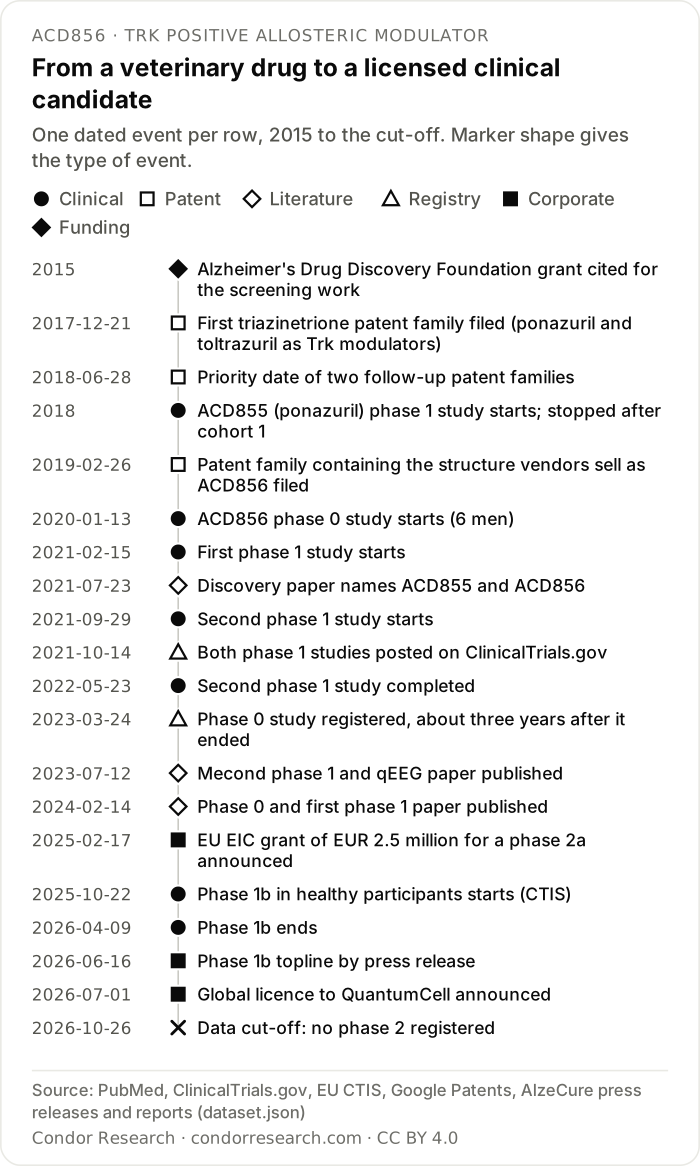
The programme began with a screen of about 25,000 molecules supported by the Alzheimer’s Drug Discovery Foundation, which picked out the veterinary triazinetriones.9 Ponazuril, renamed ACD855, went into a phase 1 study in 2018; after the first cohort its plasma half-life averaged 68 days against a predicted 4.6 days, and the study was stopped.4 AlzeCure then started ACD856 with a phase 0 study in 2020, with sub-pharmacological exposure, to check its half-life, followed by two phase 1 studies in 2021-2022.4,21 In 2025 the company received a EUR 2.5 million EU grant for a phase 2a in Alzheimer’s disease and ran a phase 1b; in July 2026 it licensed the global rights to QuantumCell.23,22,7
In plain terms. The first molecule stayed in the body for months, so it was dropped. ACD856 is the follow-up. Six years after its first human dose it has still only been given to healthy volunteers.
What human studies exist, and where are their results?
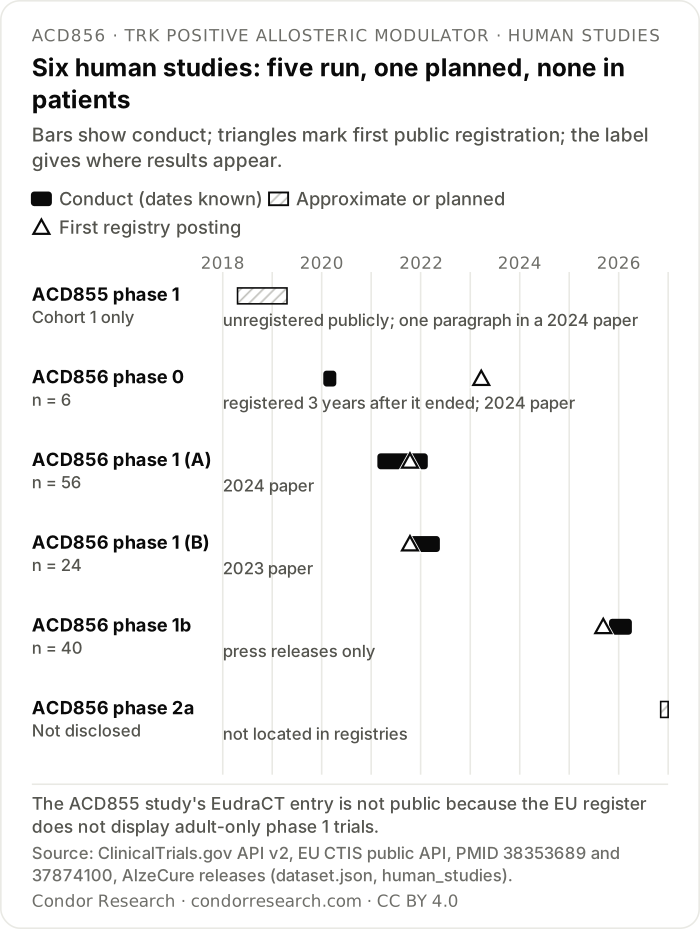
| Study (unit) | Phase | Population and n | Design | Conduct | Status | Result as reported | Where reported |
|---|---|---|---|---|---|---|---|
| ACD855 (ponazuril) EudraCT 2018-002320-16 (not public: adult phase 1) |
1 | Healthy volunteers; n = Cohort 1 only (n not reported) | Phase 1, stopped after the first cohort | 2018 to 2019 | Prematurely terminated | Plasma half-life averaged 68 days against a predicted 4.6 days; development stopped4 | Background paragraph and supplementary figure of PMID 38353689 |
| ACD856 NCT05783830; EudraCT 2019-003504-13 |
0 | Healthy men; n = 6 | Open-label phase 0, sub-pharmacological exposure | 2020-01-13 to 2020-04-18 | Completed | Terminal half-life about 19-20 h; 8 adverse events in 4 participants, 7 judged possibly related, including one transient liver-enzyme elevation (two events of severe intensity by CTCAE) for which the authors cite strenuous exercise; no serious adverse events4,20 | PMID 38353689; AAIC 2021 poster |
| ACD856 NCT05077631; EudraCT 2020-003379-16 |
1 | Healthy adults; n = 56 (42 active, 14 placebo) | Randomised, double-blind, placebo-controlled | 2021-02-15 to 2022-02-22 | Completed | 62 adverse events in 31 of 56 participants; 24 events in 13 participants on ACD856 judged possibly related, mostly mild, headache most common; no serious adverse events; exposure proportional across cohorts4,24 | PMID 38353689 |
| ACD856 NCT05077501 |
1 | Healthy adults; n = 24 (18 active, 6 placebo) | Randomised, double-blind, placebo-controlled, 7-day study period | 2021-09-29 to 2022-05-23 | Completed | No serious adverse events; CSF levels rose across cohorts; qEEG: more relative theta, less fast alpha and beta power21,25 | PMID 37874100; CTAD 2022 abstract |
| ACD856 CTIS 2025-522287-32-00 |
1b | Healthy participants, 18-64 and 65+; n = 40 (CTIS field) | Randomised, double-blind, placebo-controlled phase 1b | 2025-10-22 to 2026-04-09 | Ended | Company: well tolerated, no substance-related safety findings, higher blood and CSF concentrations3,22 | Press releases of 20 April and 16 June 2026 only |
| ACD856 Not located (CTIS, ClinicalTrials.gov) |
2a | People with Alzheimer's disease (planned); n = Not disclosed | Not disclosed | planned 2026 | Planned; EU EIC grant awarded | None23,8 | Company reports |
Table 6. All human studies located, one row per study. All sponsored by AlzeCure. Doses omitted by editorial rule.
Reconciling the sources. Three records, three channels. The ClinicalTrials.gov record of the second phase 1 study lists safety measures, mood and suicidality questionnaires and prolactin as outcomes; it lists neither the CSF measurements nor the qEEG that the 2023 article reports, and it links no publication.25,21 The phase 0 study was submitted to ClinicalTrials.gov in April 2021, a year after it ended, and first posted in March 2023; the 2024 article itself labels it “retrospectively registered”.26,4 The phase 1b is listed in CTIS with 40 participants and dates from 22 October 2025 to 9 April 2026; it is not on ClinicalTrials.gov, and its only reported results are two press releases.3,27,22 The ACD855 study is identified only by a EudraCT number printed in the 2024 article; the EU Clinical Trials Register does not display adult-only phase 1 trials, and ClinicalTrials.gov and CTIS have no entry for it.4,28
| Study | Registry | Start | End | First registry posting | Posting minus start (days) | End to journal article (days) |
|---|---|---|---|---|---|---|
| ACD856 phase 0 | NCT05783830; EudraCT 2019-003504-13 | 2020-01-13 | 2020-04-18 | 2023-03-24 | 1166 | 1397 |
| ACD856 phase 1 (A) | NCT05077631; EudraCT 2020-003379-16 | 2021-02-15 | 2022-02-22 | 2021-10-14 | 241 | 722 |
| ACD856 phase 1 (B) | NCT05077501 | 2021-09-29 | 2022-05-23 | 2021-10-14 | 15 | 415 |
| ACD856 phase 1b | CTIS 2025-522287-32-00 | 2025-10-22 | 2026-04-09 | 2025-09-10 | -42 | none at cut-off |
Table 7. Registration and publication timing. For the phase 1b the date shown is the CTIS authorisation decision. Negative values mean registration before the start. Source: ClinicalTrials.gov API v2; CTIS; PubMed (analytics.json).2,3
None of the three ClinicalTrials.gov records has posted results; for phase 1 trials run outside the United States this is not required, and the data are in journals. The phase 1b ended 200 days before the cut-off without a public results summary; under the EU Clinical Trials Regulation a summary is generally due within a year of the end of a trial, with deferrals possible for early-phase studies.
In plain terms. The published human data come from 86 healthy volunteers in three studies. A fourth study with 40 more volunteers finished in April 2026; so far only the company’s press releases describe it.
What can these studies detect? (our analysis)
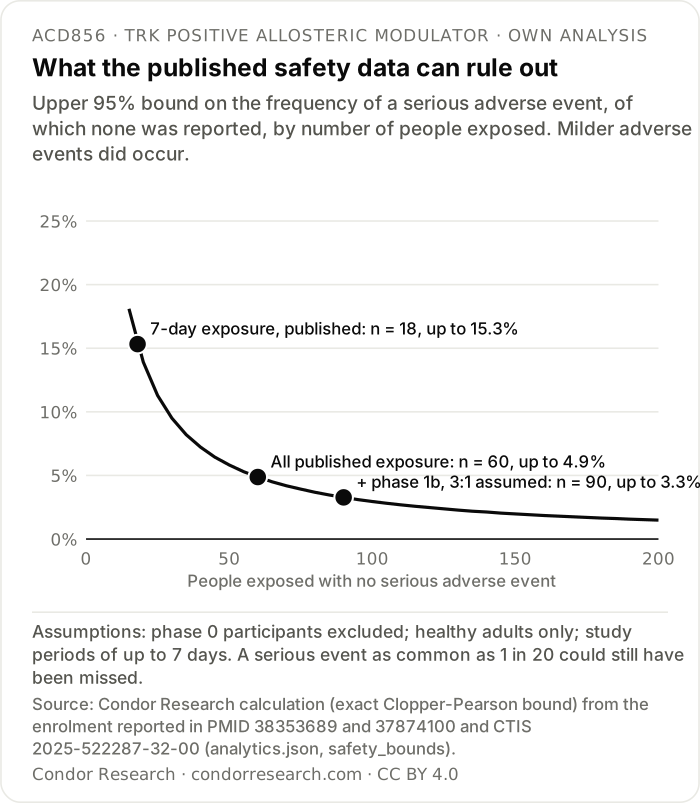
Small safety studies can only rule out common problems. Adverse events were reported in these studies, mostly mild; none was serious. We calculated the exact upper 95% bound on how often a serious adverse event could occur, given that none was seen among the people exposed (Figure 3). Assumptions: phase 0 participants excluded, because their exposure was far below pharmacological levels; each participant counted once; phase 1b allocation not published, so two scenarios are shown.
| Exposure group | n | Upper 95% bound (exact) | Rule of three (3/n) |
|---|---|---|---|
| 7-day study period, published (second phase 1) | 18 | 15.3% | 16.7% |
| Any pharmacological exposure, published (both phase 1 studies) | 60 | 4.9% | 5.0% |
| Published + phase 1b if all 40 received ACD856 (upper scenario) | 100 | 2.9% | 3.0% |
| Published + phase 1b if 30 of 40 received ACD856 (assumed 3:1) | 90 | 3.3% | 3.3% |
Table 8. Upper bound on the frequency of an adverse event observed in no participant. Our calculation; assumptions in the text.
The same logic applies to the EEG. Each qEEG cohort had six participants on ACD856. A paired comparison of six people has 80% power only for very large within-person changes, a standardised effect of about 1.4 at the usual 5% threshold (1.2 at the 10% threshold that the study’s maps also display).21 Smaller effects would usually be missed, and significant results from samples this small tend to overstate the true size of an effect. The authors themselves note that no active control with a known EEG profile was used.21
In plain terms. Volunteers did report side effects, mostly mild ones such as headache, but none was serious. Seeing no serious event in 60 people still leaves room for one that affects up to one person in twenty. The EEG study was large enough to see only big changes.
Who produced the published literature?
| Record | Evidence type | Design | System | n | Developer-linked authors | Funding | Role |
|---|---|---|---|---|---|---|---|
| PMID 34440640 Cells 2021 |
Animal (+ cells) | Screen of about 25,000 molecules; recombinant Trk cell assays, surface plasmon resonance, kinase kinetics, rat hippocampal slices (LTP), rat microdialysis, mouse and rat memory models including 18-month-old mice | cells; mouse; rat | 8 per group typical (mouse); 6 rats (microdialysis); 12 per group (rat object recognition) | 7/10 employed by or holding equity in AlzeCure (conflict statement) | ADDF, Vinnova, Swedish Research Council, Swedish Brain Foundation and others | Discovery paper: ACD855 (ponazuril) and ACD856 named as Trk PAMs; chemical structure withheld by the developer ('company confidentiality')9 |
| PMID 37394539 Psychopharmacology (Berl) 2023 |
Animal (+ cells) | Forced swim test in mice and rats with ACD855, ACD856 and AC26845, ketamine and fluoxetine; rat microdialysis | mouse; rat | 6-8 mice per group; 6 rats (microdialysis) | 5/7 employed by AlzeCure | not stated beyond employment | Antidepressant-like behaviour in rodents19 |
| PMID 37446337 Int J Mol Sci 2023 |
Animal (+ cells) | PC12, SH-SY5Y and primary cortical neurons (neurite outgrowth, SNAP25, pTrkB, pERK, amyloid-beta and energy-deprivation toxicity, BDNF); BDNF in brains of 3-month and 21-month-old mice; forced swim test | cells; mouse | 7-8 mice per group (behaviour) | 10/10 employed by AlzeCure at the time | no external funding | Neuroprotection and BDNF data; reports about 60% TrkA activation without NGF in recombinant cells (partial agonism)10 |
| PMID 37874100 J Prev Alzheimers Dis 2023 |
Human | Phase 1, randomised, double-blind, placebo-controlled, 7 days, healthy volunteers; plasma, urine and CSF pharmacokinetics; qEEG in two cohorts | human | 24 (18 active, 6 placebo) | 6/10 AlzeCure; 2 CRO (CTC); 2 qEEG vendor (Siesta Group) | AlzeCure | Only published repeated-exposure human data; qEEG as a target-engagement marker21 |
| PMID 38353689 Eur J Clin Pharmacol 2024 |
Human | Phase 0 (open label, 6 men, sub-pharmacological exposure) and phase 1 (randomised, double-blind, placebo-controlled) | human | 6 + 56 (42 active, 14 placebo) | 5/7 AlzeCure (3 employees, 2 paid consultants); 2 CRO (CTC) | AlzeCure; open-access fee paid by Karolinska Institutet | First-in-human data; also the only public report of the discontinued ACD855 human study4 |
| PMID 39204102 Pharmaceuticals (Basel) 2024 |
Review | Narrative review of Trk positive allosteric modulators | review | – | 6/6 employed by AlzeCure | no external funding | States that AlzeCure has not disclosed the chemical structure of ACD856 in journals11 |
Table 9. The six PubMed records naming ACD856 in title or abstract, coded from the full text.
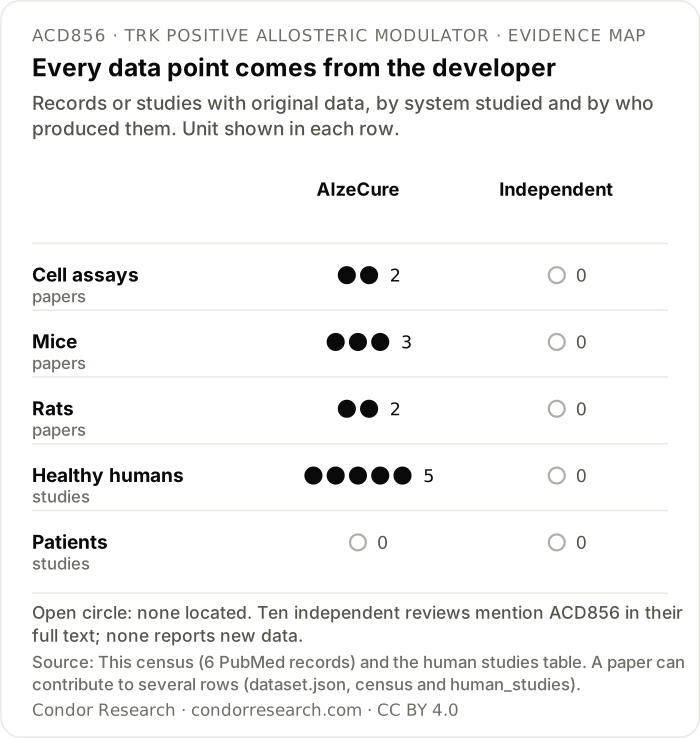
Concentration of authorship. We measure the share of records with at least one AlzeCure author or AlzeCure funding (criterion A) and the share whose first or last author is an AlzeCure employee (criterion B), with the PubMed record as the unit and trials counted separately. Both give 6 of 6. Adding the ten independent reviews that mention ACD856 only in their full text lowers the share to 6 of 16, but none of those reviews reports data. At trial level, 5 of 5 human studies were sponsored by AlzeCure. Contract organisations ran the clinical work and two co-authors of the 2024 phase 1 paper are paid AlzeCure consultants; these are disclosed in the articles.4,21
| Criterion (unit) | Value | Note |
|---|---|---|
| A: any AlzeCure author or funding (record) | 6/6 | Primary data 5/5; human 2/2 |
| B: AlzeCure first or last author (record) | 6/6 | Read from the articles’ author lists |
| Sensitivity: add full-text-only mentions | 6/16 | The 10 independent reviews report no new data |
| Trial level (study) | 5/5 | ACD855 phase 1, ACD856 phase 0, two ACD856 phase 1 studies, phase 1b |
| Independent primary data | 0 | No record, no study |
Table 10. Concentration of authorship with sensitivity analysis.
For context we applied one affiliation-only rule to other programmes: a record counts if any printed affiliation names the originating company. ACD856 scores 6 of 6, against half of the records for fosgonimeton and for osavampator (Table 11). The rule undercounts because PubMed prints affiliations incompletely; LM11A-31 was left out because most of its papers come from its academic inventors.
| Programme | PubMed records (title/abstract) | With originator affiliation | Share |
|---|---|---|---|
| ACD856 | 6 | 6 | 1.00 |
| Fosgonimeton (ATH-1017) | 8 | 4 | 0.50 |
| Osavampator (TAK-653) | 14 | 7 | 0.50 |
Table 11. Same affiliation-only rule across programmes, PubMed on 2026-10-26. Affiliations only, so values are lower bounds. Source: PubMed (analytics.json).
In plain terms. Every study of ACD856 was done or paid for by the company that owns it. That is normal at this stage of drug development, but it means nobody has yet checked the findings independently.
Where ACD856 sits among neurotrophic small molecules
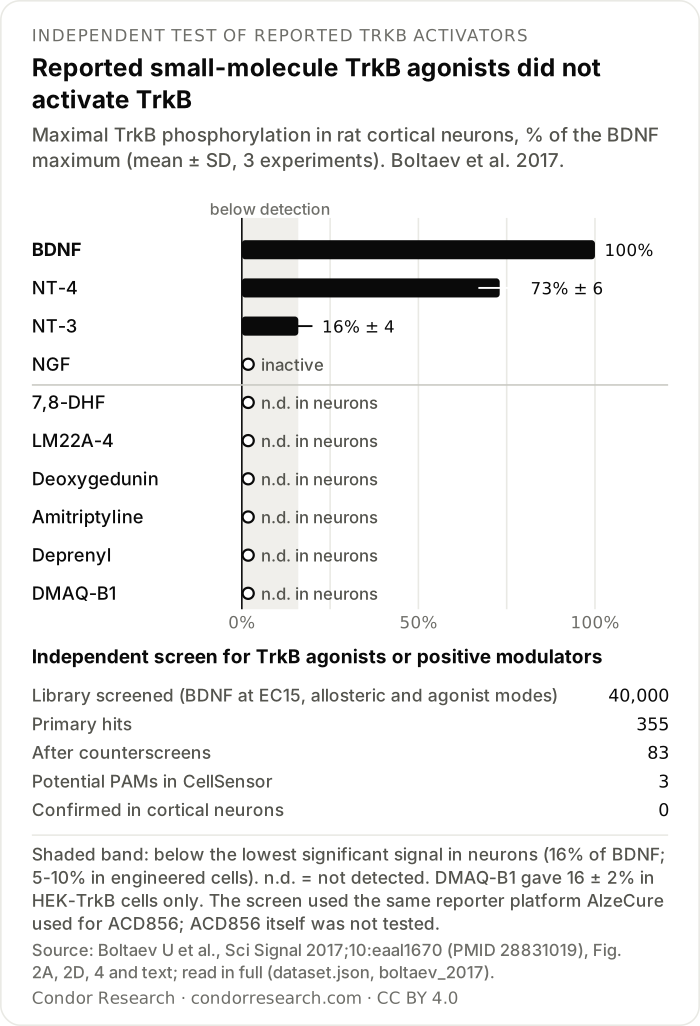
Making small molecules that boost neurotrophin signalling has a difficult record. Two widely used research tools, 7,8-dihydroxyflavone and LM22A-4, were reported as TrkB activators.29,30 In 2017 groups at Columbia University and the Broad Institute retested them, together with deoxygedunin, amitriptyline, deprenyl and DMAQ-B1, using TrkB phosphorylation assays, downstream AKT and ERK measurements and two reporter cell systems, in rat cortical neurons, HEK cells expressing human TrkB and SH-SY5Y cells.31 With BDNF as the 100% reference, NT-4 reached 73% and NT-3 16%, the lowest signal the neuron assay could resolve. None of the reported small molecules produced detectable TrkB phosphorylation in neurons; only DMAQ-B1 gave a weak signal (16% of BDNF) in TrkB-expressing HEK cells, with transient downstream activation (Figure 5).31 An earlier independent group had also failed to confirm 7,8-DHF and LM22A-4, as cited by the 2017 authors.32 AlzeCure’s review cites the 2017 result to distinguish its positive modulators.11
Why this matters for ACD856. The same 2017 study screened 40,000 compounds for TrkB agonists or positive allosteric modulators on the DiscoverX PathHunter reporter, the cell-assay format AlzeCure used to measure ACD856’s potency. The screen gave 355 potential hits; a counterscreen in cells without TrkB reduced them to 83 candidates for further assays; 3 gave a potential signal in a second reporter assay (CellSensor), and none was confirmed as a TrkB activator in cortical neurons, so the study identified no reliable lead.31,9 This does not show that ACD856 is a false positive: AlzeCure reports orthogonal data (receptor phosphorylation in SH-SY5Y cells, ERK phosphorylation in primary neurons, kinase kinetics), and ACD856 was not among the compounds tested in 2017.10,9 It does show why confirmation in native neurons by an independent laboratory is the test the ACD856 cell data have not yet faced.
Two programmes acting on neighbouring neurotrophic systems reached patients with Alzheimer’s disease: LM11A-31, a p75 receptor modulator, met its primary safety endpoint in a phase 2a without significant effects on cognitive tests, and fosgonimeton, a positive modulator of the HGF/MET system, did not meet its primary or secondary endpoints in the phase 2/3 LIFT-AD trial.33,34,35 Eisai’s TrkA modulator E2511 is, like ACD856, in phase 1.11
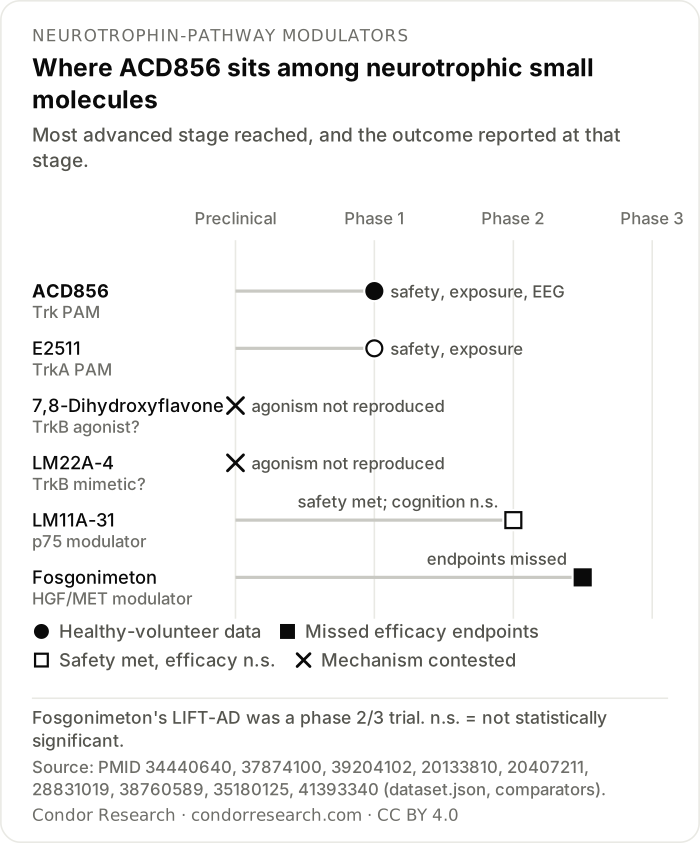
| Compound | Developer | Mechanism | Stage reached | Outcome at that stage | Sources |
|---|---|---|---|---|---|
| ACD856 | AlzeCure Pharma (licensed to QuantumCell, 2026) | Positive allosteric modulator of TrkA, TrkB and TrkC (cell assays); binds the TrkA intracellular domain | Phase 1 / 1b in healthy volunteers | Safety, pharmacokinetics, CSF exposure, qEEG; no efficacy trial | 9,21 |
| E2511 | Eisai | TrkA positive modulator binding the intracellular juxtamembrane region (company data) | Phase 1 | Phase 1 studies in healthy volunteers, as summarised by AlzeCure's review | 11 |
| 7,8-Dihydroxyflavone | Academic (Emory University) | Reported TrkB agonist (binding to the extracellular domain) | Preclinical | Independent test (Columbia and Broad groups, 2017): no reproducible TrkB phosphorylation above the study's threshold in rat cortical neurons, HEK-TrkB or SH-SY5Y cells under the conditions tested, no AKT or ERK activation in neurons, no signal in two reporter assays; also tested across concentrations and time points | 29,31,32 |
| LM22A-4 | Academic (Stanford/UCSF) | Reported BDNF loop-domain mimetic, TrkB partial agonist | Preclinical | Same independent test, compound synthesised in-house: no TrkB phosphorylation, no AKT or ERK activation, no reporter signal | 30,31,32 |
| Deoxygedunin, amitriptyline, deprenyl | Various (reported TrkB activators) | Reported to induce TrkB phosphorylation | Preclinical (amitriptyline and deprenyl are approved drugs for other uses) | Same independent test: no TrkB phosphorylation and no AKT or ERK activation in neurons | 31 |
| DMAQ-B1 | Academic (natural product) | Reported Trk and insulin-receptor activator | Preclinical | Same independent test: weak TrkB phosphorylation in HEK-TrkB cells (16% of BDNF), none detected in neurons; transient ERK and AKT activation in neurons | 31 |
| LM11A-31 | PharmatrophiX | p75 neurotrophin receptor modulator (not a Trk modulator) | Phase 2a in Alzheimer's disease | Met its primary safety endpoint; no significant effect on cognitive tests | 33 |
| Fosgonimeton (ATH-1017) | Athira Pharma | Positive modulator of the HGF/MET system (not Trk) | Phase 2/3 (LIFT-AD) | Did not meet primary or secondary endpoints in mild-to-moderate Alzheimer's disease | 34,35 |
Table 12. Neurotrophin-pathway small molecules compared. Doses omitted. LM11A-31 and fosgonimeton act on neighbouring systems (p75, HGF/MET), not on Trk.
In plain terms. Similar ideas have failed before, either because the molecules did not do what was claimed in the lab or because they did not help patients. ACD856 has not yet reached the stage where that second test happens.
What do the forums claim, and what does the evidence show?
ACD856 is discussed mainly on one Reddit community. Condor Research’s trend file of 25 October 2026 counted 41 organic posts naming it in the last six months against 55 in the six months before; the volume is falling.36 The claims below were collected from public threads as search excerpts and checked against primary sources. Personal regimens posted in threads are not reproduced.
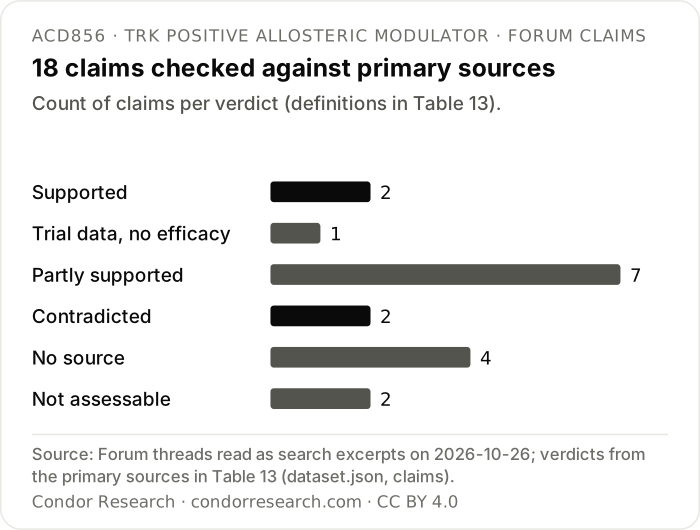
| # | Claim (paraphrased) | Where | Verdict | What the sources show |
|---|---|---|---|---|
| 1 | ACD856 improves memory or cognition in people | Forum threads | No source | No human study has a memory or cognition endpoint. The memory data are from mice and rats; the human trials measured safety, exposure and EEG.9,21 |
| 2 | It raises BDNF levels | Forum threads | Partly supported | In cultured cortical neurons BDNF rose by about 30%, and brain BDNF rose in 21-month-old mice; in 3-month-old mice five days of exposure did not change cortical or hippocampal BDNF. No human BDNF measurement is published.10 |
| 3 | It only amplifies BDNF that is already there, so it cannot overstimulate | Forum threads | Contradicted | The developer reports about 60% TrkA activation without NGF in recombinant cells and calls this partial agonism, while noting it may reflect receptor over-expression.10 |
| 4 | It is selective for Trk receptors | Vendor pages, forums | Partly supported | In the same assays ACD856 was as potent at IGF1R and FGFR1 as at Trk receptors; the authors describe selectivity in efficacy, not potency.9 |
| 5 | It works as an antidepressant / against anhedonia | Forum threads | Partly supported | Antidepressant-like effects in the forced swim test in mice and rats. In the 7-day human trial, mood questionnaires were safety measures in healthy volunteers. No trial in depression is registered.19,10,21 |
| 6 | It reverses age-related memory loss | Forum threads, vendor copy | Partly supported | In 18-month-old mice the change was non-significant at 24 h and significant at 11 days in a passive avoidance task, in one experiment.9 |
| 7 | It is neuroprotective or disease-modifying in Alzheimer's | Company releases, vendor copy | Partly supported | Protection against amyloid-beta and energy deprivation in cultured neurons, from the developer. No human disease-modification data.10 |
| 8 | It crosses into the brain | Forums, company | Partly supported | In the second phase 1 study (24 healthy volunteers, 18 on ACD856), CSF concentrations sampled at steady state rose across cohorts: evidence of exposure in the central nervous system, not a measurement in brain tissue or of Trk engagement.21 |
| 9 | Its half-life is about a day | Forum threads | Supported | Terminal half-life about 19-20 h in the phase 0 and second phase 1 studies.4,21 |
| 10 | It shows target engagement in humans | Company releases | Trial data (efficacy unproven) | qEEG changes graded across two cohorts of six; the authors state these do not allow general conclusions on neuronal activity, and no active control was used.21 |
| 11 | Side effects: drowsiness, brain fog, raised heart rate | Forum reports | Not assessable | Published studies report adverse events, mostly mild (headache most common; 24 possibly related events in 13 of 56 participants in the first phase 1 study), and no serious adverse events within study periods of up to 7 days; forum anecdotes concern unverified material and cannot be assessed.4,21 |
| 12 | Effects fade after weeks (tolerance) | Forum threads | No source | No human study with a study period longer than 7 days has been published.21 |
| 13 | It helps sexual dysfunction | Forum threads | No source | No data in any species located. |
| 14 | It is safer than 7,8-DHF | Forum threads | No source | No head-to-head data. In an independent test, 7,8-DHF produced no detectable TrkB phosphorylation or downstream AKT/ERK activation in neurons or TrkB-expressing cells, so its claimed mechanism is itself unconfirmed.31 |
| 15 | It came from a veterinary drug | Forum threads | Supported | The series started with ponazuril (renamed ACD855), a veterinary antiprotozoal; ACD856 is a follow-up compound.9,4 |
| 16 | It is in phase 2 / close to approval | Forum threads | Contradicted | At the cut-off no phase 2 trial was located in CTIS or ClinicalTrials.gov; the company plans a phase 2a. No regulator has approved it.3,2,8 |
| 17 | The powder sold as ACD856 is the clinical compound | Vendor pages | Not assessable | AlzeCure has not disclosed ACD856's structure; vendors sell a patent example (CAS 2375424-89-6) under the name. The link is plausible but unconfirmed.11,37 |
| 18 | It raises serotonin and dopamine | Forum threads | Partly supported | Rat hippocampal microdialysis: serotonin rose significantly; noradrenaline and dopamine showed trends (company poster).20,19 |
Table 13. Eighteen forum claims set against primary sources. Supported: a primary source states it; Trial data (efficacy unproven): a trial reports results that do not establish benefit; Partly supported: part of the claim matches a primary source, in the species named; Contradicted: a primary source states the opposite; No source: no published or registered data; Not assessable: the literature cannot test it.36
In our reading, the claims that circulate most, better memory and better mood, are the least supported in humans: there is rodent behaviour data and a short safety study in healthy people, and nothing that measured either outcome in people. Of the 18 claims, 2 are supported by a primary source, 7 are partly supported, 1 rests on trial data without proven efficacy, 2 are contradicted, 4 have no source and 2 cannot be assessed. Counting claim 11 as contradicted rather than not assessable changes the totals to 3 contradicted and 1 not assessable.
In plain terms. Forum users report effects on memory and mood. The science so far shows that ACD856 reaches the fluid around the brain and changes the EEG in healthy people, and that it changes behaviour in rodents. It does not show that it improves memory or mood in people.
Who has a financial stake in the outcome?
Direct interests are parties with contractual or ownership rights in ACD856 itself; indirect interests are parties whose stake runs through another entity or through services. Amounts are reproduced as stated by the companies; none is attributed to ACD856 unless the company did so.
| Type | Party | Role | Interest as stated | Source |
|---|---|---|---|---|
| Direct | AlzeCure Pharma AB | Originator, sponsor of every human study, employer of most authors | Licensor under the July 2026 QuantumCell agreement: USD 12 million upfront (USD 5 million of it as an equity investment), milestones and tiered royalties; company states total value above USD 2.2 billion excluding royalties | 7,8 |
| Direct | QuantumCell ApS | Licensee of global rights to the NeuroRestore platform including ACD856 | Development and commercial rights; pays the above terms | 7 |
| Direct | European Innovation Council (EIC Accelerator) | Grant funder of the planned phase 2a | EUR 2.5 million grant (first payment December 2025), with a possible further investment through the EIC Fund | 23,8 |
| Indirect | QuantumCell's owners (Novo Holdings, Forbion, Lundbeck Foundation, First Spark Ventures) | Investors in the licensee, as listed by AlzeCure | Indirect, through QuantumCell; no compound-specific figures disclosed | 8 |
| Indirect | Stiftelsen AlzeCure (AlzeCure Foundation) | Original assignee of the 2017 triazinetrione patent family; author affiliation in the 2021 discovery paper | Indirect; holdings not quantified here | 9 |
| Indirect | Contract organisations: CTC Clinical Trial Consultants, Siesta Group, Suven Life Sciences, Pronexus | Ran trials, qEEG analysis and animal studies; CTC staff co-authored both clinical papers | Fee-for-service; no equity disclosed | 4,21,9 |
| Indirect | Paid consultants | Two co-authors of the 2024 phase 1 paper are paid consultants of AlzeCure | Disclosed in the article | 4 |
Table 14. Financial interests, direct and indirect. Amounts as stated by the companies.
The USD 10 million upfront from Eli Lilly (June 2026) concerns AlzeCure's Alzstatin platform (ACD680), not ACD856, and is excluded.8
In plain terms. AlzeCure and its new licensee stand to gain if ACD856 succeeds, and an EU grant pays for the next trial. That does not make the data wrong; it is why independent replication matters.
What is its regulatory status?
| Jurisdiction | Status at 2026-10-26 | Basis | Source |
|---|---|---|---|
| EU (EMA) | No marketing authorisation or application located | EMA medicines search, 2026-10-26 | 6 |
| United States (FDA) | No approval located | openFDA drugsfda: no match for ACD856 | 5 |
| Sport (WADA) | Not named on the 2026 Prohibited List; an unapproved substance falls under section S0 | WADA 2026 List | 38 |
| Clinical status | Investigational; human data from healthy volunteers only | CTIS and ClinicalTrials.gov | 3,2 |
Table 15. Regulatory status.
In plain terms. ACD856 is an unapproved experimental compound. In sport it falls under the general ban on unapproved substances.
How does this compare with the sources we reviewed?
| Source | What it covers | What this dossier adds |
|---|---|---|
| Wikipedia article ‘ACD856’ (revision of 25 July 2026) | Published pharmacology, history, half-life, phase 1 status | Registry census including the CTIS phase 1b, the unregistered ACD855 study, patents, vendor identity gap, licence terms, own calculations, claims check |
| AlzeCure review, 202411 | Field review by the developer; ACD856 and E2511 phase 1 data | Independent appraisal, authorship concentration, the developer’s own partial-agonism and selectivity data set side by side |
| AlzeCure press releases 2025-202622,7 | Phase 1b topline, licence, grant | What the releases do not give: doses, adverse-event counts, registry status |
| Vendor pages14 | CAS, formula, cell-assay values | Structure provenance, two checkable errors, absence of developer confirmation |
| Forum threads36 | User reports | Each claim checked against primary sources |
Table 16. Comparison with the sources reviewed for this dossier, not a ranking of all sources.
What this literature allows, and does not allow, us to say
- ACD856 positively modulates TrkA, TrkB and TrkC signalling in engineered cells, as reported by its developer; it is about as potent at the IGF1 receptor and FGFR1 and shows partial agonism at TrkA in over-expressing cells.
- In mice and rats it changes performance in memory and forced-swim tasks; these are developer studies with group sizes of 6 to 12 animals.
- In 86 healthy volunteers across three published studies with study periods of up to seven days, adverse events occurred, mostly mild (in the first phase 1 study, 24 events in 13 of 56 participants judged possibly related), and no serious adverse event was reported. Zero serious events among the 60 people with pharmacological exposure still allows a serious event affecting up to about 1 in 20.
- It reaches the cerebrospinal fluid and changes resting EEG in a way graded across cohorts of six; the authors read this as a sign of central target engagement, an exploratory pharmacodynamic signal, and note that it allows no general conclusions on neuronal activity. Neither measure shows Trk binding in brain tissue.
- No study has measured memory, cognition or mood as an outcome in humans, and no study has enrolled patients.
- No independent group has published original data on ACD856.
- The chemical identity of ACD856 has not been disclosed; the structure sold under the name is an attribution, not a confirmed identity.
What is not known
- ACD856’s structure, and whether it is the compound sold as CAS 2375424-89-6. A disclosure by AlzeCure or QuantumCell, or an INN application, would settle it.
- Whether the TrkA activity without NGF occurs in cells with natural receptor levels, which bears directly on the “only amplifies existing signal” argument.
- What IGF1 receptor and FGFR1 modulation at similar potency means for longer exposure; no study longer than seven days in humans has been published.
- The phase 1b results: doses, adverse events and CSF data have not been published.
- The design, endpoints and size of the planned phase 2a, and whether QuantumCell will run it.
- Whether any independent laboratory can reproduce the Trk potentiation with the clinical compound in native neurons; an independent 2017 screen on the same reporter platform found no hit that survived that step.
- Whether the qEEG change predicts any effect on cognition in patients.
Answer to the central question
The evidence establishes that ACD856, as produced by AlzeCure, potentiates Trk receptor signalling in cells, alters rodent behaviour, and in short published studies of healthy volunteers produced mostly mild adverse events and no serious one, reaches the cerebrospinal fluid and changes the EEG. All of it comes from the developer and its contractors. It does not establish any cognitive or mood effect in people, and no patient has been studied. Whether the powder sold as ACD856 is the tested molecule cannot be determined from public information: the developer has not disclosed the structure, and vendors sell a compound from its patent that is plausible but unconfirmed, with at least one vendor quoting a formula incompatible with its own CAS number.
Methods
Names first. Searches used ACD856, ACD-856 and “ACD 856”. No INN, USAN or CAS number assigned by the developer was located; the vendor CAS number was used only to identify the catalogue structure, not to count literature. ACD855 and ponazuril were searched separately to reconstruct the history.12
PubMed. Query through NCBI E-utilities on 2026-10-26: "ACD856"[tiab] OR "ACD-856"[tiab] OR "ACD 856"[tiab], 6 records. The same terms in all fields returned 12 records, of which the 6 additional ones were false matches on “ACD” and “856”. A search by AlzeCure affiliation (32 records) added no record naming ACD856. Every cited PMID was re-verified with esummary at build time.
Europe PMC. Full-text search for the same names (21 hits): the 6 census records, 2 preprints of them, 10 independent reviews that name ACD856 only in their full text, 2 conference abstract books and 1 false match on a DOI string. The reviews are listed in the dataset and not counted as evidence.
Registries. ClinicalTrials.gov API v2 with each name, as intervention, by sponsor “AlzeCure”, and for ACD855 (3 ACD856 records; 0 for ACD855). A search for ponazuril returned 8 unrelated device trials because the registry expands the brand name “Marquis”. EU CTIS public API with ACD856, ACD-856, ACD855, AlzeCure and NeuroRestore (1 record). EU Clinical Trials Register by sponsor (1 record, a different compound; adult phase 1 trials are not displayed). All on 2026-10-26.2,3,28
Comparator literature read in full. Boltaev et al. 2017 (Science Signaling) was read in full from a copy purchased by Condor Research; figures from it are taken from its Figure 2A, Figure 4 and text. Other comparator records were read from open-access full texts or, where noted, abstracts.31
Company, patent and regulatory documents. AlzeCure press releases and interim reports 2025-2026; the AAIC 2021 poster on the company site; Google Patents for five WO families (retrieved through a scraping service because direct requests were refused); PubChem; openFDA; EMA; the WADA 2026 List. No paywall was bypassed and no unofficial copy used.
Classification and double coding. Each record was coded for evidence type, origin and data role from the full text (open access for 5 of 6; the sixth read from the publisher’s page). Because the census has fewer than 40 records, all six were double-coded: coder 1 froze manual codes; coder 2 was a set of deterministic rules, written before comparison, applied only to PubMed metadata. Agreement was 100% on all three variables (Table 17). Kappa is 1.00 for evidence type and data role and undefined for origin, because both coders put every record in one category. Perfect agreement on six clear-cut records shows consistency, not robustness on harder cases; the second coder is a rule set, not an independent human.
Independent blind recoding. A third coder from a different model family (Codex), without access to our files or labels, ran its own PubMed search (“ACD856” OR “ACD-856”, all fields, 26 October 2026), retrieved the same six records and coded them from titles, abstracts and affiliations: agreement 6/6 on evidence type (three animal, two human, one review) and 6/6 on origin (all developer-linked). The search coverage and the codes therefore do not depend on our own reading.
Vendors. Six public catalogue pages were read without purchase or account; they are anonymised here and their URLs are kept internally. Masses and ions were computed with RDKit from PubChem structures.
Own analyses. Exact Clopper-Pearson one-sided 95% bounds for zero events; minimum detectable standardised paired effect with the noncentral t distribution (n = 6, 80% power). Assumptions are stated with each result.
Forum claims. Web-search excerpts of public threads on 2026-10-26; Reddit was not queried directly. Claim prevalence was not measured; post volume comes from the existing Condor Research trend file.36
Limitations. All mechanistic and clinical figures come from the developer. Patent legal status is as displayed by Google Patents and is not a legal opinion. “Not located” means not found in the named sources at 2026-10-26.
| Variable | Agreement | Cohen's kappa | n |
|---|---|---|---|
| evidence_type | 100% | 1.0 | 6 |
| origin | 100% | undefined (one category) | 6 |
| data_role | 100% | 1.0 | 6 |
Table 17. Double coding of the whole census (coder 2: deterministic rules on PubMed metadata).
Data and code. The dataset (dataset.json, CC BY 4.0) contains the census with codes, full-text mentions, human studies, registration lags, patent families, identity calculations, anonymised vendor data, comparators, claims, financial interests, the safety and EEG calculations, the search log, the changelog and a data dictionary. Editorial standards: editorial policy. Related: TAK-653 (osavampator) evidence dossier and the Research Use Only disclaimer.
Glossary
- Neurotrophins (NGF, BDNF): proteins that support the survival and plasticity of nerve cells.
- Trk receptors (TrkA, TrkB, TrkC): the receptor kinases that neurotrophins activate; NGF acts mainly on TrkA, BDNF on TrkB.
- Positive allosteric modulator (PAM): a molecule that binds away from the main site and strengthens a receptor’s response to its natural signal.
- Partial agonism: activating a receptor to some degree without the natural signal.
- EC50: the concentration giving half of the maximal effect in an assay.
- Triazinetrione: a molecule containing a six-membered ring of three carbon and three nitrogen atoms with three carbonyl groups.
- Phase 0 study: a first study in people with sub-pharmacological exposure, used to measure how the body handles a compound.
- Phase 1 study: an early study of safety and of how the body handles a compound, usually in healthy volunteers.
- Half-life: the time for the concentration in plasma to fall by half.
- qEEG: quantitative analysis of brain electrical activity recorded from the scalp.
- Forced swim test: a rodent test used to screen for antidepressant-like activity.
- CTIS: the EU Clinical Trials Information System, the public register for trials under the EU Clinical Trials Regulation.
- Upper 95% bound: the highest event frequency still compatible with observing no events, at 95% confidence.
- Research Use Only (RUO): material supplied for laboratory research, not for human or veterinary use.
How to cite, version and changes
Condor Research Editorial. ACD856 Evidence Card, version 1.1, data cut-off 26 October 2026. https://condorresearch.com/research/acd856-evidence-card/
Version 1.1 (26 October 2026). Boltaev et al. 2017 read in full: comparator rows for 7,8-dihydroxyflavone and LM22A-4 made specific; deoxygedunin, amitriptyline, deprenyl and DMAQ-B1 added; Figure 5 added; the link between that study’s screen and the assay platform used for ACD856 stated; Todd et al. 2014 cited.
Version 1.0 (26 October 2026). First version.
Declaration of interest
Condor Research sells research-use-only compounds, including nootropic research compounds. It does not sell ACD856. Its catalogue contains an unpublished draft listing for 7,8-dihydroxyflavone, a comparator in Table 12, not offered for sale at the cut-off. No party named on this page reviewed or paid for it. Prepared by Condor Research Editorial.
References
- Condor Research census of PubMed records, this dossier (dataset.json). Source. Accessed 26 October 2026.
- ClinicalTrials.gov API v2, queries ACD856, ACD-856, ACD855, AlzeCure (sponsor), retrieved 2026-10-26. Source. Accessed 26 October 2026.
- EU Clinical Trials Information System, trial 2025-522287-32-00 (public API record). Source. Accessed 26 October 2026.
- Nilsson B, Bylund J, Halldin MM et al. ACD856, a novel positive allosteric modulator of Trk receptors, single ascending doses in healthy subjects: Safety and pharmacokinetics. Eur J Clin Pharmacol. 2024;80(5):717-727. PMID 38353689. DOI 10.1007/s00228-024-03645-1.
- openFDA drugsfda endpoint, search ACD856, 2026-10-26: no matches. Source. Accessed 26 October 2026.
- European Medicines Agency, medicines search, 2026-10-26: no ACD856 entry. Source. Accessed 26 October 2026.
- AlzeCure Pharma. AlzeCure Pharma enters an out-licensing and collaboration agreement with QuantumCell ApS for the NeuroRestore ACD856 project. Press release, 1 July 2026. Source. Accessed 26 October 2026.
- AlzeCure Pharma. Interim report April-June 2026. Source. Accessed 26 October 2026.
- Dahlström M, Madjid N, Nordvall G et al. Identification of Novel Positive Allosteric Modulators of Neurotrophin Receptors for the Treatment of Cognitive Dysfunction. Cells. 2021;10(8). PMID 34440640. DOI 10.3390/cells10081871.
- Parrado Fernandez C, Juric S, Backlund M et al. Neuroprotective and Disease-Modifying Effects of the Triazinetrione ACD856, a Positive Allosteric Modulator of Trk-Receptors for the Treatment of Cognitive Dysfunction in Alzheimer's Disease. Int J Mol Sci. 2023;24(13). PMID 37446337. DOI 10.3390/ijms241311159.
- Forsell P, Parrado Fernández C, Nilsson B et al. Positive Allosteric Modulators of Trk Receptors for the Treatment of Alzheimer's Disease. Pharmaceuticals (Basel). 2024;17(8). PMID 39204102. DOI 10.3390/ph17080997.
- PubChem. CID 139434107 (IGF-1R modulator 1, CAS 2375424-89-6) and CID 3050408 (ponazuril). Name search 'ACD856' and 'ACD-856': no record. Source. Accessed 26 October 2026.
- Nordvall G, Forsell P. Triazine derivatives for treating diseases relating to neurotrophins. WO2019162702A1. Source. Accessed 26 October 2026.
- Six public vendor catalogue pages read on 2026-10-26; anonymised, URLs held by Condor Research Editorial. Source. Accessed 26 October 2026.
- Nordvall G, Forsell P, Sandin J. Triazinetrione derivatives and their use as modulators of neurotrophin receptor and receptor tyrosine kinases. WO2018115891A1. Source. Accessed 26 October 2026.
- Nordvall G, Forsell P. 4-substituted phenyl-1,3,5-triazine derivatives as modulators of Trk receptors. WO2020002949A1. Source. Accessed 26 October 2026.
- Nordvall G, Forsell P. 4-substituted phenyl-1,3,5-triazine derivatives as modulators of Trk receptors. WO2020002950A1. Source. Accessed 26 October 2026.
- Nordvall G, Forsell P. Triazine derivatives for treating diseases relating to neurotrophins. WO2021038241A1. Source. Accessed 26 October 2026.
- Madjid N, Lidell V, Nordvall G et al. Antidepressant effects of novel positive allosteric modulators of Trk-receptor mediated signaling – a potential therapeutic concept?. Psychopharmacology (Berl). 2023;240(8):1789-1804. PMID 37394539. DOI 10.1007/s00213-023-06410-x.
- Nordvall G, Madjid N, Backlund M, et al. ACD856, a novel positive allosteric modulator of Trk-receptors in clinical development for the treatment of Alzheimer's disease. Poster, AAIC 2021 (company copy). Source. Accessed 26 October 2026.
- Önnestam K, Nilsson B, Rother M et al. Safety, Tolerability, Pharmacokinetics and Quantitative Electroencephalography Assessment of ACD856, a Novel Positive Allosteric Modulator of Trk-Receptors Following Multiple Doses in Healthy Subjects. J Prev Alzheimers Dis. 2023;10(4):778-789. PMID 37874100. DOI 10.14283/jpad.2023.89.
- AlzeCure Pharma. Positive results from the Phase Ib clinical study of NeuroRestore ACD856. Press release, 16 June 2026. Source. Accessed 26 October 2026.
- AlzeCure Pharma. AlzeCure receives payment of EU grant for Phase 2 clinical trial with NeuroRestore ACD856. Press release, 3 December 2025. Source. Accessed 26 October 2026.
- ClinicalTrials.gov NCT05077631, first phase 1 study of ACD856. Source. Accessed 26 October 2026.
- ClinicalTrials.gov NCT05077501, second phase 1 study of ACD856. Source. Accessed 26 October 2026.
- ClinicalTrials.gov NCT05783830, phase 0 study of ACD856. Source. Accessed 26 October 2026.
- AlzeCure Pharma. Last patient has completed AlzeCure's Phase Ib clinical study with NeuroRestore ACD856. Press release, 20 April 2026. Source. Accessed 26 October 2026.
- EU Clinical Trials Register search 'AlzeCure' (1 result, ACD440); the register does not display adult-only phase 1 trials. Source. Accessed 26 October 2026.
- Jang SW, Liu X, Yepes M et al. A selective TrkB agonist with potent neurotrophic activities by 7,8-dihydroxyflavone. Proc Natl Acad Sci U S A. 2010;107(6):2687-92. PMID 20133810. DOI 10.1073/pnas.0913572107.
- Massa SM, Yang T, Xie Y et al. Small molecule BDNF mimetics activate TrkB signaling and prevent neuronal degeneration in rodents. J Clin Invest. 2010;120(5):1774-85. PMID 20407211. DOI 10.1172/JCI41356.
- Boltaev U, Meyer Y, Tolibzoda F et al. Multiplex quantitative assays indicate a need for reevaluating reported small-molecule TrkB agonists. Sci Signal. 2017;10(493). PMID 28831019. DOI 10.1126/scisignal.aal1670.
- Todd D, Gowers I, Dowler SJ et al. A monoclonal antibody TrkB receptor agonist as a potential therapeutic for Huntington's disease. PLoS One. 2014;9(2):e87923. PMID 24503862. DOI 10.1371/journal.pone.0087923.
- Shanks HRC, Chen K, Reiman EM et al. p75 neurotrophin receptor modulation in mild to moderate Alzheimer disease: a randomized, placebo-controlled phase 2a trial. Nat Med. 2024;30(6):1761-1770. PMID 38760589. DOI 10.1038/s41591-024-02977-w.
- Hua X, Church K, Walker W et al. Safety, Tolerability, Pharmacokinetics, and Pharmacodynamics of the Positive Modulator of HGF/MET, Fosgonimeton, in Healthy Volunteers and Subjects with Alzheimer's Disease: Randomized, Placebo-Controlled, Double-Blind, Phase I Clinical Trial. J Alzheimers Dis. 2022;86(3):1399-1413. PMID 35180125. DOI 10.3233/JAD-215511.
- Porsteinsson AP, Sabbagh M, Tariot PN et al. Fosgonimeton in mild-to-moderate Alzheimer's disease. J Alzheimers Dis Rep. 2025;9:25424823251405817. PMID 41393340. DOI 10.1177/25424823251405817.
- Public forum threads (r/NooTopics, r/cognitivescience, r/PSSD, r/NootropicsDepot) read as web-search excerpts on 2026-10-26; volume from Condor Research's Reddit trend file of 25 October 2026. Personal regimens are not reproduced. Source. Accessed 26 October 2026.
- Kargbo RB. Modulation of Tropomyosin Receptor Kinase for the Treatment of Neurotrophin Diseases: Alzheimer's, Huntington's and Parkinson's. ACS Med Chem Lett. 2019;10(12):1590-1591. PMID 31857832. DOI 10.1021/acsmedchemlett.9b00506.
- World Anti-Doping Agency. 2026 Prohibited List (section S0, non-approved substances). Source. Accessed 26 October 2026.
What is ACD856?
ACD856 is an investigational small molecule from AlzeCure Pharma described as a positive allosteric modulator of the TrkA, TrkB and TrkC receptors, which respond to the growth factors NGF, BDNF and NT-3. It belongs to the triazinetrione class and followed ACD855 (the veterinary drug ponazuril). It is not approved anywhere.
Has ACD856 been tested in humans?
Only in healthy volunteers. Published studies cover 86 participants (a phase 0 study and two phase 1 studies); a phase 1b with 40 participants ended in April 2026 and has been reported only by press release. No study in patients was registered at 26 October 2026.
Does ACD856 improve memory in people?
That has not been studied. Memory effects come from developer experiments in mice and rats. The human studies measured safety, drug levels, spinal-fluid exposure and EEG, not memory or mood.
Is the ACD856 sold online the same compound AlzeCure tested?
It cannot be confirmed. AlzeCure has not disclosed ACD856's chemical structure. Vendors sell CAS 2375424-89-6, a compound from one of AlzeCure's patents; the link is plausible but not confirmed by the developer, and one vendor quotes a formula incompatible with that CAS number.
Is there independent research on ACD856?
No independent original data were located. All six PubMed records naming ACD856 and all five human studies come from AlzeCure; ten independent reviews mention it but report no new data.