
R-(-)-BPAP: Evidence Card. A Literature, Patent and Registry Dossier
R-(-)-BPAP dossier: 61 records, 93.5% of primary work by the developers, one 10-patient EudraCT trial, and the rat lifespan cohort recalculated.
R-(-)-BPAP dossier: 61 records, 93.5% of primary work by the developers, one 10-patient EudraCT trial, and the rat lifespan cohort recalculated.
R-(-)-BPAP is a small synthetic amine, a benzofuran ring attached to a short propylamino-pentane chain, selected from 65 newly synthesised relatives of a selegiline-derived compound by the Hungarian pharmacologist Joseph Knoll and the Japanese company Fujimoto Pharmaceutical (first patent priority August 1997, first pharmacology paper 1999). Its developers describe it as an “enhancer”: a substance said to amplify the release of noradrenaline, dopamine and serotonin only when nerve cells fire. This page is a literature, patent and registry dossier written for researchers, not information for consumers. It counts every record we could locate up to 26 October 2026: 50 publications and 11 patent families. Almost all of the primary research carries an author from the two developing institutions. One study in people exists, registered only in the European trials register, with ten participants, no placebo and results posted fifteen years after it ended. The receptor most often named online, TAAR1, has been linked to BPAP only indirectly, by one group, in rat brain slices.
Version 1.1, 26 October 2026. Condor Research Editorial. Last reviewed: 26 October 2026. Counts, identifiers, registry entries and regulatory status were checked against primary databases on that date; literal queries are in the method note, and the classified census can be downloaded as dataset.json (CC BY 4.0). Research Use Only: nothing on this page describes or supports use in humans.
Central question. What does the published and registered record on R-(-)-BPAP actually contain, who produced it, and which of the statements that circulate about it are supported by primary sources?
What does the record on R-(-)-BPAP consist of?
Evidence level, in one line: a preclinical programme in rats, mice and cells, run almost entirely by the developing group and its corporate partner, plus one uncontrolled, unpublished ten-patient study known only from a registry.
| Measure (unit) | Condor census, 26 Oct 2026 |
|---|---|
| Records located (record) | 61: 50 literature records and 11 patent families |
| Literature records indexed in PubMed (record) | 47 of 50 |
| Primary studies with original data on BPAP (record) | 31: 14 animal, 7 ex vivo, 6 in vitro, 1 animal pharmacokinetic, 2 chemistry, 1 computational |
| Reviews and commentary by the developers’ group (record) | 13 |
| Passing mentions by unaffiliated authors (record) | 6 |
| Peer-reviewed publications reporting data from people (publication) | 0 |
| Registered human studies (registry entry) | 1: EudraCT 2006-000361-11, 10 participants, summary results posted 2022 |
| Primary records with a developer co-author (record) | 29 of 31 (93.5%); sensitivity 45.2% to 100% |
| Primary studies read in full (record) | 13 of 31 (4 open access, 9 purchased); the rest in abstract |
| Full-text primary papers that name a compound source, naming Fujimoto (paper) | 11 of 11 that name one; the other 2 are Fujimoto’s own synthesis papers |
| Classification agreement with a second, rule-based coder (47 PubMed records) | Evidence type 80.9%, kappa 0.75 |
The Condor Evidence Card for R-(-)-BPAP, version 1.1. Publications, registry entries and patent families are counted separately and never mixed in one figure. Sources: census.json; EU Clinical Trials Register; PubMed E-utilities. Checked 2026-10-26.89
93.5% of the 31 primary studies on BPAP have at least one author from the Knoll-Miklya group at Semmelweis University or from Fujimoto Pharmaceutical. This measures co-authorship, not control of the data.
10 people took part in the only human study located. It had no placebo group, its results were posted on a registry fifteen years after it ended, and no journal article reports it.
40 of 399 PubMed records that contain “BPAP” in the title or abstract are about this compound. The rest concern bilevel airway pressure, bisphenol AP and four other meanings of the acronym.
In plain terms: BPAP has been studied for a quarter of a century, but nearly all of that work comes from the people who invented it and the company that patented it, and almost all of it is in animals. Only ten people have ever received it in a registered study, and the outcome was never published in a journal.
What exactly is R-(-)-BPAP, and what is it not?
BPAP is 1-(1-benzofuran-2-yl)-N-propylpentan-2-amine. It has one stereocentre. The compound studied in the literature is the laevorotatory enantiomer, whose absolute configuration was shown by X-ray crystallography in 2001 to be R; the developers’ own papers write it as (-)-BPAP, R-(-)-BPAP or, from 2016, (2R)-1-(1-benzofuran-2-yl)-N-propylpentane-2-amine.375 It came out of a structure-activity series in which the phenyl ring of (-)-PPAP, a selegiline-derived amine without monoamine oxidase inhibition, was replaced by other aromatic rings; of 65 new compounds, the benzofuran analogue was selected.3438 Fujimoto’s development code for the hydrochloride is FPFS-1169.39
The full structure-activity paper lets the selection be checked. Its four tables itemise 52 racemic analogues (17 phenyl, furyl and thienyl, 11 methylenedioxyphenyl, 14 naphthyl and 10 indolyl, benzothienyl or benzofuryl compounds), and the four most active racemates were separated into 8 enantiomers by chiral HPLC: 60 substances in all, against the 65 stated in 1999; the remainder are not itemised in either paper. The ranking test was a single rat behavioural screen, reversal of a tetrabenazine-induced learning deficit in a shuttle box, in which (-)-BPAP was about 100 times as potent as PPAP and about 130 times as potent as selegiline.4 The synthesis paper reports (-)-BPAP as about 50 times or more as potent as its (+)-enantiomer in that programme.37 In short, the choice rests on one assay in one species; transporter, receptor and pharmacokinetic data came afterwards.
| Molecule | PubChem | Formula | Average MW (g/mol) | Monoisotopic mass of the base (Da) | [M+H]+ (m/z) | InChIKey |
|---|---|---|---|---|---|---|
| (R)-(-)-BPAP free base | CID 9816303 | C16H23NO | 245.37 | 245.178 | 246.1852 | LJHIBIVAYHQPBT-CQSZACIVSA-N |
| (S)-(+)-BPAP free base | CID 67426312 | C16H23NO | 245.37 | 245.178 | 246.1852 | LJHIBIVAYHQPBT-AWEZNQCLSA-N |
| BPAP, stereochemistry undefined (racemate) | CID 9859674 | C16H23NO | 245.37 | 245.178 | 246.1852 | LJHIBIVAYHQPBT-UHFFFAOYSA-N |
| (R)-(-)-BPAP hydrochloride (FPFS-1169) | CID 11984587 | C16H24ClNO | 281.83 | 245.178 | 246.1852 | GKKNDWKXWAVGOK-PFEQFJNWSA-N |
| 3-F-BPAP (antagonist analogue) | CID 10125543 | C16H20F3NO | 299.34 | 299.1497 | 300.157 | JCZRCOLYSDAPPW-UHFFFAOYSA-N |
| 1-phenyl-2-propylaminopentane (PPAP), stereo undefined | CID 10262369 | C14H23N | 205.34 | 205.183 | 206.1903 | PBENSVGEGPJNFJ-UHFFFAOYSA-N |
Computed identity with RDKit 2026.09.1; formulas checked against PubChem. The R, S and racemic forms share every value except the InChIKey stereo block.
Five naming problems change what a search returns or what a label means.
- “BPAP” is not unique. A PubChem name lookup for “BPAP” returns bisphenol AP, an industrial bisphenol.40 In PubMed, BPAP also abbreviates bilevel positive airway pressure, benzoyl-Phe-Ala-Pro (an enzyme substrate), bicyclic polyprenylated acylphloroglucinols and back-propagating action potentials (Figure 5).
- “(-)PPAP” is two different molecules. The selegiline-derived template of BPAP is (-)-1-phenyl-2-propylaminopentane. A 1990 paper uses “(-)PPAP” for N-(3-phenylpropyl)-1-phenyl-2-aminopropane, an unrelated sigma-receptor ligand (C18H23N, versus C14H23N).41
- Stereochemistry is often dropped. PubChem holds separate records for R (CID 9816303), S (CID 67426312) and the undefined-stereo form (CID 9859674); the undefined record carries the synonym “(-)1-(benzofuran-2-yl)-2-propylaminopentane”, which belongs to the R record.424344 A 2011 chapter by the developers states that the neuron-culture experiment in the first 1999 paper used racemic BPAP, while the paper’s title names (-)-BPAP; the paper’s abstract writes “BPAP”, without the stereodescriptor, for that experiment only. Knoll’s 2012 book, which we read in full, says the same: “in this early study we worked with racemic BPAP”.11345
- Base and salt carry different CAS numbers. The free base is CAS 260550-89-8; the hydrochloride is CAS 265130-22-1. The hydrochloride weighs 14.9% more per mole: the free base is 87.1% of the salt’s mass (identity.json).
- It is not a peptide. Several affiliate pages title it “BPAP peptide”. It has no amino acids.
The mass point matters analytically. R, S and racemic BPAP have identical exact mass, protonated ion (m/z 246.1852) and two-dimensional descriptors. A purity value obtained by achiral LC-MS or HPLC-UV therefore says nothing about which enantiomer, or what mixture, is present. Only a chiral separation or an optical-rotation measurement can, and optical rotation is a weak test here. The published specific rotations of the two hydrochlorides in methanol are small: -4.08 and -4.23 for R, +4.01 and +5.11 for S, measured at different concentrations in the two papers.437 On the first R value, a sample containing 10% of the S-enantiomer would read about -3.3, and one containing 25% about -2.0 (reanalysis.json): differences of the same order as the spread between the two published S values. A chiral HPLC method, which both developer papers used to separate the enantiomers, is the more informative check.
What public product pages state
| Seller | Type | Stereochemistry stated | Salt stated | CAS shown | Molecular weight shown | Form | Documentation on page |
|---|---|---|---|---|---|---|---|
| Vendor A | consumer research-chemical shop | (-) / R stated | not stated | 260550-89-8 (free base) | free-base value | liquid solution | COA shown on page |
| Vendor B | consumer research-chemical shop | (-) stated | not stated | 260550-89-8 (free base) | free-base value | liquid and solid forms | COA linked; purity by LC-MS |
| Vendor C | consumer research-chemical shop | not stated | not stated | not stated | not stated | liquid solution | COA shown on page |
| Vendor D | consumer research-chemical shop | (-) stated | not stated (its own library page says 'usually the hydrochloride') | 260550-89-8 (free base) | free-base value | liquid and solid forms | COA mentioned |
| Vendor E | laboratory reagent supplier | (R)-(-) | hydrochloride | 265130-22-1 (HCl) | salt value | powder | purity >=98%; listed under a 'Bcl-2 stimulant' target |
What five public product pages state about identity, read on 26 October 2026. Sellers are anonymised; the URLs are kept in Condor’s internal file. We did not test any material. Condor Research does not sell BPAP.
In our reading of these pages, three of the four consumer sellers show the free-base CAS number and the free-base molecular weight without stating whether the product is the base or the hydrochloride; one of them has a separate library page saying BPAP is “usually” supplied as the hydrochloride. One consumer seller states no stereochemistry, CAS number or formula at all. The one purity method named, LC-MS, cannot confirm the enantiomer. The laboratory reagent supplier lists the R-hydrochloride under a “Bcl-2 stimulant” target, a label that traces to a single 2004 cell study, not to the compound’s primary pharmacology.21 We did not obtain or test any material.
In plain terms: “BPAP” can mean several unrelated things, and even for the right molecule a label may not say which mirror-image form is inside or whether the weight given is for the salt or the free base. Standard purity tests cannot tell the mirror-image forms apart.
How did BPAP get from a selegiline analogue to a research chemical?
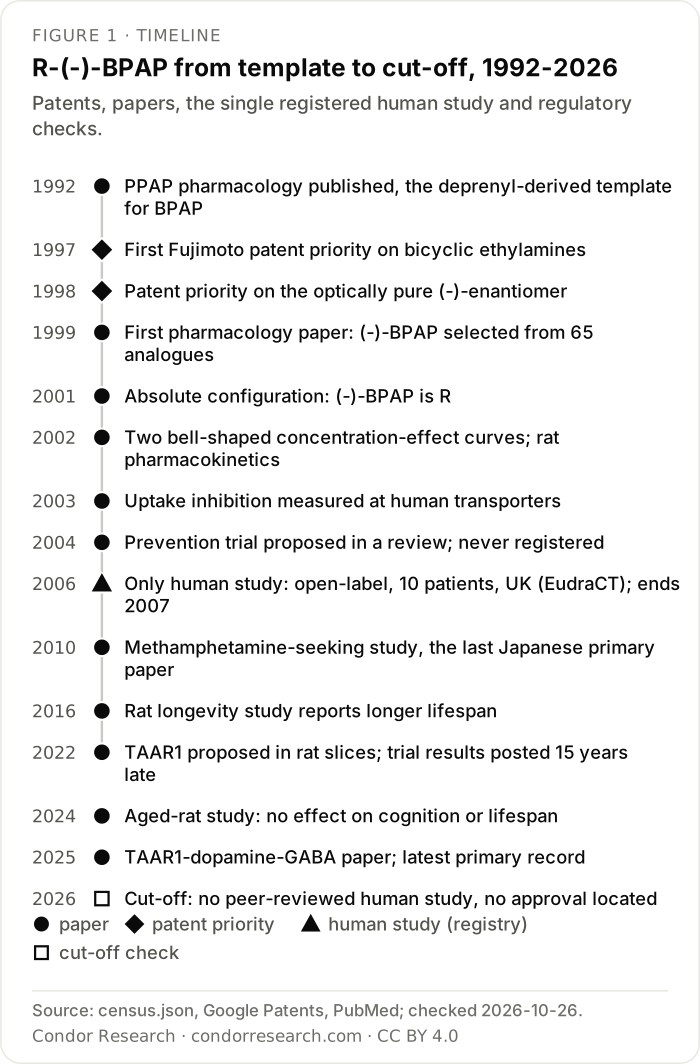
Knoll’s group had described (-)-PPAP in 1992 as a selegiline relative that stimulated catecholamine neurons without inhibiting monoamine oxidase.38 Fujimoto filed the first patent on the bicyclic class in August 1997 and a patent on the optically pure (-)-enantiomer, “substantially free from the (+)-isomer”, in October 1998.3132 The first pharmacology paper appeared in 1999.3 Between 2000 and 2005 the two partners published most of what is known: synthesis, structure-activity data, a radiolabel study in rats, transporter assays, astrocyte and neuroblastoma experiments, and behavioural tests.3722131921 In 2004 two reviews by Miklya and Gaszner proposed controlled human studies; no registration of either was located.4647
Fujimoto then ran one human study in the United Kingdom (2006-2007) and kept filing patents on new uses and formulations until 2014: substance dependence, a formulation, attention-deficit/hyperactivity disorder and, with Semmelweis University, cancer. These are patent subjects, not products or uses that have been developed or validated.833343536 Japanese primary publications stop in 2010.48 From 2014 every primary record comes from the Semmelweis group and collaborators: a rat longevity study, a tumour-manifestation study, xenografts, stress and anxiety models, the TAAR1 experiments and an aged-rat study with a null result.561817 Knoll died before the 2020 memorial article written by his colleagues.49
Patent families
| Priority | Applicant | Inventors (selection) | Subject | Family members listed |
|---|---|---|---|---|
| 1997-08-07 | Fujimoto Brothers | Yoneda F; Knoll J | Ethylamine derivatives with bicyclic rings (benzofuran class)31 | WO1999007667A1; HU228759B1; IL129322A; SI9820009A |
| 1998-10-29 | Fujimoto Brothers | Yoneda F; Knoll J | Optically active (-)-BPAP, substantially free of the (+)-isomer32 | WO2000026204A1; US6391914B1; EP1052259; CA2317036C; JP2000136187A |
| 2000-04-11 | Fujimoto | Yoneda F; Oka T; Watanabe M; Yasusa T | Process for optically active aminopentane derivatives | WO2001077074; JP2001294583A; AU4474201A |
| 2001-09-14 | Fujimoto | Yoneda F; Knoll J | Trifluoropropylaminopentane derivative (3-F-BPAP) | JP2003081960A |
| 2001-09-19 | Fujimoto | Yoneda F; Knoll J | Apoptosis inhibitor | JP2003089695A; JP2003089643A |
| 2004-11-25 | Fujimoto | Yamamoto T; Yoneda F | Use against substance dependence (relapse)33 | US8318799B2; EP1815853; CA2589289C; IL183028; KR20070091610 |
| 2005-06-28 | Fujimoto | Yoneda F; Watanabe M | Process and intermediates for the optically active compound | US7807840B2; US8178686B2; EP1905760B1; CA2612290C; AU2006263167 |
| 2007-06-21 | Fujimoto | Yoneda F; Ohde H; Hoshino N | Formulation34 | WO2008156160A1; EP2158908B1; US20100137429A1; CA2690945C; CN101677988A; JP5754885B2 |
| 2013-12-25 | Fujimoto | Togashi H; Hiraide S | Attention-deficit/hyperactivity disorder use35 | WO2015098591A1; AU2014371437B2; CN106163514A |
| 2014-12-05 | Fujimoto; Semmelweis University | Knoll J; Miklya I | Tumour-manifestation suppression (family 1)36 | WO2016088111A1; US10258598B2; EP3226851B1; CN107205966A |
| 2014-12-05 | Fujimoto; Semmelweis University | Knoll J; Miklya I | Tumour-manifestation suppression (family 2) | WO2016088112A1; US10258599B2; EP3226852B1; RU2714893C2; JP6875278B2 |
Eleven patent families naming BPAP or its synthesis, located through Google Patents and Europe PMC on 26 October 2026. Members are as listed by Google Patents; legal status was read only for the records cited. Families, not documents, are counted.
In plain terms: BPAP was a corporate development project. A Japanese company patented it and its uses for almost twenty years and tested it once in a small group of patients; since then, academic work has continued at the university where it was invented.
What has been published, and by whom?
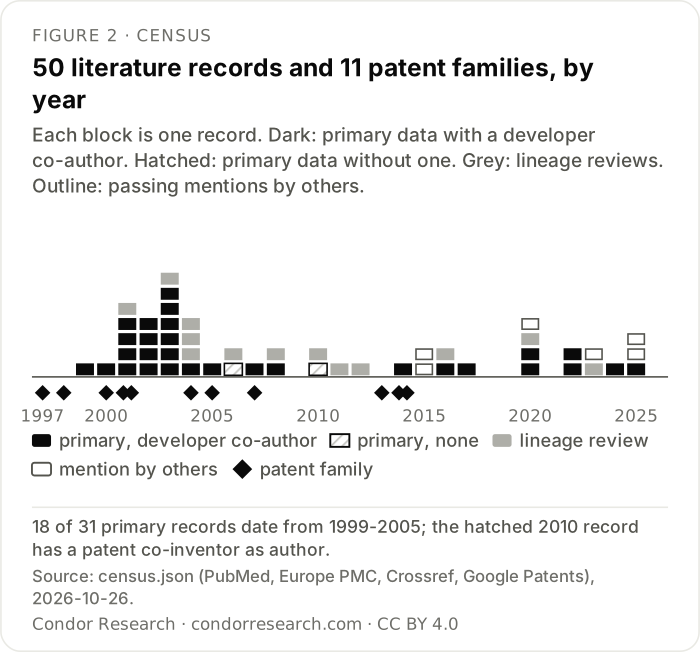
Of 31 primary records, 18 date from 1999 to 2005, 4 from 2006 to 2013 and 9 from 2014 onward. Rats appear in 25 of them, mice in 4, and human cells (transporters expressed in kidney cells, a neuroblastoma line, brain endothelial cells, medulloblastoma lines) in 4.
Authorship concentration
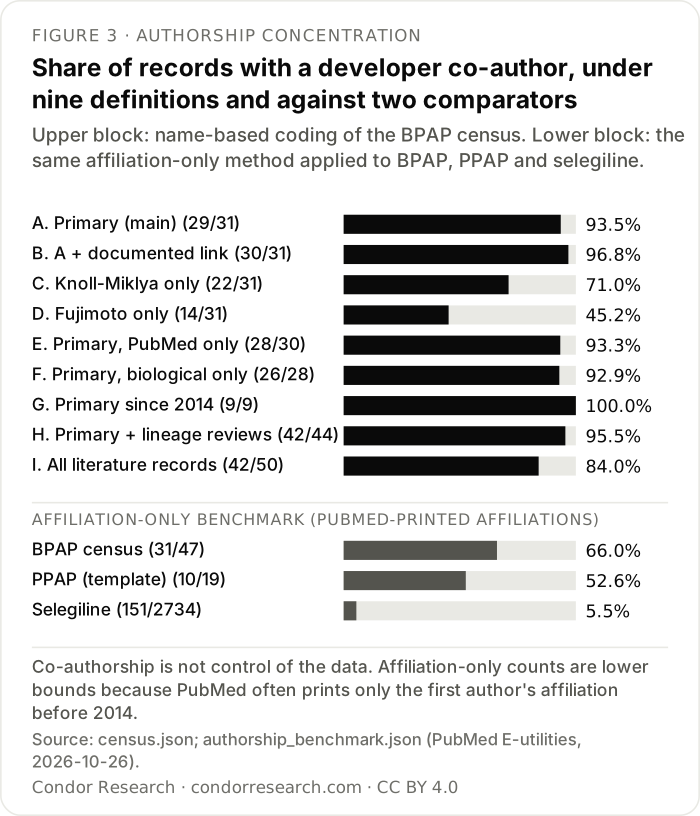
The main definition counts a primary record as “lineage” if any author belongs to the Knoll-Miklya group (Knoll J, Knoll B, Miklya I) or to Fujimoto Pharmaceutical (Yoneda F, Shimazu S, Ohde H and colleagues). Under that definition 29 of 31 primary records qualify (93.5%). The two that do not are a 2006 study of cultured cells from a different Semmelweis department, which reports the same two-range pattern described by the developers, and a 2010 rat study from Kyushu University whose second author is a co-inventor on Fujimoto’s substance-dependence patent.174833 Counting that documented link raises the share to 96.8%. Restricting to Knoll-Miklya authors gives 71.0%; to Fujimoto authors, 45.2%; to primary records since 2014, 100% (9 of 9).
To compare like with like, we applied one affiliation-only method, PubMed-printed affiliations matching Semmelweis, Fujimoto or Chinoin, to three compounds. The share was 66.0% for the BPAP census (31 of 47), 52.6% for PPAP (10 of 19) and 5.5% for selegiline (151 of 2,734). Affiliation-only figures are lower bounds, because before about 2014 PubMed often prints only the first author’s affiliation. Selegiline, the approved drug from the same school, has a literature in which the originators are a small minority; BPAP and its template have not left the originating network.
The supply chain is narrow as well. Of the 13 primary papers we read in full, 11 state where the compound came from, and all 11 name Fujimoto (or FP Pharmaceutical, its later name) as the source, synthesiser or supporter; the remaining 2 are Fujimoto’s own synthesis papers. In each of the four open-access primary papers from 2020 to 2025, the compound was supplied by Fujimoto or the work was acknowledged as partly supported by it; one of them also declares no competing interests.181721650 A 2023 paper by the same group declares partial support by Fujimoto.10
In plain terms: for an approved drug from the same family, almost all research is done by others. For BPAP, almost none is, and recent studies used material from the company that owns the patents.
What does the only human study report?
EudraCT 2006-000361-11 is a proof-of-concept study sponsored by Fujimoto Pharmaceutical in patients with Parkinson’s disease. The protocol record lists the investigational product as R-(-)-1-(benzofuran-2-yl)-2-propylaminopentane hydrochloride (CAS 265130-22-1) under the code FPFS-1169.8 Its design was open-label and single-site, with no placebo, no comparator and no randomisation; its primary objectives concerned a predefined change on a Parkinson’s rating scale and plasma concentrations.8
| Field | Registry entry |
|---|---|
| Register, country | EU Clinical Trials Register (EudraCT); United Kingdom (MHRA), one site |
| Sponsor | Fujimoto Pharmaceutical Corporation |
| Design | Open-label, uncontrolled by placebo, not randomised |
| Participants | 10 adults with Parkinson’s disease (18 screened); 9 men, 1 woman; 6 aged 65-84 |
| Recruitment | September 2006 to February 2007 |
| End of trial | 30 March 2007 on the results record; 2 April 2007 on the protocol record (a minor discrepancy) |
| Primary endpoints reported | Pharmacokinetic values and a rating-scale response, per participant; descriptive statistics only, no statistical analysis |
| Outcome as posted | A rating-scale response is listed for 8 of 10 participants; descriptive only, without a comparator, so it does not establish efficacy |
| Safety as posted | 0 serious adverse events, 0 deaths; non-serious adverse events in a minority of participants, listed descriptively in the registry |
| Results posted | 21 July 2022, version 1 |
| Other registers; publication | Not on ClinicalTrials.gov or ISRCTN; no journal article located |
The single human study of R-(-)-BPAP. Dose levels and administration details are deliberately omitted (Research Use Only). Source: EudraCT protocol and results records, accessed 2026-10-26.892728
What the posting allows us to say is limited. Without a placebo arm, a change on a rating scale cannot be separated from the patients’ usual medication cycle, expectation or chance; with ten participants divided into small exploratory groups of one to three people. The posting also contains no statistical test. Two features of the record are notable in themselves: it is filed under the code FPFS-1169, so a register search for “BPAP” does not find it (Figure 5), and summary results appeared fifteen years after the trial ended, far outside the 12-month window that current EU guidance sets for posting most trial results.
A 2023 paper by the Semmelweis group refers to “early clinical findings” suggesting antiparkinsonian potential for (-)-BPAP and cites a 2011 book chapter for them.10 In our reading of that open-access chapter, its BPAP passages report rat experiments and cultured cells, including human endothelial cells, but no data from people.11 The registry study may be what the authors had in mind; it is not what they cite.
In plain terms: one tiny, uncontrolled study in Parkinson’s patients was run in 2006 and 2007. Its basic numbers were put online in 2022 and never written up. It cannot show whether BPAP does anything in people.
What mechanism does the literature describe?
The developers’ central concept is the “catecholaminergic/serotonergic activity enhancer” (CAE/SAE) effect: an increase in the amount of transmitter released per nerve impulse, without the impulse-independent release produced by amphetamine-like drugs.351 In their experiments the effect is read out as more radiolabelled or HPLC-measured noradrenaline, dopamine or serotonin released by electrical stimulation from isolated rat brain tissue, or as reversal of a learning deficit caused by depleting catecholamine stores.1452 The endogenous trace amines phenylethylamine and tryptamine are proposed as natural enhancers, with selegiline and BPAP as synthetic ones.53
The bimodal curve. Knoll’s group reports that the effect of (-)-BPAP is not monotonic. It appears in two separate concentration ranges, one extremely low and one far higher, each shaped like a bell: the effect rises, peaks and falls back to baseline before the next range begins.16 The developers interpret the low range as a “specific” enhancer effect and the high range as “non-specific”.175 One group without a developer author reported the same two-range pattern for cell survival in cultured cells.17 No independent laboratory has reproduced the release experiments themselves, and no mechanism accounts for the gap between the two ranges.
Reading the 2002 paper in full changes how that curve should be described. The readout was not electrically evoked release: pieces of five rat brain regions were placed in an organ bath, and the transmitter that appeared in the bath over a 20-minute window was measured by HPLC, with uptake and metabolism deliberately left intact. Each point rests on 8 rats, and the figures are compared with paired t-tests and no correction for the many comparisons, including comparisons between separately treated groups of animals, where an unpaired test would be expected. The falling limb was not present in every region: in the olfactory tubercle the paper reports the effect as present across the range it tested. The authors also note that the low range was absent in cultured cortical neurons and astrocytes, which they read as evidence that the specific effect belongs to midbrain neurons.16 Within the same paper, the higher range is attributed to binding at sigma sites; a 2022 paper instead attributes it to inhibition of monoamine oxidase A, citing a 2014 study that, read in full, measured behaviour rather than enzyme activity and in turn cites the 1999 paper.115
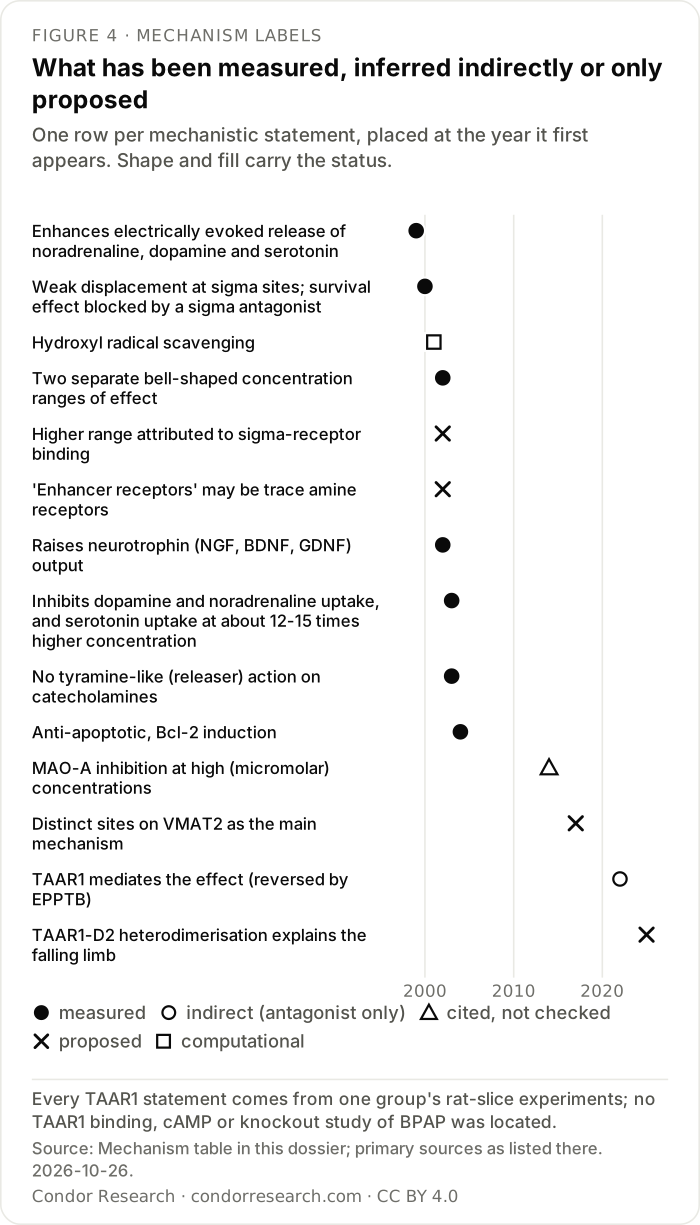
| Mechanistic statement | First year | Status | Who and how |
|---|---|---|---|
| Enhances electrically evoked release of noradrenaline, dopamine and serotonin | 1999 | Measured | lineage, ex vivo rat3 |
| Weak displacement at sigma sites; survival effect blocked by a sigma antagonist | 2000 | Measured | lineage co-authors, rat neurons24 |
| Hydroxyl radical scavenging | 2001 | Computational only | lineage, molecular-orbital model only25 |
| Two separate bell-shaped concentration ranges of effect | 2002 | Measured | lineage; resting release from isolated rat brain pieces, 8 rats per point; not seen in every region16 |
| Higher range attributed to sigma-receptor binding | 2002 | Proposed | lineage, discussion; later replaced by MAO-A (below)16 |
| 'Enhancer receptors' may be trace amine receptors | 2002 | Proposed | lineage, hypothesis in the discussion16 |
| Raises neurotrophin (NGF, BDNF, GDNF) output | 2002 | Measured | mouse astrocytes, high range only26 |
| Inhibits dopamine and noradrenaline uptake, and serotonin uptake at about 12-15 times higher concentration | 2003 | Measured | lineage with a US co-author, human transporters in HEK293 cells; at least 3 independent experiments; cocaine as reference13 |
| No tyramine-like (releaser) action on catecholamines | 2003 | Measured | rat synaptosomes13 |
| Anti-apoptotic, Bcl-2 induction | 2004 | Measured | human neuroblastoma cells21 |
| MAO-A inhibition at high (micromolar) concentrations | 2014 | Cited, not checked by us | lineage; the 2022 paper cites 2014, which cites 1999; the 2014 paper did not measure MAO15 |
| Distinct sites on VMAT2 as the main mechanism | 2017 | Proposed | lineage, stated in an abstract6 |
| TAAR1 mediates the effect (reversed by EPPTB) | 2022 | Indirect (antagonist only) | lineage, rat striatal slices; no receptor assay1 |
| TAAR1-D2 heterodimerisation explains the falling limb | 2025 | Proposed | lineage, stated as speculation2 |
Mechanistic statements on (-)-BPAP and the evidence behind each. ‘Measured’ means the paper reports a direct experimental readout; ‘indirect’ means the conclusion rests on reversal by an antagonist; ‘proposed’ means a hypothesis stated in the text. Status is our classification.
Three points stand out. First, the best-characterised action is ordinary transporter pharmacology. In human transporters expressed in HEK293 cells, (-)-BPAP inhibited dopamine and noradrenaline uptake with IC50 values of 42 and 52 nM and serotonin uptake at 640 nM; displacement constants for a cocaine-like radioligand were 16, 211 and 638 nM, from at least three independent experiments each. Reading the paper in full adds the comparator it used: cocaine, measured side by side, was about 12 times weaker at the dopamine transporter and about 7 times weaker at the noradrenaline transporter, but slightly stronger at the serotonin transporter. On the uptake figures, (-)-BPAP is about 15 times more potent at the dopamine transporter and about 12 times more potent at the noradrenaline transporter than at the serotonin transporter (reanalysis.json). The same paper found no tyramine-like release and reported that (-)-BPAP blocked tyramine-induced release.13 Second, the label for the “enhancer receptor” has moved: trace amine receptors in 2002 (as a hypothesis), distinct sites on the vesicular transporter VMAT2 in 2017, and TAAR1 from 2022.1661 Third, the TAAR1 evidence consists of the antagonist EPPTB reversing the BPAP effect on stimulated dopamine release in rat striatal slices, plus a speculative heterodimerisation model for the falling limb of the curve.12 Neither paper tests BPAP at TAAR1 directly; we located no binding, cAMP signalling or knockout study, inside or outside the developers’ group.
In plain terms: what has actually been measured is that BPAP blocks the pumps that recycle dopamine and noradrenaline, and that in the developers’ rat tissue it increases transmitter release in an unusual, two-peaked pattern. The popular claim that it works through the TAAR1 receptor is an inference from one lab’s experiments, not a direct measurement.
What do the animal and cell studies report?
The animal programme covers locomotor activity and interaction with L-DOPA in reserpinised rats, learning in a shuttle box, forced-swim, social-interaction and olfactory-bulbectomy models, relapse to methamphetamine seeking, anxiety-like behaviour and glutamate-receptor markers, chronic mild stress, a lung adenocarcinoma xenograft and two studies that followed rats until death.545550485657186 Cell studies report raised neurotrophin output by astrocytes, mostly in the high concentration range, higher BDNF and trkB expression in brain slices, sigma-site-dependent survival of cortical neurons and protection of neuroblastoma cells against a neurotoxin.2619202421 The only pharmacokinetic study, with radiolabelled compound in rats, reports rapid absorption, brain penetration and mainly urinary elimination.22 Read in full, it has a limitation that its abstract does not state: it measured total radioactivity by scintillation counting, not the parent compound, with 3 rats per time point. Its only chemical separation was a pilot thin-layer chromatogram of urine, which identified one metabolite against the single reference substance available and left 7 to 8 further spots unidentified; the authors note that an analysis of the metabolites was still in progress. So the reported tissue and brain readings are the sum of the compound and whatever it turns into, and no human pharmacokinetic study has been published.22
The rat lifespan and tumour cohort, recalculated
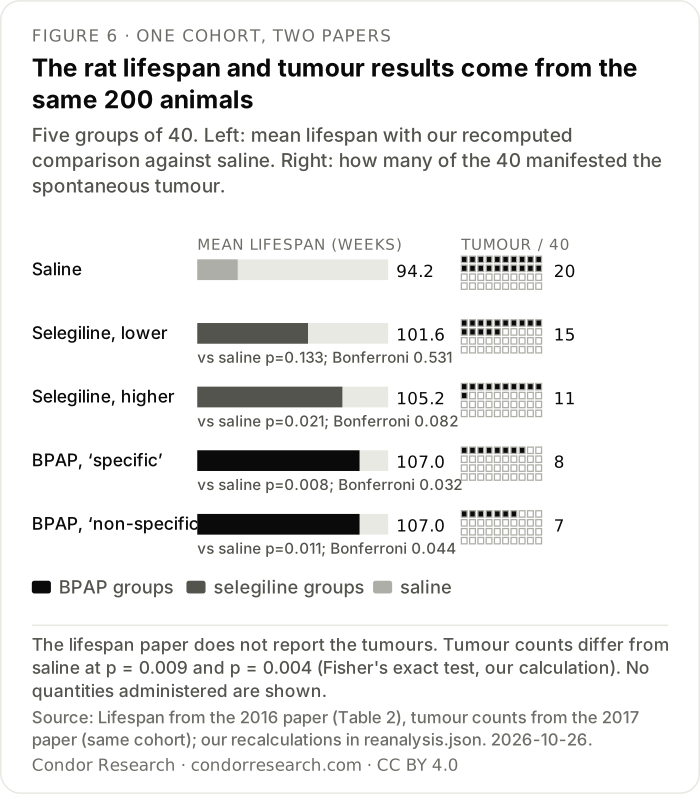
The two most-quoted animal results, longer lifespan and fewer tumours, come from a single experiment: 200 male Wistar rats in five groups of 40, treated from 10 weeks of age until death and reported in two papers a year apart.56 Having both full texts lets the figures be checked.
| Group (n = 40) | Mean lifespan, weeks (SEM) | Our t-test vs saline | With Bonferroni (4 tests) | Lived > 2 years | Manifested the tumour |
|---|---|---|---|---|---|
| Saline | 94.23 (3.48) | – | – | 14 | 20 |
| Selegiline, lower group | 101.60 (3.38) | p = 0.13 | p = 0.53 | 19 | 15 |
| Selegiline, higher group | 105.20 (3.07) | p = 0.021 | p = 0.082 | 22 | 11 |
| BPAP, “specific” group | 107.00 (3.14) | p = 0.0079 | p = 0.032 | 23 | 8 |
| BPAP, “non-specific” group | 107.00 (3.45) | p = 0.011 | p = 0.044 | 22 | 7 |
One cohort, two papers. Lifespan and survival figures from the 2016 paper; tumour counts from the 2017 paper. Our recalculations assume independent groups of 40, SD = SEM x sqrt(40) and two-sided tests; the scripts and assumptions are in reanalysis.json. Group labels are the authors’ own; we give no quantities.56
Our reading of these two papers gives five observations. First, the pairwise comparisons hold up: both BPAP groups survive a Bonferroni correction for four comparisons, with a standardised difference of about 0.6, while the lower selegiline group does not. Second, the omnibus test is weaker than the pairwise ones. The 2016 paper’s Table 2 prints F = 2.632 and p = 0.0356, which our recomputation from its means and standard errors reproduces (F = 2.64, p = 0.035). Its Figure 3, however, prints F(4,195) = 2.0356 with a significance mark; that value would correspond to p = 0.09 and is most likely a typographical error in the figure. Third, the survival advantage is in mean lifespan, not clearly in the proportion reaching two years: 23 against 14 of 40 gives p = 0.07 by Fisher’s exact test for the better BPAP group, and p = 0.12 for the other (22 of 40); the selegiline groups give p = 0.12 and 0.36. Fourth, the design was underpowered for what it was asked to show: at 40 per group, a difference of 12.8 weeks against this variability has about 74% power, and about 47 rats per group would be needed for 80%, or 67 with a correction for four comparisons. Fifth, and most consequential, the tumour result is the stronger of the two: 8 and 7 of 40 against 20 of 40 give p = 0.009 and p = 0.004, absolute risk differences of 30.0 and 32.5 percentage points (two-sided Fisher’s exact test). Yet the 2016 lifespan paper does not mention that about half the saline rats developed a fibromyxosarcoma, a fact its own cohort reported a year later. The 2017 paper does summarise the lifespan result, so the omission runs one way: a reader of the 2016 paper alone does not learn about the tumours.
Against this, in 2024 a Semmelweis behavioural-pharmacology group, with Miklya as co-author and compound from Fujimoto, followed aged, cognitively experienced rats until death and found that BPAP improved neither cognitive performance nor lifespan; the authors suggest a ceiling effect from dietary restriction and lifelong training.7 A 2025 meta-analysis of selegiline longevity experiments mentions the positive 2016 BPAP result in passing and does not mention the 2024 study.58 Its subject is selegiline, and it was not obliged to cover BPAP; we note the asymmetry only because it is one of the few recent reviews that mention BPAP’s longevity data.
In plain terms: the animal results are varied and mostly positive, but they come from the same network, and the one test of the most-quoted claim, longer life, by a different team within that network found no effect.
What is claimed online, and what do the primary sources say?
| What circulates (and where) | What the primary sources show | Verdict |
|---|---|---|
| BPAP is a TAAR1 agonist vendor pages; forum guides |
The TAAR1 link rests on one group's experiments in rat striatal slices, where the TAAR1 antagonist EPPTB reversed the BPAP effect. No binding, cAMP or knockout experiment on TAAR1 itself was located.12 | Not established |
| BPAP is about 100 to 130 times more potent than selegiline Wikipedia; vendor pages |
The figure comes from a rat learning test (tetrabenazine shuttle box), the screen used to rank the analogues: about 130 times selegiline and about 100 times PPAP. It is a ratio in one assay, not a general potency measure, and has not been measured in people.34 | Narrower than claimed |
| BPAP extends lifespan longevity forums; one 2025 meta-analysis |
One cohort of 200 rats (40 per group), reported by the developers in 2016, showed longer mean lifespan in both BPAP groups by pairwise t-tests, which survive a Bonferroni correction in our recalculation (p = 0.03 and 0.04). The printed five-group F statistic corresponds to p = 0.09, while the paper's own table of means gives p = 0.035, so the omnibus test is at best modest. The same cohort's 2017 report shows that tumour manifestation also differed between groups, which the 2016 paper does not mention. A 2024 study in aged rats found no effect on lifespan or cognition.567 | Conflicting rodent data |
| BPAP has never been tested in humans forums; review pages |
One human study exists, registered only in the EU Clinical Trials Register (EudraCT 2006-000361-11): an open-label, single-site UK study in 10 adults with Parkinson's disease, sponsored by Fujimoto, completed in 2007, with summary results posted in July 2022 and no peer-reviewed publication located. It is absent from ClinicalTrials.gov and ISRCTN.89 | Incorrect: one small registry-only study |
| Clinical data show BPAP works in Parkinson's disease a 2023 paper ('early clinical findings'); forums |
The only human data are the EudraCT summary results: no placebo, no randomisation, no statistical analysis, 10 participants. The 2023 statement cites a 2011 chapter that, in our reading, reports no human BPAP data.91011 | Not supported |
| BPAP is an approved or prescribed antidepressant a 2020 synthesis review |
No approval was located in the EMA medicines dataset or Drugs@FDA. The review lists (-)-BPAP among 'prescribed agents'.12 | Incorrect |
| BPAP is a pure 'enhancer' and not a reuptake inhibitor forum guides |
Uptake inhibition at human dopamine and noradrenaline transporters was measured in 2003 at nanomolar concentrations. Whether the 'enhancer' effect is separate from uptake inhibition depends on the model and has been tested mainly by the originating group.1314 | Contradicted in part |
| BPAP does not inhibit MAO vendor pages |
Reported as leaving MAO practically unchanged in the low range. MAO-A inhibition at high concentrations is stated in 2014 with a citation to the 1999 paper and is invoked in 2022 for the second peak; the 2014 study did not measure MAO activity itself.151 | Partly supported |
| More is not better: the effect follows a bell-shaped curve forum guides; vendor pages |
Two bell-shaped concentration-effect ranges are reported ex vivo by the developers, and a similar pattern in cultured cells by one group without a developer author. The mechanism is unexplained and the pattern has not been studied in people.1617 | Reported preclinically |
| BPAP suppresses tumours patent summaries; forum guides |
Fewer tumours were observed in the BPAP groups of one rat cohort; that cohort (the 2016-2017 longevity study) reported fewer spontaneous fibromyxosarcomas in BPAP groups (8 and 7 of 40, against 20 of 40 with saline), and one mouse xenograft study reported slower tumour growth; both come from the developers' network. No independent replication was located.618 | Reported preclinically |
| BPAP is neuroprotective or raises BDNF vendor pages; forums |
Neurotrophin and anti-apoptotic effects were measured in astrocyte cultures, brain slices and a neuroblastoma line, mostly in the high concentration range; no in vivo human measurement exists.192021 | Preclinical only |
| BPAP is safe or free of side effects forums |
The EudraCT summary lists no serious adverse events or deaths in 10 participants in a short exploratory protocol, with non-serious events in some. Ten people in an uncontrolled study cannot establish safety, and no full repeat-dose toxicology report was located; the only published pharmacokinetic study is in rats and measured total radioactivity rather than the parent compound.922 | Not established |
| BPAP is a peptide vendor and affiliate pages titled 'BPAP peptide' |
BPAP is a small benzofuran amine (C16H23NO), not a peptide. | Incorrect |
| BPAP is not prohibited in sport forums |
BPAP is not named on the WADA 2026 List. Section S0 prohibits pharmacological substances with no current governmental approval for human therapeutic use that are not addressed elsewhere; no approval of BPAP was located. No WADA statement on BPAP was located.23 | Not named; S0 wording applies |
Claims gathered from vendor pages, wiki and affiliate pages, forum thread titles in Condor’s earlier Reddit passes and web search results, 25-26 October 2026. Sources are not quoted at length and vendors are not named. Verdicts are ours and use a fixed scale: Incorrect, Not supported, Not established, Contradicted in part, Narrower than claimed, Partly supported, Reported preclinically, Preclinical only, No data.
Online attention is small and hard to measure because of the acronym. In Condor’s earlier Reddit pass (25 October 2026), 124 unique posts matched “BPAP”: 115 were about bilevel airway pressure machines, 1 was a profile page and 8 concerned the compound, 7 of them in the six months to 25 October 2026 and 1 in the six months before. A second pass through the PullPush archive found 64 posts and 229 comments matching the regular expression “bpap” in the 5.5 months to 10 October 2026, against 86 and 282 in the preceding 5.5 months; its top subreddits include sleep-apnoea forums, so those figures mix the homonym with the compound and should not be read as interest in BPAP.
In plain terms: several popular statements about BPAP go further than the studies behind them, and a few are simply wrong: it is not a peptide, not an approved medicine, and it has been given to people once, in a study of ten.
What is BPAP’s regulatory status?
| Register or authority | Query | Result on 26 Oct 2026 |
|---|---|---|
| EU Clinical Trials Register (EudraCT) | FPFS-1169; BPAP | 1 study of the compound: 2006-000361-11 (Fujimoto, Parkinson's disease, UK, completed 2007, results posted 2022); the 4 'BPAP' hits are unrelated8 |
| ClinicalTrials.gov (API v2) | BPAP; benzofuranylpropylaminopentane; FPFS-1169; propylaminopentane | 0 studies of the compound; the 22 'BPAP' hits are bilevel airway pressure or unrelated27 |
| ISRCTN | BPAP; benzofuran-2-yl; FPFS | 028 |
| EMA medicines dataset | full-text search of 2,754 records | no match29 |
| Drugs@FDA (openFDA) | ingredient and generic-name queries | no match30 |
| WADA Prohibited List 2026 | full-text search | not named; selegiline is named in S6; S0 covers non-approved substances23 |
Registry and regulatory checks. Negative results mean ‘not located in that source on that date’.
No marketing authorisation was located in the EU or US datasets checked.2930 A 2020 review of benzofuran synthesis lists (-)-BPAP among “prescribed agents” and calls it an antidepressant; we found no basis for either statement.12 On the WADA 2026 List, selegiline is named among stimulants and BPAP is not named. Section S0 prohibits any pharmacological substance not addressed by another section and without current governmental approval for human therapeutic use.23 No WADA statement specific to BPAP was located.
In plain terms: BPAP is not approved as a medicine anywhere we checked. It is not named on the anti-doping list, but the list’s catch-all rule for unapproved substances is written broadly.
Why is BPAP hard to look up?
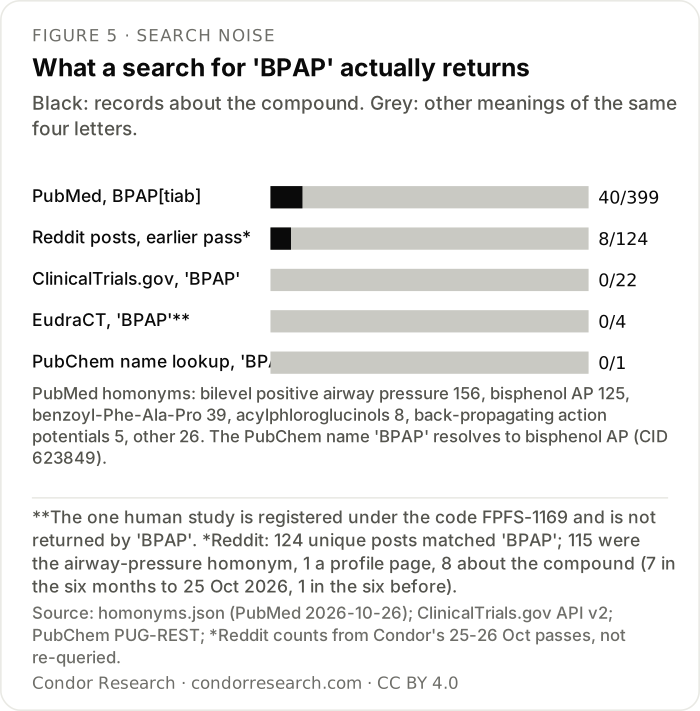
Of 399 PubMed records with “BPAP” in the title or abstract, 156 concern bilevel positive airway pressure, 125 bisphenol AP, 39 the enzyme substrate benzoyl-Phe-Ala-Pro, 8 acylphloroglucinols, 5 back-propagating action potentials and 26 other meanings; 40 concern the compound. The 22 ClinicalTrials.gov records for “BPAP” are airway devices or unrelated, and the 4 EudraCT records for “BPAP” are unrelated trials; the compound’s one trial is filed as FPFS-1169.278 The most specific PubMed handle is the MeSH supplementary concept “1-(benzofuran-2-yl)-2-propylaminopentane” (30 records), which misses the newer papers that use the (2R)-pentan-2-amine name.59
In plain terms: a quick search for “BPAP” mostly finds breathing machines and plastics chemicals, and misses the one human study.
What this literature allows, and does not allow, us to say
- R-(-)-BPAP is a well-defined molecule with a known absolute configuration, CAS numbers for base and salt, and a single main developer network.
- Its measured pharmacology includes nanomolar inhibition of dopamine and noradrenaline uptake at human transporters, about 12 to 15 times weaker at the serotonin transporter and more potent than cocaine at the first two in the same assay, plus an increase in transmitter release from isolated rat brain tissue with an unusual two-range concentration dependence.
- The TAAR1 mechanism is a hypothesis supported by antagonist experiments in one laboratory; it has not been tested at the receptor.
- Nearly all primary data (93.5% of primary records under the main definition; 100% since 2014) carry an author from the developing institutions, and recent work used compound supplied by the patent holder.
- Human evidence is limited to one open-label, ten-patient registry entry with descriptive results and no publication. It does not establish efficacy and does not allow a safety profile to be characterised; the events it records can only be described.
- The lifespan and tumour findings come from one 200-rat cohort reported in two papers. In our recalculation the lifespan difference survives correction for multiple comparisons but the study was underpowered, its printed omnibus statistic and its own table disagree, and the lifespan paper does not mention the tumours; a 2024 study in aged rats found no lifespan effect.
- Several widely repeated statements (prescribed drug, peptide, “early clinical findings”, proven TAAR1 agonist) are not supported by the sources they rest on.
- Product labels often omit stereochemistry and salt form, and the purity methods named cannot confirm the enantiomer.
What is not known
- Does (-)-BPAP bind or activate TAAR1 in a recombinant assay, and does its release effect persist in TAAR1-knockout tissue?
- Can a laboratory with no link to the developers or Fujimoto reproduce the low-range enhancement of evoked release ex vivo?
- How much of the in vivo profile is explained by dopamine and noradrenaline uptake inhibition alone, compared head to head with a selective uptake inhibitor?
- Beyond the developers’ own comparison, which reports the S-enantiomer as less potent, how active is the S form in independent hands, and was racemic material used in any other published experiment?
- What did the 2006-2007 study find on its secondary endpoints, and why were results posted only in 2022?
- Why did the two rodent longevity studies disagree, and would a preregistered replication with adequate numbers settle it?
- Does the tumour-manifestation finding hold in a cohort that is not the one that produced the lifespan result, and in another strain?
- What does BPAP itself, rather than total radioactivity, do in the body, and what are the 7 to 8 unidentified metabolites seen in rat urine in 2002?
- What is the composition of material sold as BPAP, as measured by chiral chromatography?
Method note
Searches (26 October 2026). PubMed E-utilities (curl): “BPAP”[tiab] (399), “1-(benzofuran-2-yl)-2-propylaminopentane”[tiab] (26), propylaminopentane[tiab] (33), the MeSH supplementary concept 1-(benzofuran-2-yl)-2-propylaminopentane (30), “catecholaminergic activity enhancer”, “enhancer substance(s)”, “enhancer regulation”[tiab] (160), Knoll J[au] OR Miklya I[au] (586) and PPAP with context terms; 1,091 candidate records were fetched and screened by title and abstract, with full text where open. Europe PMC full text: five queries on the IUPAC name, BPAP with context terms, propylaminopentane and patents (74 unique hits). Crossref bibliographic queries for non-PubMed records. Google Patents by keyword, assignee (Fujimoto, Semmelweis) and inventor (Knoll, Miklya, Yoneda). Registers: ClinicalTrials.gov API v2, EU Clinical Trials Register, ISRCTN. Regulators: EMA medicines JSON, openFDA drugsfda, WADA 2026 List. PubChem PUG-REST for identifiers. WHO ICTRP, Japanese registers (jRCT, UMIN) and Google Scholar were not searched.
Inclusion. A literature record enters the census if it reports original data on BPAP (primary), discusses it as a subject (secondary) or names it in passing (mention), after full-text confirmation for Europe PMC-only hits. One Europe PMC hit whose full text did not mention BPAP was excluded. Patent families are counted once, by priority. PPAP-only records are a comparator set, not census records.
Coding. Each record was coded for kind, evidence type, species, origin and role (codebook in census.json). Origin is defined by author names and printed affiliations; “linked” requires a documented tie (patent co-inventorship). A second coder, rule-based and blind to the first, coded the 47 PubMed records from metadata alone: agreement 80.9% on evidence type (kappa 0.75); origin agreement was 100%, which is expected because both use author names and is not independent validation. Disagreements were mostly ex vivo versus in vitro and are listed in census.json.
Independent blind recoding. A third coder from a different model family (Codex), without access to our files or labels, ran its own PubMed searches for the compound (26 October 2026) and excluded homonyms itself. It retrieved 13 of our 47 PubMed records and none we had missed, which illustrates how much a name-based search loses for this compound. On those 13 it agreed with our evidence type in 11 (the two differences are rat tissue we coded ex vivo and it coded animal) and with our origin in 12. The one origin difference is a 2008 Nagoya study whose author list includes F. Yoneda of Fujimoto, which we code as developer-linked.
Benchmark. Affiliation-only authorship was computed identically for the BPAP census, PPAP and selegiline (selegiline[tiab] OR deprenyl[tiab], 3,231 records, 2,734 with affiliations). Scripts: scripts/02_authorship_benchmark.py to scripts/07_build.py.
Identity. RDKit-computed formula, average and monoisotopic mass, [M+H]+ and descriptors from PubChem SMILES, with formulas asserted against PubChem (identity.json). Five public product pages were read once; we recorded only identity fields and did not record or reproduce any usage information.
Reddit. Figures come from Condor’s earlier passes of 25-26 October 2026 and were not re-queried for this dossier.
Full texts. 13 of the 31 primary records were read in full: four open-access papers from 2020 to 2025 and nine obtained legally for this revision (the 2001 structure-activity and synthesis papers, the 2002 concentration-curve and pharmacokinetic papers, the 2003 transporter paper, the 2008 mood-model paper, the 2014 comparison paper and the 2016 and 2017 reports of the rat cohort), together with the 2012 Bentham chapter and the book it belongs to. Recalculations from published summary statistics, with their assumptions, are in reanalysis.json.
Limits. Several Japanese and Hungarian papers were read in abstract only. Patent legal status was read for a few documents. Negative findings mean “not located in the sources listed on 26 October 2026”. Related Condor dossiers: osavampator (TAK-653) and non-peptide compounds explained.
Glossary
- Enantiomer
- One of two mirror-image forms of a molecule with one stereocentre. R-(-)-BPAP and S-(+)-BPAP are enantiomers; a 50:50 mixture is a racemate.
- CAE/SAE effect
- “Catecholaminergic/serotonergic activity enhancer” effect: the developers’ term for more transmitter released per nerve impulse.
- Bell-shaped (bimodal) curve
- An effect that rises and then falls as concentration increases; “bimodal” here means two such ranges.
- TAAR1
- Trace amine-associated receptor 1, a receptor activated by trace amines and amphetamines.
- EPPTB
- A selective TAAR1 antagonist used as a pharmacological tool.
- IC50
- The concentration that halves a measured activity in an assay.
- Ex vivo
- Experiments on tissue removed from an animal, such as brain slices.
- EudraCT
- The database behind the EU Clinical Trials Register for trials authorised before 2023.
- Open-label
- A study in which participants and investigators know what is given.
- Homonym
- Here, a different meaning of the same acronym.
Frequently asked questions
What is R-(-)-BPAP?
R-(-)-BPAP is (2R)-1-(1-benzofuran-2-yl)-N-propylpentan-2-amine (PubChem CID 9816303, CAS 260550-89-8 for the free base; the hydrochloride is CAS 265130-22-1, code FPFS-1169). It was selected by Joseph Knoll's group at Semmelweis University with Fujimoto Pharmaceutical (Osaka) from 65 analogues of PPAP (first patent priority 1997, first pharmacology paper 1999), a selegiline-derived amine, and is described in that literature as a catecholaminergic and serotonergic activity enhancer. It is a small amine, not a peptide.
Has BPAP been studied in humans?
One human study was located: EudraCT 2006-000361-11, an open-label, single-site study in 10 adults with Parkinson's disease in the United Kingdom, sponsored by Fujimoto and completed in 2007. Summary results were posted on the EU Clinical Trials Register on 21 July 2022, with descriptive statistics only, no placebo and no randomisation. No peer-reviewed report of it, and no other human study, was located as of 26 October 2026. It is not on ClinicalTrials.gov or ISRCTN.
Is BPAP a TAAR1 agonist?
That has been proposed, not shown directly. Two papers by the Semmelweis group (2022 and 2025) report that the TAAR1 antagonist EPPTB reverses the effect of (-)-BPAP on dopamine release in rat striatal slices. No receptor binding, cAMP signalling or TAAR1-knockout experiment with BPAP was located. Uptake inhibition at human dopamine and noradrenaline transporters, by contrast, was measured directly in 2003.
Who has published research on BPAP?
In Condor's census of 31 primary records (1999 to 2025), 29 (93.5%) have at least one author from the Knoll-Miklya group or from Fujimoto Pharmaceutical; the range across nine definitions is 45.2% to 100%. The two primary records without such an author are a 2006 cell study from another Semmelweis department and a 2010 rat study whose second author is a co-inventor on a Fujimoto BPAP patent. Of the 13 primary papers we read in full, all 11 that name a compound source name Fujimoto; the remaining 2 are Fujimoto's own synthesis papers.
What do the rat lifespan and tumour papers actually report?
Both claims come from one experiment: 200 male Wistar rats in five groups of 40, reported by the developers in a 2016 lifespan paper and a 2017 tumour paper. Mean lifespan was 94.2 weeks on saline against 107.0 in both BPAP groups; in our recalculation those differences give p = 0.008 and 0.011 and survive a Bonferroni correction, but the study had about 74% power, and the paper's printed omnibus F corresponds to p = 0.09 while its own table of means gives p = 0.035. The tumour difference is larger: 8 and 7 of 40 against 20 of 40 (p = 0.009 and 0.004, our calculation). The 2016 lifespan paper does not mention the tumours. A 2024 study in aged rats found no effect on lifespan or cognition, and no independent replication was located.
What is the difference between BPAP, R-(-)-BPAP and racemic BPAP?
BPAP has one stereocentre. The research compound is the R-(-)-enantiomer (absolute configuration by X-ray, 2001). 'BPAP' without a descriptor can mean the racemate (PubChem CID 9859674) and, in a PubChem name lookup, resolves to bisphenol AP, an unrelated industrial chemical. The R and S forms and the racemate have the same mass, so an achiral LC-MS or HPLC-UV result cannot tell them apart; chiral chromatography or optical rotation is needed.
Is BPAP approved anywhere or on the WADA list?
No approval was located in the EMA medicines dataset or Drugs@FDA on 26 October 2026. BPAP is not named on the WADA 2026 Prohibited List; section S0 prohibits pharmacological substances that are not addressed elsewhere on the List and have no current governmental approval for human therapeutic use. No WADA statement specific to BPAP was located.
How to cite this dossier
Condor Research Editorial. R-(-)-BPAP: Evidence Card. A literature, patent and registry dossier. Version 1.1, 26 October 2026. https://condorresearch.com/research/r-bpap-evidence-card/. Dataset: dataset.json, CC BY 4.0.
Changelog. v1.1 (26 October 2026): thirteen primary papers read in full after legal purchase; the rat lifespan and tumour cohort recalculated and shown to be one experiment reported twice; transporter, pharmacokinetic, structure-activity and optical-rotation sections corrected against the full texts; the MAO-A attribution traced to its source. v1.0 (26 October 2026): first publication.
Condor Research Editorial. Research Use Only: this dossier describes published and registered research and is not medical advice or information for human use.
References
- Harsing LG, Knoll J, Miklya I. Enhancer Regulation of Dopaminergic Neurochemical Transmission in the Striatum. Int J Mol Sci. 2022. PMID 35955676. DOI 10.3390/ijms23158543.
- Harsing LG Jr, Szénási G, Fehér B, et al. Regulation by Trace Amine-Associated Receptor 1 (TAAR1) of Dopaminergic-GABAergic Interaction in the Striatum: Effects of the Enhancer Drug (-)BPAP. Neurochem Res. 2025. PMID 39903411. DOI 10.1007/s11064-025-04337-7.
- Knoll J, Yoneda F, Knoll B, et al. (-)1-(Benzofuran-2-yl)-2-propylaminopentane, [(-)BPAP], a selective enhancer of the impulse propagation mediated release of catecholamines and serotonin in the brain. Br J Pharmacol. 1999. PMID 10588928. DOI 10.1038/sj.bjp.0702995.
- Yoneda F, Moto T, Sakae M, et al. Structure-activity studies leading to (-)1-(benzofuran-2-yl)-2-propylaminopentane, ((-)BPAP), a highly potent, selective enhancer of the impulse propagation mediated release of catecholamines and serotonin in the brain. Bioorg Med Chem. 2001. PMID 11377178. DOI 10.1016/s0968-0896(01)00002-5.
- Knoll J, Miklya I. Longevity study with low doses of selegiline/(-)-deprenyl and (2R)-1-(1-benzofuran-2-yl)-N-propylpentane-2-amine (BPAP). Life Sci. 2016. PMID 27777099. DOI 10.1016/j.lfs.2016.10.023.
- Knoll J, Baghy K, Eckhardt S, et al. A longevity study with enhancer substances (selegiline, BPAP) detected an unknown tumor-manifestation-suppressing regulation in rat brain. Life Sci. 2017. PMID 28623006. DOI 10.1016/j.lfs.2017.06.010.
- Ernyey AJ, Kassai F, Kozma K, et al. Age-related decline of various cognitive functions in well-experienced male rats treated with the putative anti-aging compound (2R)-1-(1-benzofuran-2-yl)-N-propylpentane-2-amine ((-)BPAP). Geroscience. 2024. PMID 37306892. DOI 10.1007/s11357-023-00821-6.
- EU Clinical Trials Register. EudraCT 2006-000361-11, protocol record (GB): proof-of-concept study of FPFS-1169 in patients with Parkinson’s disease; sponsor Fujimoto Pharmaceutical Corporation; title abbreviated. Accessed 2026-10-26. https://www.clinicaltrialsregister.eu/ctr-search/trial/2006-000361-11/GB
- EU Clinical Trials Register. EudraCT 2006-000361-11, summary results, version 1, published 21 July 2022. Accessed 2026-10-26. https://www.clinicaltrialsregister.eu/ctr-search/trial/2006-000361-11/results
- Harsing LG Jr, Timar J, Miklya I. Striking Neurochemical and Behavioral Differences in the Mode of Action of Selegiline and Rasagiline. Int J Mol Sci. 2023. PMID 37686140. DOI 10.3390/ijms241713334.
- Miklya I. The Knoll-concept to decrease the prevalence of Parkinson’s disease. In: Finkelstein DI, ed. Towards New Therapies for Parkinson’s Disease. InTech; 2011:77-100. Open access. DOI 10.5772/18654. https://doi.org/10.5772/18654
- Chiummiento L, D'Orsi R, Funicello M, et al. Last Decade of Unconventional Methodologies for the Synthesis of Substituted Benzofurans. Molecules. 2020. PMID 32429435. DOI 10.3390/molecules25102327.
- Shimazu S, Tsunekawa H, Yoneda F, et al. Transporter-mediated actions of R-(-)-1-(benzofuran-2-yl)-2-propylaminopentane. Eur J Pharmacol. 2003. PMID 14659999. DOI 10.1016/j.ejphar.2003.09.044.
- Miklya I, Knoll J. Analysis of the effect of (-)-BPAP, a selective enhancer of the impulse propagation mediated release of catecholamines and serotonin in the brain. Life Sci. 2003. PMID 12697274. DOI 10.1016/s0024-3205(03)00197-8.
- Miklya I. Essential difference between the pharmacological spectrum of (-)-deprenyl and rasagiline. Pharmacol Rep. 2014. PMID 24905523. DOI 10.1016/j.pharep.2013.11.003.
- Knoll J, Miklya I, Knoll B. Stimulation of the catecholaminergic and serotoninergic neurons in the rat brain by R-(-)-1-(benzofuran-2-yl)-2-propylaminopentane, (-)-BPAP. Life Sci. 2002. PMID 12204771. DOI 10.1016/s0024-3205(02)01969-0.
- Denes L, Szilágyi G, Gál A, et al. Cytoprotective effect of two synthetic enhancer substances, (-)-BPAP and (-)-deprenyl, on human brain capillary endothelial cells and rat PC12 cells. Life Sci. 2006. PMID 16624331. DOI 10.1016/j.lfs.2006.03.005.
- Mervai Z, Reszegi A, Miklya I, et al. Inhibitory Effect of (2R)-1-(1-Benzofuran-2-yl)-N-propylpentan-2-amine on Lung Adenocarcinoma. Pathol Oncol Res. 2020. PMID 30734151. DOI 10.1007/s12253-019-00603-6.
- Shimazu S, Tanigawa A, Sato N, et al. Enhancer substances: selegiline and R-(-)-1-(benzofuran-2-yl)-2-propylaminopentane [(-)-BPAP] enhance the neurotrophic factor synthesis on cultured mouse astrocytes. Life Sci. 2003. PMID 12679194. DOI 10.1016/s0024-3205(03)00191-7.
- Hirami C, Takahata K, Shimazu S, et al. Effects of R-(-)-BPAP on the expressions of neurotrophins and their receptors in mesencephalic slices. Biol Pharm Bull. 2005. PMID 16079507. DOI 10.1248/bpb.28.1524.
- Maruyama W, Yi H, Takahashi T, et al. Neuroprotective function of R-(-)-1-(benzofuran-2-yl)-2-propylaminopentane, [R-(-)-BPAP], against apoptosis induced by N-methyl(R)salsolinol, an endogenous dopaminergic neurotoxin, in human dopaminergic neuroblastoma SH-SY5Y cells. Life Sci. 2004. PMID 15102525. DOI 10.1016/j.lfs.2003.12.001.
- Magyar K, Lengyel J, Bolehovszky A, et al. The fate of (-)1-(benzofuran-2-yl)-2-propylaminopentane . HCl, (-)-BPAP, in rats, a potent enhancer of the impulse-evoked release of catecholamines and serotonin in the brain. Eur J Drug Metab Pharmacokinet. 2002. PMID 12365195. DOI 10.1007/BF03190451.
- World Anti-Doping Agency. Prohibited List 2026, in force from 1 January 2026 (sections S0 and S6 searched in full text). Accessed 2026-10-26. https://www.wada-ama.org/sites/default/files/2025-09/2026list_en_final_clean_september_2025.pdf
- Hamabe W, Fujita R, Yasusa T, et al. (-)1-(Benzofuran-2-yl)-2-propylaminopentane shows survival effect on cortical neurons under serum-free condition through sigma receptors. Cell Mol Neurobiol. 2000. PMID 11100977. DOI 10.1023/a:1007050808754.
- Nakai S, Yoneda F. Theoretical investigation of (-)1-(benzofuran-2-yl)-2-propylaminopentane[(-)-BPAP] as a hydroxyl radical scavenger. Bioorg Med Chem. 2001. PMID 11377187. DOI 10.1016/s0968-0896(01)00008-6.
- Ohta K, Ohta M, Mizuta I, et al. The novel catecholaminergic and serotoninergic activity enhancer R-(-)-1-(benzofuran-2-yl)-2-propylaminopentane up-regulates neurotrophic factor synthesis in mouse astrocytes. Neurosci Lett. 2002. PMID 12147307. DOI 10.1016/s0304-3940(02)00461-5.
- ClinicalTrials.gov API v2, queries ‘BPAP’, ‘benzofuranylpropylaminopentane’, ‘FPFS-1169’, ‘propylaminopentane’. Accessed 2026-10-26. https://clinicaltrials.gov/search?term=BPAP
- ISRCTN registry, query API: ‘BPAP’, ‘benzofuran-2-yl’, ‘FPFS’ (0 results each). Accessed 2026-10-26. https://www.isrctn.com/search?q=BPAP
- European Medicines Agency. Medicines data, JSON report (2,754 records). Searched 2026-10-26. https://www.ema.europa.eu/en/medicines/download-medicine-data
- US Food and Drug Administration. openFDA drugsfda endpoint, ingredient and generic-name queries (no match). Accessed 2026-10-26. https://open.fda.gov/apis/drug/drugsfda/
- Yoneda F, Knoll J, et al. Ethylamine derivatives containing bicyclic rings. HU228759B1; priority 1997-08-07; Fujimoto Brothers Co. (family of WO1999007667A1). Accessed 2026-10-26. https://patents.google.com/patent/HU228759B1/en
- Yoneda F, Knoll J, et al. Novel optically active aminopentane derivative. WO2000026204A1; priority 1998-10-29; Fujimoto Brothers Co. Google Patents record accessed 2026-10-26. https://patents.google.com/patent/WO2000026204A1/en
- Yamamoto T, Yoneda F, et al. Therapeutic agent for substance dependence. US8318799B2; priority 2004-11-25; Fujimoto Co. Status on Google Patents: expired, fee related. Accessed 2026-10-26. https://patents.google.com/patent/US8318799B2/en
- Yoneda F, Ohde H, et al. Composition for transdermal or transmucosal administration. WO2008156160A1; priority 2007-06-21; Fujimoto Co. Accessed 2026-10-26. https://patents.google.com/patent/WO2008156160A1/en
- Togashi H, et al. Prophylactic and therapeutic agent for attention-deficit/hyperactivity disorder. WO2015098591A1; priority 2013-12-25; Fujimoto Co. Accessed 2026-10-26. https://patents.google.com/patent/WO2015098591A1/en
- Knoll J, Miklya I, et al. Arylalkylamine compounds for use in the prevention or treatment of cancer. WO2016088111A1; priority 2014-12-05; Fujimoto Co. and Semmelweis University. Accessed 2026-10-26. https://patents.google.com/patent/WO2016088111A1/en
- Oka T, Yasusa T, Ando T, et al. Enantioselective synthesis and absolute configuration of (-)-1-(benzofuran-2-yl)-2-propylaminopentane, ((-)-BPAP), a highly potent and selective catecholaminergic activity enhancer. Bioorg Med Chem. 2001. PMID 11377179. DOI 10.1016/s0968-0896(00)00341-2.
- Knoll J, Knoll B, Török Z, et al. The pharmacology of 1-phenyl-2-propylamino-pentane (PPAP), a deprenyl-derived new spectrum psychostimulant. Arch Int Pharmacodyn Ther. 1992. PMID 1356324.
- PubChem CID 11984587, FPFS-1169, the (R)-hydrochloride (CAS 265130-22-1; UNII 327MBZ3R13). Accessed 2026-10-26. https://pubchem.ncbi.nlm.nih.gov/compound/11984587
- PubChem CID 623849, 4,4′-(1-phenylethylidene)bisphenol (bisphenol AP), the record returned by a PubChem name lookup for ‘BPAP’. Accessed 2026-10-26. https://pubchem.ncbi.nlm.nih.gov/compound/623849
- Glennon RA, Battaglia G, Smith JD. (-)PPAP: a new and selective ligand for sigma binding sites. Pharmacol Biochem Behav. 1990. PMID 1965044. DOI 10.1016/0091-3057(90)90027-f.
- PubChem CID 9816303, (R)-1-(benzofuran-2-yl)-N-propylpentan-2-amine (CAS 260550-89-8; UNII 5XG5HU8U55). Accessed 2026-10-26. https://pubchem.ncbi.nlm.nih.gov/compound/9816303
- PubChem CID 67426312, (2S)-1-(1-benzofuran-2-yl)-N-propylpentan-2-amine. Accessed 2026-10-26. https://pubchem.ncbi.nlm.nih.gov/compound/67426312
- PubChem CID 9859674, 1-(benzofuran-2-yl)-2-propylaminopentane, stereochemistry undefined. Accessed 2026-10-26. https://pubchem.ncbi.nlm.nih.gov/compound/9859674
- Knoll J. How Selegiline ((-)-Deprenyl) Slows Brain Aging. Bentham Science Publishers; 2012. Book, read in full (purchased copy). DOI 10.2174/97816080547011120101. https://doi.org/10.2174/97816080547011120101
- Miklya I, Gaszner P. Treatment possibilities of Alzheimer's disease. Neuropsychopharmacol Hung. 2004. PMID 15825676.
- Gaszner P, Miklya I. The use of the synthetic enhancer substances (-)-deprenyl and (-)-BPAP in major depression. Neuropsychopharmacol Hung. 2004. PMID 15825677.
- Hiranita T, Yamamoto T, Nawata Y. A tryptamine-derived catecholaminergic enhancer, (-)-1-(benzofuran-2-yl)-2-propylaminopentane [(-)-BPAP], attenuates reinstatement of methamphetamine-seeking behavior in rats. Neuroscience. 2010. PMID 19883738. DOI 10.1016/j.neuroscience.2009.10.055.
- Ferdinandy P, Yoneda F, Muraoka S, et al. Geroprotection in the future. In memoriam of Joseph Knoll: The selegiline story continues. Eur J Pharmacol. 2020. PMID 31743738. DOI 10.1016/j.ejphar.2019.172793.
- Tsunekawa H, Noda Y, Miyazaki M, et al. Effects of (R)-(-)-1-(benzofuran-2-yl)-2-propylaminopentane hydrochloride [(-)-BPAP] in animal models of mood disorders. Behav Brain Res. 2008. PMID 18243357. DOI 10.1016/j.bbr.2007.12.016.
- Knoll J. Enhancer regulation/endogenous and synthetic enhancer compounds: a neurochemical concept of the innate and acquired drives. Neurochem Res. 2003. PMID 12834268. DOI 10.1023/a:1024224311289.
- Knoll J, Miklya I, Knoll B, et al. 1-(Benzofuran-2-yl)-2-(3,3,3-trifluoropropyl)aminopentane HCl, 3-F-BPAP, antagonizes the enhancer effect of (-)-BPAP in the shuttle box and leaves the effect of (-)-deprenyl unchanged. Life Sci. 2002. PMID 12175892. DOI 10.1016/s0024-3205(02)01968-9.
- Shimazu S, Miklya I. Pharmacological studies with endogenous enhancer substances: beta-phenylethylamine, tryptamine, and their synthetic derivatives. Prog Neuropsychopharmacol Biol Psychiatry. 2004. PMID 15093948. DOI 10.1016/j.pnpbp.2003.11.016.
- Shimazu S, Takahata K, Katsuki H, et al. (-)-1-(Benzofuran-2-yl)-2-propylaminopentane enhances locomotor activity in rats due to its ability to induce dopamine release. Eur J Pharmacol. 2001. PMID 11516435. DOI 10.1016/s0014-2999(01)01040-8.
- Shimazu S, Tamashiro A, Yoneda F, et al. The L-DOPA-sparing effect of R-(-)-1-(benzofuran-2-yl)-2-propylaminopentane hydrochloride [(-)-BPAP] in reserpine-pretreated rats. Life Sci. 2003. PMID 12527038. DOI 10.1016/s0024-3205(02)02411-6.
- Knoll J, Zelena D, Timar J, et al. Synthetic enhancer compounds, besides acting on biogenic amine system, influence the glutamate transmission and stress response. Behav Brain Res. 2020. PMID 31610214. DOI 10.1016/j.bbr.2019.112290.
- Hrivikova K, Zelena D, Graban J, et al. Chronic treatment with enhancer drugs modifies the gene expression of selected parameters related to brain plasticity in rats under stress conditions. Neurochem Int. 2022. PMID 35853552. DOI 10.1016/j.neuint.2022.105404.
- Bene MR. L-deprenyl extends lifespan across mammalian species: A meta-analysis of 22 longevity experiments. Ageing Res Rev. 2025. PMID 40816452. DOI 10.1016/j.arr.2025.102873.
- National Library of Medicine. MeSH Supplementary Concept ‘1-(benzofuran-2-yl)-2-propylaminopentane’ (entry term ‘BPAP cpd’). Accessed 2026-10-26. https://www.ncbi.nlm.nih.gov/mesh/67404200
What is R-(-)-BPAP?
R-(-)-BPAP is (2R)-1-(1-benzofuran-2-yl)-N-propylpentan-2-amine (PubChem CID 9816303, CAS 260550-89-8 for the free base; the hydrochloride is CAS 265130-22-1, code FPFS-1169). It was selected by Joseph Knoll's group at Semmelweis University with Fujimoto Pharmaceutical (Osaka) from 65 analogues of PPAP (first patent priority 1997, first pharmacology paper 1999), a selegiline-derived amine, and is described in that literature as a catecholaminergic and serotonergic activity enhancer. It is a small amine, not a peptide.
Has BPAP been studied in humans?
One human study was located: EudraCT 2006-000361-11, an open-label, single-site study in 10 adults with Parkinson's disease in the United Kingdom, sponsored by Fujimoto and completed in 2007. Summary results were posted on the EU Clinical Trials Register on 21 July 2022, with descriptive statistics only, no placebo and no randomisation. No peer-reviewed report of it, and no other human study, was located as of 26 October 2026. It is not on ClinicalTrials.gov or ISRCTN.
Is BPAP a TAAR1 agonist?
That has been proposed, not shown directly. Two papers by the Semmelweis group (2022 and 2025) report that the TAAR1 antagonist EPPTB reverses the effect of (-)-BPAP on dopamine release in rat striatal slices. No receptor binding, cAMP signalling or TAAR1-knockout experiment with BPAP was located. Uptake inhibition at human dopamine and noradrenaline transporters, by contrast, was measured directly in 2003.
Who has published research on BPAP?
In Condor's census of 31 primary records (1999 to 2025), 29 (93.5%) have at least one author from the Knoll-Miklya group or from Fujimoto Pharmaceutical; the range across nine definitions is 45.2% to 100%. The two primary records without such an author are a 2006 cell study from another Semmelweis department and a 2010 rat study whose second author is a co-inventor on a Fujimoto BPAP patent. Of the 13 primary papers we read in full, all 11 that name a compound source name Fujimoto; the remaining 2 are Fujimoto's own synthesis papers.
What do the rat lifespan and tumour papers actually report?
Both claims come from one experiment: 200 male Wistar rats in five groups of 40, reported by the developers in a 2016 lifespan paper and a 2017 tumour paper. Mean lifespan was 94.2 weeks on saline against 107.0 in both BPAP groups; in our recalculation those differences give p = 0.008 and 0.011 and survive a Bonferroni correction, but the study had about 74% power, and the paper's printed omnibus F corresponds to p = 0.09 while its own table of means gives p = 0.035. The tumour difference is larger: 8 and 7 of 40 against 20 of 40 (p = 0.009 and 0.004, our calculation). The 2016 lifespan paper does not mention the tumours. A 2024 study in aged rats found no effect on lifespan or cognition, and no independent replication was located.
What is the difference between BPAP, R-(-)-BPAP and racemic BPAP?
BPAP has one stereocentre. The research compound is the R-(-)-enantiomer (absolute configuration by X-ray, 2001). 'BPAP' without a descriptor can mean the racemate (PubChem CID 9859674) and, in a PubChem name lookup, resolves to bisphenol AP, an unrelated industrial chemical. The R and S forms and the racemate have the same mass, so an achiral LC-MS or HPLC-UV result cannot tell them apart; chiral chromatography or optical rotation is needed.
Is BPAP approved anywhere or on the WADA list?
No approval was located in the EMA medicines dataset or Drugs@FDA on 26 October 2026. BPAP is not named on the WADA 2026 Prohibited List; section S0 prohibits pharmacological substances that are not addressed elsewhere on the List and have no current governmental approval for human therapeutic use. No WADA statement specific to BPAP was located.