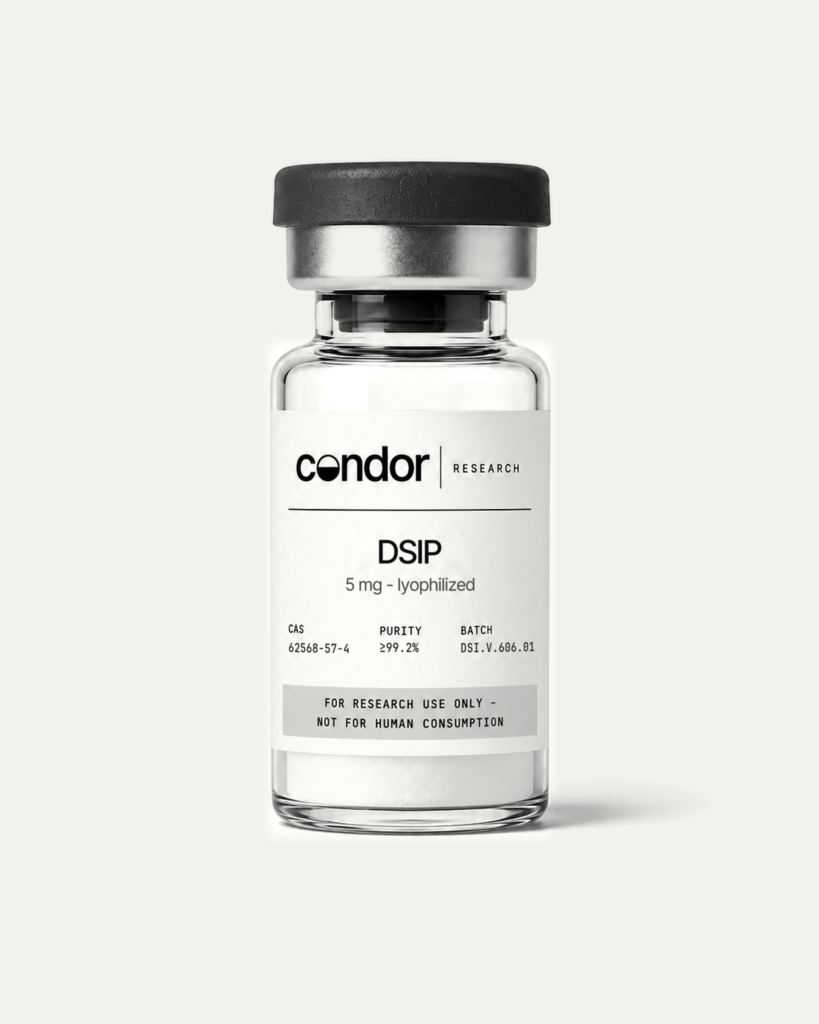
Lyophilised · ≥99% (HPLC) ·
Supplied lyophilised. Reconstitution typically uses bacteriostatic water.
DSIP (Delta Sleep-Inducing Peptide) is a synthetic nonapeptide originally isolated from rabbit brain venous blood, studied in sleep-cycle modulation, stress-response attenuation, and neuroendocrine signalling models. Sequence Trp-Ala-Gly-Gly-Asp-Ala-Ser-Gly-Glu; CAS 62568-57-4; molecular weight 848.8 g/mol; supplied lyophilised at ≥99% purity by HPLC. For laboratory research use only; not for human or veterinary use.
First isolated in the 1970s from the cerebral venous blood of sleeping rabbits, DSIP (Delta Sleep-Inducing Peptide) is a naturally occurring nonapeptide whose biology has fascinated — and puzzled — neuroscientists for half a century. Despite its evocative name, its precise mechanism remains incompletely understood, which is exactly what makes it an enduring subject of experimental investigation into sleep, stress and neuroprotection.
A peptide named for a riddle it has yet to fully explain. DSIP was identified through its apparent ability to promote delta-wave (slow-wave) electroencephalographic activity in animal models. In the decades since, researchers have repeatedly returned to it as an open question in neurochemistry, with one influential review aptly describing it as a "still unresolved riddle" (Kovalzon et al., 2006). Its small, well-defined sequence makes it a tractable probe for dissecting endogenous regulatory peptide signalling.
What the research explores. The literature on DSIP spans several neuroscience and biochemistry themes, all within cellular and animal systems:
These observations are drawn entirely from in‑vitro and animal research and provide no basis for conclusions in humans. Full citations are listed under the Scientific References tab.
Physicochemical profile. CAS 62568-57-4 · Molecular formula C35H48N10O15 · Molecular weight 848.82 g/mol · Sequence Trp-Ala-Gly-Gly-Asp-Ala-Ser-Gly-Glu · Appearance white lyophilized powder · Soluble in water.
Specification & quality. Each individually sealed vial contains 10 mg of DSIP at ≥99% purity by HPLC. Every batch is third-party tested, with a Certificate of Analysis (COA) available. Store at −20 °C, protected from light and moisture.
This product is intended for laboratory research use only (RUO). It is not a drug, food, cosmetic, or dietary supplement, and is not for human or veterinary use, ingestion, or diagnostic application. Handling is restricted to qualified research professionals operating in an appropriately equipped laboratory.
Supplied for in-vitro laboratory research use only (RUO). Not a drug, food or supplement; not for human or veterinary use.
Certificate of Analysis — lot-specific COA ships with every order and is available on request.
Each lot is tested by an independent third-party laboratory for identity (mass spectrometry) and purity (HPLC). The Certificate of Analysis for your specific batch ships with the order and is available on request — no house data, no exceptions.
References are illustrative of the research literature surrounding this compound. All claims relate to in-vitro and animal models only.
DSIP (Delta Sleep-Inducing Peptide) is a naturally occurring nonapeptide first isolated in the 1970s from the cerebral venous blood of sleeping rabbits. Its sequence is Trp-Ala-Gly-Gly-Asp-Ala-Ser-Gly-Glu. Condor Research supplies it as a 10 mg lyophilized vial at ≥99% HPLC purity, strictly as a research-use-only reference material for in-vitro laboratory study.
No. The name reflects the historical research context in which DSIP was first isolated, not a claimed effect or any approved use. DSIP is supplied strictly as a research-use-only reference compound for in-vitro laboratory study; it is not for human or veterinary use, administration, or consumption. Condor Research makes no therapeutic claims and provides no human-use guidance.
DSIP and Selank are different neuropeptides studied in different contexts. DSIP is a naturally occurring nonapeptide (Trp-Ala-Gly-Gly-Asp-Ala-Ser-Gly-Glu) studied in sleep and neuroregulatory research. Selank is a tuftsin-derived heptapeptide investigated in anxiolytic-focused research. Both are supplied as separate 10 mg vials at ≥99% HPLC purity, for research use only.
DSIP and Epitalon are distinct peptides sometimes grouped under sleep/circadian biology. DSIP is a nine-residue naturally occurring peptide studied in sleep-related neuroregulatory research. Epitalon is the tetrapeptide Ala-Glu-Asp-Gly (AEDG), studied as a reagent in cellular-aging research. They differ in sequence, length, and research focus, and each is a separate ≥99% HPLC, research-use-only reference peptide.
DSIP and Semax are different research neuropeptides. DSIP is a naturally occurring nonapeptide studied in sleep and neuroregulatory research. Semax is a synthetic ACTH(4-10)-derived heptapeptide studied as a nootropic research model. Their sequences, origins, and research applications differ, and each is supplied as a separate 10 mg vial at ≥99% HPLC purity for research use only.
Both are short peptides studied in neuro and circadian-adjacent research, but they differ chemically. DSIP is the naturally occurring nonapeptide Trp-Ala-Gly-Gly-Asp-Ala-Ser-Gly-Glu. Pinealon is the synthetic tripeptide Glu-Asp-Arg, framed around neuroprotective research. Each is a distinct ≥99% HPLC, research-use-only reference peptide, selected according to the in-vitro model under study.
Yes. DSIP is supplied strictly for laboratory research use only (in vitro). It is not a medicine, food, supplement, cosmetic, or medical device, and is not for human or veterinary use, administration, or consumption. Condor Research provides no dosing or protocols. Purchase is restricted to qualified professionals and institutions aged 18 or over.
For analytical laboratory preparation only, DSIP is water-soluble and can be reconstituted with a sterile aqueous diluent; the volume chosen sets the working concentration. Store the sealed lyophilized vial at -20°C, protected from light, with a 24-month shelf life from manufacture. This is laboratory handling information, not guidance for any human or animal use.
Yes. Each DSIP lot is tested by an independent third-party laboratory by HPLC for identity and purity, with mass spectrometry confirmation, and ships against a batch-specific Certificate of Analysis (COA) verifying ≥99% purity. To request the COA for the current lot before ordering, contact info@condorresearch.com.
Each DSIP vial contains 10 mg of lyophilized peptide at ≥99% HPLC purity, supplied as a research-use-only reference material. The stated mass is an analytical reference quantity, not a dose. Vial fill and identity are verified by independent third-party testing and documented on the lot's Certificate of Analysis.
Condor Research supplies DSIP directly, dispatched from our EU facility in Slovakia to the EU, EEA, UK and Switzerland. Deliveries to EU destinations clear no third-country customs, and shipping is calculated at checkout. Supplied strictly as a research-use-only reference material — not for human or veterinary use.
No verified reviews yet.
Leave a reviewCookies
We use strictly necessary cookies to run the store. With your consent we also use analytics (order attribution) and marketing (Omnisend) cookies. Read our Cookie Policy.