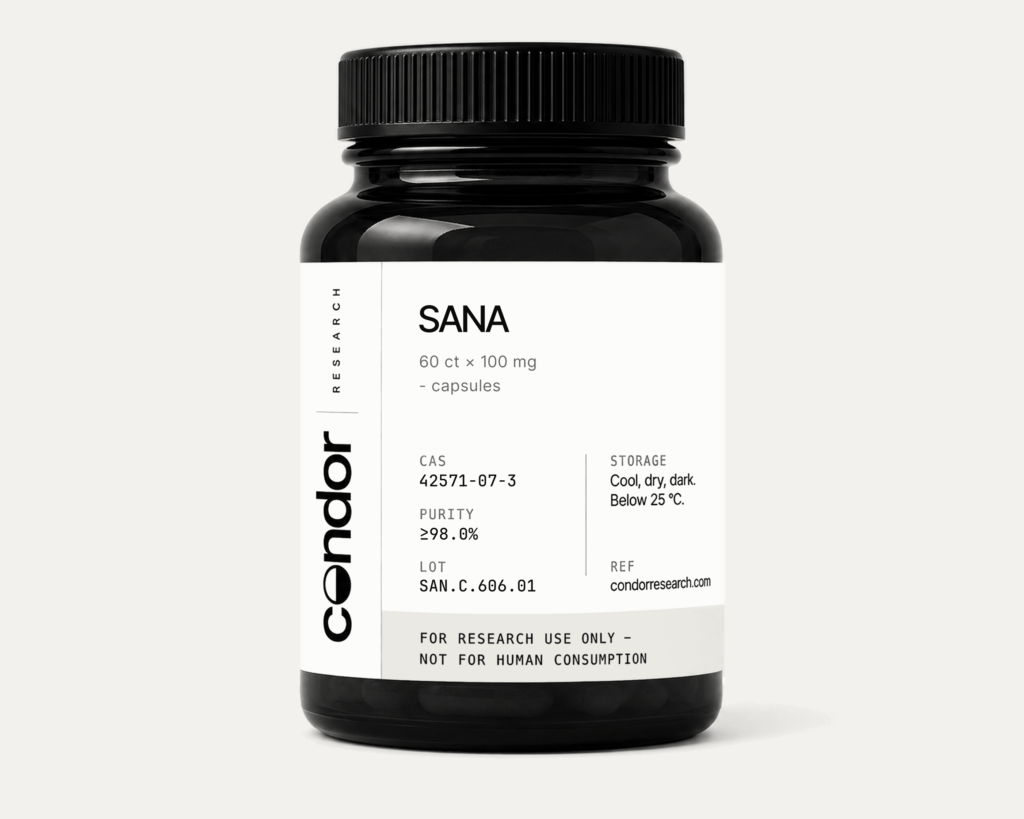
per bottle
Encapsulated · ≥98% (HPLC) ·
Size
One restock alert. You also join the research list; unsubscribe anytime.
Ships from Slovakia · no EU customs ·
SANA (2-hydroxy-5-[(E)-2-nitroethenyl]benzoic acid; also catalogued as MVD1) is a synthetic nitroalkene derivative of salicylic acid, studied for its capacity to raise creatine-dependent energy expenditure in adipose tissue and to activate the cation channel TMEM176B in experimental models. CAS 42571-07-3; molecular formula C9H7NO5; molecular weight 209.16 g/mol. Supplied encapsulated at HPLC ≥98% purity. For laboratory research use only; not for human or veterinary use.
Salicylate is one of the oldest molecules in pharmacology. SANA is what happens when medicinal chemists attach a nitroalkene group to it and screen the result against cells rather than against a hypothesis: an unexpectedly specific modulator of how mitochondria and fat tissue spend energy. It is studied less as a salicylate and more as a probe of a pathway — the creatine-driven futile cycle — that biology has only recently begun to map.
A phenotypic discovery. SANA emerged from phenotypic screening of nitroalkene-containing small molecules for obesity-related metabolic dysfunction. In preclinical diet-induced-obesity models it reduced liver steatosis and insulin resistance, enhanced mitochondrial respiration and increased creatine-dependent energy expenditure in adipose tissue — effects that persisted under thermoneutral conditions and did not depend on uncoupling protein 1 (UCP1) or AMPK activity (Cal et al., 2025). The same paper reports a randomised, double-blind, placebo-controlled phase 1A/B trial whose primary endpoint was safety and tolerability.
A second target, in a different field. TMEM176B is an intracellular cation channel of myeloid cells previously tied to allograft tolerance (Segovia et al., 2014). Independently of metabolism, SANA was identified as an activator of TMEM176B-dependent ion transport; in mouse skin-graft and rat heart-graft models it prolonged graft survival in a Tmem176b-dependent manner and induced the immunoregulatory enzyme heme oxygenase-1 in dendritic cells (Galliussi et al., 2026).
What the research explores. Across cell-culture and animal systems, SANA has been investigated along several converging lines:
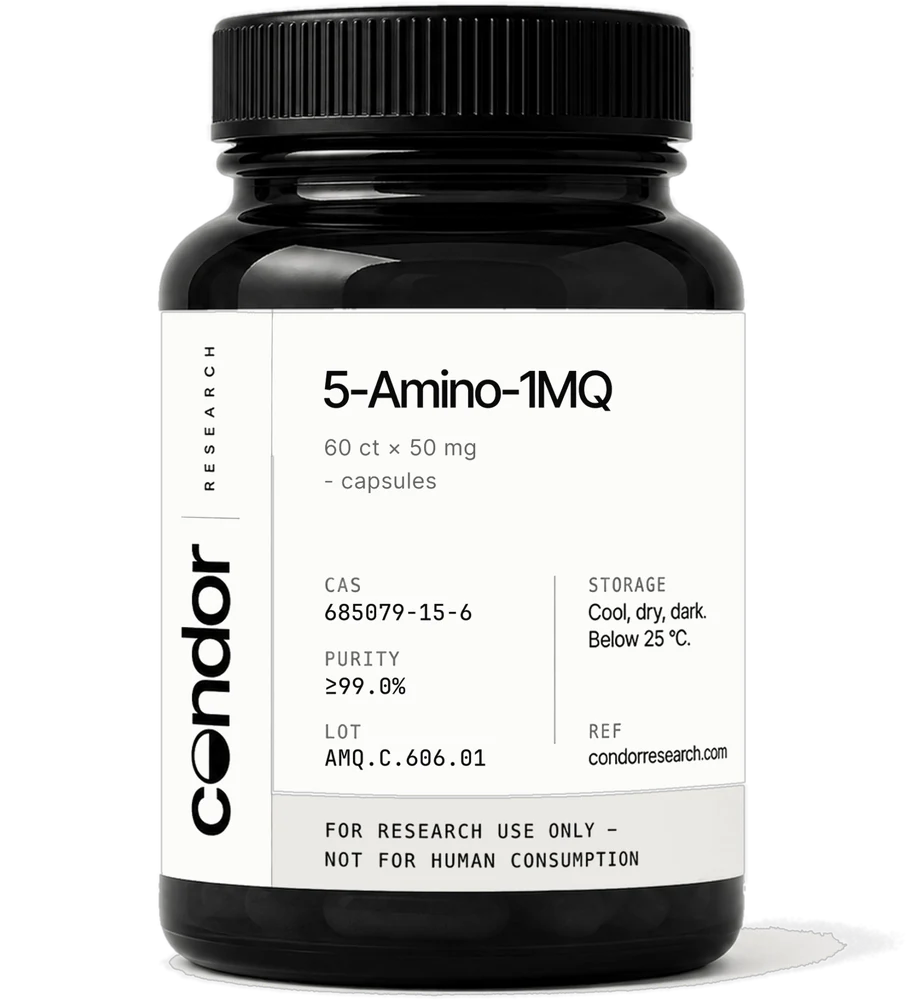
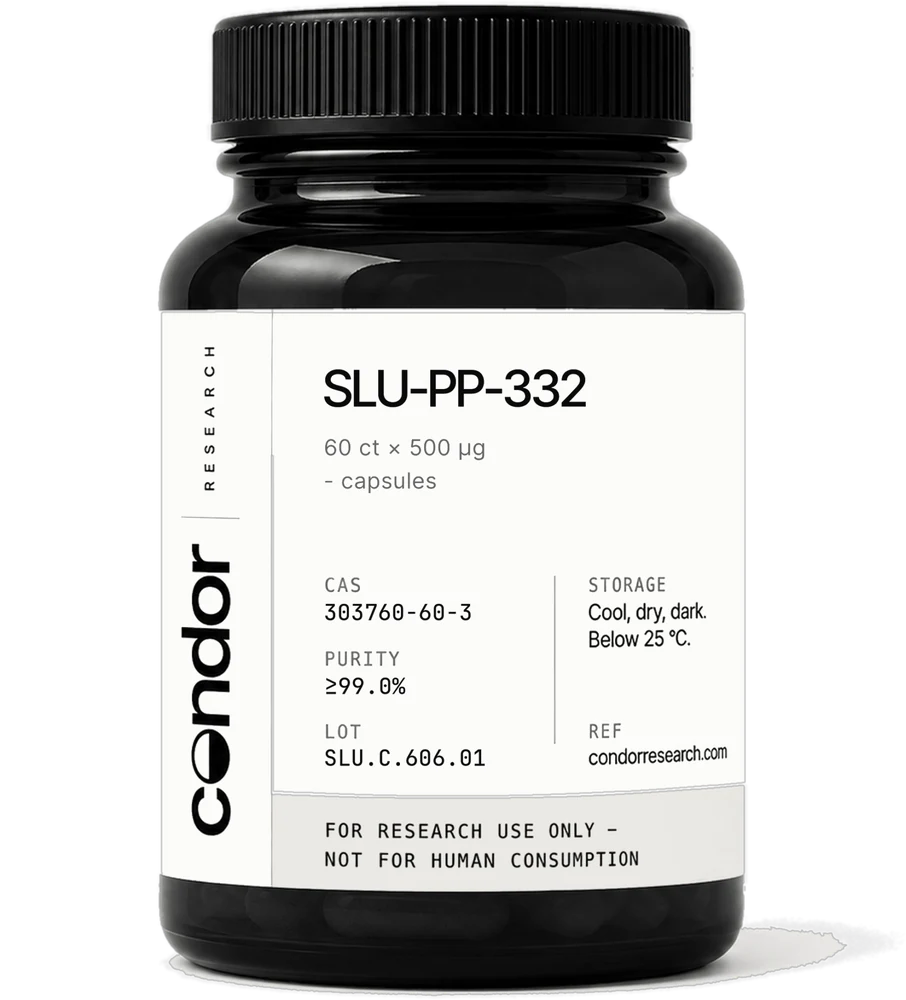
The activity described here is drawn from cell-culture and animal studies; it characterises biological behaviour in experimental models and does not establish efficacy or safety in humans. Full citations are listed under the Scientific References tab. The creatine-cycle field is itself still contested: the role of creatine in thermogenesis has been critically reassessed (Nicholls & Brand, 2023), so SANA's mechanism should be read as an active research question rather than a settled one. Related reference materials and reading: 5-Amino-1MQ Capsules, SLU-PP-332 Capsules, Methylene Blue Capsules.
Physicochemical profile. CAS No. 42571-07-3 · Molecular formula C9H7NO5 · Molecular weight 209.16 g/mol · Appearance: Crystalline powder (colour per lot COA) · Solubility: Soluble in DMSO.
Specification & quality. Each bottle contains 60 HPMC (plant-derived) capsules, each containing 100mg of SANA at ≥98% (HPLC). Encapsulated — no reconstitution required. Every batch is independently third-party tested, and a Certificate of Analysis (COA) is available. Store at room temperature, protect from light and moisture; shelf life 24 months from the manufacture date. EU warehoused.
This product is intended for laboratory research use only (RUO). It is not a drug, food, cosmetic, or dietary supplement, and is not for human or veterinary use, ingestion, or diagnostic application. Handling is restricted to qualified research professionals operating in an appropriately equipped laboratory.
Supplied for in-vitro laboratory research use only (RUO). Not a drug, food or supplement; not for human or veterinary use.
Certificate of Analysis — lot-specific COA ships with every order and is available on request.
Each lot is tested by an independent third-party laboratory for identity (mass spectrometry) and purity (HPLC). The Certificate of Analysis for your specific batch ships with the order and is available on request — no house data, no exceptions.
References are illustrative of the research literature surrounding this compound. All claims relate to in-vitro and animal models only.
SANA (MVD1; 2-hydroxy-5-[(E)-2-nitroethenyl]benzoic acid) is a nitroalkene derivative of salicylate studied in cell and animal models for creatine-dependent energy expenditure and for activation of the TMEM176B ion channel (Cal et al., 2025; Galliussi et al., 2026). Condor Research supplies it strictly as a Research Use Only reference compound, not as a medicine or supplement for human or veterinary use.
Salicylic acid and acetylsalicylic acid are classical cyclooxygenase-related molecules, whereas SANA carries a nitroalkene group and was selected in phenotypic screens for effects on mitochondrial respiration and creatine-dependent energy expenditure (Cal et al., 2025). It is therefore studied as a distinct chemical probe, not as a salicylate substitute. Supplied for research use only.
Classical brown-fat thermogenesis depends on UCP1, while SANA's reported effects persisted independently of UCP1 and AMPK activity and were linked to a creatine-driven substrate cycle (Cal et al., 2025; Bunk et al., 2025). The wider creatine-cycle literature remains debated (Nicholls & Brand, 2023). Supplied strictly for research use only.
Incretin-pathway compounds act through gut-hormone receptors; SANA is a small molecule that the authors position as a complementary, non-incretin mechanism acting on energy expenditure (Cal et al., 2025). They address different research questions and are not interchangeable. Both classes are offered strictly for research use only.
Yes. Condor Research supplies SANA strictly as a Research Use Only reference compound to professionals and institutions, not as a medicine, supplement or product for human or veterinary use. Buyers are responsible for confirming import legality in their own country. SANA is an investigational compound; its availability and any intellectual-property position are matters buyers should confirm for their jurisdiction. Questions: info@condorresearch.com.
The capsule is a pre-weighed solid format that makes a fixed 100mg quantity of SANA powder easy to store and handle in the laboratory, using HPMC (vegan) shells. It is not intended for consumption and does not imply ingestion. The capsule format is provided strictly for research use only; not for human or veterinary use.
No. Each capsule already contains pre-weighed solid SANA powder, so no reconstitution is required for laboratory handling. For in vitro work, researchers may dissolve the contents in an appropriate solvent such as DMSO. This product is for research use only and not for human or veterinary use.
Each bottle contains 60 HPMC (vegan) capsules, with each capsule providing 100mg of SANA at ≥98% (HPLC) purity. Every batch is independently third-party tested. The capsules are a pre-measured solid format for laboratory research use only, not for human or veterinary use.
SANA has the molecular formula C9H7NO5, a molecular weight of 209.16 g/mol, and CAS number 42571-07-3. It presents as crystalline powder (colour per lot COA); soluble in DMSO. It is supplied strictly as a research-use-only reference compound.
Yes. Every SANA batch is tested by an independent third-party laboratory by HPLC for identity and purity (≥98%), and ships with a lot-specific Certificate of Analysis. To request the COA for a particular lot, contact info@condorresearch.com. For laboratory research use only. Not for human or veterinary use.
Condor Research supplies SANA Capsules directly, dispatched from our EU facility in Slovakia to the EU, EEA, UK and Switzerland. Deliveries to EU destinations clear no third-country customs, and shipping is calculated at checkout. Supplied strictly as a research-use-only reference material — not for human or veterinary use.
Suppliers and secondary sources catalogue SANA (CAS 42571-07-3) under the designation MVD1; the peer-reviewed literature uses the name SANA, for the nitroalkene derivative 5-(2-nitroethenyl)salicylic acid. Supplied strictly for research use only.
No verified reviews yet.
Leave a review
Cookies
We use strictly necessary cookies to run the store. With your consent we also use analytics (order attribution) and marketing (Omnisend) cookies. Read our Cookie Policy.