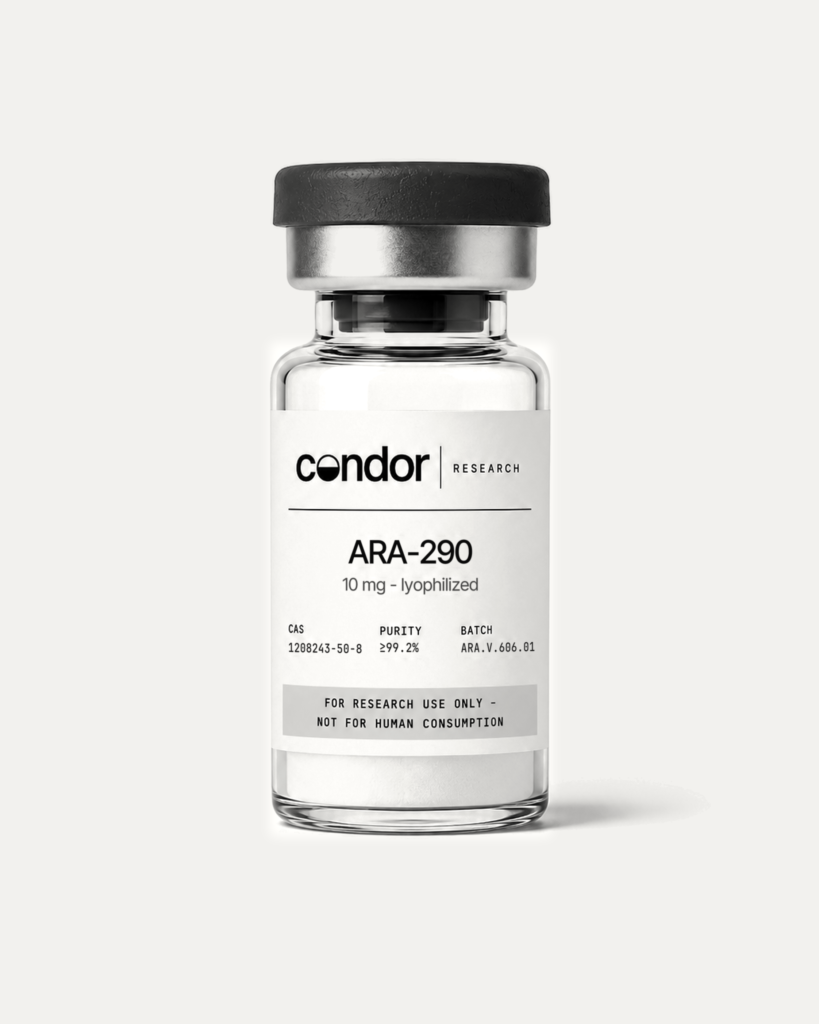
Lyophilised · ≥99% (HPLC) ·
Supplied lyophilised. Reconstitution typically uses bacteriostatic water.
ARA-290 (Cibinetide) is a synthetic 11-amino-acid peptide analogue of erythropoietin (EPO), engineered to selectively activate the innate repair receptor (IRR) without engaging the classical EPO receptor, making it a subject of neuroprotective and anti-inflammatory research. CAS 1208243-50-8; sequence pGlu-Glu-Gln-Leu-Glu-Arg-Ala-Leu-Asn-Ser-Ser (N-terminal pyroglutamate, also known as pyroglutamate helix B surface peptide, pHBSP); molecular formula C51H84N16O21; molecular weight approximately 1257 g/mol; supplied lyophilised at ≥99% purity by HPLC. For laboratory research use only; not for human or veterinary use.
Some of the body's most powerful repair signals are hidden inside molecules we thought we already understood. ARA-290, also known as cibinetide, is a synthetic 11-amino-acid peptide derived from a helical region of the erythropoietin (EPO) molecule — the part tied to tissue protection rather than red blood cell production. It has become a key tool for researchers studying how the body's innate machinery for repair and inflammation can be engaged without the hematopoietic effects of EPO itself.
A signal carved out of erythropoietin. Classical EPO drives red blood cell formation through the homodimeric EPO receptor, but a separate "innate repair receptor" — a heteromer of the EPO receptor and the β-common receptor (CD131) — mediates its cytoprotective and anti-inflammatory actions. ARA-290 was engineered to engage this innate repair receptor selectively, capturing tissue-protective signaling while avoiding effects on erythropoiesis (Collino et al., 2015). This design made cibinetide an attractive probe for dissecting repair pathways in isolation.
What the research explores. Investigations span several domains:
Findings derive from in vitro systems, animal models, and early-phase clinical research; they characterize biological activity and do not establish safety or efficacy in humans. Full citations are listed under the Scientific References tab.
Physicochemical profile. CAS 1208243-50-8 · Molecular formula C₅₁H₈₄N₁₆O₂₁ · Molecular weight 1257.3 g/mol · Sequence Pyr-Glu-Gln-Leu-Glu-Arg-Ala-Leu-Asn-Ser-Ser · Appearance: white lyophilized powder · Soluble in water.
Specification & quality. Each individually sealed vial contains 10 mg of ARA-290 (cibinetide) as a white lyophilized powder at ≥99% purity by HPLC. Every batch is third-party tested, with a Certificate of Analysis (COA) available. Store at −20 °C, protected from light and moisture.
This product is intended for laboratory research use only (RUO). It is not a drug, food, cosmetic, or dietary supplement, and is not for human or veterinary use, ingestion, or diagnostic application. Handling is restricted to qualified research professionals operating in an appropriately equipped laboratory.
Supplied for in-vitro laboratory research use only (RUO). Not a drug, food or supplement; not for human or veterinary use.
Certificate of Analysis — lot-specific COA ships with every order and is available on request.
Each lot is tested by an independent third-party laboratory for identity (mass spectrometry) and purity (HPLC). The Certificate of Analysis for your specific batch ships with the order and is available on request — no house data, no exceptions.
References are illustrative of the research literature surrounding this compound. All claims relate to in-vitro and animal models only.
ARA-290, also called Cibinetide, is a synthetic 11-amino-acid peptide (Pyr-Glu-Gln-Leu-Glu-Arg-Ala-Leu-Asn-Ser-Ser) derived from a region of the erythropoietin molecule that signals through the innate repair receptor without affecting red-blood-cell production. It is studied in tissue-repair and neuroprotective research. Condor Research supplies it as a 10 mg lyophilized vial at ≥99% HPLC purity, for in-vitro laboratory use only.
ARA-290 is an 11-residue erythropoietin-derived peptide that engages the innate repair receptor pathway, whereas BPC-157 is a 15-residue gastric pentadecapeptide studied for cytoprotective and angiogenic mechanisms. They share a tissue-repair research theme but act through unrelated systems. Condor Research offers both as separate ≥99% HPLC, research-use-only reference compounds, each with its own batch COA.
ARA-290 (Cibinetide) is an EPO-derived peptide acting at the innate repair receptor, while SS-31 (Elamipretide) is a mitochondria-targeting tetrapeptide that associates with cardiolipin on the inner mitochondrial membrane. Both appear in neuroprotective research framing but through fundamentally different targets. Each is supplied as a distinct ≥99% HPLC, research-use-only reference material for laboratory study.
ARA-290 is an erythropoietin-derived 11-mer signalling via the innate repair receptor, whereas TB-500 is the synthetic actin-binding fragment derived from thymosin β4. Both are studied in regenerative contexts but engage different molecular pathways. Condor Research supplies each as a separate ≥99% HPLC, research-use-only reference compound; the choice depends on your in-vitro experimental design.
ARA-290 is selected when the research target is specifically the innate repair receptor pathway derived from erythropoietin biology — a mechanism distinct from BPC-157, TB-500, or GHK-Cu. Researchers pick it to study that particular signalling axis. As with all catalog items, it is a research-use-only reference material with no human or veterinary application.
ARA-290 is an erythropoietin-derived 11-mer studied at the innate repair receptor, while KPV is a tripeptide corresponding to the C-terminal sequence of α-MSH, investigated for anti-inflammatory research mechanisms. They differ in size, origin, and pathway. Both are offered as separate ≥99% HPLC, research-use-only reference compounds for laboratory use only.
Yes. The N-terminal pyroglutamate (Pyr) cap and the full sequence (Pyr-Glu-Gln-Leu-Glu-Arg-Ala-Leu-Asn-Ser-Ser, CAS 1208243-50-8) are verified for each lot by an independent third-party laboratory using HPLC for purity and mass spectrometry for identity. These results are documented on the batch-specific Certificate of Analysis available on request.
Yes. ARA-290 is supplied strictly for laboratory research use only (in vitro). It is not a medicine, food, supplement, cosmetic, or medical device, and is not for human or veterinary use, administration, or consumption. Condor Research provides no dosing, protocols, or human-use guidance. Purchase is limited to qualified professionals and institutions aged 18 or over.
Yes. Each ARA-290 lot is tested by an independent third-party laboratory by HPLC for identity and purity, with mass spectrometry confirmation, and ships against a batch-specific Certificate of Analysis verifying ≥99% purity. To request the COA for the current lot before you order, contact info@condorresearch.com.
For analytical laboratory preparation only, ARA-290 is water-soluble and can be reconstituted with a sterile aqueous diluent; the chosen volume sets the working concentration. Store the sealed lyophilized vial at -20°C, protected from light, with a 24-month shelf life from manufacture. This is laboratory handling information, not guidance for any human or animal use.
Condor Research supplies ARA-290 (Cibinetide) directly, dispatched from our EU facility in Slovakia to the EU, EEA, UK and Switzerland. Deliveries to EU destinations clear no third-country customs, and shipping is calculated at checkout. Supplied strictly as a research-use-only reference material — not for human or veterinary use.
No verified reviews yet.
Leave a reviewCookies
We use strictly necessary cookies to run the store. With your consent we also use analytics (order attribution) and marketing (Omnisend) cookies. Read our Cookie Policy.