
ARA-290: The Peptide That Tried to Split Erythropoietin in Two
Cibinetide was engineered to keep erythropoietin's tissue-protective signalling while abandoning its blood-building job. The molecular logic is elegant; the human evidence, gathered mostly in small neuropathy trials, is real but early.
ARA-290 (cibinetide) is an 11-amino-acid peptide modelled on erythropoietin's helix-B region, designed to activate the innate repair receptor and trigger tissue protection without stimulating red-cell production. Small early-phase trials in sarcoidosis small-fibre neuropathy and diabetic neuropathic pain reported symptom and corneal-nerve signals. It remains unapproved and unproven at scale.
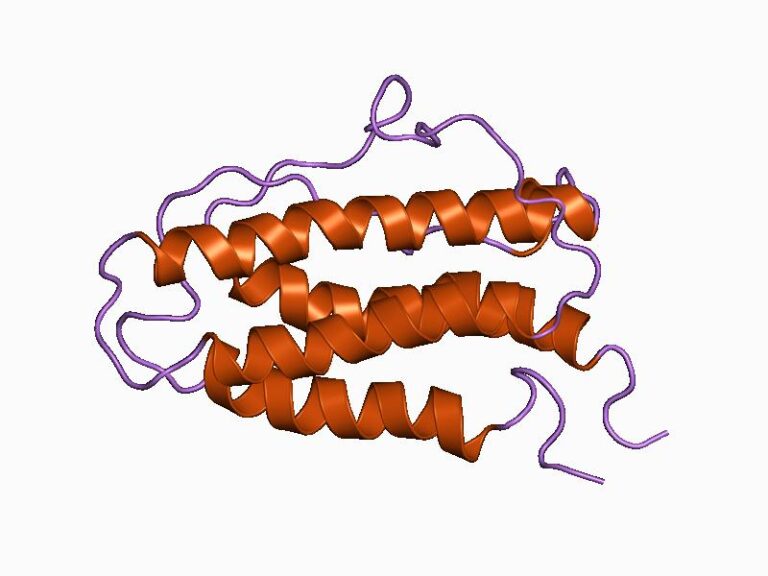
Erythropoietin is famous for one trick: it tells the marrow to make red blood cells. That single property made it a blockbuster drug and a doping scandal. But somewhere in the 2000s a quieter observation surfaced — EPO also appeared to protect injured tissue in the brain, the heart and the peripheral nerves, long before any new red cell could plausibly be involved.912 ARA-290, or cibinetide, is the molecule built to chase that second property while throwing the first one away.12
Why would anyone want an erythropoietin that does not build blood?
The appeal of EPO as a tissue-protective agent ran straight into a wall: its erythropoietic activity. Driving haematocrit upward raises blood viscosity, blood pressure and thrombotic risk, which makes chronic, high-exposure dosing for repair indications difficult to justify.12 Researchers wanted the cytoprotective signal without the haematological cost — a way to separate the two arms of EPO biology that nature had bundled together.12
The structural insight that made this conceivable was that EPO’s tissue-protective signalling appeared to be mediated by a different receptor assembly than its blood-building signalling.12 If the two functions ran through two different receptors, then in principle a molecule could be designed to engage only one of them.
11 amino acids — the length of cibinetide, a fragment of a much larger hormone12
What is the innate repair receptor, and how does cibinetide reach it?
The classical erythropoietic effect of EPO is attributed to a homodimer of the EPO receptor.12 Tissue protection, by contrast, has been linked to a distinct heteromeric assembly pairing the EPO receptor with the beta-common receptor — the so-called innate repair receptor.1215 This receptor is reported to appear on injured or stressed tissue and to drive anti-inflammatory, anti-apoptotic and pro-repair responses rather than red-cell production.1215
Cibinetide was engineered from the helix-B region of EPO — the face of the molecule thought to contact the tissue-protective receptor rather than the erythropoietic one.12 Because it reproduces the water-facing surface of that helix and begins with a pyroglutamate residue, the peptide is also known in the literature as pyroglutamate helix B surface peptide (pHBSP) — a useful synonym to recognise when searching the primary sources. The result is an 11-amino-acid peptide that, in published work, retains tissue-protective signalling in models of injury while showing no meaningful erythropoietic activity.612 In animal and in-vitro systems it has been reported to limit inflammation and support repair without raising haematocrit, which is the entire point of the design.712
The ambition was surgical: keep the repair, lose the blood.
What did the human neuropathy trials actually show?
A frequently cited clinical line of work comes from the Leiden group, with investigators including Niesters and Dahan, who examined cibinetide in conditions where small nerve fibres degenerate.813 The flagship setting was sarcoidosis-associated small-fibre neuropathy — a painful, poorly served condition with few good options — alongside studies in diabetic peripheral neuropathic pain.813
These early-phase trials reported signals rather than cures.13 Investigators observed changes in patient-reported neuropathic symptoms and, intriguingly, in objective corneal nerve-fibre measures assessed by corneal confocal microscopy — a non-invasive window onto small-fibre integrity.813 Movement in an objective structural marker, not just a symptom questionnaire, is what gave the work its credibility.8 Where trial doses are reported in the literature they are historical study facts; they are not guidance and are not reproduced here.
| Property | Erythropoietin | Cibinetide (ARA-290) |
|---|---|---|
| Size | Large glycoprotein hormone | 11-amino-acid peptide |
| Primary receptor | EPO receptor homodimer | Innate repair receptor (EPOR/beta-common) |
| Red-cell stimulation | Yes — its defining action | Reported absent by design |
| Studied repair settings | Broad preclinical | Small-fibre neuropathy, diabetic neuropathy |
| Regulatory status | Approved medicine (EPO drugs) | Unapproved investigational peptide |
The design intent: same protective signalling, none of the erythropoietic baggage.
How strong is the evidence, honestly?
It is thin, and saying otherwise would be dishonest. The clinical dataset rests on small, early-phase trials, not large confirmatory ones, and the populations studied are narrow.813 Signals on symptoms and corneal nerve fibres are encouraging, but they are signals — hypothesis-generating findings that require replication in adequately powered trials before any conclusion about efficacy is warranted.10 Cibinetide is not an approved drug anywhere; it remains an investigational peptide.13
The mechanistic story, while elegant, also carries unsettled questions. The innate repair receptor model — the EPOR/beta-common heteromer as the tissue-protective entity — is well argued but not universally settled, and the precise pharmacology of how the peptide engages it continues to be studied.1215 A clever design hypothesis is not the same as a proven clinical effect, and the gap between the two is exactly where most promising peptides stall.10
- Scale: trials are small and early, not pivotal.
- Breadth: evidence concentrates in a few neuropathy settings, not a broad repair claim.
- Status: no marketing approval; investigational only.
Where does ARA-290 sit among repair and immune peptides?
Cibinetide belongs to a loose family of peptides studied for innate-repair and immune-modulatory signalling rather than direct agonism of a single classical pathway.712 Within Condor Research’s immune cluster it sits naturally alongside LL-37, the human cathelicidin studied for host-defence and wound-related signalling6, and Thymosin Alpha-1, an immunomodulatory peptide with its own substantial literature.7 Each approaches the immune-repair interface from a different angle, and reading them together gives a fuller picture of how this corner of peptide science is being explored.
This article describes ARA-290 strictly as a research-use-only reference material for laboratory investigation; it is not a medicine, not a treatment, and nothing here is dosing or clinical guidance. For any in-vitro or preclinical work, compound identity and purity are the foundation of reproducible results — which is why a current Certificate of Analysis, with HPLC purity and mass-spectrometry confirmation of identity, matters more than any marketing claim. An 11-residue peptide is only as trustworthy as the documentation that proves what is actually in the vial.
- Cibinetide is an 11-mer derived from erythropoietin's helix-B domain, built to retain tissue protection while discarding erythropoiesis entirely.
- Its proposed target is the innate repair receptor, described as a heteromer of the EPO receptor and the beta-common receptor, distinct from the classical erythropoietic EPO receptor.
- Decoupling tissue protection from red-cell stimulation matters because erythropoietic dosing carries thrombotic and hypertensive risk that limits EPO as a repair agent.
- The Leiden group reported signals on neuropathic symptoms and corneal nerve-fibre measures in sarcoidosis-associated and diabetic neuropathy.
- The honest caveat: trials are small, early-phase and not definitive; ARA-290 is not approved anywhere and outcomes remain to be confirmed.
- Sits in the immune/repair cluster alongside LL-37 and Thymosin Alpha-1 as a research-grade reference compound.
Does ARA-290 raise haematocrit the way erythropoietin does?
No — that is the central design goal. Cibinetide was engineered from EPO's helix-B region to engage the tissue-protective innate repair receptor while showing no meaningful erythropoietic activity in published models. Separating tissue protection from red-cell stimulation is precisely what distinguishes it from EPO, which carries thrombotic and hypertensive risk tied to driving haematocrit upward.
Is cibinetide an approved drug for neuropathy?
No. ARA-290 is an investigational peptide and is not approved by any regulator. The clinical evidence comes from small, early-phase trials — notably the Leiden group's work in sarcoidosis-associated small-fibre neuropathy and diabetic neuropathy — which reported encouraging signals on symptoms and corneal nerve fibres. Those findings require confirmation in larger trials before efficacy can be claimed.
What is the innate repair receptor?
It refers to a proposed heteromeric receptor pairing the erythropoietin receptor with the beta-common receptor, distinct from the classical EPO receptor homodimer that drives red-cell production. This assembly is reported to appear on stressed or injured tissue and to mediate anti-inflammatory, anti-apoptotic repair signalling. It is the target cibinetide was designed to reach, though the model remains an area of active study.
How does ARA-290 relate to LL-37 and Thymosin Alpha-1?
All three are studied at the immune-repair interface rather than as agonists of one classical pathway. LL-37 is a human cathelicidin examined for host-defence and wound-related signalling; Thymosin Alpha-1 is an immunomodulatory peptide with a large literature. Cibinetide approaches innate repair via EPO-derived signalling. Reading them together gives researchers a broader map of this peptide cluster.