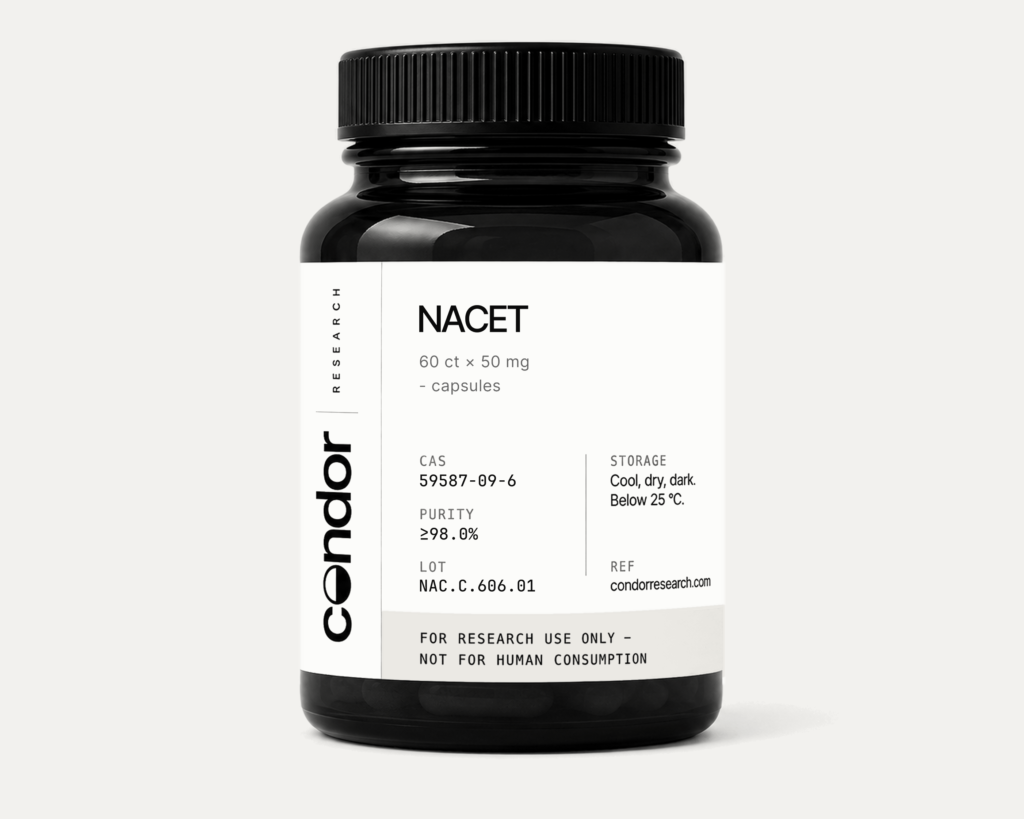
per bottle
Encapsulated · ≥98% (HPLC) ·
Size
One restock alert. You also join the research list; unsubscribe anytime.
Ships from Slovakia · no EU customs ·
NACET (N-acetyl-L-cysteine ethyl ester; ethyl (2R)-2-acetamido-3-sulfanylpropanoate) is the ethyl ester of N-acetylcysteine, a lipophilic, cell-permeable cysteine derivative studied for intracellular glutathione biochemistry and redox signalling. CAS 59587-09-6; molecular formula C7H13NO3S; molecular weight 191.25 g/mol. Supplied encapsulated at HPLC ≥98% purity. For laboratory research use only; not for human or veterinary use.
N-acetylcysteine is a workhorse of redox biology — and a molecule with a well-known weakness. Taken up poorly by cells, it has to be supplied in large amounts to move intracellular cysteine at all. NACET is the chemist's answer: cap the carboxyl group as an ethyl ester, make the molecule lipophilic, and let it cross membranes before cells strip it back to NAC and cysteine from the inside.
Pharmacokinetic rationale (preclinical). Oral NAC has a low bioavailability in healthy volunteers — about 4% for reduced NAC and about 9% for total NAC in a pharmacokinetic crossover study (Olsson et al., 1988). Giustarini and colleagues reasoned that esterification would drastically raise lipophilicity, and reported that NACET is rapidly absorbed in rats yet reaches very low plasma concentrations, because it enters cells and is trapped there as NAC and cysteine; unlike NAC, oral NACET given to rats raised glutathione in most tissues examined, brain included (Giustarini et al., 2012).
Head-to-head and signalling work. In primary human endothelial cells, NACET was the most efficient of four glutathione-enhancing compounds tested, with a reported concentration ceiling beyond which the effect declined (Giustarini et al., 2018). In retinal pigment epithelial cells it protected against oxidative damage more efficiently than NAC (Tosi et al., 2021), and later work reported that NACET activates the transcription factor NRF2 through cysteinylation of KEAP1 sensor residues, with retinal effects in mouse models of ageing and diabetes (Realini et al., 2025).
What the research explores. Across cell-culture and animal systems, NACET has been investigated along several converging lines:
The activity described here is drawn from in-vitro and animal studies; it characterises biological behaviour in experimental models and does not establish efficacy or safety in humans. Full citations are listed under the Scientific References tab. The NAC background literature cited alongside (Raghu et al., 2021; Pedre et al., 2021; Dean et al., 2011) concerns the parent molecule, not NACET itself. Related reference materials and reading: Methylene Blue Capsules, Spermidine Trihydrochloride.
Physicochemical profile. CAS No. 59587-09-6 · Molecular formula C7H13NO3S · Molecular weight 191.25 g/mol · Appearance: White to off-white solid · Solubility: Soluble in DMSO and ethanol.
Specification & quality. Each bottle contains 60 HPMC (plant-derived) capsules, each containing 50mg of NACET at ≥98% (HPLC). Encapsulated — no reconstitution required. Every batch is independently third-party tested, and a Certificate of Analysis (COA) is available. Store cool (2–8°C recommended), protect from light, moisture and air; shelf life 24 months from the manufacture date. EU warehoused.
This product is intended for laboratory research use only (RUO). It is not a drug, food, cosmetic, or dietary supplement, and is not for human or veterinary use, ingestion, or diagnostic application. Handling is restricted to qualified research professionals operating in an appropriately equipped laboratory.
Supplied for in-vitro laboratory research use only (RUO). Not a drug, food or supplement; not for human or veterinary use.
Certificate of Analysis — lot-specific COA ships with every order and is available on request.
Each lot is tested by an independent third-party laboratory for identity (mass spectrometry) and purity (HPLC). The Certificate of Analysis for your specific batch ships with the order and is available on request — no house data, no exceptions.
References are illustrative of the research literature surrounding this compound. All claims relate to in-vitro and animal models only.
NACET (N-acetyl-L-cysteine ethyl ester) is a lipophilic, cell-permeable derivative of N-acetylcysteine studied in cell and rodent models as a glutathione-raising and NRF2-activating antioxidant (Giustarini et al., 2012; Realini et al., 2025). Condor Research supplies it strictly as a Research Use Only reference compound, not as a medicine or supplement for human or veterinary use.
NAC is hydrophilic and has low oral bioavailability in volunteers (Olsson et al., 1988), whereas NACET is lipophilic, enters cells and is converted to NAC and cysteine inside them; in comparative studies it raised glutathione more effectively than NAC in cells and tissues (Giustarini et al., 2012; Giustarini et al., 2018; Tosi et al., 2021). Both are supplied for research use only.
In human umbilical vein endothelial cells, NACET raised intracellular glutathione more than NAC, 2-oxothiazolidine-4-carboxylate and glutathione ethyl ester (Giustarini et al., 2018). That is an in-vitro comparison, not a statement about humans. Supplied strictly for research use only.
NACET is reported to activate NRF2 through direct cysteinylation of KEAP1 sensor residues while also supplying cysteine for glutathione synthesis (Realini et al., 2025), combining a substrate and a signalling mechanism in one reagent. Supplied strictly for research use only.
Yes. Condor Research supplies NACET strictly as a Research Use Only reference compound to professionals and institutions, not as a medicine, supplement or product for human or veterinary use. Buyers are responsible for confirming import legality in their own country. Questions: info@condorresearch.com.
The capsule is a pre-weighed solid format that makes a fixed 50mg quantity of NACET powder easy to store and handle in the laboratory, using HPMC (vegan) shells. It is not intended for consumption and does not imply ingestion. The capsule format is provided strictly for research use only; not for human or veterinary use.
No. Each capsule already contains pre-weighed solid NACET powder, so no reconstitution is required for laboratory handling. For in vitro work, researchers may dissolve the contents in an appropriate solvent such as DMSO. This product is for research use only and not for human or veterinary use.
Each bottle contains 60 HPMC (vegan) capsules, with each capsule providing 50mg of NACET at ≥98% (HPLC) purity. Every batch is independently third-party tested. The capsules are a pre-measured solid format for laboratory research use only, not for human or veterinary use.
NACET has the molecular formula C7H13NO3S, a molecular weight of 191.25 g/mol, and CAS number 59587-09-6. It presents as white to off-white solid; soluble in DMSO and ethanol. It is supplied strictly as a research-use-only reference compound.
Yes. Every NACET batch is tested by an independent third-party laboratory by HPLC for identity and purity (≥98%), and ships with a lot-specific Certificate of Analysis. To request the COA for a particular lot, contact info@condorresearch.com. For laboratory research use only. Not for human or veterinary use.
Condor Research supplies NACET Capsules directly, dispatched from our EU facility in Slovakia to the EU, EEA, UK and Switzerland. Deliveries to EU destinations clear no third-country customs, and shipping is calculated at checkout. Supplied strictly as a research-use-only reference material — not for human or veterinary use.
NACET contains a free thiol and an ester, so it is sensitive to oxidation and moisture. We recommend storing the bottle cool (2–8°C), tightly closed and protected from light, moisture and air. Supplied strictly for research use only.
No verified reviews yet.
Leave a review
Cookies
We use strictly necessary cookies to run the store. With your consent we also use analytics (order attribution) and marketing (Omnisend) cookies. Read our Cookie Policy.