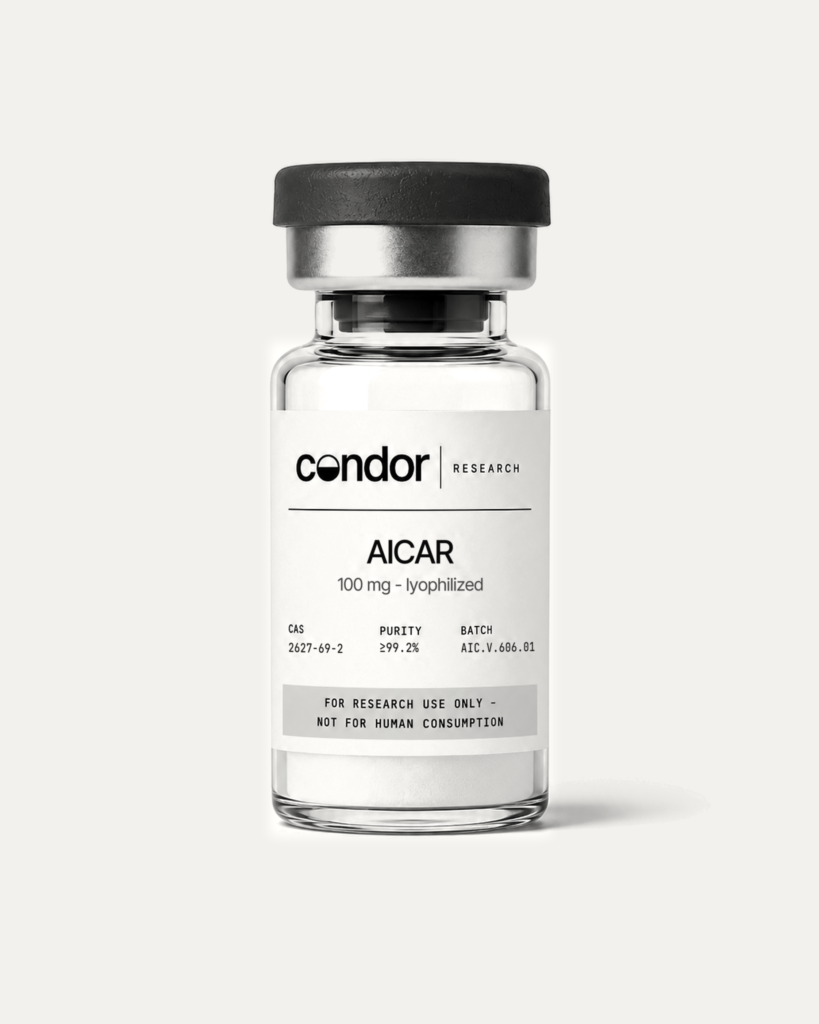
Lyophilised · ≥99% (HPLC) ·
Supplied lyophilised. Reconstitution typically uses bacteriostatic water.
AICAR (5-aminoimidazole-4-carboxamide riboside; also acadesine or AICA riboside) is a cell-permeable nucleoside analogue used in cellular metabolism and energetics research. Inside cells it is phosphorylated to ZMP (5-aminoimidazole-4-carboxamide ribonucleotide), which mimics AMP and allosterically activates AMP-activated protein kinase (AMPK). CAS 2627-69-2; molecular formula C9H14N4O5; molecular weight 258.23 g/mol; supplied as a 100 mg vial at HPLC purity ≥99%. For laboratory research use only; not for human or veterinary use.
A naturally occurring metabolic intermediate repurposed as a master-switch activator of the cell's energy sensor, AICAR (5-aminoimidazole-4-carboxamide ribonucleotide, also known as acadesine) is a small-molecule activator of AMP-activated protein kinase (AMPK) and one of the most widely used pharmacological tools in energy-metabolism research. This purine nucleoside analogue — a small molecule, not a peptide — is taken up by cells and phosphorylated to ZMP, an AMP mimetic that directly engages and activates AMPK.
A cellular fuel gauge, switched on by design. AMPK behaves as the cell's energy gauge: when energy charge falls, rising AMP levels activate the kinase, which then restores balance by promoting catabolic, energy-producing pathways and restraining energy-consuming ones. AICAR exploits this logic. Once inside the cell, it is converted to ZMP, which mimics AMP and activates AMPK without altering true nucleotide pools — giving researchers a clean handle to interrogate AMPK-dependent signalling across tissues. That mechanism has made acadesine a long-standing reference compound in studies of metabolism, ischaemia, and exercise physiology.
What the research explores. Work in cellular and animal models has mapped several branches of AMPK biology:
These observations arise from in vitro and animal studies conducted in controlled research settings; they characterise the compound's pharmacology and do not constitute evidence of benefit for any non-investigational purpose. Full citations are listed under the Scientific References tab.
Physicochemical profile. CAS 2627-69-2 · Molecular formula C₉H₁₄N₄O₅ · Molecular weight 258.23 · Appearance: white powder · Solubility: soluble in water.
Specification & quality. Each individually sealed vial contains 100 mg of AICAR as a white powder, verified at ≥99% purity by HPLC. Every batch is third-party tested, and a Certificate of Analysis (COA) is available. Store at −20 °C, protected from light and moisture.
This product is intended for laboratory research use only (RUO). It is not a drug, food, cosmetic, or dietary supplement, and is not for human or veterinary use, ingestion, or diagnostic application. Handling is restricted to qualified research professionals operating in an appropriately equipped laboratory.
Supplied for in-vitro laboratory research use only (RUO). Not a drug, food or supplement; not for human or veterinary use.
Certificate of Analysis — lot-specific COA ships with every order and is available on request.
Each lot is tested by an independent third-party laboratory for identity (mass spectrometry) and purity (HPLC). The Certificate of Analysis for your specific batch ships with the order and is available on request — no house data, no exceptions.
References are illustrative of the research literature surrounding this compound. All claims relate to in-vitro and animal models only.
AICAR (5-aminoimidazole-4-carboxamide ribonucleotide, also known as acadesine) is a small-molecule activator of AMP-activated protein kinase (AMPK), a central cellular energy sensor, and is a widely used tool in metabolic research. It is a small molecule, not a peptide. It is supplied strictly for laboratory research use only (in vitro), not for human or veterinary use, administration or consumption.
AICAR is a small molecule (molecular formula C₉H₁₄N₄O₅, MW ~258.23, CAS 2627-69-2), not a peptide, and has no amino-acid sequence. It is also known as acadesine. Although listed under the vials catalog, it is chemically a small-molecule research compound supplied strictly for laboratory research use only (in vitro), not for human or veterinary use.
Both are small-molecule metabolic research tools acting on different targets: AICAR activates AMP-activated protein kinase (AMPK), while SLU-PP-332 is an agonist of the estrogen-related receptors (ERRs). They also differ in solubility — AICAR is water-soluble, SLU-PP-332 is DMSO-soluble. Both are supplied strictly for laboratory research use only (in vitro), not for human or veterinary use.
AICAR activates AMP-activated protein kinase (AMPK), the cellular energy sensor, whereas 5-Amino-1MQ inhibits nicotinamide N-methyltransferase (NNMT), an enzyme in methylation and NAD⁺ metabolism. They are both water-soluble small molecules but engage entirely different mechanisms. Both are supplied strictly for laboratory research use only (in vitro) and are not for human or veterinary use, administration or consumption.
AICAR is a small-molecule AMPK activator, while MOTS-C is a 16-amino-acid mitochondrial-derived peptide studied in metabolism. One is a defined small molecule, the other a peptide, and they differ in target and handling. Selection depends on the research question. Both are supplied strictly for laboratory research use only (in vitro), not for human or veterinary use, administration or consumption.
These three small molecules act on distinct targets: AICAR activates AMPK, SLU-PP-332 is an ERR agonist, and 5-Amino-1MQ is an NNMT inhibitor. The right choice depends on which metabolic pathway you intend to study, since each is a different mechanistic tool. All three are supplied strictly for laboratory research use only (in vitro) and are not for human or veterinary use.
AICAR appears under the vials catalog for listing purposes, but it is chemically a small molecule (acadesine), not a peptide. Each batch is third-party tested with ≥99% HPLC purity and a Certificate of Analysis. For small-molecule structural confirmation such as NMR/HRMS, contact info@condorresearch.com to confirm what is available for a given batch. Supplied for laboratory research use only.
Yes, AICAR is listed as soluble in water, so an aqueous stock is prepared for analytical laboratory use; the vial contains 100 mg. As a water-soluble small molecule, it follows standard dilution math to a target concentration. Any preparation data is for in-vitro laboratory use only, never for human or animal use. For specifics, contact info@condorresearch.com.
Store the unopened 100 mg vial at -20°C, protected from light (24-month shelf life). A prepared aqueous stock should be handled as a laboratory working solution and kept cold. All storage and preparation guidance is for analytical laboratory use only, never for human or veterinary use. For batch-specific stability details, contact info@condorresearch.com.
Yes. Each lot is tested by an independent third-party laboratory with purity verified at ≥99% by HPLC, and a Certificate of Analysis is issued per batch. Manufacturer documentation is not published, to preserve supply-chain integrity. To request the COA for a specific lot, contact info@condorresearch.com. AICAR is supplied strictly for laboratory research use only (in vitro).
Condor Research supplies AICAR directly, dispatched from our EU facility in Slovakia to the EU, EEA, UK and Switzerland. Deliveries to EU destinations clear no third-country customs, and shipping is calculated at checkout. Supplied strictly as a research-use-only reference material — not for human or veterinary use.
No verified reviews yet.
Leave a reviewCookies
We use strictly necessary cookies to run the store. With your consent we also use analytics (order attribution) and marketing (Omnisend) cookies. Read our Cookie Policy.