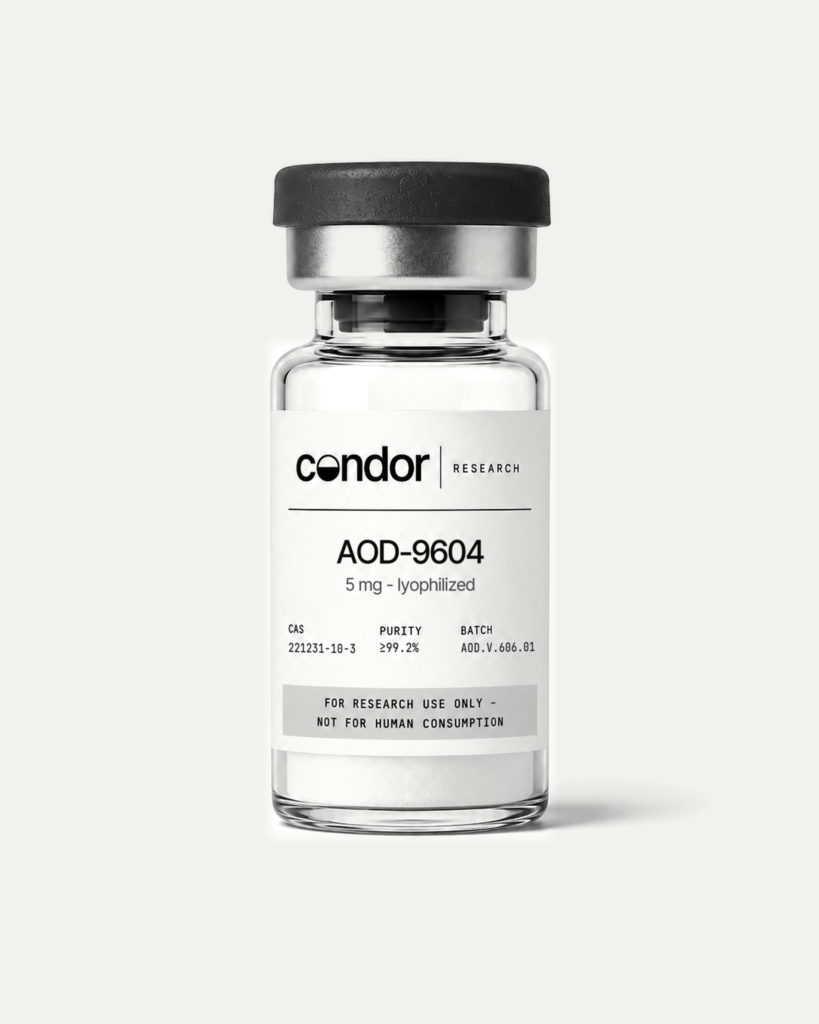
Lyophilisé · ≥99% (HPLC) ·
Fourni lyophilisé. La reconstitution se fait généralement avec de l'eau bactériostatique.
AOD-9604 (Anti-Obesity Drug 9604) is a synthetic 16-amino-acid peptide fragment corresponding to the C-terminal region (Tyr-hGH177–191) of human growth hormone, modified with a tyrosine residue at the N-terminus to enhance stability; CAS 221231-10-3; molecular formula C78H123N23O23S2; molecular weight 1815.1 g/mol; studied in adipogenesis, lipolysis regulation, and metabolic research models. Supplied lyophilised at HPLC ≥99% purity. For laboratory research use only; not for human or veterinary use.
Derived from the very tail of the human growth-hormone molecule, AOD-9604 is a synthetic peptide fragment corresponding to the C-terminal lipolytic domain of hGH (residues 177-191) with an added tyrosine and a stabilising disulfide bridge. It was designed around a simple hypothesis: that the fat-metabolising activity of growth hormone could be isolated from the rest of its signalling, and it has since become a reference compound in metabolic-peptide research.
One function, distilled from a larger hormone. Full-length growth hormone exerts many effects, of which lipid mobilisation is only one. Investigators mapped this lipolytic activity to the hormone's C-terminal region and synthesised the corresponding fragment to probe it in isolation (Ng et al., 2000). Because the peptide reproduces fat-metabolism signalling without acting through the classic IGF-1-raising pathway, it offered a cleaner experimental window into adipocyte regulation.
What the research explores. The fragment has been examined across metabolic and musculoskeletal models:
All such findings stem from in vitro and animal research; no human-use conclusions are implied. Full citations are listed under the Scientific References tab.
Physicochemical profile. CAS 221231-10-3 · Molecular formula C₇₈H₁₂₃N₂₃O₂₃S₂ · Molecular weight 1815.1 · Sequence Tyr-Leu-Arg-Ile-Val-Gln-Cys-Arg-Ser-Val-Glu-Gly-Ser-Cys-Gly-Phe (Cys⁷–Cys¹⁴ disulfide) · Appearance: white lyophilized powder · Solubility: soluble in water.
Specification & quality. Each individually sealed vial contains 5 mg of AOD-9604 as a white lyophilized powder of ≥99% purity by HPLC. Every batch is third-party tested, with a Certificate of Analysis (COA) available. Store at −20 °C, protected from light and moisture. Shelf life: 24 months from the manufacture date.
This product is intended for laboratory research use only (RUO). It is not a drug, food, cosmetic, or dietary supplement, and is not for human or veterinary use, ingestion, or diagnostic application. Handling is restricted to qualified research professionals operating in an appropriately equipped laboratory.
Fourni exclusivement pour un usage de recherche en laboratoire in vitro (RUO). Ne constitue ni un médicament, ni une denrée alimentaire, ni un complément ; ne convient pas à un usage humain ou vétérinaire.
Certificat d'analyse — un COA propre au lot est fourni avec chaque commande et disponible sur demande.
Each lot is tested by an independent third-party laboratory for identity (mass spectrometry) and purity (HPLC). The Certificate of Analysis for your specific batch ships with the order and is available on request — no house data, no exceptions.
Ces références illustrent la littérature de recherche relative à ce composé. Toutes les données mentionnées concernent exclusivement des modèles in vitro et animaux.
L'AOD-9604 est un fragment peptidique synthétique correspondant au domaine lipolytique C-terminal de l'hormone de croissance humaine (résidus 177-191), avec une tyrosine ajoutée et un pont disulfure stabilisateur. Contrairement à un sécrétagogue, il dérive de la molécule de GH elle-même. Condor Research le fournit en flacon de 5 mg, ≥99 % HPLC, strictement pour un usage de recherche in vitro.
L'AOD-9604 reproduit uniquement le fragment C-terminal (résidus 177-191) de l'hormone de croissance associé à son activité lipolytique, et non l'appareil de signalisation qui déclenche la libération de GH. C'est donc un fragment dérivé de la GH, non un sécrétagogue : il ne stimule pas les récepteurs de la GHRH ou de la ghréline comme le font le CJC-1295 ou l'Ipamorelin. C'est un peptide de référence réservé à la recherche.
Ils se situent à des points différents de l'axe de la GH. Le CJC-1295 est un sécrétagogue analogue de la GHRH, modélisé sur l'hormone qui signale en amont pour libérer l'hormone de croissance. L'AOD-9604 est en revanche un fragment de la molécule de GH elle-même (résidus 177-191), étudié pour le domaine lipolytique. Les deux sont fournis strictement comme matériels de recherche in vitro.
Le Tesamorelin est un analogue de la GHRH, une molécule de type sécrétagogue agissant en amont de l'hormone de croissance. L'AOD-9604 est un fragment de la molécule de GH elle-même (résidus 177-191), étudié comme son domaine lipolytique plutôt que comme signal stimulant la libération. Ce sont des peptides de recherche distincts abordant des extrémités opposées de la biologie de la GH, tous deux vendus pour un usage in vitro uniquement.
Ils représentent différentes couches de l'axe GH/IGF. L'AOD-9604 est un court fragment de l'hormone de croissance elle-même (résidus 177-191). L'IGF-1 LR3 est un analogue recombinant bien plus grand, de 83 résidus, du facteur de croissance analogue à l'insuline-1, l'effecteur en aval. L'AOD-9604 se situe donc au niveau de la GH et l'IGF-1 LR3 au niveau de l'IGF. Les deux sont des matériels de référence réservés à la recherche.
L'AOD-9604 est un fragment peptidique de l'hormone de croissance (résidus 177-191), soluble dans l'eau et fourni sous forme lyophilisée. Le SLU-PP-332 est un agoniste ERR de type petite molécule non peptidique, soluble dans le DMSO. Ce sont des classes de composés entièrement différentes étudiées en recherche métabolique. Les deux sont proposés strictement comme matériels de référence in vitro, sans protocole d'usage fourni.
Chaque lot est testé par un laboratoire tiers indépendant, l'identité et la pureté étant confirmées par HPLC et spectrométrie de masse, et est expédié avec un certificat d'analyse spécifique au lot certifiant une pureté ≥99 %. La séquence, le pont disulfure et la masse moléculaire indiqués (1815,1) correspondent à l'AOD-9604. Pour demander le COA du lot actuel, écrivez à info@condorresearch.com.
L'AOD-9604 est une poudre lyophilisée soluble dans l'eau, dissoute dans un diluant aqueux compatible pour la préparation in vitro, le volume étant choisi pour atteindre la concentration analytique cible à partir du flacon de 5 mg. Conservez le flacon scellé à -20 °C, à l'abri de la lumière (durée de conservation de 24 mois). Il s'agit uniquement de préparation analytique ; aucune indication de dosage humain ou vétérinaire n'est fournie.
Non — l'AOD-9604 est fourni strictement comme matériel de référence réservé à la recherche (in vitro) : ni médicament, ni complément, ni dispositif médical, et non destiné à l'administration ou à la consommation humaine ou vétérinaire. Les ventes sont réservées aux professionnels et institutions âgés de 18 ans ou plus. Il incombe aux acheteurs de vérifier la légalité de l'importation dans leur propre juridiction.
Reconstitution was clean with no visible particulates. The lot-specific COA matched the assay we ran in-house — purity is exactly as stated.
We verify every incoming compound by HPLC; this batch came back within tolerance of the certificate. Dispatch from the EU warehouse was quick.
Cold-chain handling was respected end to end. Vials arrived sealed, labelled and intact. Documentation is the most thorough I've seen from an EU supplier.
Solubilité et stabilité conformes à la description. Une étoile retirée uniquement car les options d'expédition express sont limitées, mais la qualité n'est pas en cause.
Cookies
Nous utilisons des cookies strictement nécessaires au fonctionnement de la boutique. Avec votre consentement, nous utilisons également des cookies d'analyse (attribution des commandes) et marketing (Omnisend). Consultez notre Politique relative aux cookies.